- Who files
- Every filer with a Part I liability
- Due
- With each quarterly Form 720
- Filed with
- Form 720, page 4
- Form revision
- Form 720 (Rev. June 2026)
- Pages
- 1 (page 4, shared with Schedule T)
At a glance
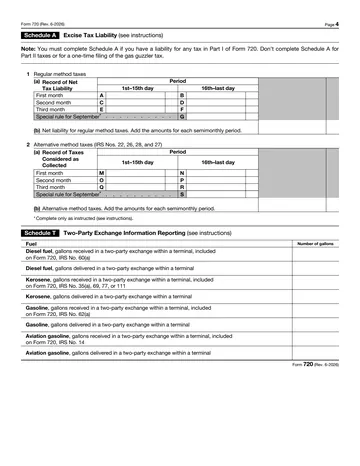
Schedule A, Excise Tax Liability, is page 4 of Form 720 (Rev. June 2026). It splits the quarter's Part I taxes into the six half months (semimonthly periods) that the deposit rules run on, so the IRS can line each deposit up against the liability for its period. The form's note sets the scope: “You must complete Schedule A if you have a liability for any tax in Part I of Form 720. Don't complete Schedule A for Part II taxes or for a one-time filing of the gas guzzler tax.”
- Who completes it. Every Form 720 filer with a Part I liability, including those under the $2,500 deposit threshold: “Complete Schedule A to record net tax liabilities for Form 720, Part I, taxes for each semimonthly period in a quarter even if your net liability is under $2,500.”
- The periods. “A semimonthly period is the first 15 days of a month (the first semimonthly period) or the 16th through the last day of a month (the second semimonthly period).”
- Two lines. Line 1 for regular method taxes (boxes A to G), line 2 for communications and air taxes deposited under the alternative method (boxes M to S): as the instructions' table sets out.
- Filed with. The quarterly Form 720, due April 30, July 31, October 31 and January 31. Schedule T shares the page; it is covered on the Form 720 page.
Tap a box once for its note, again to jump to the line. Zoom in to read the small print.
Line 1: regular method taxes
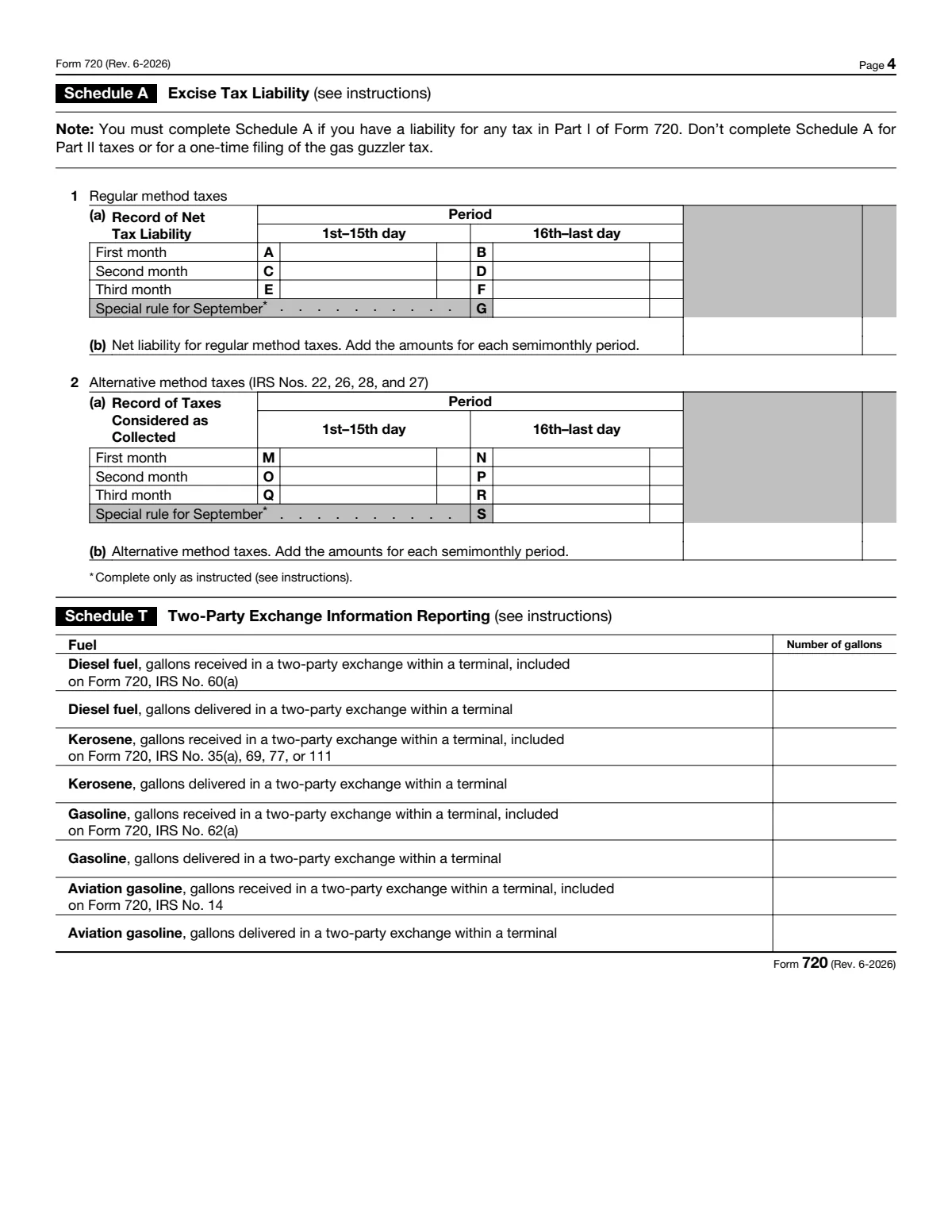
Every Part I tax is a regular method tax unless it is a communications or air tax deposited on billings. For each half month, enter the net liability: the tax incurred in that period less the Schedule C claims for it. You may split a month evenly instead: “Net tax liability for a semimonthly period may be figured by dividing the net tax liability for the month by 2, provided this method of computation is used for all semimonthly periods in the calendar quarter.”
Instructions for Form 720 (Rev. June 2026), When To Make Deposits and Schedule A.
| Box | Label | What goes there |
|---|---|---|
| A | First month, 1st to 15th day (box A) | The net tax liability for regular method taxes incurred in the first 15 days of the quarter's first month (Jan. 1 to 15, April 1 to 15, July 1 to 15 or Oct. 1 to 15). “The net tax liability for a semimonthly period is the total liability for the period minus any claims allowed on Schedule C for the period.” The deposit for this period is due by the 29th of the same month. |
| B | First month, 16th to last day (box B) | The liability for the 16th to the last day of the first month. Its deposit is due by the 14th of the next month. |
| C | Second month, 1st to 15th day (box C) | The second month's first half. Deposit due the 29th of that month; for February the IRS penalty manual says “(except when February has 28 days, then March 1)” |
| D | Second month, 16th to last day (box D) | The second month's second half. Deposit due the 14th of the third month. |
| E | Third month, 1st to 15th day (box E) | The third month's first half. Deposit due the 29th of the third month. |
| F | Third month, 16th to last day (box F) | The third month's second half; its deposit is due the 14th of the month after the quarter, before the return. In the third quarter, box F holds only Sept. 27 to 30: “Enter the liability for the period beginning September 26/27 and ending September 30 in box F.” |
| G | Special rule for September* (box G) | Third quarter returns only. The liability for Sept. 16 to 26, which has its own deposit due Sept. 29. The IRS penalty manual says “the period beginning September 16th and ending September 26th should be reported in Box G”. The form marks the box: “Complete only as instructed (see instructions).” Leave it blank in the other quarters. |
| 1b | (b) Net liability for regular method taxes. Add the amounts for each semimonthly period. | The sum of boxes A to G. It should match the regular method taxes in Part I: Part I, line 1, less any alternative method taxes reported on line 2 and any one-time gas guzzler filing. |
Line 2: alternative method taxes
Collectors of the communications tax (IRS No. 22) and the air transportation taxes (IRS Nos. 26, 27 and 28) may deposit on what they bill rather than what they collect. “Under the alternative method, the tax included in amounts billed or tickets sold during a semimonthly period is considered collected during the first 7 days of the second following semimonthly period.” Line 2 records the tax by that later half month, so a box on line 2 is always two half months behind the billing. Using the method also means “you must keep separate accounts of the tax included in amounts billed or tickets sold during the month”, and the Form 720 lines for IRS Nos. 22 to 28 report billings, not collections.
| Box | Label | What goes there |
|---|---|---|
| M | First month, 1st to 15th day (box M) | Only for communications and air transportation taxes (IRS Nos. 22, 26, 27 and 28) deposited under the alternative method. Enter the tax considered collected in this half month, which is the tax billed or ticketed two half months earlier. The instructions' example: billings for June 1 to 15, 2026 are considered collected July 1 to 7, 2026, and are reported “for the third quarter of 2026 on Schedule A in box M, not the second quarter of 2026.” |
| N | First month, 16th to last day (box N) | Tax considered collected in the first month's second half. In a fourth quarter return, box N holds the tax billed Sept. 16 to 30. |
| O | Second month, 1st to 15th day (box O) | Tax considered collected in the second month's first half (billed in the first month's second half). |
| P | Second month, 16th to last day (box P) | Tax considered collected in the second month's second half. |
| Q | Third month, 1st to 15th day (box Q) | Tax considered collected in the third month's first half. |
| R | Third month, 16th to last day (box R) | Tax considered collected in the third month's second half. |
| S | Special rule for September* (box S) | Fourth quarter returns only: the tax billed Sept. 1 to 11, deposited by Sept. 29. The penalty manual: “the period beginning September 1st and ending September 11th should be reported in Box S”. Tax billed Sept. 12 to 15 goes in box M of the same return. |
| 2b | (b) Alternative method taxes. Add the amounts for each semimonthly period. | The sum of boxes M to S. |
How Schedule A ties to the deposits
Each box is the amount the deposit for that half month is measured against. The deposits themselves are made by electronic funds transfer, usually through EFTPS (or IRS Direct Pay), and their total goes on Part III, line 5. The Form 720 quarter checklist walks through reconciling them at quarter end. The rules the boxes feed:
- Amount. “Deposits of taxes for a semimonthly period must be at least 95% of the amount of net tax liability for that period, unless the safe harbor rule applies.” Form 720-X amounts do not count: “The net tax liability for a semimonthly period isn't reduced by any amounts from Form 720-X.”
- Timing, regular method. “The deposit of tax for a semimonthly period is due by the 14th day following that period.” That is the 29th for a first half month and the 14th of the next month for a second half; “If the 14th or the 29th day falls on a Saturday, Sunday, or legal holiday, you must make the deposit by the immediately preceding day that isn't a Saturday, Sunday, or legal holiday.”
- Timing, alternative method. “The deposit of tax is due by the third business day after the seventh day of that period.”
- No deposits. “The net liability for taxes listed in Form 720, Part I, doesn't exceed $2,500 for the quarter.” Schedule A is still completed.
- Safe harbor. A filer who filed for the look-back quarter (two quarters back) meets the rule “if the deposit for each semimonthly period in the current quarter is at least 1/6 (16.67%) of the net tax liability reported for the lookback quarter.” The rest is paid with the return and the box on line 5 is checked. The safe harbor does not work for a tax that was not in effect throughout the look-back quarter, which is why Notice 2025-55 says a remittance transfer provider “will be unable to use the deposit safe harbor to calculate semimonthly deposits of the tax until the third calendar quarter of 2026.”
- How the IRS checks. Its penalty manual says “To determine whether a sufficient amount has been deposited, Schedule A must be completed.” and “If the deposit is timely made by electronic funds transfer (EFT) and equals or exceeds the amount entered in the Schedule A box for the semi-monthly period, the deposit requirement for that class of tax for the semi-monthly period is satisfied.”
A missing Schedule A does not avoid the deposit check; it makes it worse. When the IRS cannot get one, the manual tells staff to “compute and assess an averaged penalty.” The penalty tiers and relief are on the Form 720 penalties page; for the deposit penalty itself, our sister site explains the failure to deposit penalty.
A quarter worked out
The second quarter is the busiest Form 720 of the year, because PCORI filers join it. For a regular method filer, the six boxes A to F and their deposit dates for April to June 2027 work out as follows. The PCORI fee itself is a Part II fee: it is not on Schedule A and is not deposited.
Regular method deposit dates computed from the Instructions for Form 720 (Rev. June 2026): the 14th day after each half month, moved to the day before when it falls on a weekend or a District of Columbia legal holiday; none of these dates is a holiday. The return moves to the next business day.
| Box | Half month | Deposit due | Day |
|---|---|---|---|
| A | April 1 to April 15, 2027 | April 29, 2027 | Thursday |
| B | April 16 to April 30, 2027 | May 14, 2027 | Friday |
| C | May 1 to May 15, 2027 | May 28, 2027 | Friday |
| D | May 16 to May 31, 2027 | June 14, 2027 | Monday |
| E | June 1 to June 15, 2027 | June 29, 2027 | Tuesday |
| F | June 16 to June 30, 2027 | July 14, 2027 | Wednesday |
Say a fuel distributor's net Part I liability is $40,000 in April and is split evenly: $20,000 in box A and $20,000 in box B. If it filed for the fourth quarter of 2026 (the look-back quarter for April to June 2027) and reported $90,000 of net regular method liability there, the safe harbor deposit is $15,000 a half month (1/6 of $90,000), whatever the current boxes show; the difference is paid with the return by Aug. 2, 2027 and the line 5 box is checked. Without the safe harbor, each deposit must be at least 95% of its box: $19,000 for box A.
Deposit dates for any quarter, with weekends flagged, are in the Form 720 calendar; whether a quarter qualifies for the safe harbor is the subject of the deposit safe harbor checker.
The September rule
Once a year the federal fiscal year end splits a half month (the September rule in the due dates guide gives the 2026 and 2027 dates). The statute moves part of September's deposit into September: deposits “for the period beginning on September 16 and ending on September 26 not later than September 29.” (IRC 6302(f)(1))IRC 6302Internal Revenue Code, Cornell LII. For alternative method taxes, the tax billed “during the period beginning on September 1 and ending on September 11 shall be deposited not later than September 29.” (IRC 6302(e)(2))IRC 6302Internal Revenue Code, Cornell LII. If Sept. 29 is a Saturday the deposit is due the day before, and if a Sunday the day after.
26 U.S.C. 6302(f)(1)26 U.S.C. 6302United States Code, Cornell LII; 26 CFR 40.6302(c)-2; Instructions for Form 720 (Rev. June 2026). The instructions give a different date for Sept. 27 to 30; see the text.
Regular method. The regulation requires “separate deposits are required for the period September 16th through 26th and for the period September 27th through 30th.” The Sept. 16 to 26 liability goes in box G of the third quarter return and the Sept. 27 to 30 liability in box F. For the amount, the regulation lets you treat 11/15 of the expected second-half September liability as the Sept. 16 to 26 part, and the safe harbor needs at least 11/90 of the look-back quarter's liability by Sept. 29 (26 CFR 40.6302(c)-2).
The Sept. 27 to 30 deposit date. The regulation says “The deposit required for the period ending September 30th must be made at the time prescribed in § 40.6302(c)-1(c).” That is the regular 14th-day rule, which put it at Wednesday, Oct. 14, 2026. The June 2026 instructions say instead: “make your deposits by the 10th day of October. Because October 11 is a Saturday, you must deposit the day before.” In 2026, October 11 was a Sunday and October 10 a Saturday, so that sentence does not fit the 2026 calendar, and the September 2022 instructions gave the regulation's date: “make your deposits by the 14th day of October.” The regulation governs; a deposit made by Friday, Oct. 9 meets either reading.
Alternative method. Tax billed Sept. 1 to 11 is deposited by Sept. 29 and reported in box S of the fourth quarter return; tax billed Sept. 12 to 15 goes in box M and Sept. 16 to 30 in box N of that return. The instructions point to Publication 509 for the remaining September deposit dates.
For 2027. Sept. 29, 2027 is a Wednesday, so the regular and alternative September deposits are both due that day. Ozone-depleting chemical taxes have their own statutory version of the rule (IRC 6302(f)(2))IRC 6302Internal Revenue Code, Cornell LII; the instructions and Schedule A give it no separate box (Not listed).
Rules that trip filers up
- Skipping Schedule A under $2,500. The $2,500 rule removes the deposits, not the schedule.
- Putting Part II taxes on it. The PCORI fee, the sport fishing and archery taxes, tanning, inland waterways, the recapture lines, stock buybacks and designated drugs stay off Schedule A.
- Boxes that do not add up. Line 1(b) plus line 2(b) should equal the Part I total (less a one-time gas guzzler filing).
- Netting a Form 720-X refund. An amended return's overpayment does not reduce the net liability in any box.
- Missing the September split. The Sept. 16 to 26 liability belongs in box G, not box F. The penalty manual puts the split on the filer: “The taxpayer must separate any portion of a liability that qualifies for the” Special September Rule from box F or M.
- Alternative method billings in the wrong quarter. Billings late in a quarter are considered collected in the next one and belong on the next return's Schedule A.
How it connects
- The whole return, line by line: Form 720 line by line, including Part III, line 5 (deposits) and the safe harbor box.
- The rules behind the boxes: Form 720 due dates and deposits (its September rule section), the Schedule A instructions walk-through, the Form 720 guide, the instructions walk-through and penalties.
- Tools: the Form 720 calendar, the deposit safe harbor checker and the IRS No. lookup (which IRS Nos. are Part I).
- The taxes that use line 2: air transportation tax.
Questions filers ask
Do I need Schedule A if my Part I tax is under $2,500?
Yes. The $2,500 threshold means no deposits are required for the quarter, but the instructions still require Schedule A for any Part I liability.
Is the PCORI fee reported on Schedule A?
No. The PCORI fee (IRS No. 133) is a Part II fee, paid with the second-quarter return. Schedule A covers Part I taxes only.
What goes in box G?
Only on a third quarter return: the regular method liability for Sept. 16 to 26, which has its own deposit due Sept. 29. Box F then holds Sept. 27 to 30.
What is net tax liability on Schedule A?
The tax incurred in the half month minus the Schedule C claims for that half month. Form 720-X amounts do not reduce it. You may divide a month's net liability by 2 if you do so for every half month in the quarter.
When do I use line 2 instead of line 1?
Only for the communications and air transportation taxes (IRS Nos. 22, 26, 27 and 28) when you deposit on amounts billed or tickets sold. Taxes on actual collections go on line 1.
What happens if I leave Schedule A blank?
The IRS cannot match your deposits to periods. Its manual has staff ask for the schedule and, if none comes, assess an averaged failure to deposit penalty.