From Form 720 (Rev. June 2026) and 26 U.S.C. 4081(a)(2)26 U.S.C. 4081United States Code, Cornell LII and (d). Rates are not indexed: they change only when Congress changes the Code.
What is taxable fuel
The federal fuel tax in section 4081 of the Code reaches three fuels. Publication 510 puts it in one line: “Taxable fuel. This means gasoline, diesel fuel, and kerosene.” Gasoline includes aviation gasoline and gasoline blendstocks, diesel includes dyed diesel, and kerosene includes dyed kerosene and kerosene used in aviation (Publication 510, chapter 1). States can lean on the federal paperwork for blendstocks: Alabama exempts gasoline blendstocks sold to a licensed supplier, or to a buyer that will not use them to make gasoline or as motor fuel, as shown by “the exemption certificate prescribed under regulations promulgated under Section 4081, Title 26 of the United States Code”. Other fuels (liquefied petroleum gas, compressed and liquefied natural gas, liquefied hydrogen, P Series fuels, liquid fuel from biomass and the rest) are taxed under section 4041 when they are delivered into the tank of a motor vehicle or motorboat, and go on Form 720 under IRS Nos. 79, 112, 118 and 120 to 124; the Form 720 instructions walk-through covers those lines.
The tax is per gallon and not indexed. Congress wrote the rates into the Code: “in the case of gasoline other than aviation gasoline, 18.3 cents per gallon” and “in the case of diesel fuel or kerosene, 24.3 cents per gallon”, each raised by the 0.1 cent LUST rate (IRC 4081(a)(2)). Volumes “can be measured on the basis of actual volumetric gallons or gallons adjusted to 60 degrees Fahrenheit”.
Removal at the terminal rack
The statute lists four taxable events: removal from a refinery, removal from a terminal, entry into the United States, and “the sale of a taxable fuel to any person who is not registered under section 4101 unless there was a prior taxable removal or entry of such fuel” (IRC 4081(a)(1)). In practice almost every gallon is taxed at one point: the terminal rack, where fuel leaves the pipeline and vessel network and goes into a truck or railcar. The regulation states the rule plainly: “all removals of taxable fuel at a terminal rack are subject to tax and the position holder with respect to the fuel is liable for the tax” (26 CFR 48.4081-2).
A terminal is a facility “supplied by pipeline or vessel, and from which taxable fuel may be removed at a rack”, and a rack is a mechanism that delivers fuel into “a means of transport other than a pipeline or vessel” (Pub. 510, chapter 1). Once the fuel crosses the rack, the federal tax has been imposed, and later sales down the chain to jobbers, retailers and fleets carry it in the price.
26 U.S.C. 4081(a)(1)26 U.S.C. 4081United States Code, Cornell LII; 26 CFR 48.4081-226 CFR 48.4081-2Code of Federal Regulations, eCFR; Pub. 510 (Rev. December 2025), chapter 1. Removals from a refinery, entries into the United States and sales to unregistered persons are taxed too.
Fuel that is taxed twice (for example removed at one rack, trucked into a second terminal and removed again) can be refunded to the person that paid the second tax. The first taxpayer files a first taxpayer's report with Form 720, and the claim goes on Schedule 5 of Form 8849 (Instructions for Form 720, Fuel Taxes).
The position holder
The position holder is “the person that holds the inventory position in the taxable fuel, as reflected on the records of the terminal operator” (26 CFR 48.4081-1). Publication 510 adds that you hold the position “when you have a contractual agreement with the terminal operator for the use of the storage facilities and terminaling services for the taxable fuel”, and that “A terminal operator that owns taxable fuel in its terminal is a position holder”. For gasoline the rule reads “The position holder for that gasoline is liable for the tax”, and the same rule applies to diesel and kerosene: “The position holder for that fuel is liable for the” tax.
Two details decide who actually files. In a two-party exchange between registrants, “the receiving person, not the delivering person, is liable for the tax” on the rack removal, and the gallons go on Schedule T of Form 720. And the terminal operator backs up an unregistered position holder: “The terminal operator is jointly and severally liable for the tax if the position holder is a person other than the terminal operator and isn't a registrant”. A terminal operator avoids that liability only if it is registered and holds an unexpired notification certificate from the position holder, and Pub. 510 warns that a copy of the registrant's “letter of registration can't be used as a notification certificate”.
Pub. 510 (Rev. December 2025), chapter 1; 26 CFR 48.4081-2(c)26 CFR 48.4081-2Code of Federal Regulations, eCFR.
Every position holder, terminal operator, refiner, enterer and blender must be registered with the IRS before it starts, on Form 637 with activity letter S or M. The Form 637 registration guide covers the letters, the review and the penalty of $10,000 plus $1,000 a day for not registering.
The bulk transfer/terminal system
The bulk transfer/terminal system “means the taxable fuel distribution system consisting of refineries, pipelines, vessels, and terminals” (26 CFR 48.4081-1), and a bulk transfer is “the transfer of taxable fuel by pipeline or vessel”. Fuel moving inside the system is not taxed yet. The Code exempts a removal or entry “transferred in bulk by pipeline or vessel to a terminal or refinery” when the person removing or entering the fuel, the pipeline or vessel operator and the terminal or refinery operator are all registered under section 4101 (IRC 4081(a)(1)(B)). That is why pipeline and vessel operators register too (activity letter X).
The system ends at the rack. Pub. 510 says fuel “in the supply tank of any engine, or in any tank car, railcar, trailer, truck, or other equipment suitable for ground transportation isn't in the bulk transfer/terminal system”. When a link in the chain is unregistered, the exemption fails and the tax is charged earlier: on a bulk removal from a terminal by an unregistered position holder or carrier, on a refinery removal to an unregistered person, or on an entry by an unregistered enterer.
Rates by fuel and IRS No.
These are the fuel lines in Part I of Form 720 (Rev. June 2026), as of November 2026, with the statute that builds each rate and the change the Code schedules. The Instructions for Form 720 confirm the per gallon multipliers: for gasoline “Multiply the total number of gallons subject to tax on lines 62(a) and 62(b) by $.184”, and for diesel the gallons on “lines 60(a), 60(b), and 60(c) by $.244”.
| IRS No. | Fuel and Form 720 line | Rate a gallon (Form 720, Rev. June 2026) | How the Code builds it | Scheduled change |
|---|---|---|---|---|
| 62 | Gasoline: 62(a) removal at the terminal rack; 62(b) other taxable events | $.184 | 18.3 cents plus 0.1 cent LUST (IRC 4081(a)(2)(A)(i) and (B))IRC 4081Internal Revenue Code, Cornell LII | 4.3 cents a gallon after Sept. 30, 2028 (IRC 4081(d)(1))IRC 4081Internal Revenue Code, Cornell LII |
| 14 | Aviation gasoline | $.194 | 19.3 cents plus 0.1 cent LUST (IRC 4081(a)(2)(A)(ii))IRC 4081Internal Revenue Code, Cornell LII | 4.3 cents a gallon after Sept. 30, 2028 (IRC 4081(d)(2))IRC 4081Internal Revenue Code, Cornell LII |
| 60 | Diesel: 60(a) rack; 60(b) other events; 60(c) biodiesel mixture blended outside the bulk system | $.244 | 24.3 cents plus 0.1 cent LUST (IRC 4081(a)(2)(A)(iii))IRC 4081Internal Revenue Code, Cornell LII | 4.3 cents a gallon after Sept. 30, 2028 (IRC 4081(d)(1))IRC 4081Internal Revenue Code, Cornell LII |
| 35 | Kerosene: 35(a) rack (not at an airport); 35(b) other events | $.244 | 24.3 cents plus 0.1 cent LUST (IRC 4081(a)(2)(A)(iii))IRC 4081Internal Revenue Code, Cornell LII | 4.3 cents a gallon after Sept. 30, 2028 (IRC 4081(d)(1))IRC 4081Internal Revenue Code, Cornell LII |
| 69 | Kerosene for use in aviation (noncommercial, or when a further reduced rate is not met) | $.219 | 21.8 cents plus 0.1 cent LUST (IRC 4081(a)(2)(C)(ii))IRC 4081Internal Revenue Code, Cornell LII | 4.3 cents a gallon after Sept. 30, 2028 (IRC 4081(d)(2))IRC 4081Internal Revenue Code, Cornell LII |
| 77 | Kerosene for use in commercial aviation (other than foreign trade), registered Y operators | $.044 | 4.3 cents plus 0.1 cent LUST (IRC 4081(a)(2)(C)(i))IRC 4081Internal Revenue Code, Cornell LII | No change listed in IRC 4081(d)IRC 4081Internal Revenue Code, Cornell LII |
| 104 | Diesel-water fuel emulsion (at least 14% water, registered taxpayer) | $.198 | 19.7 cents plus 0.1 cent LUST (IRC 4081(a)(2)(D))IRC 4081Internal Revenue Code, Cornell LII | Not listed |
| 105 | Dyed diesel, LUST tax | $.001 | LUST rate only | LUST rate applies before Oct. 1, 2028 (IRC 4081(d)(3))IRC 4081Internal Revenue Code, Cornell LII |
| 107 | Dyed kerosene, LUST tax | $.001 | LUST rate only | LUST rate applies before Oct. 1, 2028 (IRC 4081(d)(3))IRC 4081Internal Revenue Code, Cornell LII |
| 111 | Kerosene for use in aviation, LUST tax on nontaxable uses | $.001 | LUST rate only | LUST rate applies before Oct. 1, 2028 (IRC 4081(d)(3))IRC 4081Internal Revenue Code, Cornell LII |
| 119 | LUST tax, other exempt removals (gasoline blendstocks, feedstock kerosene, diesel or kerosene sold or used in Alaska) | $.001 | LUST rate only | LUST rate applies before Oct. 1, 2028 (IRC 4081(d)(3))IRC 4081Internal Revenue Code, Cornell LII |
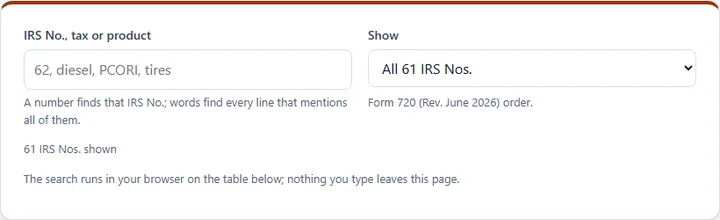
The Code schedules a drop: the gasoline, diesel and kerosene rates “shall be 4.3 cents per gallon after September 30, 2028” (IRC 4081(d)), and the aviation gasoline and noncommercial aviation kerosene rates fall to 4.3 cents after the same date. Fuel used in a fractional ownership program aircraft also pays a surtax: the instructions say it “is subject to a surtax of $.141” per gallon (IRS No. 13). Each IRS No. is explained in the IRS No. lookup.
The 0.1 cent LUST tax
Every 4081 rate includes the Leaking Underground Storage Tank Trust Fund tax. The Code says the base rates “shall each be increased by 0.1 cent per gallon”, and that rate “shall apply after September 30, 1997, and before October 1, 2028” (IRC 4081(a)(2)(B) and (d)(3)). That is why gasoline is $.184 on Form 720 and not $.183.
The LUST tax stays when the rest of the tax is excused. The Form 720 instructions say “Tax is imposed at $.001 per gallon on removals, entries, and sales of gasoline, diesel, and kerosene described as exempt transactions”, reported on IRS Nos. 105 (dyed diesel), 107 (dyed kerosene) and 119 (other exempt removals), and IRS No. 111 for kerosene removed into aircraft for nontaxable uses. It is also usually kept when a claim refunds the rest: Pub. 510 notes that a fuel credit or refund is less than the tax deducted as an expense because “the LUST tax is generally not refunded”, which is why nontaxable use claims run $.183 for gasoline and $.243 for diesel rather than the full rate.
Dyed diesel and kerosene
Diesel and kerosene destined for a nontaxable use (a farm, off-highway business use, a state or local government and the other uses on the Type of Use Table) can leave the terminal without the 24.3 cent tax if it is dyed. The exemption applies only if the person otherwise liable is a registrant, the terminal is an approved terminal and the fuel meets the dyeing rules, and even then “dyed diesel fuel and dyed kerosene are subject to $0.001 per gallon LUST tax” unless exported (Pub. 510, chapter 1). Shipping papers and retail pumps must carry the notice “DYED DIESEL FUEL, NONTAXABLE USE ONLY, PENALTY FOR TAXABLE USE”.
The penalty for selling or using dyed fuel for a taxable use is “the greater of $1,000 or $10 per gallon” of the fuel involved, and the $1,000 part rises with each later violation (IRC 6715)IRC 6715Internal Revenue Code, Cornell LII. For the last quarter of 2026 the IRS has suspended it: after an Oct. 5, 2026 executive order, it said “it will not impose a penalty when dyed diesel fuel is sold for use or used on highways nationwide”, and “The relief is retroactive to Oct. 1, 2026, and will remain in effect until Dec. 31, 2026.” The release adds that “It has no effect on state fuel taxes”, and that guidance on how the relief applies to Form 720 is still to come (IR-2026-122, Oct. 14, 2026). The dyed fuel guide covers inspections, the penalty and the appeal path, and the new section 6435 refund covers tax paid on fuel that is later dyed.
Kerosene and aviation fuel
Kerosene is taxed like diesel at $.244 at the rack, but kerosene removed directly into the fuel tank of an aircraft gets its own rates. The Form 720 instructions set “the tax rate is $.219 per gallon. This rate applies to kerosene used in noncommercial aviation” (IRS No. 69), $.044 for commercial aviation other than foreign trade (IRS No. 77), and $.001 for nontaxable uses (IRS No. 111). The commercial rate belongs to registered operators only: “The line for IRS No. 77 is only applicable to registered commercial aviation operators” (Form 637 activity letter Y). Aviation gasoline is $.194 (IRS No. 14).
Refueler trucks at an airport count as part of the terminal only if they meet the conditions in IRC 4081(a)(3)IRC 4081Internal Revenue Code, Cornell LII, and Pub. 510 says that for a refueler the commercial rate applies only “if the qualifying refueler is loaded at a SAT”, a secured airport terminal. The aviation fuel and kerosene guide covers those rules, the foreign trade exemption and the model certificates.
Who files what
The fuel taxes are Part I taxes, so they are deposited during the quarter as well as reported on the return: “The deposit of tax for a semimonthly period is due by the 14th day following that period” (Instructions for Form 720). The due dates and deposits page has the calendar, the safe harbors and the special September rule. Terminal operators and carriers also file monthly information returns, and “Electronic filing is required for each return reporting 25 or more transactions a month” through the Excise Summary Terminal Activity Reporting System, ExSTARS (Instructions for Form 720-TO).
| Return or form | Who files | When | Where it goes |
|---|---|---|---|
| Form 720, Part I (IRS Nos. 62, 60, 35, 69, 77 and the rest) | The person liable: position holder, refiner, enterer, blender, registered Y aviation operator | Quarterly, with semimonthly deposits | IRS, with deposits by EFT (EFTPS) |
| Form 720, Schedule T | Taxable fuel registrants in a two-party exchange | With Form 720 | IRS |
| Form 720-TO | Terminal operators, one per approved terminal | Monthly, by the last day of the next month | IRS; electronic through ExSTARS for 25 or more transactions a month |
| Form 720-CS | Bulk transport carriers (barges, vessels and pipelines) | Monthly, by the last day of the next month | IRS |
| Form 637 | Everyone who must register under IRC 4101IRC 4101Internal Revenue Code, Cornell LII, and claimants who choose to | Before the activity starts | IRS Excise Operations Unit, Cincinnati (fax or mail) |
| Form 8849 and Form 4136 | Claimants: ultimate purchasers, vendors, credit card issuers | Quarterly or annually, by schedule | Form 8849 to the IRS; Form 4136 with the income tax return |
The heavy highway vehicle use tax on Form 2290 is a separate federal excise return for trucks of 55,000 pounds or more. Our sister site IFTACompliance.com covers Form 2290, IFTA and the carrier side of fuel tax.
Claims and credits
When taxed fuel ends up in a nontaxable use, the tax comes back by one of three routes, and Pub. 510 says “Only one credit may be taken for each amount of any fuel type”. Form 720 filers with a Part I or II liability can take a credit on Schedule C. Others file Form 8849 for a quarterly refund (Schedule 1 for ultimate purchasers, Schedule 2 for registered ultimate vendors, Schedule 8 for registered credit card issuers), or take the credit once a year with the income tax return on Form 4136. The biodiesel, renewable diesel and alternative fuel credits and payments under sections 6426 and 6427 ended after 2024, and the sustainable aviation fuel mixture credit after Sept. 30, 2025.
Fuel guides
- Form 637 registration: who must register, the activity letters, the review, the status check and the 10-day appeal.
- Form 8849: the refund schedules, minimums, claim periods and interest.
- Form 4136: the annual fuel tax credit on the income tax return.
- Tax-free sales, dyed fuel, aviation fuel and kerosene and the section 6435 dyed fuel refund.
- For the quarterly return itself: the Form 720 guide and the Form 720 form page.
Tools for this topic
Questions filers ask
Who pays the federal excise tax on gasoline and diesel?
The position holder: the company whose name the fuel is in on the terminal operator's records when it is removed at the terminal rack. Refiners, importers (enterers) and blenders pay on their own taxable events. The tax is then built into the price down the chain.
What is the federal fuel tax rate in 2026?
On Form 720 (Rev. June 2026): gasoline $.184 a gallon (IRS No. 62), aviation gasoline $.194 (IRS No. 14), diesel and kerosene $.244 (IRS Nos. 60 and 35), each including the 0.1 cent LUST tax. Kerosene removed into aircraft is $.219 for noncommercial aviation and $.044 for registered commercial operators.
Do federal fuel tax rates change each year?
No. They are fixed amounts in 26 U.S.C. 408126 U.S.C. 4081United States Code, Cornell LII and are not indexed for inflation. The Code schedules the gasoline, diesel and kerosene rates to fall to 4.3 cents a gallon after Sept. 30, 2028, and the LUST rate applies only before Oct. 1, 2028.
Is dyed diesel tax free?
Dyed diesel and dyed kerosene removed by a registrant from an approved terminal are free of the 24.3 cent tax but still pay the 0.1 cent LUST tax (IRS No. 105 or 107). Using it on the highway brings the dyed fuel penalty, which the IRS has waived for Oct. 1 to Dec. 31, 2026 (IR-2026-122).
Does a terminal operator owe the tax?
Only on fuel it owns in its own terminal, or jointly with an unregistered position holder. A registered terminal operator holding an unexpired notification certificate from the position holder, with no reason to doubt it, is not liable for that position holder's tax.
Where do truckers claim fuel tax back?
Fuel used in a highway vehicle on the road is not a nontaxable use, so it earns no federal refund. Off-highway and other nontaxable uses are claimed on Form 8849 Schedule 1 or Form 4136. IFTACompliance.com covers the carrier side, including Form 2290 and IFTA.
Sources
- 26 U.S.C. 408126 U.S.C. 4081United States Code, Cornell LII: Cornell LII; 26 CFR 48.4081-126 CFR 48.4081-1Code of Federal Regulations, eCFR and 48.4081-2: eCFR
- Form 720 and Instructions for Form 720 (Rev. June 2026): irs.gov, About Form 720; Instructions for Form 720-TO and 720-CS
- Publication 510, Excise Taxes (Rev. December 2025), chapters 1 and 2
- IR-2026-122 (Oct. 14, 2026), dyed diesel relief: irs.gov newsroom