From Notice 2026-69, Notice 2025-61, 26 U.S.C. 437526 U.S.C. 4375United States Code, Cornell LII and 4376 and the Instructions for Form 720 (Rev. June 2026).
What the PCORI fee is
The IRS describes it as “a fee on issuers of specified health insurance policies and plan sponsors of applicable self-insured health plans that helps to fund the Patient-Centered Outcomes Research Trust Fund”. It was created by the Affordable Care Act in sections 4375 and 4376 of the Internal Revenue Code, and the Form 720 instructions call it the PCOR fee; most filers call it the PCORI fee, after the institute it funds. The amount is simple: “The amount of the PCORI fee is equal to the average number of lives covered during the policy year or plan year multiplied by the applicable dollar amount for the year.”
Although it is called a fee, the Code treats it like a tax for filing, payment, penalties and interest: “For purposes of subtitle F, the fees imposed by this subchapter shall be treated as if they were taxes.” (IRC 4377(c)). It goes on Form 720, the quarterly federal excise tax return, on the line for IRS No. 133 in Part II, and most employers meet Form 720 for the first time because of it. Searches for it climb every June and peak in July, the month the return is due.
Who pays: insurers and plan sponsors
For insured coverage the insurer pays: “The fee imposed by subsection (a) shall be paid by the issuer of the policy.” (IRC 4375(b)). An employer whose group health plan is fully insured does not file for that plan. For self-insured coverage the employer, or other sponsor, pays: “The fee imposed by subsection (a) shall be paid by the plan sponsor.” (IRC 4376(b)). A plan counts as self-insured if any part of the coverage is provided other than through an insurance policy (26 CFR 46.4376-1(b)(1))26 CFR 46.4376-1Code of Federal Regulations, eCFR.
The regulation names the sponsor. It is “The employer, in the case of an applicable self-insured health plan established or maintained by a single employer”, the employee organization for a union plan, and “The joint board of trustees, in the case of a multiemployer plan”. When several related employers share one self-insured plan and the plan document names no sponsor, each employer pays for its own employees, which means “each plan sponsor must file a separate Form 720”. The plan document can instead designate one of them, in writing and with that employer's written consent, by the due date of the return (26 CFR 46.4376-1(b)(2)).
26 U.S.C. 4375(b)26 U.S.C. 4375United States Code, Cornell LII and 4376(b); 26 CFR 46.4376-1(b)26 CFR 46.4376-1Code of Federal Regulations, eCFR; IRS application chart and PCORI questions and answers.
The IRS application chart puts it in one line per arrangement: accident and health coverage is paid by “The issuer if insured” and by “The plan sponsor if self-insured”, and COBRA and retiree-only coverage follow the same rule (IRS application chart). Governmental and tax-exempt employers are not excused: unless the plan is an exempt governmental program, “the health insurance issuer or plan sponsor is responsible for the PCORI fee” (Q&A 10).
Which coverage is subject
Major medical coverage is subject, insured or self-insured, including retiree-only plans, state and local government plans, and coverage under more than one policy or plan. An HRA or a health FSA is subject “Yes, unless the arrangement satisfies the requirements for being treated as an excepted benefit”. The IRS notes that plans with only excepted benefits, such as dental or vision plans “and most flexible spending arrangements, are not subject to the PCORI fee”; a health FSA that is not an excepted benefit is an applicable self-insured health plan (26 CFR 46.4376-1(b)(1)(ii)(A))26 CFR 46.4376-1Code of Federal Regulations, eCFR.
Not subject: “The PCORI fee does not apply to exempt governmental programs, including Medicare, Medicaid, Children's Health Insurance Program” and the military, veterans and Indian Health programs; plans that provide only excepted benefits, such as “Stand-alone dental or vision coverage”; employee assistance, disease management and wellness programs that do not provide significant medical care; and plans built for employees working abroad, because “the PCORI fee does not apply to policies and plans that are designed specifically to cover employees who are working and residing outside the United States” (Q&A 9). The chart also lists HSAs, Archer MSAs, hospital indemnity, “Stop-loss or indemnity reinsurance”, accident-only, disability, workers' compensation and on-site clinics as not subject.
Two plans can sometimes be counted as one. A sponsor may combine self-insured arrangements “but only if the plans have” the same plan sponsor and the same plan year, so an HRA paired with the sponsor's own self-insured major medical plan is not a second fee. “There is no similar rule for lives covered by more than one insurance policy subject to the PCORI fee.” An HRA that pays deductibles under an insured policy is therefore its own fee, paid by the employer, on top of the insurer's fee for the policy.
The amount per covered life, by plan year
The applicable dollar amount started at $2 in the statute and rises each federal fiscal year with National Health Expenditures. The amount that applies is the one for the year in which the plan or policy year ends, not the year it is filed. For the current years:
- Plan and policy years ending Oct. 1, 2025 to Sept. 30, 2026: Notice 2025-61 set the amount at “$3.84”, and the June 2026 Form 720 prints it on lines 133(b) and (d): “(b) With a policy year ending on or after October 1, 2025, and before October 1, 2026 $3.84”.
- Plan and policy years ending Oct. 1, 2026 to Sept. 30, 2027: “The applicable dollar amount that must be used to calculate the fee imposed by sections 4375 and 4376 for policy years and plan years that end on or after October 1, 2026, and before October 1, 2027, is $4.05.” (Notice 2026-69). The IRS figured it from “National Health Expenditures published by HHS on June 16, 2026”.
The $4.05 amount is not on Form 720 yet. The June 2026 form and instructions print only $3.47 and $3.84, and the IRS rates and dates chart, as we read it on Nov. 22, 2026, ended with plan years ending in December 2025. The IRS says “Typically, the second Form 720 revision released in the spring of each year has the updated rates for the annual filing due by July 31.” Use the revision current when you file, and check that its line 133 shows $4.05 for years ending after Sept. 30, 2026.
The full history, for amended returns and late filings, from the IRS questions and answers and the notices. A bracket that runs October to September covers plan years ending in two calendar years, so it has two due dates:
| Plan or policy year ends | Amount per covered life | Authority | Form 720 due (second quarter) |
|---|---|---|---|
| Oct. 1, 2026 to Sept. 30, 2027 | $4.05 | Notice 2026-69 | Years ending Oct. to Dec. 2026: July 31, 2027 Years ending Jan. to Sept. 2027: July 31, 2028 |
| Oct. 1, 2025 to Sept. 30, 2026 | $3.84 | Notice 2025-61 | Years ending Oct. to Dec. 2025: July 31, 2026 Years ending Jan. to Sept. 2026: July 31, 2027 |
| Oct. 1, 2024 to Sept. 30, 2025 | $3.47 | Notice 2024-83 | Years ending Oct. to Dec. 2024: July 31, 2025 Years ending Jan. to Sept. 2025: July 31, 2026 |
| Oct. 1, 2023 to Sept. 30, 2024 | $3.22 | Notice 2023-70 | Years ending Oct. to Dec. 2023: July 31, 2024 Years ending Jan. to Sept. 2024: July 31, 2025 |
| Oct. 1, 2022 to Sept. 30, 2023 | $3.00 | IRS PCORI fee Q&A | Years ending Oct. to Dec. 2022: July 31, 2023 Years ending Jan. to Sept. 2023: July 31, 2024 |
| Oct. 1, 2021 to Sept. 30, 2022 | $2.79 | IRS PCORI fee Q&A | Years ending Oct. to Dec. 2021: July 31, 2022 Years ending Jan. to Sept. 2022: July 31, 2023 |
| Oct. 1, 2020 to Sept. 30, 2021 | $2.66 | IRS PCORI fee Q&A | Years ending Oct. to Dec. 2020: July 31, 2021 Years ending Jan. to Sept. 2021: July 31, 2022 |
| Oct. 1, 2019 to Sept. 30, 2020 | $2.54 | IRS PCORI fee Q&A | Years ending Oct. to Dec. 2019: July 31, 2020 Years ending Jan. to Sept. 2020: July 31, 2021 |
| Oct. 1, 2018 to Sept. 30, 2019 | $2.45 | IRS PCORI fee Q&A | Years ending Oct. to Dec. 2018: July 31, 2019 Years ending Jan. to Sept. 2019: July 31, 2020 |
| Oct. 1, 2017 to Sept. 30, 2018 | $2.39 | IRS PCORI fee Q&A | Years ending Oct. to Dec. 2017: July 31, 2018 Years ending Jan. to Sept. 2018: July 31, 2019 |
| Oct. 1, 2016 to Sept. 30, 2017 | $2.26 | IRS PCORI fee Q&A | Years ending Oct. to Dec. 2016: July 31, 2017 Years ending Jan. to Sept. 2017: July 31, 2018 |
| Oct. 1, 2015 to Sept. 30, 2016 | $2.17 | IRS PCORI fee Q&A | Years ending Oct. to Dec. 2015: July 31, 2016 Years ending Jan. to Sept. 2016: July 31, 2017 |
| Oct. 1, 2014 to Sept. 30, 2015 | $2.08 | IRS PCORI fee Q&A | Years ending Oct. to Dec. 2014: July 31, 2015 Years ending Jan. to Sept. 2015: July 31, 2016 |
| Oct. 1, 2013 to Sept. 30, 2014 | $2.00 | IRS PCORI fee Q&A | Years ending Oct. to Dec. 2013: July 31, 2014 Years ending Jan. to Sept. 2014: July 31, 2015 |
| Oct. 1, 2012 to Sept. 30, 2013 | $1.00 | IRS PCORI fee Q&A | Years ending Oct. to Dec. 2012: July 31, 2013 Years ending Jan. to Sept. 2013: July 31, 2014 |
The due dates in the last column follow the rule in the regulation: a return for a self-insured plan “must be filed by July 31 of the calendar year immediately following the last day of the plan year” (26 CFR 40.6071(a)-1(c)). The PCORI fee calculator picks the amount from the plan year end date for you.
Counting covered lives
Every covered person counts, not just employees. The IRS says a plan sponsor “must count an employee and his dependent child as two separate covered lives” unless its only self-insured plan is an HRA or health FSA, and COBRA and retiree coverage count too: “These covered individuals and their beneficiaries must be taken into account in calculating the average number of lives covered.” (Q&A 5 and 6).
Plan sponsors of self-insured plans choose one of three methods (26 CFR 46.4376-1(c)(2)):
- Actual count. “adding the totals of lives covered for each day of the plan year and dividing that total by the number of days in the plan year”.
- Snapshot. Count lives on one date in the first, second or third month of each quarter (or more dates, the same number each quarter) and divide by the number of dates. Later dates must be “within three days of the date in that quarter that corresponds to the date used for the first quarter”. On each date, count the actual lives (snapshot count) or use the snapshot factor: self-only participants plus “The number of participants with coverage other than self-only coverage on the date multiplied by 2.35”.
- Form 5500. Use the participants reported on the plan's Form 5500 or 5500-SF, but only if it is “filed no later than the due date for the fee imposed by section 4376 for that plan year”. A self-only plan adds the participants at the beginning and end of the year and divides by 2; a plan with family coverage adds them and does not divide. A Form 5500 filed on extension after July 31 cannot be used.
The method must be used “consistently for the duration of the plan year. However, a plan sponsor may use a different method from one plan year to the next.” The PCORI fee worksheet walks a plan sponsor through each method. Two counting shortcuts help employers: a sponsor whose only self-insured plan is an HRA or health FSA may “treat each participant's health FSA or HRA as covering a single life”, and a plan with both insured and self-insured options may “disregard the lives that are covered solely under the fully-insured options”.
Insurers choose among four methods: “1. The actual count method. 2. The snapshot method. 3. The member months method. 4. The state form method.” The member months method uses the NAIC Supplemental Health Care Exhibit, where “the average number of lives covered under the policies in effect for the calendar year equals the member months divided by 12”. An insurer must use one method for all policies reported on the year's Form 720, and an insurer on member months or state form “must use the same method for calculating lives covered for all policy years for which the fee applies” (26 CFR 46.4375-1(c)(2)).
26 CFR 46.4376-1(c)26 CFR 46.4376-1Code of Federal Regulations, eCFR; Instructions for Form 720 (Rev. June 2026), Part II.
A note on the regulations: the eCFR text of both sections still says, for example, “This section applies for plan years that end on or after October 1, 2012, and before October 1, 2019.” That text predates the 2019 law that extended the fee. The statute now reaches plan years ending through Sept. 30, 2029, and the IRS says the fee “will continue to be imposed through 2029” and still points filers to the final regulations for the counting methods. The statute governs the dates; the IRS applies the same counting methods.
A worked example
The regulation's own snapshot factor example counts four dates in a calendar year plan: 600 self-only and 800 other participants on the first date, 608 and 800 on the second, 610 and 809 on the third and fourth. It reaches “9,988 [(600 + (800 × 2.35)) + (608 + (800 × 2.35)) + (610 + (809 × 2.35)) + (610 + (809 × 2.35))] divided by 4, or 2,497”. Applied to a calendar year 2026 plan, our arithmetic is:
| Step | Figure |
|---|---|
| Average covered lives (snapshot factor method) | 2,497 |
| Plan year ends | Dec. 31, 2026, in the bracket ending Sept. 30, 2027 |
| Applicable dollar amount | $4.05 (Notice 2026-69) |
| PCORI fee | 2,497 × $4.05 = $10,112.85 |
| Report on | Form 720 for the second quarter of 2027, IRS No. 133, line (d) or its successor for years ending after Sept. 30, 2026 |
| Due | July 31, 2027, a Saturday, so the return may be filed Aug. 2, 2027 |
26 CFR 40.6071(a)-1(c)(2); Instructions for Form 720 (Rev. June 2026), When To File. A legal holiday also moves the date.
The same plan's 2025 plan year, ended Dec. 31, 2025, fell in the $3.84 bracket and was due July 31, 2026. The PCORI fee worksheet lays out each method's count on one page.
Filing on Form 720 and paying
The fee is reported once a year: “to report and pay the fee on the second-quarter Form 720 no later than July 31 of the calendar year immediately following the last day of the policy year or plan year to which the fee applies” (About Form 720). If the business has no other excise taxes, “If you file Form 720 only to report the fee, don't file Form 720 for the first, third, or fourth quarter of the year.” A business that files Form 720 every quarter for other taxes reports the fee on its second-quarter return and leaves line 133 blank on the others. The PCORI fee worksheet carries the count to the Form 720 line and its due date.
On the return, “Report the average number of lives covered in column (a). Apply the applicable rate (column (b)) and enter the fee in column (c).” Insurers use lines 133(a) and (b) and plan sponsors lines 133(c) and (d), and the combined fee goes in the Tax column for IRS No. 133. Because the amount changes each year, “you should determine the fee using the instructions for the second-quarter Form 720”. The return is the Form 720 PDF, with its instructions; the Form 720 form page marks line 133 and the Form 720 guide covers the rest of the return. “Electronic filing is available but not required.”
No deposits: “Deposits aren't required for this fee, so issuers and plan sponsors aren't required to pay the fee using EFTPS.” The fee is paid by the July 31 due date, one of the Form 720 returns with their own dates. A payer that does use EFTPS applies it to the second quarter; the IRS says to “select Q2 for the Quarter under Tax Period” on the business tax payment page. The Form 720-V guide covers paying the fee by check.
Corrections, short years and common mistakes
- Overpaid or used the wrong amount. Do not net it against next year: “Plan sponsors and policy issuers cannot reduce the PCORI fee due July 31 for any overpayment from a prior year.” Correct the earlier return on Form 720-X, which “may be filed anytime within the applicable limitation period” (Q&A 15 and 16).
- Short plan year. “the PCORI fee applies to a short plan year of an applicable self-insured health plan”, at the amount for the year the short year ends, due July 31 of the next calendar year (Q&A 12 to 14). A plan that moves from a fiscal year to a calendar year has one short year and owes for it.
- Fully insured employer filing anyway. The insurer pays the fee for insured coverage. The employer files only for its self-insured plans, including an HRA that is not an excepted benefit.
- Counting only employees. Spouses, dependents, COBRA beneficiaries and retirees are covered lives, except under the HRA and FSA single-life rule.
- Using last year's form. The amount printed on line 133 changes; use the current revision and the amount for the year your plan year ended.
- Late filing or payment. Because the fee is treated as a tax, the failure to file and failure to pay penalties and interest apply. The Form 720 penalties page covers them; the minimum late filing penalty in IRC 6651(a)IRC 6651Internal Revenue Code, Cornell LII applies only to income tax returns, not Form 720 (IRM 20.1.11).
When the fee ends
The fee has a fixed end date in the Code: “This section shall not apply to policy years ending after September 30, 2029.” (IRC 4375(e)), and “This section shall not apply to plan years ending after September 30, 2029.” (IRC 4376(e)). The trust fund it pays for closes on the same date: “No amounts shall be available for expenditure from the PCORTF after September 30, 2029” (IRC 9511). So the last plan years that owe the fee are those ending by Sept. 30, 2029, and a calendar year plan's last fee year is 2028, due July 31, 2029. A fiscal year plan ending June 30, 2029 owes one more, due July 31, 2030, the last PCORI return. The fee was first set to end in 2019; a 2019 law extended it ten years, and the IRS notes that “The Further Consolidated Appropriations Act, 2020 (Pub. L. 116-94), signed into law on Dec. 20, 2019, has extended the Patient-Centered Outcomes Research Trust Fund fee”. A further extension would take another act of Congress; as of November 2026 the Code shows none.
Tools and templates for this topic
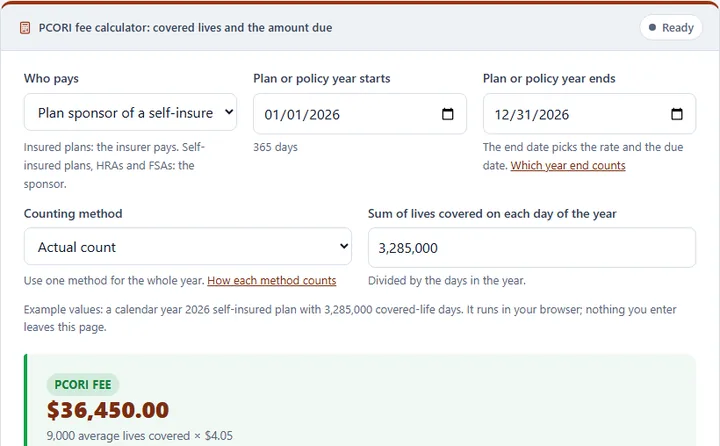
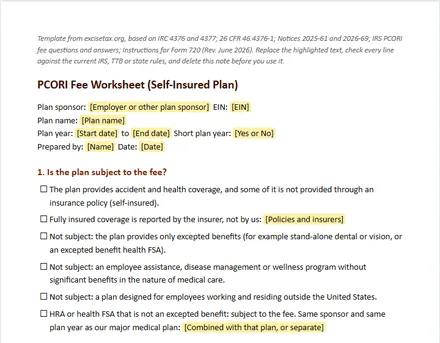
PCORI fee worksheet
A fill-in worksheet for a self-insured plan's PCORI fee: whether the plan is covered, the three counting methods, the rate for the plan year end, and the Form 720 line and due date.
Questions filers ask
What is the PCORI fee for 2026?
It depends on when the plan year ends. Plan years ending Oct. 1, 2025 to Sept. 30, 2026 use $3.84 per covered life (Notice 2025-61), so a calendar year 2025 plan paid $3.84 by July 31, 2026. Plan years ending Oct. 1, 2026 to Sept. 30, 2027, including calendar year 2026 plans, use $4.05 (Notice 2026-69), due by July 31, 2027.
Who pays the PCORI fee, the employer or the insurer?
For a fully insured plan, the insurer. For a self-insured plan, including a plan that is only partly self-insured, an HRA or a non-excepted health FSA, the plan sponsor, which for a single employer plan is the employer.
When is the PCORI fee due?
By July 31 of the calendar year after the plan year ends, on the second-quarter Form 720. If July 31 falls on a weekend, the return may be filed the next business day; July 31, 2027 is a Saturday, so Aug. 2, 2027 works that year.
Do I have to file Form 720 every quarter if I only owe PCORI?
No. If the PCORI fee is the only excise tax you report, you file only the second-quarter Form 720 each year and no return for the other quarters.
Do HRAs owe the PCORI fee?
Yes, unless the HRA is an excepted benefit. The sponsor may count one life per employee in the HRA if it has no other self-insured plan, and an HRA with the same sponsor and plan year as the sponsor's self-insured medical plan is counted with that plan instead of separately.
When does the PCORI fee end?
It does not apply to plan or policy years ending after Sept. 30, 2029 (IRC 4375(e), 4376(e))IRC 4375Internal Revenue Code, Cornell LIIIRC 4376Internal Revenue Code, Cornell LII. The last returns are due July 31, 2030.
Sources
- 26 U.S.C. 437526 U.S.C. 4375United States Code, Cornell LII, 4376, 4377 and 9511: Cornell LII; 26 CFR 46.4375-126 CFR 46.4375-1Code of Federal Regulations, eCFR and 46.4376-1: eCFR; 26 CFR 40.6071(a)-1: eCFR
- Notice 2026-69 ($4.05): Internal Revenue Bulletin 2026-48; Notice 2025-61 ($3.84): Internal Revenue Bulletin 2025-45
- IRS: Patient-Centered Outcomes Research Institute fee; PCORI fee questions and answers; application chart; filing due dates and applicable rates
- Form 720 and Instructions for Form 720 (Rev. June 2026): irs.gov, About Form 720; the amounts table: irs_nos.py (PCORI_RATES)