From 26 U.S.C. 408126 U.S.C. 4081United States Code, Cornell LII, the Instructions for Form 720 (Rev. June 2026), Notice 2026-69 and the state sources behind the vapor map.
What an excise tax is
An excise tax is imposed on a named product, service or activity, at a rate the law sets for that item. The Internal Revenue Code shows the pattern in almost every excise section. For fuel, Congress wrote that “There is hereby imposed a tax at the rate specified in paragraph (2) on” the removal of a taxable fuel from a refinery or terminal, its entry into the United States, or its sale to an unregistered person (IRC 4081). For heavy trucks, the tax is “a tax of 12 percent of the amount for which the article is so sold”, imposed “on the first retail sale” of the listed trucks, trailers and tractors (IRC 4051).
Three things set an excise tax apart: it applies to a specific item, it is charged at one point in the chain (removal from a terminal, the first retail sale, the payment for a ticket), and it falls on the business at that point, which reports it on an excise return. The IRS's guide to these taxes, Publication 510, says it “covers the excise taxes for which you may be liable and which are reported on Form 720 and other forms”.
The word means the same thing at the state level: a state's cigarette, motor fuel, alcohol, vapor or cannabis tax is an excise tax on that product, filed by a distributor, wholesaler, supplier or retailer. Some states also use the word for a whole return. Washington's Department of Revenue tells tobacco distributors “You will report the tax on your combined excise tax return”, and it says it “administers numerous excise taxes in addition to the business and occupation, retail sales, property, and use taxes” (Washington Department of Revenue, other taxes). Each state page says in its first lines when the state uses the word more broadly. In Hawaii, “The General Excise Tax (GET) is Hawaii's tax on business activity”; in Massachusetts, the owner of a registered car or trailer pays a yearly “motor vehicle and trailer excise”.
Excise tax vs sales tax
A sales tax applies to retail sales in general and is collected from the buyer at the register. An excise tax applies to one product, usually earlier in the chain and usually per unit, and the buyer rarely sees it as a line on the receipt. California's motor fuel notice shows both on one gallon: the state sets “Excise Tax Rates per Gallon”, which rose to 63.4 cents for gasoline on July 1, 2026, and it separately sets a sales tax prepayment, which it figures “at 80 percent of the combined state and local sales tax on the average selling price of the fuel” (CDTFA Special Notice L-1025).
Some states tax the same product either way. Delaware taxes vapor products as an excise, “at the rate of five cents ($0.05) per fluid milliliter”, paid by the wholesale or retail dealer that first handles them. New York instead imposes “A 20% supplemental sales tax” on retail sales of vapor products, and the dealer “must separately state on the customer's receipt the 20% supplemental sales tax” (New York vapor products tax). Maryland raised both kinds in one 2024 law: it “increases excise tax rates on cigarettes and on the wholesale price of other tobacco products” and raised the sales and use tax rate on electronic smoking devices (Comptroller tax alert, July 1, 2024).
The difference matters to the business because the two taxes run on different returns, with different registrations, rates and due dates. A fuel supplier, tobacco distributor or brewer files excise returns on top of any sales tax returns, and a retailer can owe sales tax on a price that already includes excise tax.
Federal and state excise taxes
Federal excise taxes come from two agencies. The IRS administers the excise taxes on Form 720 and a few other returns: fuel, the Superfund chemical and petroleum taxes, heavy trucks, tires, the gas guzzler tax, air transportation, foreign insurance, the PCORI fee on health plans, the stock buyback tax and more. The Form 720 instructions say to “Use Form 720 and attachments to report your liability by IRS No. and pay the excise taxes listed on the form” (About Form 720). The federal excise taxes page lists every one with its IRS No.
The Alcohol and Tobacco Tax and Trade Bureau, the TTB, administers the federal excise taxes on alcohol, tobacco, firearms and ammunition. Publication 510 points there: “For tax forms relating to alcohol, firearms, and tobacco, visit the Alcohol and Tobacco Tax and Trade Bureau website at TTB.gov”. The TTB tells the businesses it regulates, “As a TTB-regulated industry member, you may be responsible for paying federal excise taxes” (TTB, Taxes and Filing). Its returns are filed and paid through Pay.gov. The guides start at alcohol, tobacco and firearms and ammunition.
A third federal excise return belongs to trucking: the heavy highway vehicle use tax on Form 2290, which “applies to highway motor vehicles with a taxable gross weight of 55,000 pounds or more”. Our sister site IFTACompliance.com covers Form 2290 and the carrier side of fuel taxes.
The states levy their own excise taxes on the same products, on top of the federal tax. A pack of cigarettes carries the federal tax of “$50.33 per thousand” cigarettes, about $1.01 a pack (IRC 5701), plus the state's own tax. New Jersey raised its rate in 2025, telling sellers the new law “will increase tax on cigarettes, liquid nicotine, and container e-liquid on August 1, 2025” (New Jersey Division of Taxation). Vapor products show how far the states differ: by our count of their own statutes and tax pages, 35 states and DC tax vapor products now, Iowa has a vapor tax starting on a later date, and 14 have no state vapor tax we could find. The state map shows which, and the state excise taxes page explains what the states tax and who files.
Who pays and who files
Excise law names the person who owes the tax, and that person is almost always a business. At the fuel terminal, the regulation says “The position holder with respect to the taxable fuel is liable for the tax” (26 CFR 48.4081-2), and the position holder is “the person that holds the inventory position in the taxable fuel, as reflected on the records of the terminal operator” (26 CFR 48.4081-1). For the PCORI fee on self-insured health plans, “The fee imposed by subsection (a) shall be paid by the plan sponsor” (IRC 4376).
Some excise taxes are imposed on the customer but collected by the business. The air transportation tax is “a tax equal to 7.5 percent of the amount so paid” for taxable transportation (IRC 4261), and the business that receives the payment “shall collect the amount of the tax from the person making such payment” (IRC 4291). For those collected taxes, the filer is the collector: “the person required to collect the tax (and not the person incurring liability) must file the return” (26 CFR 40.6011(a)-1).
IRC 4051IRC 4051Internal Revenue Code, Cornell LII, 4081, 4261, 4291 and 4376; 26 CFR 48.4081-226 CFR 48.4081-2Code of Federal Regulations, eCFR and 40.6011(a)-1.
Who files at the state level depends on the product and the state: a motor fuel supplier or distributor, a cigarette stamping agent, a tobacco or vapor wholesaler, a brewer or wholesaler for alcohol, a cultivator or retailer for cannabis. Each state page names the filer for each tax.
Per unit and percentage rates
Excise taxes are figured one of two ways. A per unit tax is a fixed amount per gallon, pack, barrel, ton or covered life; a percentage tax (an ad valorem tax) is a share of the price. The federal tax on gasoline is per unit: “in the case of gasoline other than aviation gasoline, 18.3 cents per gallon”, and the rates “shall each be increased by 0.1 cent per gallon” for the Leaking Underground Storage Tank Trust Fund (IRC 4081(a)(2)). Cigarettes ($50.33 per thousand) and the PCORI fee (an amount times the average number of covered lives) are per unit too.
The percentage taxes include the 12 percent heavy truck tax, the 7.5 percent air ticket tax, and the firearms and ammunition tax, where the statute lists “Articles taxable at 10 percent” (pistols and revolvers) and “Articles taxable at 11 percent” (other firearms, shells and cartridges) (IRC 4181). States use both: Delaware's 5 cents per milliliter on vapor products is per unit, while Illinois taxes tobacco products, “including moist snuff and electronic cigarettes”, at 45 percent of the wholesale price (Illinois excise tax rates).
Per unit rates do not move with prices unless the law indexes them. The federal fuel and cigarette rates are fixed in the Code, while California resets its fuel excise each July 1 for inflation and the PCORI amount changes every plan year. That is why every rate on this site carries its date and its authority.
How a federal excise tax is filed
Most IRS excise taxes go on Form 720, the Quarterly Federal Excise Tax Return. Each quarterly return “must be filed by the last day of the first calendar month following the quarter for which it is made” (26 CFR 40.6071(a)-1): April 30, July 31, October 31 and January 31. The taxes in Part I are deposited during the quarter, twice a month: “The deposit of tax for a semimonthly period is due by the 14th day following that period”, and no deposit is required when “The net liability for taxes listed in Form 720, Part I, doesn't exceed $2,500 for the quarter”. Deposits go by electronic funds transfer, usually through EFTPS.
Instructions for Form 720 (Rev. June 2026): Payment of Taxes, When To File and Schedule C; Form 720-X. No deposit is required when Part I liability for the quarter is $2,500 or less.
Regular method under the Instructions for Form 720 (Rev. June 2026): a deposit falling on a weekend or legal holiday is due the day before; a return falling on one may be filed the next business day.
The return itself is the Form 720 PDF with its instructions. The Form 720 guide walks through who files, Parts I to III and Schedules A, C and T; the due dates and deposits page covers the safe harbor rules and the special September deposits; and the Form 720 form page puts a note on every line. The PCORI fee is the one most employers meet: it is paid once a year on the July Form 720, as the PCORI fee guide explains.
How excise taxes reach prices
For shoppers asking why fuel, cigarettes or a plane ticket cost what they do: most excise taxes are paid by a business before the sale reaches you, so they are part of the price rather than a line on the receipt, and the air ticket tax is collected by the airline from the passenger. Questions about a particular price belong with the seller; this site is written for the businesses that file.
For a business, the same point has a practical side. Because an excise tax is built into the price, a contract or price list needs to say whether its prices include the tax, and a seller that sells to a buyer exempt from a federal tax, such as a registered buyer of fuel for a nontaxable use, needs the records that support the tax-free sale. The Form 637 registration page covers the registration that makes many of those sales possible.
Where to go next
- Which return do I file? Start with which excise tax return to file, or pick what your business does on the home page.
- Form 720 filers: the Form 720 guide, the instructions walk-through and the IRS No. lookup.
- Fuel: federal fuel excise taxes, Form 8849 and Form 4136.
- Health plans: the PCORI fee and its calculator.
- Alcohol, tobacco and firearms: the TTB guides, from alcohol excise tax.
- States: the map and 51-state table and a page for every state and DC.
Tools and templates for this topic
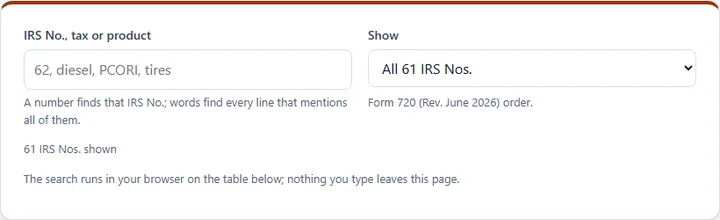
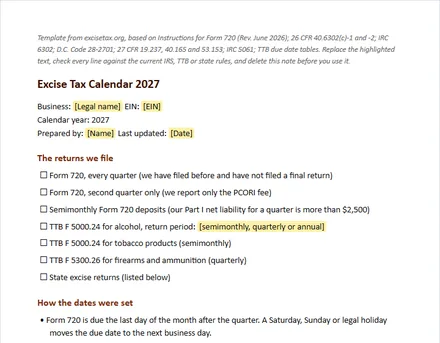
Excise tax calendar
A month by month calendar of the year's federal excise dates: Form 720 returns and deposits, the September rule, the PCORI line, the TTB returns, with blank rows for state returns.
Questions filers ask
What is an excise tax in simple terms?
A tax on one kind of product or activity, such as fuel, cigarettes, alcohol, heavy trucks or airline tickets, charged at a set rate per unit or as a percentage of the price. The business that makes, removes, sells or collects for the item usually files and pays it.
What is the difference between excise tax and sales tax?
A sales tax covers retail sales in general and is collected from the buyer at the register. An excise tax covers a named product, is usually charged earlier in the chain, often per gallon or per pack, and is filed by the business on an excise return, so the buyer pays it through the price.
Who pays federal excise tax?
The person the Code names: for example the position holder at a fuel terminal, the first retail seller of a heavy truck, the insurer or plan sponsor for the PCORI fee. For collected taxes such as the air ticket tax, the customer pays and the business that receives the payment collects the tax and files the return.
Which form is used for federal excise taxes?
Most IRS excise taxes go on Form 720, filed quarterly by April 30, July 31, October 31 and January 31. Alcohol, tobacco and firearms taxes are filed with the TTB, and the heavy highway vehicle use tax on Form 2290.
Do states have excise taxes too?
Yes. Every state taxes some of these products itself, on top of the federal tax: motor fuel, cigarettes and tobacco, alcohol and, in many states, vapor products and cannabis. By our count 35 states and DC tax vapor products now.
Is excise tax included in the price?
Usually yes. Most excise taxes are paid by a business before the retail sale, so they are in the shelf or pump price. The air transportation tax is an exception that the airline collects from the passenger on the ticket.
Sources
- 26 U.S.C. 405126 U.S.C. 4051United States Code, Cornell LII, 4081, 4261, 4291 and 4376: Cornell LII; 26 U.S.C. 418126 U.S.C. 4181United States Code, Cornell LII and 5701: Cornell LII
- 26 CFR 48.4081-126 CFR 48.4081-1Code of Federal Regulations, eCFR and 48.4081-2: eCFR; 26 CFR part 4026 CFR part 40Code of Federal Regulations, eCFR (40.6011(a)-1, 40.6071(a)-1)Treas. Reg. 40.6011(a)-1Treasury regulations, eCFRTreas. Reg. 40.6071(a)-1Treasury regulations, eCFR: eCFR
- Instructions for Form 720 (Rev. June 2026) and Form 720: irs.gov, About Form 720; Publication 510, Excise Taxes (Rev. December 2025)
- Notice 2026-69 (PCORI applicable dollar amount): Internal Revenue Bulletin 2026-48
- TTB, Taxes and Filing: ttb.gov
- State sources: CDTFA Special Notice L-1025 (July 2026), Delaware vapor products FAQs, New York vapor products tax, Maryland Comptroller tax alert (July 1, 2024), New Jersey tobacco tax increase notice, Illinois excise tax rates, Washington tobacco products tax; and the state sources behind each map color (states_et.py)