- Who files
- Anyone liable for, or collecting, a Part I or II tax
- Due
- April 30, July 31, Oct. 31, Jan. 31
- Filed with
- IRS, Ogden, UT, or e-file
- Form revision
- Rev. June 2026
- Pages
- 7, plus Form 720-V
At a glance
Form 720 is the quarterly federal excise tax return. “Use Form 720 and attachments to report your liability by IRS No. and pay the excise taxes listed on the form.” Each tax has an IRS No. and a line: Part I holds the taxes that are deposited during the quarter, Part II the taxes paid with the return, Part III works out the balance, and three schedules ride along: Schedule A (liability by half month), Schedule T (two-party fuel exchanges) and Schedule C (claims).
- Who files. “You were liable for, or responsible for collecting, any of the federal excise taxes listed in Form 720, Parts I and II, for a prior quarter and you haven't filed a final return”, or you owe or collect one for the current quarter. A quarter with nothing to report still gets a return: “If you aren't reporting a tax that you normally report, enter a zero on the appropriate line in Form 720, Part I or II.”
- When. The last day of the month after each quarter: “Jan., Feb., Mar. April 30”, “Apr., May, June July 31”, “July, Aug., Sept. October 31” and “Oct., Nov., Dec. January 31”. “If any due date for filing a return falls on a Saturday, Sunday, or legal holiday, you may file the return on the next business day.” The date calendar is on the due dates and deposits page and in the Form 720 calendar.
- Where and how. On paper to “Department of the Treasury Internal Revenue Service Ogden, UT 84201-0009”, or electronically through the IRS e-file program for excise taxes. “Electronic filing of Form 720 is optional for any taxpayer who chooses to e-file.”
- Form revision. Form 720 (Rev. June 2026), with the Instructions for Form 720 (Rev. June 2026). The PDF carries the form (pages 1 to 3), Schedules A and T (page 4), Schedule C (pages 5 to 7) and the Form 720-V voucher (page 8).
- Records. “Keep records to support all claims and all exemptions at least 4 years from the latest of the date:” the tax became due, you paid it, or you filed a claim.
Instructions for Form 720 (Rev. June 2026), When To File. A due date on a weekend or legal holiday moves to the next business day.
Tap a box once for its note, again to jump to the line. Zoom in to read the small print.
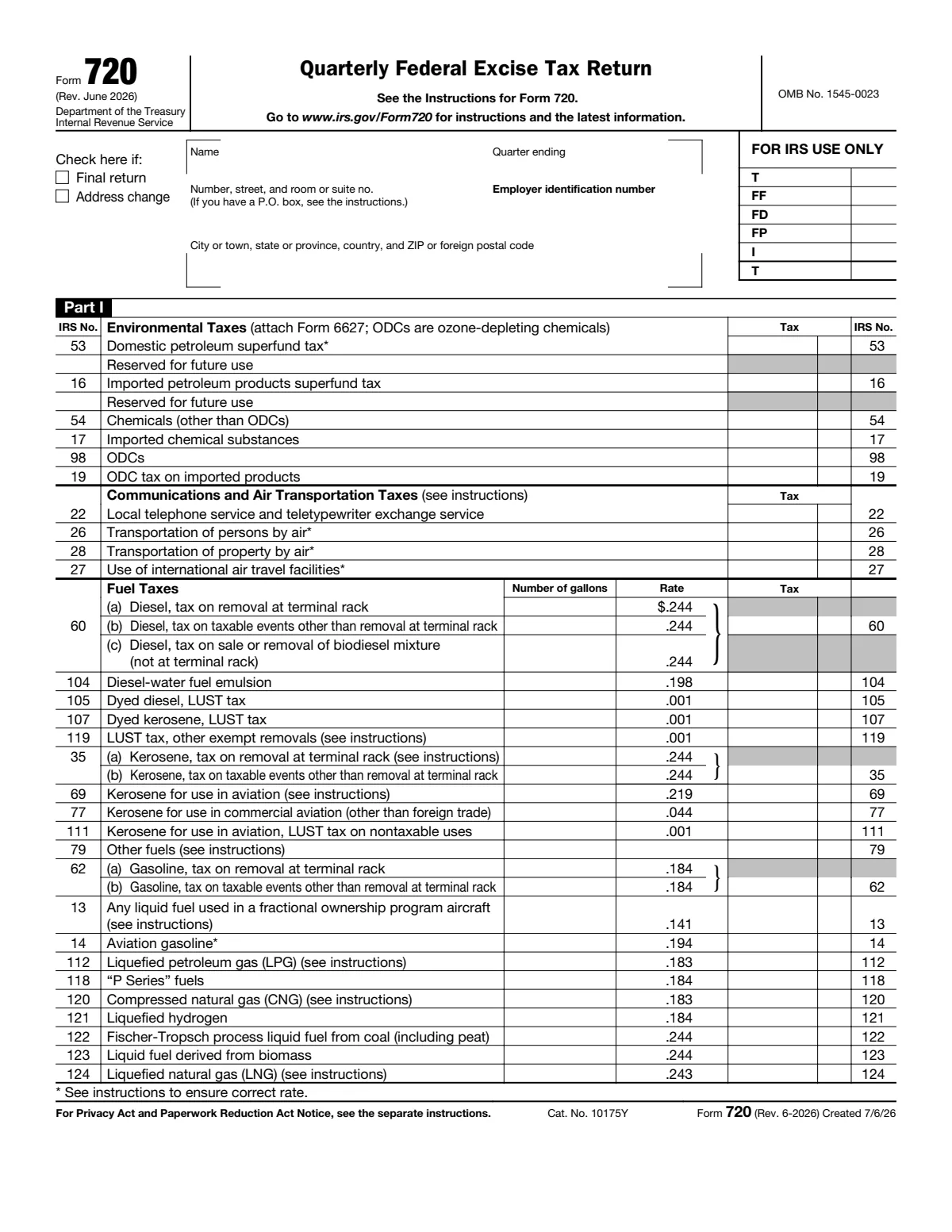 FinalAddress-changeNameQuarterStreetEINCityIRS-useIRS-53IRS-18IRS-16IRS-21IRS-54IRS-17IRS-98IRS-19IRS-22IRS-26IRS-28IRS-27IRS-60aIRS-60bIRS-60cIRS-60IRS-104IRS-105IRS-107IRS-119IRS-35aIRS-35bIRS-35IRS-69IRS-77IRS-111IRS-79IRS-62aIRS-62bIRS-62IRS-13IRS-14IRS-112IRS-118IRS-120IRS-121IRS-122IRS-123IRS-124
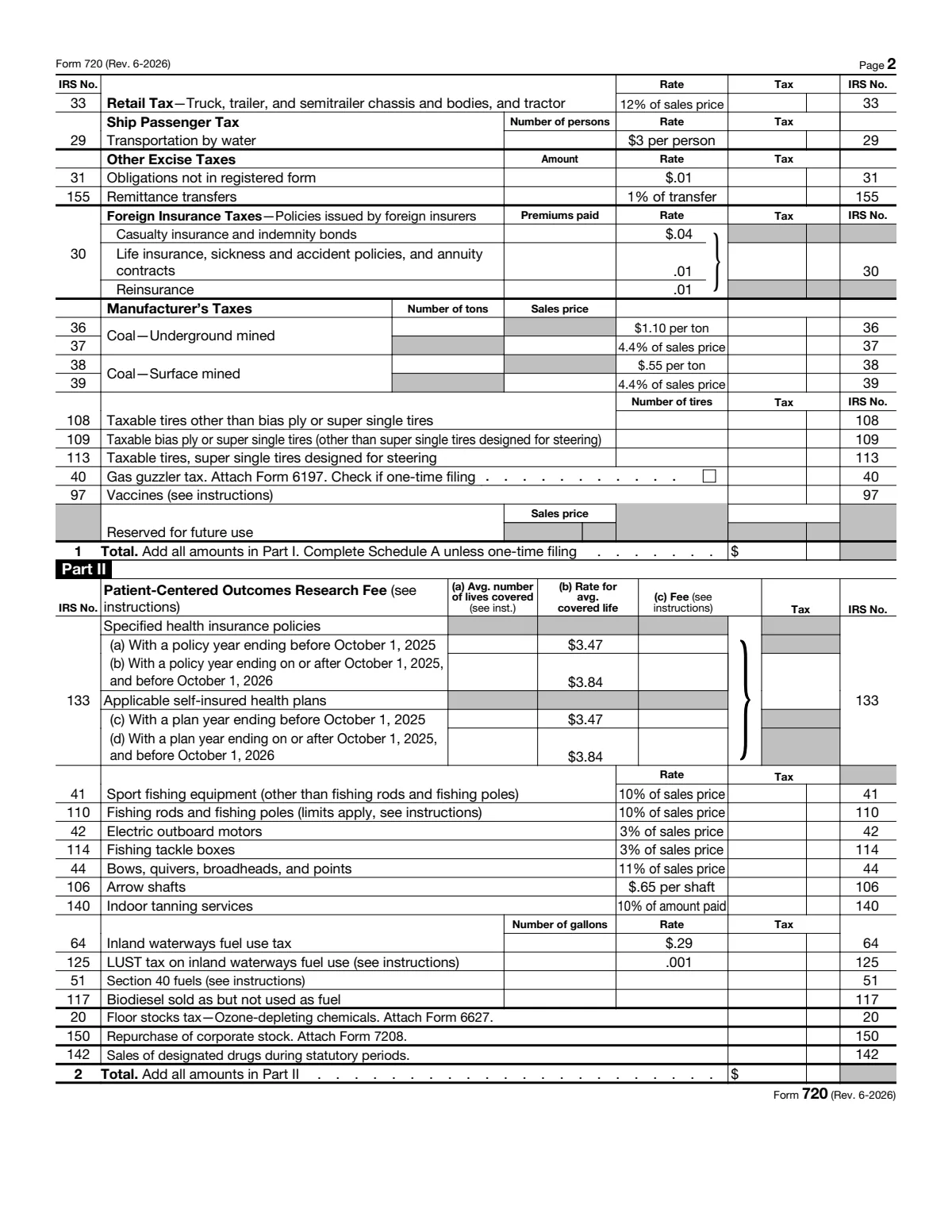
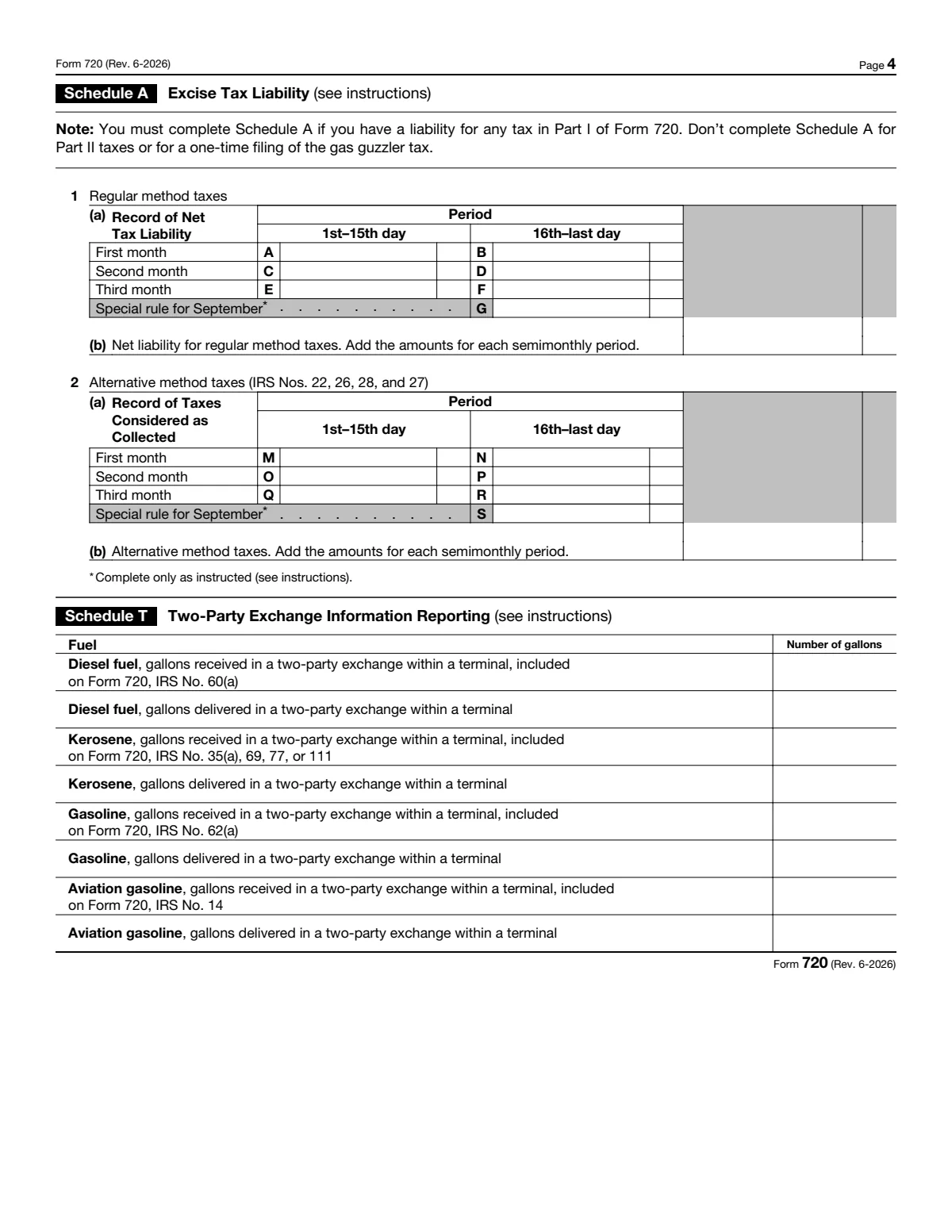
Name, EIN and quarter
The top of page 1 identifies the filer and the quarter. Use the EIN of the entity that owes the tax: single-owner disregarded entities and QSubs file excise returns under their own EIN, because “QSubs and eligible single-owner disregarded entities are treated as separate entities for excise tax and reporting purposes.”
| Line | Label | What goes there |
|---|---|---|
| Final | Final return | Check it on your last return. The instructions say to file a final return if you “Go out of business, or” “Won't owe excise taxes that are reportable on Form 720 in future quarters.” For PCORI-only filers: “If you file the second-quarter Form 720 only to report the PCOR fee, no filing is required in other quarters unless you have to report other fees or taxes.” |
| Address-change | Address change | “If your address changes, check the ‘Address change’ box above Form 720, Part I.” |
| Name | Name | The legal name of the person liable for the taxes, the one that goes with the EIN. The instructions start the return here: “Enter your name, your address, and the quarter ending date (month and year).” |
| Quarter | Quarter ending | The last month of the calendar quarter and the year (March, June, September or December). One return covers one quarter; corrections to an earlier quarter go on Form 720-X, not here: “Don't enter adjustments on Form 720.” |
| Street | Number, street, and room or suite no. (If you have a P.O. box, see the instructions.) | “If the post office doesn't deliver mail to the street address and you have a P.O. box, show the box number instead of the street address.” |
| EIN | Employer identification number | “Enter the correct EIN. If you are a one-time filer, you may not need an EIN.” A one-time gas guzzler filer who is an individual without an EIN enters an SSN or ITIN instead (see IRS No. 40). Entities that are disregarded for income tax are not disregarded here: “These actions can't take place under the owner's taxpayer identification number (TIN).” |
| City | City or town, state or province, country, and ZIP or foreign postal code | “Follow the country's practice for entering the postal code. Don't abbreviate the country name.” |
| IRS-use | FOR IRS USE ONLY (T, FF, FD, FP, I, T) | The IRS's own processing codes. Leave the whole box blank. |
Part I, line by line
Part I lists the taxes that are deposited during the quarter (the instructions walk-through for Part I covers the same ground by tax group). For each IRS No. you report either the gallons, tons, units, premiums or the tax itself, as the column heads say, and the Tax column carries the result. Each row below gives the rule from the instructions, then the rate, the unit and who reports from our shared IRS No. table (the same one behind the IRS No. lookup). The asterisked lines tell you to check the instructions for the correct rate; each rate below carries its period.
Instructions for Form 720 (Rev. June 2026), Payment of Taxes; 26 CFR 40.6302(c)-1.
The environmental taxes at the top are figured on Form 6627 and carried here; “Attach Form 6627 to Form 720. The tax rates for these taxes are shown on Form 6627.” The fuel lines (IRS Nos. 60 to 124) are where most of the dollars are; the fuel excise tax page explains who is liable at the terminal rack, and gallons received or delivered in a two-party exchange also go on Schedule T.
| Line | Label | What goes there |
|---|---|---|
| IRS-53 | 53 Domestic petroleum superfund tax* | Barrels of crude oil received at a U.S. refinery, figured on Form 6627. “Attach Form 6627 to Form 720. The tax rates for these taxes are shown on Form 6627.” The asterisk says to check the rate. Two sources disagree for 2026: Rev. Proc. 2025-32 says the section 4611 tax “is $0.27 per barrel.” The Form 6627 instructions say “For 2026, the petroleum Superfund tax rate is $0.18 per barrel.” The $0.27 adds the oil spill rate, which the statute ended: “The Oil Spill Liability Trust Fund financing rate shall not apply after December 31, 2025.” The statute governs: use $0.18 for 2026. Rate: $0.18 per barrel (2026; Instructions for Form 6627 (Rev. January 2026)); form 720 marks this line: see instructions to ensure correct rate; $0.18 per barrel (2027; Rev. Proc. 2026-35); rev. Proc. 2025-32 printed $0.27 for 2026, which adds the expired oil spill rate; the statute and Form 6627 give $0.18. Enter: Barrels of crude oil received at a U.S. refinery or used before receipt. Who reports: Operator of the U.S. refinery (or the person using or exporting the crude oil). Deposits: Semimonthly deposits (Part I), unless the quarter's Part I net liability is $2,500 or less. More: Superfund taxes, IRS No. 53 in the lookup. |
| IRS-18 | Reserved for future use | The June 2026 form prints this row as Reserved for future use. It held IRS No. 18, the domestic petroleum oil spill tax, which “expired after 2025.” “Don't enter the expired taxes on the lines for IRS Nos. 18 and 21 unless Congress extends the taxes.” Rate: 9 cents per barrel (Through Dec. 31, 2025; IRC 4611(c)(2)(B)IRC 4611Internal Revenue Code, Cornell LII); None per barrel (After Dec. 31, 2025; IRC 4611(f)(2)IRC 4611Internal Revenue Code, Cornell LII; Rev. Proc. 2026-35 sets $0.00 for 2027). Enter: Barrels of crude oil (2025 and earlier quarters only). Who reports: Operator of the U.S. refinery. Deposits: Semimonthly deposits (Part I), unless the quarter's Part I net liability is $2,500 or less. Status: Expired after Dec. 31, 2025; do not enter it unless Congress extends the tax. More: Superfund taxes, IRS No. 18 in the lookup. |
| IRS-16 | 16 Imported petroleum products superfund tax | Barrels of petroleum products entered into the United States, from Form 6627. Rate: $0.18 per barrel (2026; Instructions for Form 6627 (Rev. January 2026)); $0.18 per barrel (2027; Rev. Proc. 2026-35). Enter: Barrels of petroleum products entered into the United States. Who reports: The person entering the product for consumption, use or warehousing. Deposits: Semimonthly deposits (Part I), unless the quarter's Part I net liability is $2,500 or less. More: Superfund taxes, IRS No. 16 in the lookup. |
| IRS-21 | Reserved for future use | Formerly IRS No. 21, the imported petroleum products oil spill tax, expired after 2025 with IRS No. 18 (see the row above). Rate: 9 cents per barrel (Through Dec. 31, 2025; IRC 4611(c)(2)(B)IRC 4611Internal Revenue Code, Cornell LII); None per barrel (After Dec. 31, 2025; IRC 4611(f)(2)IRC 4611Internal Revenue Code, Cornell LII). Enter: Barrels of petroleum products entered (2025 and earlier quarters only). Who reports: The person entering the product. Deposits: Semimonthly deposits (Part I), unless the quarter's Part I net liability is $2,500 or less. Status: Expired after Dec. 31, 2025; do not enter it unless Congress extends the tax. More: Superfund taxes, IRS No. 21 in the lookup. |
| IRS-54 | 54 Chemicals (other than ODCs) | The Superfund chemical tax, figured chemical by chemical on Form 6627, Part II, and carried here as one total. Rate: $0.44 to $9.74 per ton, by chemical (42 chemicals) (July 1, 2022 through Dec. 31, 2031; IRC 4661(b)IRC 4661Internal Revenue Code, Cornell LII; Form 6627, Part II). Enter: Tons of each taxable chemical sold or used. Who reports: Manufacturer, producer or importer of the chemical. Deposits: Semimonthly deposits (Part I), unless the quarter's Part I net liability is $2,500 or less. More: Superfund taxes, IRS No. 54 in the lookup. |
| IRS-17 | 17 Imported chemical substances | Imported taxable substances on the IRS list, figured on Form 6627, Part III. See imported substances. Rate: The tax the listed chemicals would bear per ton of substance (Through Dec. 31, 2031; IRC 4671(b)(1)IRC 4671Internal Revenue Code, Cornell LII); 10% of appraised value of the substance at entry (When the importer cannot give the data; IRC 4671(b)(2)IRC 4671Internal Revenue Code, Cornell LII). Enter: Tons of each listed taxable substance sold or used. Who reports: Importer of the substance. Deposits: Semimonthly deposits (Part I), unless the quarter's Part I net liability is $2,500 or less. More: Superfund Imported Substances, IRS No. 17 in the lookup. |
| IRS-98 | 98 ODCs | Ozone-depleting chemicals sold or used, figured on Form 6627, Part IV. The rate is a base amount times each chemical's ozone-depletion factor. Rate: $19.30 times the ozone-depletion factor per pound (2026; Instructions for Form 6627 (Rev. January 2026)); $19.75 times the ozone-depletion factor per pound (2027; Computed from IRC 4681(b)(1)(B)IRC 4681Internal Revenue Code, Cornell LII: $5.35 plus 45 cents a year after 1995); figured from the statute; the IRS has not published a 2027 rate table. Enter: Pounds of each ODC sold or used. Who reports: Manufacturer, producer or importer of the ODC. Deposits: Semimonthly deposits (Part I), unless the quarter's Part I net liability is $2,500 or less. More: Superfund taxes, IRS No. 98 in the lookup. |
| IRS-19 | 19 ODC tax on imported products | Imported products that used ODCs as materials, figured on Form 6627, Part V. Rate: The ODC tax on the ODCs used to make the product by the Imported Products Table (Current; IRC 4681(b)(2)IRC 4681Internal Revenue Code, Cornell LII); 1% of entry value of the product (When the ODC weight cannot be determined; Pub. 510 (Rev. December 2025)). Enter: Imported taxable products. Who reports: Importer of the product. Deposits: Semimonthly deposits (Part I), unless the quarter's Part I net liability is $2,500 or less. More: Superfund taxes, IRS No. 19 in the lookup. |
| IRS-22 | 22 Local telephone service and teletypewriter exchange service | “The person receiving the payment for communications services must collect and submit the tax and file the return.” “Enter the amount of tax collected or considered collected for the quarter.” Under the alternative method, report billings on Schedule A line 2, not line 1. Rate: 3% of amounts paid (Current; Instructions for Form 720 (Rev. June 2026); IRC 4251IRC 4251Internal Revenue Code, Cornell LII). Enter: Tax collected (or considered collected) for the quarter. Who reports: The person receiving the payment collects the tax from the customer and files. Deposits: Semimonthly deposits, by the regular or the alternative method. More: Federal excise taxes, IRS No. 22 in the lookup. |
| IRS-26 | 26 Transportation of persons by air* | Two taxes on one line: “Add the percentage tax and the domestic segment tax to get the total tax on transportation of persons by air.” “If a segment is to or from a rural airport, the domestic segment tax doesn't apply.” The domestic segment amount is set for each calendar year (see the rates below). Rate: 7.5% of the amount paid (Through Sept. 30, 2028; IRC 4261(a)IRC 4261Internal Revenue Code, Cornell LII; 4261(k)); $5.30 per domestic segment, plus the 7.5% (2026; Instructions for Form 720 (Rev. June 2026); Rev. Proc. 2025-32); $5.50 per domestic segment, plus the 7.5% (2027; Rev. Proc. 2026-35); not yet in the Form 720 instructions (Rev. June 2026). Enter: Tax collected (or considered collected) for the quarter. Who reports: The person receiving the payment collects the tax from the passenger and files. Deposits: Semimonthly deposits, by the regular or the alternative method. More: Air transportation tax, IRS No. 26 in the lookup. |
| IRS-28 | 28 Transportation of property by air* | The air cargo tax. “The tax doesn't apply if the surtax on fuel used in a fractional ownership program aircraft is imposed.” Rate: 6.25% of the amount paid (Through Sept. 30, 2028; IRC 4271IRC 4271Internal Revenue Code, Cornell LII; Instructions for Form 720 (Rev. June 2026)). Enter: Tax collected (or considered collected) for the quarter. Who reports: The air carrier for hire receiving the payment collects the tax and files. Deposits: Semimonthly deposits, by the regular or the alternative method. More: Air transportation tax, IRS No. 28 in the lookup. |
| IRS-27 | 27 Use of international air travel facilities* | The international arrival and departure tax, and the lower Alaska and Hawaii amount: “a lower rate of tax applies to a domestic segment beginning or ending in Alaska or Hawaii, and that tax applies only to departures.” Rate: $23.40 per person (Alaska or Hawaii departures $11.70) (2026; Instructions for Form 720 (Rev. June 2026); Rev. Proc. 2025-32); $24.10 per person (Alaska or Hawaii departures $12.10) (2027; Rev. Proc. 2026-35); not yet in the Form 720 instructions (Rev. June 2026). Enter: Tax collected (or considered collected) for the quarter. Who reports: The person receiving the payment collects the tax and files. Deposits: Semimonthly deposits, by the regular or the alternative method. More: Air transportation tax, IRS No. 27 in the lookup. |
| IRS-60a | (a) Diesel, tax on removal at terminal rack | Gallons of diesel you are liable for on removal at the terminal rack, usually as the position holder. Gallons received in a two-party exchange go here and on Schedule T. |
| IRS-60b | (b) Diesel, tax on taxable events other than removal at terminal rack | Gallons of diesel you are liable for on a taxable event other than removal at the terminal rack. |
| IRS-60c | (c) Diesel, tax on sale or removal of biodiesel mixture (not at terminal rack) | Gallons of biodiesel you blended with taxed diesel outside the bulk transfer and terminal system. “If you report gallons on line 60(c), don't report those gallons on line 60(b).” |
| IRS-60 | Tax column for IRS No. 60 | “Multiply the total number of gallons subject to tax on lines 60(a), 60(b), and 60(c) by $.244 and make one entry in the ‘Tax’ column.” Rate: $.244 per gallon (Through Sept. 30, 2028; Form 720 (Rev. June 2026); IRC 4081IRC 4081Internal Revenue Code, Cornell LII (24.3 cents plus 0.1 cent LUST)); 4.3 cents per gallon (After Sept. 30, 2028; IRC 4081(d)(1)IRC 4081Internal Revenue Code, Cornell LII and (d)(3)); the 0.1 cent LUST rate also ends. Enter: Gallons. Who reports: Position holder at the terminal rack; for other events the refiner, enterer, seller or blender. Deposits: Semimonthly deposits (Part I), unless the quarter's Part I net liability is $2,500 or less. More: Fuel excise tax, IRS No. 60 in the lookup. |
| IRS-104 | 104 Diesel-water fuel emulsion | The reduced rate needs all three conditions, starting with “the diesel-water emulsion must contain at least 14% water”, an EPA-registered additive and IRS registration. “If these requirements aren't met, you must report the sale, removal, or use of a diesel-water emulsion as diesel.” Rate: $.198 per gallon (Through Sept. 30, 2028; Form 720 (Rev. June 2026); IRC 4081(a)(2)(D)IRC 4081Internal Revenue Code, Cornell LII); at least 14% water, an EPA-registered additive and an IRS-registered taxpayer; Not listed per gallon (After Sept. 30, 2028; The saved sources do not say how the 4.3 cent rule applies to the emulsion rate). Enter: Gallons. Who reports: Registered person liable for the removal or other taxable event. Deposits: Semimonthly deposits (Part I), unless the quarter's Part I net liability is $2,500 or less. More: Fuel excise tax, IRS No. 104 in the lookup. |
| IRS-105 | 105 Dyed diesel, LUST tax | Dyed diesel is free of the main tax, not of the LUST tax. Report the gallons of dyed diesel removed, entered or sold tax free. Rate: $.001 per gallon (Through Sept. 30, 2028; Form 720 (Rev. June 2026); IRC 4081(a)(2)(B)IRC 4081Internal Revenue Code, Cornell LII); None per gallon (After Sept. 30, 2028; IRC 4081(d)(3)IRC 4081Internal Revenue Code, Cornell LII); none: the 0.1 cent LUST rate applies only before October 1, 2028. Enter: Gallons of dyed diesel removed, entered or sold tax free. Who reports: The person otherwise liable on the exempt removal, entry or sale (position holder, refiner or enterer). Deposits: Semimonthly deposits (Part I), unless the quarter's Part I net liability is $2,500 or less. More: Fuel excise tax, Dyed fuel rules, IRS No. 105 in the lookup. |
| IRS-107 | 107 Dyed kerosene, LUST tax | The same LUST tax for dyed kerosene removed, entered or sold tax free. Rate: $.001 per gallon (Through Sept. 30, 2028; Form 720 (Rev. June 2026); IRC 4081(a)(2)(B)IRC 4081Internal Revenue Code, Cornell LII); None per gallon (After Sept. 30, 2028; IRC 4081(d)(3)IRC 4081Internal Revenue Code, Cornell LII); none: the 0.1 cent LUST rate applies only before October 1, 2028. Enter: Gallons of dyed kerosene removed, entered or sold tax free. Who reports: The person otherwise liable on the exempt removal, entry or sale (position holder, refiner or enterer). Deposits: Semimonthly deposits (Part I), unless the quarter's Part I net liability is $2,500 or less. More: Fuel excise tax, Dyed fuel rules, IRS No. 107 in the lookup. |
| IRS-119 | 119 LUST tax, other exempt removals (see instructions) | The instructions list what goes here: “report gasoline blendstocks, kerosene used for a feedstock purpose, and diesel or kerosene sold or used in Alaska.” Rate: $.001 per gallon (Through Sept. 30, 2028; Form 720 (Rev. June 2026); IRC 4081(a)(2)(B)IRC 4081Internal Revenue Code, Cornell LII); None per gallon (After Sept. 30, 2028; IRC 4081(d)(3)IRC 4081Internal Revenue Code, Cornell LII); none: the 0.1 cent LUST rate applies only before October 1, 2028. Enter: Gallons of gasoline blendstocks, feedstock kerosene, and diesel or kerosene sold or used in Alaska. Who reports: The person otherwise liable on the exempt removal, entry or sale. Deposits: Semimonthly deposits (Part I), unless the quarter's Part I net liability is $2,500 or less. More: Fuel excise tax, IRS No. 119 in the lookup. |
| IRS-35a | (a) Kerosene, tax on removal at terminal rack (see instructions) | “If you are liable for the kerosene tax on removal at the terminal rack (not located at an airport), report these gallons on line 35(a).” Two-party exchange gallons also go on Schedule T. |
| IRS-35b | (b) Kerosene, tax on taxable events other than removal at terminal rack | Gallons of kerosene taxed on an event other than a rack removal. |
| IRS-35 | Tax column for IRS No. 35 | “Multiply the total number of gallons subject to tax on lines 35(a) and 35(b) by $.244 and make one entry in the ‘Tax’ column.” Rate: $.244 per gallon (Through Sept. 30, 2028; Form 720 (Rev. June 2026); IRC 4081IRC 4081Internal Revenue Code, Cornell LII (24.3 cents plus 0.1 cent LUST)); 4.3 cents per gallon (After Sept. 30, 2028; IRC 4081(d)(1)IRC 4081Internal Revenue Code, Cornell LII and (d)(3)); the 0.1 cent LUST rate also ends. Enter: Gallons. Who reports: Position holder at the terminal rack (not at an airport); for other events the refiner, enterer or seller. Deposits: Semimonthly deposits (Part I), unless the quarter's Part I net liability is $2,500 or less. More: Fuel excise tax, IRS No. 35 in the lookup. |
| IRS-69 | 69 Kerosene for use in aviation (see instructions) | Kerosene removed directly from a terminal into an aircraft's fuel tank. “This rate applies to kerosene used in noncommercial aviation.” It is also the fallback rate when the conditions for IRS No. 77 or 111 are not met. Rate: $.219 per gallon (Through Sept. 30, 2028; Form 720 (Rev. June 2026); IRC 4081(a)(2)(C)IRC 4081Internal Revenue Code, Cornell LII(ii) (21.8 cents plus 0.1 cent LUST)); noncommercial aviation, or commercial use when the further reduced rate is not met; 4.3 cents per gallon (After Sept. 30, 2028; IRC 4081(d)(2)(B)IRC 4081Internal Revenue Code, Cornell LII and (d)(3)); the 0.1 cent LUST rate also ends. Enter: Gallons removed directly into the fuel tank of an aircraft. Who reports: Position holder. Deposits: Semimonthly deposits (Part I), unless the quarter's Part I net liability is $2,500 or less. More: Fuel excise tax, Aviation fuel and kerosene, IRS No. 69 in the lookup. |
| IRS-77 | 77 Kerosene for use in commercial aviation (other than foreign trade) | “The line for IRS No. 77 is only applicable to registered commercial aviation operators (Form 637 ‘Y’ Registrant).” Registration is on Form 637. Rate: $.044 per gallon (Through Sept. 30, 2028; Form 720 (Rev. June 2026); IRC 4081(a)(2)(C)(i)IRC 4081Internal Revenue Code, Cornell LII (4.3 cents plus 0.1 cent LUST)); 4.3 cents per gallon (After Sept. 30, 2028; IRC 4081(a)(2)(C)(i)IRC 4081Internal Revenue Code, Cornell LII and (d)(3)); the 4.3 cent rate has no end date in 4081(d); the 0.1 cent LUST rate ends. Enter: Gallons removed directly into the fuel tank of an aircraft. Who reports: Registered commercial aviation operator (Form 637 "Y" registrant). Deposits: Semimonthly deposits (Part I), unless the quarter's Part I net liability is $2,500 or less. More: Fuel excise tax, Form 637 activity letters, IRS No. 77 in the lookup. |
| IRS-111 | 111 Kerosene for use in aviation, LUST tax on nontaxable uses | Kerosene removed directly from a terminal into an aircraft for a nontaxable use owes only the LUST tax. Rate: $.001 per gallon (Through Sept. 30, 2028; Form 720 (Rev. June 2026)); None per gallon (After Sept. 30, 2028; IRC 4081(d)(3)IRC 4081Internal Revenue Code, Cornell LII); none: the 0.1 cent LUST rate applies only before October 1, 2028. Enter: Gallons removed directly into an aircraft for nontaxable uses. Who reports: Position holder. Deposits: Semimonthly deposits (Part I), unless the quarter's Part I net liability is $2,500 or less. More: Aviation Fuel and Kerosene Excise Tax Rules, IRS No. 111 in the lookup. |
| IRS-79 | 79 Other fuels (see instructions) | You fill in both the gallons and the rate. “If more than one rate applies, leave the ‘Rate’ column blank and attach a schedule showing the rates and number of gallons taxed at each rate.” Rate: $.184 per gallon: ethanol or methanol from coal; liquefied gas from biomass; other fuels not shown (As of the June 2026 instructions; Instructions for Form 720 (Rev. June 2026)); $.244 per gallon: B-100 (100% biodiesel) (As of the June 2026 instructions; Instructions for Form 720 (Rev. June 2026)); $.114 and $.0925 per gallon: partially exempt ethanol and methanol from natural gas (Through Sept. 30, 2028; Instructions for Form 720; IRC 4041(m)IRC 4041Internal Revenue Code, Cornell LII); 4.3 cents and 2.15 cents per gallon: partially exempt ethanol and methanol (After Sept. 30, 2028; IRC 4041(m)(1)(B)IRC 4041Internal Revenue Code, Cornell LII). Enter: Gallons delivered into the fuel supply tank of a motor vehicle or motorboat. Who reports: The seller on a delivery in connection with a sale; otherwise the operator of the vehicle or boat. Deposits: Semimonthly deposits (Part I), unless the quarter's Part I net liability is $2,500 or less. More: Fuel excise tax, IRS No. 79 in the lookup. |
| IRS-62a | (a) Gasoline, tax on removal at terminal rack | Gallons of gasoline you are liable for on removal at the terminal rack. Two-party exchange gallons also go on Schedule T. |
| IRS-62b | (b) Gasoline, tax on taxable events other than removal at terminal rack | “If you are liable for the gasoline tax because you have blended alcohol with taxed gasoline outside of the bulk transfer/terminal system, report these gallons of alcohol on line 62(b).” |
| IRS-62 | Tax column for IRS No. 62 | “Combine the tax for lines 62(a) and 62(b) and make one entry in the ‘Tax’ column.” Rate: $.184 per gallon (Through Sept. 30, 2028; Form 720 (Rev. June 2026); IRC 4081IRC 4081Internal Revenue Code, Cornell LII (18.3 cents plus 0.1 cent LUST)); 4.3 cents per gallon (After Sept. 30, 2028; IRC 4081(d)(1)IRC 4081Internal Revenue Code, Cornell LII and (d)(3)); the 0.1 cent LUST rate also ends. Enter: Gallons (alcohol blended outside the bulk system goes on 62(b)). Who reports: Position holder at the terminal rack; for other events the refiner, enterer, seller or blender. Deposits: Semimonthly deposits (Part I), unless the quarter's Part I net liability is $2,500 or less. More: Fuel excise tax, IRS No. 62 in the lookup. |
| IRS-13 | 13 Any liquid fuel used in a fractional ownership program aircraft (see instructions) | “The fractional ownership program manager is liable for the surtax.” When it applies, the flight is not commercial aviation, and IRS Nos. 26, 27 and 28 do not apply to it. A refund of this surtax goes on Form 720-X, not Schedule C. Rate: $.141 per gallon (surtax, on top of the other fuel taxes) (Through Sept. 30, 2028; Form 720 (Rev. June 2026); IRC 4043IRC 4043Internal Revenue Code, Cornell LII); None per gallon (After Sept. 30, 2028; IRC 4043(d)IRC 4043Internal Revenue Code, Cornell LII). Enter: Gallons. Who reports: The fractional ownership program manager. Deposits: Semimonthly deposits (Part I), unless the quarter's Part I net liability is $2,500 or less. More: Aviation Fuel and Kerosene Excise Tax Rules, IRS No. 13 in the lookup. |
| IRS-14 | 14 Aviation gasoline* | “Aviation gasoline is taxed at the rate shown on Form 720.” Two-party exchange gallons also go on Schedule T. Rate: $.194 per gallon (Through Sept. 30, 2028; Form 720 (Rev. June 2026); IRC 4081IRC 4081Internal Revenue Code, Cornell LII (19.3 cents plus 0.1 cent LUST)); form 720 marks this line: see instructions to ensure correct rate; 4.3 cents per gallon (After Sept. 30, 2028; IRC 4081(d)(2)(B)IRC 4081Internal Revenue Code, Cornell LII and (d)(3)); the 0.1 cent LUST rate also ends. Enter: Gallons. Who reports: Position holder at the terminal rack; for other events the refiner, enterer or seller. Deposits: Semimonthly deposits (Part I), unless the quarter's Part I net liability is $2,500 or less. More: Fuel excise tax, Aviation fuel and kerosene, IRS No. 14 in the lookup. |
| IRS-112 | 112 Liquefied petroleum gas (LPG) (see instructions) | Alternative fuel delivered into the fuel supply tank of a motor vehicle or motorboat, or sold in certain bulk sales. Enter gasoline gallon equivalents, not gallons of LPG. Rate: $.183 per gasoline gallon equivalent (5.75 pounds or 1.353 gallons of LPG) (As of the June 2026 form; Form 720 (Rev. June 2026); IRC 4041(a)(2)(B)IRC 4041Internal Revenue Code, Cornell LII(ii)); Not listed per GGE (After Sept. 30, 2028; No later rate is stated in the saved sources). Enter: Gasoline gallon equivalents. Who reports: The seller on a delivery in connection with a sale; otherwise the operator of the vehicle or boat. Deposits: Semimonthly deposits (Part I), unless the quarter's Part I net liability is $2,500 or less. More: Fuel excise tax, IRS No. 112 in the lookup. |
| IRS-118 | 118 “P Series” fuels | Alternative fuel delivered into a motor vehicle or motorboat tank, or sold in certain bulk sales. Rate: $.184 per gallon (As of the June 2026 form; Form 720 (Rev. June 2026)); Not listed per gallon (After Sept. 30, 2028; No later rate is stated in the saved sources). Enter: Gallons. Who reports: The seller on a delivery in connection with a sale; otherwise the operator of the vehicle or boat. Deposits: Semimonthly deposits (Part I), unless the quarter's Part I net liability is $2,500 or less. More: Fuel excise tax, IRS No. 118 in the lookup. |
| IRS-120 | 120 Compressed natural gas (CNG) (see instructions) | Enter gasoline gallon equivalents of CNG. Rate: $.183 per gasoline gallon equivalent (5.66 pounds or 123.57 cubic feet of CNG) (As of the June 2026 form; Form 720 (Rev. June 2026); IRC 4041(a)(3)IRC 4041Internal Revenue Code, Cornell LII); Not listed per GGE (After Sept. 30, 2028; No later rate is stated in the saved sources). Enter: Gasoline gallon equivalents. Who reports: The seller on a delivery in connection with a sale; otherwise the operator of the vehicle or boat. Deposits: Semimonthly deposits (Part I), unless the quarter's Part I net liability is $2,500 or less. More: Fuel excise tax, IRS No. 120 in the lookup. |
| IRS-121 | 121 Liquefied hydrogen | Alternative fuel delivered into a motor vehicle or motorboat tank, or sold in certain bulk sales. Rate: $.184 per gallon (As of the June 2026 form; Form 720 (Rev. June 2026)); Not listed per gallon (After Sept. 30, 2028; No later rate is stated in the saved sources). Enter: Gallons. Who reports: The seller on a delivery in connection with a sale; otherwise the operator of the vehicle or boat. Deposits: Semimonthly deposits (Part I), unless the quarter's Part I net liability is $2,500 or less. More: Fuel excise tax, IRS No. 121 in the lookup. |
| IRS-122 | 122 Fischer-Tropsch process liquid fuel from coal (including peat) | Alternative fuel delivered into a motor vehicle or motorboat tank, or sold in certain bulk sales. Rate: $.244 per gallon (As of the June 2026 form; Form 720 (Rev. June 2026); IRC 4041(a)(2)(B)IRC 4041Internal Revenue Code, Cornell LII(iii)); Not listed per gallon (After Sept. 30, 2028; No later rate is stated in the saved sources). Enter: Gallons. Who reports: The seller on a delivery in connection with a sale; otherwise the operator of the vehicle or boat. Deposits: Semimonthly deposits (Part I), unless the quarter's Part I net liability is $2,500 or less. More: Fuel excise tax, IRS No. 122 in the lookup. |
| IRS-123 | 123 Liquid fuel derived from biomass | Alternative fuel delivered into a motor vehicle or motorboat tank, or sold in certain bulk sales. Rate: $.244 per gallon (As of the June 2026 form; Form 720 (Rev. June 2026); IRC 4041(a)(2)(B)IRC 4041Internal Revenue Code, Cornell LII(iii)); Not listed per gallon (After Sept. 30, 2028; No later rate is stated in the saved sources). Enter: Gallons. Who reports: The seller on a delivery in connection with a sale; otherwise the operator of the vehicle or boat. Deposits: Semimonthly deposits (Part I), unless the quarter's Part I net liability is $2,500 or less. More: Fuel excise tax, IRS No. 123 in the lookup. |
| IRS-124 | 124 Liquefied natural gas (LNG) (see instructions) | Enter diesel gallon equivalents. The instructions' example: “10,000 gallons of LNG ÷ 1.71 = 5,848 DGE x $.243 = $1,421.06 tax.” Rate: $.243 per diesel gallon equivalent (6.06 pounds or 1.71 gallons of LNG) (As of the June 2026 form; Form 720 (Rev. June 2026); IRC 4041(a)(2)(B)IRC 4041Internal Revenue Code, Cornell LII(iv)); Not listed per DGE (After Sept. 30, 2028; No later rate is stated in the saved sources). Enter: Diesel gallon equivalents. Who reports: The seller on a delivery in connection with a sale; otherwise the operator of the vehicle or boat. Deposits: Semimonthly deposits (Part I), unless the quarter's Part I net liability is $2,500 or less. More: Fuel excise tax, IRS No. 124 in the lookup. |
| IRS-33 | 33 Retail Tax, Truck, trailer, and semitrailer chassis and bodies, and tractor | “The tax is 12% of the sales price on the first retail sale of each unit.” “Figure the tax for each vehicle sold and enter the total for the quarter on the line for IRS No. 33.” The tire credit for tires sold on the vehicle goes on Schedule C, line 14a. Rate: 12% of the sales price on the first retail sale (Through Sept. 30, 2028; Form 720 (Rev. June 2026); IRC 4051IRC 4051Internal Revenue Code, Cornell LII); None (On and after Oct. 1, 2028; IRC 4051(c)IRC 4051Internal Revenue Code, Cornell LII). Enter: Sales price of each unit. Who reports: The retail seller (first retail sale), or the user before a first retail sale. Deposits: Semimonthly deposits (Part I), unless the quarter's Part I net liability is $2,500 or less. More: FET Tax on Trucks and Trailers, IRS No. 33 in the lookup. |
| IRS-29 | 29 Transportation by water | The ship passenger tax, owed by the ship's operator. “Enter the number of passengers for the quarter on the line for IRS No. 29.” Rate: $3 per passenger on a covered voyage (Current; Form 720 (Rev. June 2026); IRC 4471IRC 4471Internal Revenue Code, Cornell LII). Enter: Number of passengers for the quarter. Who reports: The person providing the covered voyage (the ship operator). Deposits: Semimonthly deposits (Part I), unless the quarter's Part I net liability is $2,500 or less. More: Ship Passenger Tax, IRS No. 29 in the lookup. |
| IRS-31 | 31 Obligations not in registered form | For obligations issued during the quarter, “enter the principal amount of the obligation multiplied by the number of calendar years (or portion thereof) during the period beginning on the issue date and ending on the maturity date” Rate: $.01 per dollar of principal, times the calendar years (or portions) to maturity (Current; Form 720 (Rev. June 2026); IRC 4701IRC 4701Internal Revenue Code, Cornell LII). Enter: Principal amount times years to maturity, for obligations issued in the quarter. Who reports: The issuer of the obligation. Deposits: Semimonthly deposits (Part I), unless the quarter's Part I net liability is $2,500 or less. More: Federal excise taxes, IRS No. 31 in the lookup. |
| IRS-155 | 155 Remittance transfers | The tax applies “when the sender makes the transaction with cash, a money order, a cashier’s check, or a similar physical instrument.” Providers deposit it semimonthly like any Part I tax: “The first semimonthly deposit is due January 29, 2026.” Refunds for cancelled or expired transfers: use Form 8849, Schedule 6, not Form 720-X. Rate: 1% of the amount of the transfer (Transfers after Dec. 31, 2025; Form 720 (Rev. June 2026); IRC 4475IRC 4475Internal Revenue Code, Cornell LII); cash, money order, cashier's check or similar physical instrument only; proposed regulations REG-114499-25 are a proposal, not final. Enter: Tax on transfers for the quarter. Who reports: The sender pays; the remittance transfer provider collects, deposits semimonthly and files. Deposits: Semimonthly deposits (Part I), unless the quarter's Part I net liability is $2,500 or less. Status: New for 2026: transfers after Dec. 31, 2025; first on the March 2026 Form 720 (IRM: valid for tax periods 202603 and later). More: Remittance Transfer Tax, IRS No. 155 in the lookup. |
| IRS-30 | 30 Foreign Insurance Taxes, Policies issued by foreign insurers: casualty insurance and indemnity bonds; life insurance, sickness and accident policies, and annuity contracts; reinsurance | “Multiply the premiums paid by the rates listed on Form 720 and enter the total for the three types of insurance on the line for IRS No. 30.” Treaty exemptions are disclosed once a year: “This statement is filed with the first-quarter Form 720, which is due before May 1 of each year.” Form 8833 can serve as the statement. Rate: $.04 per dollar of premium: casualty insurance and indemnity bonds (Current; Form 720 (Rev. June 2026); IRC 4371(1)IRC 4371Internal Revenue Code, Cornell LII); $.01 per dollar of premium: life, sickness and accident policies, and annuity contracts (Current; Form 720 (Rev. June 2026); IRC 4371(2)IRC 4371Internal Revenue Code, Cornell LII); $.01 per dollar of premium: reinsurance (Current; Form 720 (Rev. June 2026); IRC 4371(3)IRC 4371Internal Revenue Code, Cornell LII); not for reinsurance between foreign insurers in the situations of Rev. Rul. 2008-15, per the instructions. Enter: Premiums paid during the quarter. Who reports: The person who pays the premium to the foreign insurer; otherwise the issuer, seller or insured. Deposits: Semimonthly deposits (Part I), unless the quarter's Part I net liability is $2,500 or less. More: Foreign Insurance Excise Tax, IRS No. 30 in the lookup. |
| IRS-36 | 36 Coal, Underground mined (number of tons) | “Enter on the line for IRS No. 36 the number of tons of underground mined coal sold at $25 or more per ton.” “Don't include the excise tax on coal in the sales price when determining which tax rate to use” Rate: $1.10 per ton (Current (no scheduled change); Form 720 (Rev. June 2026); IRC 4121(b)IRC 4121Internal Revenue Code, Cornell LII). Enter: Tons. Who reports: The producer of the coal. Deposits: Semimonthly deposits (Part I), unless the quarter's Part I net liability is $2,500 or less. More: Coal Excise Tax, IRS No. 36 in the lookup. |
| IRS-37 | 37 Coal, Underground mined (sales price) | “Enter on the line for IRS No. 37 the total sales price for all sales of underground mined coal sold at a selling price of less than $25 per ton.” Rate: 4.4% of the sales price (Current (no scheduled change); Form 720 (Rev. June 2026); IRC 4121(b)IRC 4121Internal Revenue Code, Cornell LII). Enter: Sales price. Who reports: The producer of the coal. Deposits: Semimonthly deposits (Part I), unless the quarter's Part I net liability is $2,500 or less. More: Coal Excise Tax, IRS No. 37 in the lookup. |
| IRS-38 | 38 Coal, Surface mined (number of tons) | “Enter on the line for IRS No. 38 the number of tons of surface mined coal sold at $12.50 or more per ton.” Rate: $.55 per ton (Current (no scheduled change); Form 720 (Rev. June 2026); IRC 4121(b)IRC 4121Internal Revenue Code, Cornell LII). Enter: Tons. Who reports: The producer of the coal. Deposits: Semimonthly deposits (Part I), unless the quarter's Part I net liability is $2,500 or less. More: Coal Excise Tax, IRS No. 38 in the lookup. |
| IRS-39 | 39 Coal, Surface mined (sales price) | “Enter on the line for IRS No. 39 the total sales price for all sales of surface mined coal sold at a selling price of less than $12.50 per ton.” Rate: 4.4% of the sales price (Current (no scheduled change); Form 720 (Rev. June 2026); IRC 4121(b)IRC 4121Internal Revenue Code, Cornell LII). Enter: Sales price. Who reports: The producer of the coal. Deposits: Semimonthly deposits (Part I), unless the quarter's Part I net liability is $2,500 or less. More: Coal Excise Tax, IRS No. 39 in the lookup. |
| IRS-108 | 108 Taxable tires other than bias ply or super single tires | “Figure the tax for each tire sold in each category, as shown in the following chart, and enter the total for the quarter on the line for IRS No. 108, 109, or 113.” “Enter the number of tires for each IRS No.” Rate: $.0945 for each 10 pounds of maximum rated load capacity over 3,500 pounds (Through Sept. 30, 2028; Instructions for Form 720 (Rev. June 2026); IRC 4071IRC 4071Internal Revenue Code, Cornell LII); None (On and after Oct. 1, 2028; IRC 4071(d)IRC 4071Internal Revenue Code, Cornell LII). Enter: Tax figured tire by tire; enter the number of tires. Who reports: Manufacturer, producer or importer. Deposits: Semimonthly deposits (Part I), unless the quarter's Part I net liability is $2,500 or less. More: FET on Tires, IRS No. 108 in the lookup. |
| IRS-109 | 109 Taxable bias ply or super single tires (other than super single tires designed for steering) | Bias ply tires and super single tires not designed for steering. “A super single tire is a tire greater than 13 inches in cross section width designed to replace two tires in a dual fitment but doesn't include any tire designed for steering.” Rate: $.04725 for each 10 pounds of maximum rated load capacity over 3,500 pounds (Through Sept. 30, 2028; Instructions for Form 720 (Rev. June 2026); IRC 4071IRC 4071Internal Revenue Code, Cornell LII); None (On and after Oct. 1, 2028; IRC 4071(d)IRC 4071Internal Revenue Code, Cornell LII). Enter: Tax figured tire by tire; enter the number of tires. Who reports: Manufacturer, producer or importer. Deposits: Semimonthly deposits (Part I), unless the quarter's Part I net liability is $2,500 or less. More: FET on Tires, IRS No. 109 in the lookup. |
| IRS-113 | 113 Taxable tires, super single tires designed for steering | Super single tires designed for steering are taxed at the full rate, not the bias ply rate. Rate: $.0945 for each 10 pounds of maximum rated load capacity over 3,500 pounds (Through Sept. 30, 2028; Instructions for Form 720 (Rev. June 2026); IRC 4071IRC 4071Internal Revenue Code, Cornell LII); None (On and after Oct. 1, 2028; IRC 4071(d)IRC 4071Internal Revenue Code, Cornell LII). Enter: Tax figured tire by tire; enter the number of tires. Who reports: Manufacturer, producer or importer. Deposits: Semimonthly deposits (Part I), unless the quarter's Part I net liability is $2,500 or less. More: FET on Tires, IRS No. 113 in the lookup. |
| IRS-40 | 40 Gas guzzler tax. Attach Form 6197. Check if one-time filing | Figure the tax on Form 6197. “Attach Form 6197 to Form 720.” A person who imports one gas guzzler outside a business may make a one-time filing: “Pay the tax with Form 720. No deposits are required.” “Check the ‘one-time’ filing box on the line for the gas guzzler tax.” Rate: $1,000 to $7,700 per automobile, by fuel economy (under 22.5 mpg) (Current (not indexed); Form 6197 (Rev. October 2023); IRC 4064(a)IRC 4064Internal Revenue Code, Cornell LII). Enter: Automobiles sold (figured on Form 6197). Who reports: The manufacturer or importer (a one-time filing is allowed for a personal importer). Deposits: Semimonthly deposits (Part I); none for a one-time filing. More: Gas Guzzler Tax, IRS No. 40 in the lookup. |
| IRS-97 | 97 Vaccines (see instructions) | Each vaccine in a combination is taxed separately: “The tax per dose on MMR is $2.25 (3 x $.75).” “Add the tax for each taxable vaccine and enter the total tax on the line for IRS No. 97.” Rate: $.75 per dose of each taxable vaccine (MMR is $2.25) (Current; Instructions for Form 720 (Rev. June 2026); IRC 4131IRC 4131Internal Revenue Code, Cornell LII). Enter: Doses. Who reports: Manufacturer, producer or importer. Deposits: Semimonthly deposits (Part I), unless the quarter's Part I net liability is $2,500 or less. More: Vaccine Excise Tax, IRS No. 97 in the lookup. |
| 1 | Total. Add all amounts in Part I. Complete Schedule A unless one-time filing | The sum of the Tax column in Part I, carried to Part III, line 3. Any Part I amount means Schedule A must be completed: “You must complete Schedule A if you have a liability for any tax in Part I of Form 720.” The row just above, Reserved for future use, is blank on the June 2026 form and has no hotspot. |
Part II, line by line
Part II holds the taxes that are not deposited. “The liability is for taxes listed in Form 720, Part II, except the floor stocks tax, which generally requires a single deposit.” (The regulation instead lists the ODC floor stocks tax among the taxes with no deposit, 26 CFR 40.6302(c)-1(e)(1)(iii); see IRS No. 20 below.) They are paid with the return and do not go on Schedule A. The PCORI fee (IRS No. 133) is the line most filers meet: it is reported once a year on the second-quarter return, due July 31; the PCORI fee calculator works out the fee by plan year.
| Line | Label | What goes there |
|---|---|---|
| IRS-133a | (a) With a policy year ending before October 1, 2025 | Issuers of specified health insurance policies, for a policy year that ended before Oct. 1, 2025 (in practice, Oct. 1, 2024 to Sept. 30, 2025). “Report the average number of lives covered in column (a). Apply the applicable rate (column (b)) and enter the fee in column (c).” |
| IRS-133b | (b) With a policy year ending on or after October 1, 2025, and before October 1, 2026 | Insurers, for a policy year ending on or after Oct. 1, 2025 and before Oct. 1, 2026. Insurers count lives by one of four methods, including “The actual count method.” and “The state form method.” |
| IRS-133c | (c) With a plan year ending before October 1, 2025 | Sponsors of applicable self-insured health plans, for a plan year that ended before Oct. 1, 2025. Calendar-year 2025 plans ended Dec. 31, 2025, so they use line (d), not this line. |
| IRS-133d | (d) With a plan year ending on or after October 1, 2025, and before October 1, 2026 | Plan sponsors, for a plan year ending on or after Oct. 1, 2025 and before Oct. 1, 2026. Sponsors count lives by the actual count, snapshot or “Form 5500 method.” |
| IRS-133 | 133 Patient-Centered Outcomes Research Fee: Tax column | “Combine the fees for specified health insurance policies and applicable self-insured health plans and enter the total in the ‘Tax’ column on the line for IRS No. 133.” The fee goes on the second-quarter return only: “If you file Form 720 only to report the fee, don't file Form 720 for the first, third, or fourth quarter of the year.” The June 2026 form prints the $3.47 and $3.84 rates only; the $4.05 amount for years ending Oct. 1, 2026 to Sept. 30, 2027 (Notice 2026-69) is not on it, and those fees are due July 31, 2027. Rate: $3.47 per average covered life (Policy and plan years ending Oct. 1, 2024 to Sept. 30, 2025; Form 720 (Rev. June 2026), lines 133(a) and (c)); $3.84 per average covered life (Policy and plan years ending Oct. 1, 2025 to Sept. 30, 2026; Notice 2025-61; Form 720 (Rev. June 2026), lines 133(b) and (d)); $4.05 per average covered life (Policy and plan years ending Oct. 1, 2026 to Sept. 30, 2027; Notice 2026-69); due July 31, 2027 or July 31, 2028, by the year the plan year ends; not yet on Form 720 (Rev. June 2026); None (Policy and plan years ending after Sept. 30, 2029; IRC 4375(e)IRC 4375Internal Revenue Code, Cornell LII and 4376(e)). Enter: Average number of lives covered. Who reports: The issuer of a specified health insurance policy; the plan sponsor of an applicable self-insured health plan. Deposits: No deposits; paid with the second-quarter return. More: PCORI fee, PCORI amount by year, Counting covered lives, PCORI fee calculator, IRS No. 133 in the lookup. |
| IRS-41 | 41 Sport fishing equipment (other than fishing rods and fishing poles) | Taxable articles “include reels, fly fishing lines (and other lines not over 130 pounds test), fishing spears, spear guns, spear tips, terminal tackle”. “Add the tax on each sale during the quarter and enter the total on the line for IRS No. 41.” Rate: 10% of the sales price (Current; Form 720 (Rev. June 2026); IRC 4161(a)IRC 4161Internal Revenue Code, Cornell LII). Enter: Sales price. Who reports: Manufacturer, producer or importer. Deposits: No deposits: paid with the return (Part II). More: Sport Fishing and Archery Excise Taxes, IRS No. 41 in the lookup. |
| IRS-110 | 110 Fishing rods and fishing poles (limits apply, see instructions) | Rods, poles and their component parts at 10%, but the tax “will have a maximum tax of $10 per article.” Rate: 10% of the sales price, at most $10 per article (Current; Form 720 (Rev. June 2026); IRC 4161(a)IRC 4161Internal Revenue Code, Cornell LII). Enter: Sales price. Who reports: Manufacturer, producer or importer. Deposits: No deposits: paid with the return (Part II). More: Sport Fishing and Archery Excise Taxes, IRS No. 110 in the lookup. |
| IRS-42 | 42 Electric outboard motors | “The tax on an electric outboard motor is 3% of the sales price.” Add the tax on each sale and enter the quarter's total. Rate: 3% of the sales price (Current; Form 720 (Rev. June 2026); IRC 4161(a)(2)IRC 4161Internal Revenue Code, Cornell LII). Enter: Sales price. Who reports: Manufacturer, producer or importer. Deposits: No deposits: paid with the return (Part II). More: Sport Fishing and Archery Excise Taxes, IRS No. 42 in the lookup. |
| IRS-114 | 114 Fishing tackle boxes | “The tax on fishing tackle boxes is 3% of the sales price.” Add the tax on each sale and enter the quarter's total. Rate: 3% of the sales price (Current; Form 720 (Rev. June 2026); IRC 4161(a)(3)IRC 4161Internal Revenue Code, Cornell LII). Enter: Sales price. Who reports: Manufacturer, producer or importer. Deposits: No deposits: paid with the return (Part II). More: Sport Fishing and Archery Excise Taxes, IRS No. 114 in the lookup. |
| IRS-44 | 44 Bows, quivers, broadheads, and points | The bow tax “applies to bows having a peak draw weight of 30 pounds or more.” Parts, accessories, quivers, broadheads and points for those bows are taxed too. Rate: 11% of the sales price (bows with a peak draw weight of 30 pounds or more) (Current; Form 720 (Rev. June 2026); IRC 4161(b)(1)IRC 4161Internal Revenue Code, Cornell LII). Enter: Sales price. Who reports: Manufacturer, producer or importer. Deposits: No deposits: paid with the return (Part II). More: Sport Fishing and Archery Excise Taxes, IRS No. 44 in the lookup. |
| IRS-106 | 106 Arrow shafts | Shafts for arrows that measure 18 inches or more, or are shorter but suit a taxable bow. All-natural wood shafts of 5/16 inch or less that do not suit a taxable bow are exempt. The form prints the 2026 amount; check the year you sell in. Rate: $0.65 per shaft (2026; Instructions for Form 720 (Rev. June 2026); Rev. Proc. 2025-32); $0.67 per shaft (2027; Rev. Proc. 2026-35); not yet in the Form 720 instructions (Rev. June 2026). Enter: Number of shafts. Who reports: Manufacturer, producer or importer. Deposits: No deposits: paid with the return (Part II). More: Sport Fishing and Archery Excise Taxes, IRS No. 106 in the lookup. |
| IRS-140 | 140 Indoor tanning services | “If the tax isn't collected for any reason, the collector is liable for the tax.” “Enter the amount of indoor tanning services tax collected (or due for failing to collect the tax) for the quarter on the line for IRS No. 140.” Rate: 10% of the amount paid (Current (services on or after July 1, 2010); Form 720 (Rev. June 2026); IRC 5000BIRC 5000BInternal Revenue Code, Cornell LII). Enter: Tax collected (or due for failing to collect) for the quarter. Who reports: The customer pays; the person receiving payment collects, files and is liable if it does not collect. Deposits: No deposits: paid with the return (Part II). More: Tanning Tax, IRS No. 140 in the lookup. |
| IRS-64 | 64 Inland waterways fuel use tax | Report the gallons subject to tax. “This is in addition to all other taxes imposed on the sale or use of the fuel.” Rate: $.29 per gallon (Current; Form 720 (Rev. June 2026); IRC 4042(b)(2)(A)IRC 4042Internal Revenue Code, Cornell LII). Enter: Gallons used as fuel in a vessel in commercial waterway transportation. Who reports: The person who operates the vessel (or the independent contractor operating it). Deposits: No deposits: paid with the return (Part II). More: Fuel excise tax, IRS No. 64 in the lookup. |
| IRS-125 | 125 LUST tax on inland waterways fuel use (see instructions) | Fuel that has not already borne the LUST tax under section 4041(d) or 4081. “For example, gallons of Bunker C residual fuel oil must be reported under both IRS Nos. 64 and 125.” Rate: $.001 per gallon (Through Sept. 30, 2028; Form 720 (Rev. June 2026); IRC 4042(b)(2)(B)IRC 4042Internal Revenue Code, Cornell LII); None per gallon (After Sept. 30, 2028; IRC 4042(b)(4)IRC 4042Internal Revenue Code, Cornell LII with IRC 4081(d)(3)IRC 4081Internal Revenue Code, Cornell LII); none: the 0.1 cent LUST rate applies only before October 1, 2028. Enter: Gallons of fuel not already subject to LUST tax. Who reports: The person who operates the vessel. Deposits: No deposits: paid with the return (Part II). More: Fuel excise tax, IRS No. 125 in the lookup. |
| IRS-51 | 51 Section 40 fuels (see instructions) | “When recapturing, you must pay a tax on each gallon of second generation biofuel at the rate you used to figure the credit.” “Fill in the number of gallons and the appropriate rate in the ‘Rate’ column on the line for IRS No. 51.” Rate: $1.01 per gallon of second generation biofuel (recapture) (Current; Instructions for Form 720 (Rev. June 2026)). Enter: Gallons. Who reports: The person who claimed the second generation biofuel producer credit and did not use the fuel as required. Deposits: No deposits: paid with the return (Part II). More: Fuel excise tax, IRS No. 51 in the lookup. |
| IRS-117 | 117 Biodiesel sold as but not used as fuel | A recapture tax when biodiesel or renewable diesel on which a credit was claimed is used other than as fuel, bought at retail to make a mixture, separated from a mixture, or used outside the small agri-biodiesel rules. “The rate of tax depends on the applicable rate used to figure the credit.” Rate: The rate used to figure the credit per gallon (recapture) (Current; Instructions for Form 720 (Rev. June 2026)). Enter: Gallons. Who reports: The person who claimed the biodiesel or renewable diesel credit and then used, bought, separated or used the fuel as described. Deposits: No deposits: paid with the return (Part II). More: Fuel excise tax, IRS No. 117 in the lookup. |
| IRS-20 | 20 Floor stocks tax, Ozone-depleting chemicals. Attach Form 6627. | Figured on Form 6627 and reported once a year: “Attach Form 6627 to the Form 720 that is due July 31 of each year.” The Form 720 instructions say to take “the amount from column (d) of Form 6627, Part IV, line 4”, but on Form 6627 (Rev. January 2026) the floor stocks tax is “Part VI Tax on Floor Stocks of ODCs, IRS No. 20”, and its line 4 is the total. Use Part VI, line 4. On deposits the sources also differ: the Form 720 instructions say the floor stocks tax “generally requires a single deposit” and “The tax payment is due by June 30.” The regulation lists it among the taxes with no deposit: “Section 4682(h) (relating to floor stocks tax on ozone-depleting chemicals);” (26 CFR 40.6302(c)-1(e)(1)(iii)). Both put the payment at June 30; the regulation governs the deposit question, so paying the tax by June 30 meets both. Rate: $0.45 times the ozone-depletion factor per pound held on January 1 (2026; Instructions for Form 6627 (Rev. January 2026)). Enter: Pounds of ODCs held for sale or further manufacture on January 1. Who reports: The holder (other than the manufacturer, producer or importer). Deposits: Payment due by June 30; reported on the second-quarter return due July 31. More: Superfund taxes, IRS No. 20 in the lookup. |
| IRS-150 | 150 Repurchase of corporate stock. Attach Form 7208. | Figured on Form 7208. “Attach your Form 7208 to your Form 720, due for the first full quarter after the close of your tax year.” Rate: 1% of the fair market value of stock repurchased in the taxable year (Repurchases after Dec. 31, 2022; IRC 4501IRC 4501Internal Revenue Code, Cornell LII; Form 7208). Enter: Tax from Form 7208, Part V, line 11. Who reports: The covered corporation (domestic, stock traded on an established securities market). Deposits: No deposits: a single annual payment with the return. More: Stock Buyback Excise Tax, IRS No. 150 in the lookup. |
| IRS-142 | 142 Sales of designated drugs during statutory periods. | “Under Regulations section 40.6011(a)-1, taxpayers are required to report any section 5000D drug tax liability on Form 720.” “You may be required to file Form 720-X to report revisions to previously reported section 5000D liabilities.” Rate: Applicable percentage of 65% to 95% (the tax is set so this percentage is met, by days in the statutory period) (Quarters beginning on or after Oct. 1, 2023 (return rule); IRC 5000D(d)IRC 5000DInternal Revenue Code, Cornell LII; 26 CFR 40.6011(a)-1). Enter: Tax on sales during the statutory periods. Who reports: Manufacturer, producer or importer of the designated drug. Deposits: No deposits: paid with the return (Part II). More: Section 5000D Excise Tax on Drug Manufacturers, IRS No. 142 in the lookup. |
| 2 | Total. Add all amounts in Part II | The sum of the Part II Tax column. Part II taxes are not deposited (the floor stocks tax aside) and do not go on Schedule A; they are paid with the return. |
Part III: the balance due
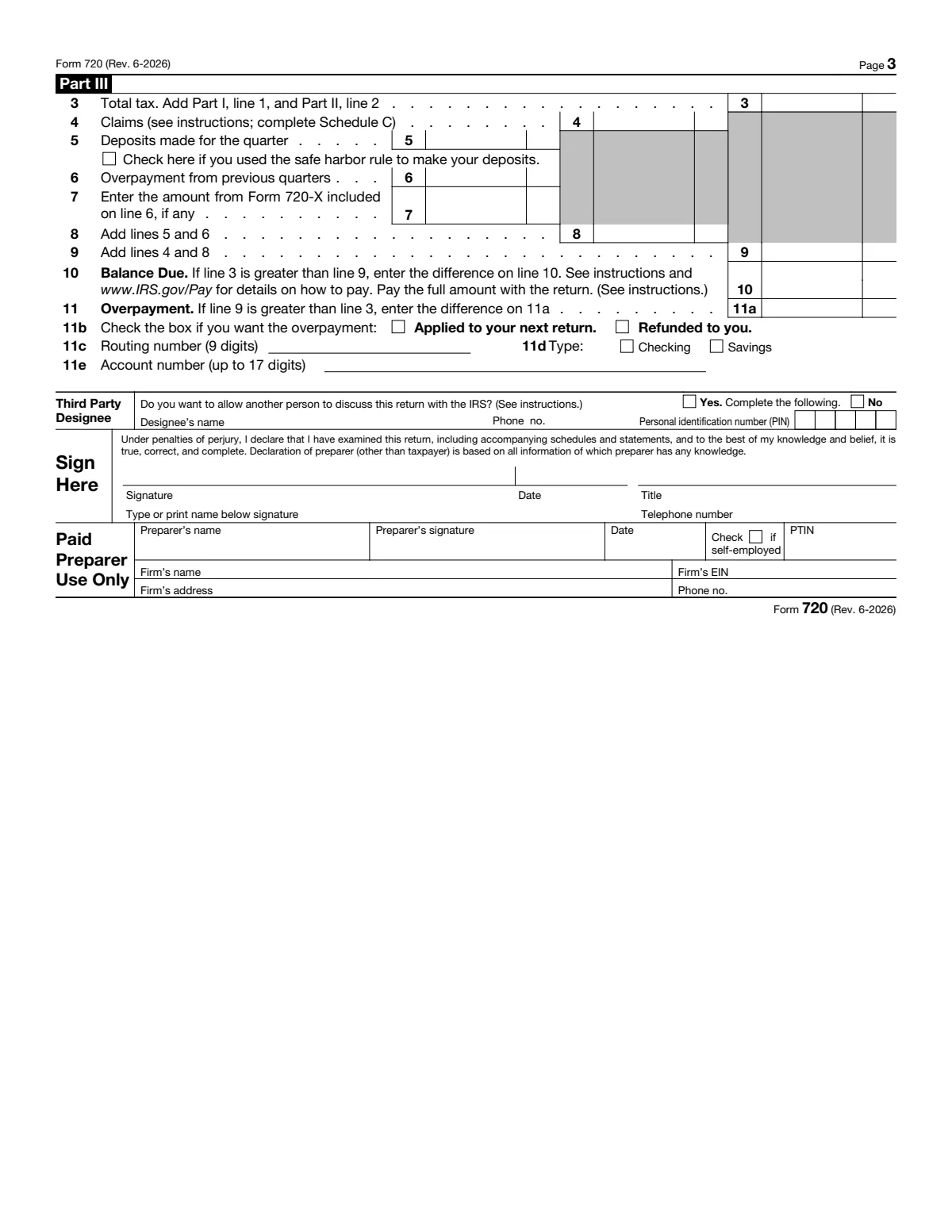
Part III nets the quarter: total tax, less claims, deposits and overpayments carried in (see also the instructions walk-through for Part III). It is also where the safe harbor box sits and where a refund is sent by direct deposit.
Form 720 (Rev. June 2026), Part III. A balance due made up of Part I taxes that should have been deposited can draw a failure to deposit penalty.
| Line | Label | What goes there |
|---|---|---|
| 3 | Total tax. Add Part I, line 1, and Part II, line 2 | The quarter's total liability. A filer with nothing to report still files: “if you have no tax to report, enter ‘None’ on Form 720, Part III, line 3; and sign and date the return.” |
| 4 | Claims (see instructions; complete Schedule C) | “Report on Form 720, line 4, the total claims from Schedule C, line 15.” Claims on line 4 may have to be added back to income: “You must include in gross income (income tax return) the amount from line 4 of Form 720, Part III” when the taxes were deducted earlier and the deduction cut the income tax. |
| 5 | Deposits made for the quarter | The total of the semimonthly deposits for this quarter's taxes, made by electronic funds transfer through EFTPS or another electronic method. Deposits are not mailed with the return: “don't mail your deposits directly to the IRS.” |
| 5-box | Check here if you used the safe harbor rule to make your deposits. | The look-back quarter safe harbor (1/6 of the net liability reported two quarters back, for each semimonthly period) works only if you check this box and pay the rest on time: “you must pay any underpayment for the current quarter by the due date of the return and check the box on line 5 of Form 720.” See how Schedule A ties to the deposits. |
| 6 | Overpayment from previous quarters | “Include on line 6 the amount from line 11 of your previous return that you applied to this return and the amount from Form 720-X, line 5b.” |
| 7 | Enter the amount from Form 720-X included on line 6, if any | The part of line 6 that came from an amended return. The IRS applies it after other debts: “If you owe other federal tax, interest, or penalty, the overpayment on line 11 and line 7 will first be applied to the unpaid amounts.” |
| 8 | Add lines 5 and 6 | Deposits plus overpayments carried in. |
| 9 | Add lines 4 and 8 | Everything that reduces the amount you owe: claims, deposits and prior overpayments. |
| 10 | Balance Due. If line 3 is greater than line 9, enter the difference on line 10. | “You don't have to pay if line 10 is under $1.00.” Pay by IRS Direct Pay, EFTPS, check or money order, or direct debit when e-filing. “If you pay by IRS Direct Pay, EFTPS, or direct debit, don't file Form 720-V.” A large balance here usually means missed deposits: “If you don't deposit as required and instead pay the taxes with Form 720, you may be subject to a penalty.” The voucher: Form 720-V. |
| 11a | Overpayment. If line 9 is greater than line 3, enter the difference on 11a | The amount you overpaid for the quarter. |
| 11b | Check the box if you want the overpayment: Applied to your next return. Refunded to you. | Applied to your next return carries it to line 6 of the next Form 720: “Include on line 6 of your next return the amount from line 11 you want to have applied to that return.” |
| 11c | Routing number (9 digits) | For a refund by direct deposit. The instructions say “To directly deposit the amount shown on line 11a to your checking or savings account, complete lines 11c through 11f.” The June 2026 form prints lines 11c, 11d and 11e only; there is no line 11f on the form. |
| 11d | Type: Checking / Savings | Check one box for the account type. |
| 11e | Account number (up to 17 digits) | The checking or savings account number for the direct deposit refund. |
| Designee | Third Party Designee: Designee's name, Phone no., Personal identification number (PIN) | Check Yes to let an employee, preparer or other person talk to the IRS about this return, and give their name, phone and any five-digit PIN they choose. “You aren't authorizing the designee to receive any refund check, bind you to anything (including additional tax liability), or otherwise represent you before the IRS.” “The authorization will automatically expire 1 year from the due date (without regard to extensions) for filing your Form 720.” Wider authority needs a power of attorney (Pub. 947). |
| Sign | Sign Here: Signature, Date, Title, Type or print name below signature, Telephone number | “Form 720 must be signed by a person authorized by the entity to sign this return.” Sign even when line 3 says None. |
| Preparer | Paid Preparer Use Only: Preparer's name, signature, date, PTIN, Firm's name, EIN, address, phone | Completed by a preparer who was paid and is not the filer's employee. The preparer enters a PTIN; “you can't use the EIN of the tax preparation firm in place of your PTIN.” |
Schedule A: Excise Tax Liability
Schedule A records the net Part I liability for each half month of the quarter, so the IRS can compare it with the deposits. “Don't complete Schedule A for Part II taxes or for a one-time filing of the gas guzzler tax.” The boxes are short here; the full walk-through, with the September rule and a quarter of deposit dates worked out, is on the Form 720 Schedule A page.
| Box | Label | What goes there |
|---|---|---|
| SA-A | Boxes A to F (line 1(a), Record of Net Tax Liability) | The net liability for each half month of the quarter, regular method. “Complete Schedule A to record net tax liabilities for Form 720, Part I, taxes for each semimonthly period in a quarter even if your net liability is under $2,500.” Every box, step by step, is on the Schedule A page. |
| SA-B | Box B | First month, 16th to last day. |
| SA-C | Box C | Second month, 1st to 15th day. |
| SA-D | Box D | Second month, 16th to last day. |
| SA-E | Box E | Third month, 1st to 15th day. |
| SA-F | Box F | Third month, 16th to last day. In the third quarter, only Sept. 27 to 30 goes here. |
| SA-G | Special rule for September (box G) | Third quarter only: the liability for Sept. 16 to 26, the period with its own deposit due Sept. 29. |
| SA-1b | (b) Net liability for regular method taxes | Add boxes A to G. |
| SA-M | Boxes M to R (line 2(a), Record of Taxes Considered as Collected) | Communications and air taxes deposited under the alternative method, by the half month in which they are considered collected (billings move two half months later). |
| SA-N | Box N | First month, 16th to last day. |
| SA-O | Box O | Second month, 1st to 15th day. |
| SA-P | Box P | Second month, 16th to last day. |
| SA-Q | Box Q | Third month, 1st to 15th day. |
| SA-R | Box R | Third month, 16th to last day. |
| SA-S | Special rule for September (box S) | Fourth quarter return only: tax billed Sept. 1 to 11. |
| SA-2b | (b) Alternative method taxes | Add boxes M to S. |
Schedule T: two-party exchanges
Schedule T is an information schedule for fuel registrants that swap inventory inside a terminal. It moves no money: it reports gallons so the IRS can match them with the terminal operator's Form 720-TO.
| Row | Label | What goes there |
|---|---|---|
| T-diesel-in | Diesel fuel, gallons received in a two-party exchange within a terminal, included on Form 720, IRS No. 60(a) | Report gallons “Received in a two-party exchange within a terminal” (these are also in your tax lines). In a two-party exchange, “the receiving person, not the delivering person, is liable for the tax imposed on the removal of taxable fuel from the terminal at the terminal rack.” Both sides must be registered, the terminal operator must treat the receiver as the remover on Form 720-TO, and “The transaction is the subject of a written contract.” |
| T-diesel-out | Diesel fuel, gallons delivered in a two-party exchange within a terminal | Gallons you, the delivering person, transferred in a two-party exchange that the receiver then removed across the rack. “Enter all gallons of fuel received or delivered in a two-party exchange within a terminal for the applicable fuel.” They are not taxed to you, so they appear only here. |
| T-kero-in | Kerosene, gallons received in a two-party exchange within a terminal, included on Form 720, IRS No. 35(a), 69, 77, or 111 | Gallons received in a two-party exchange; the same gallons are in the tax line named on the form. Also on IRS No. 35(a), 69, 77 or 111. |
| T-kero-out | Kerosene, gallons delivered in a two-party exchange within a terminal | Gallons delivered in a two-party exchange and removed by the receiving person. Not taxed to you. |
| T-gas-in | Gasoline, gallons received in a two-party exchange within a terminal, included on Form 720, IRS No. 62(a) | Gallons received in a two-party exchange; the same gallons are in the tax line named on the form. Also on IRS No. 62(a). |
| T-gas-out | Gasoline, gallons delivered in a two-party exchange within a terminal | Gallons delivered in a two-party exchange and removed by the receiving person. Not taxed to you. |
| T-avgas-in | Aviation gasoline, gallons received in a two-party exchange within a terminal, included on Form 720, IRS No. 14 | Gallons received in a two-party exchange; the same gallons are in the tax line named on the form. Also on IRS No. 14. |
| T-avgas-out | Aviation gasoline, gallons delivered in a two-party exchange within a terminal | Gallons delivered in a two-party exchange and removed by the receiving person. Not taxed to you. |
Schedule C: claims
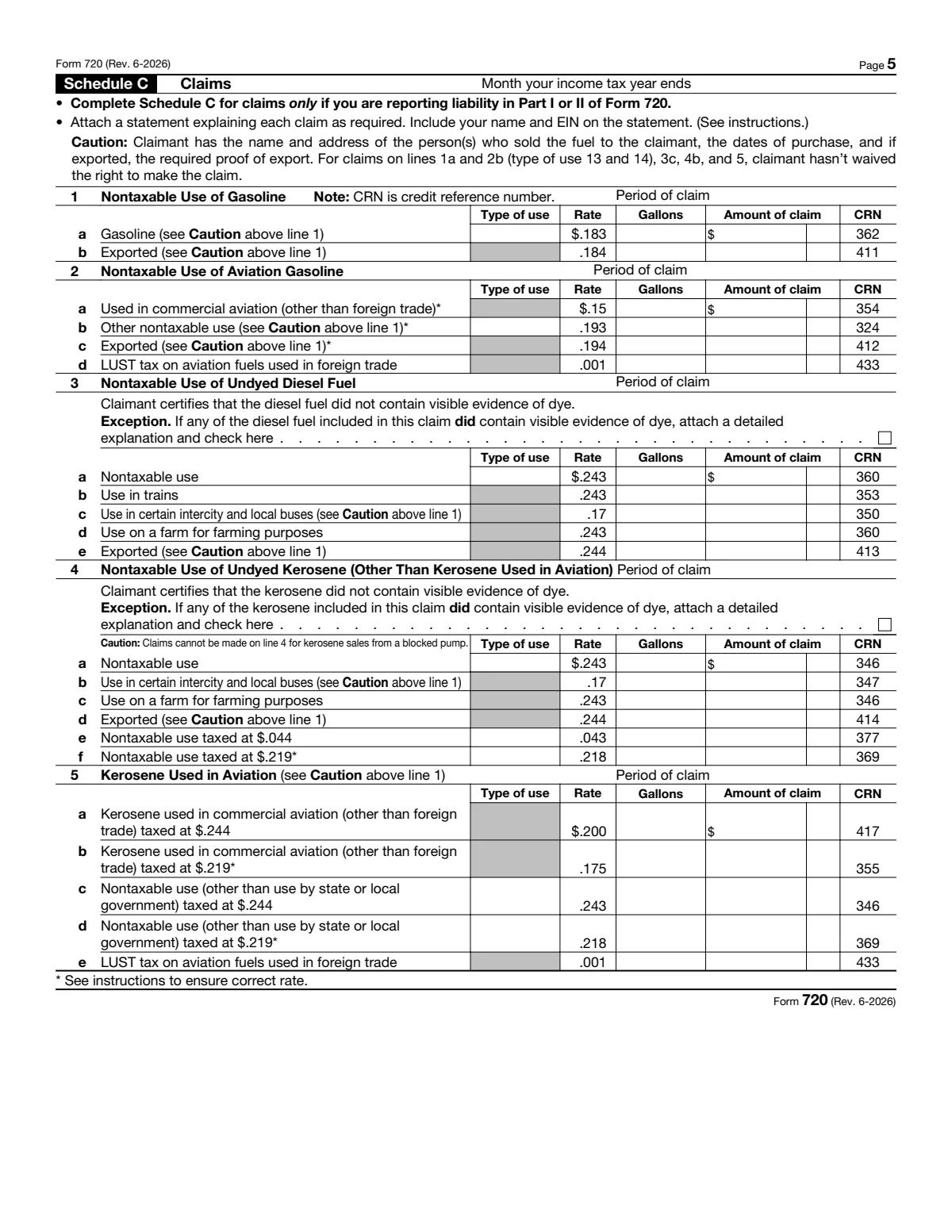
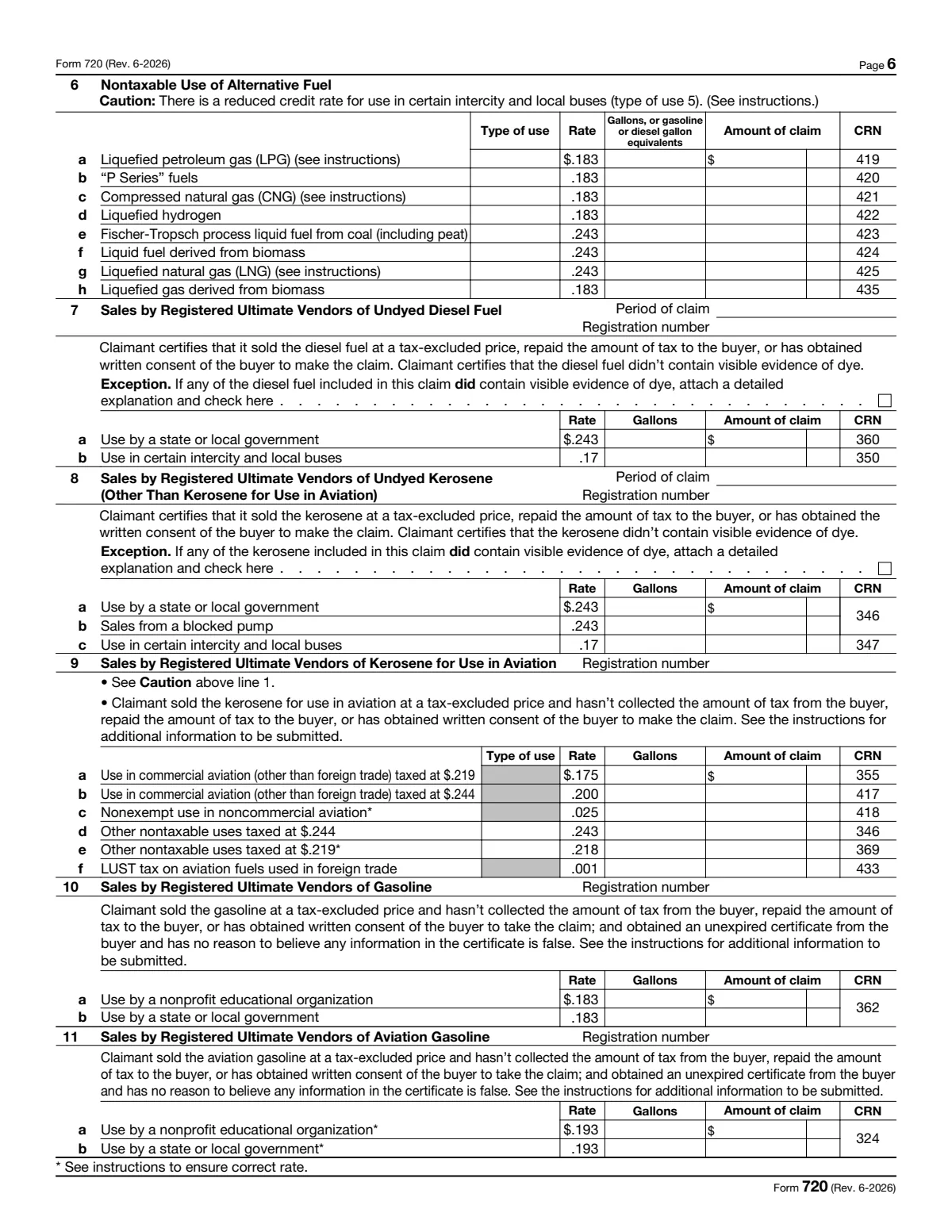
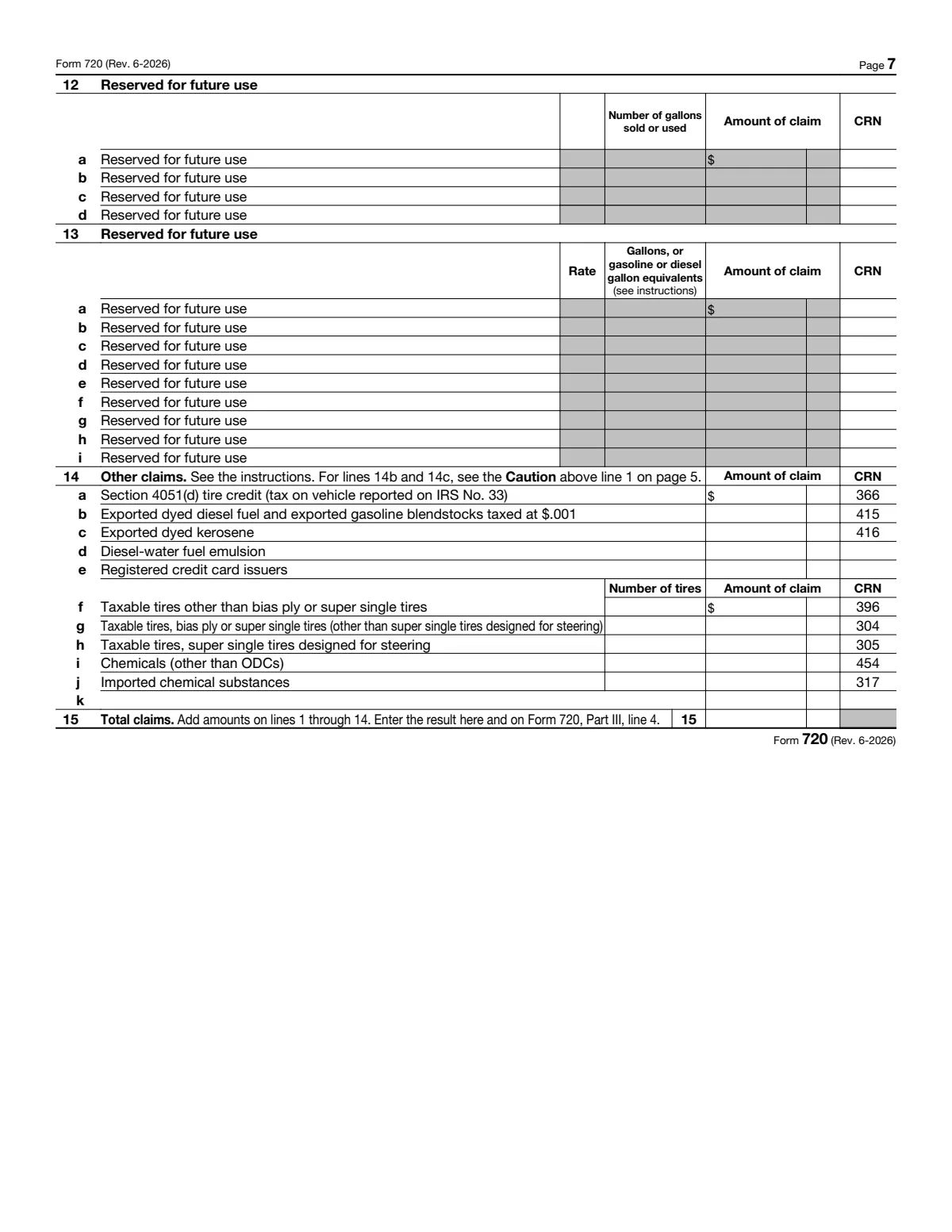
Schedule C takes credits for tax paid on fuel and articles that ended up in an exempt use or sale, against this quarter's tax. The instructions walk-through for Schedule C sets out when to use it instead of Form 8849 or Form 4136. “Complete Schedule C for claims only if you are reporting liability in Part I or II of Form 720.” It is not the place for amounts you will claim on Form 8849 or Form 4136, for changes to earlier quarters (Form 720-X), or for the fractional aircraft surtax refund. Each claim line has a credit reference number (CRN), printed on the form, and most fuel lines a type of use from the table below.
The fuel claims on lines 1 to 6 and 14b to 14d share four rules: “The amount of the claim must be at least $750” (quarters of the same income tax year can be combined), the claim is filed in the quarter after the last quarter it covers, “Only one claim may be filed for any quarter.” and “The ultimate purchaser is the only person eligible to make the claim.” Lines 7 to 11 are ultimate vendor claims, with lower minimums ($200 or $100) and a registration number from Form 637. Claims that miss these rules wait for the annual claim on Form 4136.
| Type of use | Description |
|---|---|
| 1 | On a farm for farming purposes |
| 2 | Off-highway business use |
| 3 | Export |
| 4 | In a boat engaged in commercial fishing |
| 5 | In certain intercity and local buses |
| 6 | In a qualified local bus |
| 7 | In a bus transporting students and employees of schools |
| 8 | For diesel and kerosene (other than kerosene used in aviation) used other than as a fuel in the propulsion engine of a train or diesel-powered highway vehicle |
| 9 | In foreign trade |
| 10 | Certain helicopter and fixed-wing aircraft uses |
| 11 | Exclusive use by a qualified blood collector organization |
| 12 | In a highway vehicle owned by the United States that isn't used on a highway |
| 13 | Exclusive use by a nonprofit educational organization |
| 14 | Exclusive use by a state, a political subdivision of a state, or the District of Columbia |
| 15 | In an aircraft or a vehicle owned by an aircraft museum |
| 16 | In military aircraft |
Type of use 2 is the instructions' “Off-highway business use (for business use other than in a highway vehicle registered or required to be registered for highway use) (other than use in mobile machinery)”. The rates and CRNs in the rows below are read from the June 2026 form itself; the starred rates are ones the form says to check in the instructions.
| Line | Label | What goes there |
|---|---|---|
| C-month | Month your income tax year ends | Your income tax year's last month, as MM (12 for a calendar year). The claim timing rules run off it: “Your claim will be disallowed if you don't follow the required procedures or don't provide all the required information.” |
| C-1 | Line 1: Nontaxable Use of Gasoline, period of claim | Enter the period of claim for the gallons on line 1. “The gasoline must have been used during the period of claim for type of use 2, 4, 5, 7, or 12.” “Type of use 2 doesn't include any personal use or use in a motorboat.” |
| C-1a | Gasoline (see Caution above line 1) | Claim rate printed on the form: $.183. CRN 362. Type of use 2, 4, 5, 7 or 12 (no personal use, no motorboats). A $750 minimum per claim across lines 1 to 6 and 14b to 14d, one claim per quarter, by the ultimate purchaser. |
| C-1b | Exported (see Caution above line 1) | Claim rate printed on the form: .184. CRN 411. Exported gasoline (and gasoline blendstocks taxed at the full rate). Keep proof of export. |
| C-2 | Line 2: Nontaxable Use of Aviation Gasoline | For line 2b, “the aviation gasoline must have been used during the period of claim for type of use 9, 10, or 16.” Line 2d is a further LUST claim for foreign trade. |
| C-2a | Used in commercial aviation (other than foreign trade)* | Claim rate printed on the form: $.15. CRN 354. Aviation gasoline used in commercial aviation other than foreign trade. A $750 minimum per claim across lines 1 to 6 and 14b to 14d, one claim per quarter, by the ultimate purchaser. |
| C-2b | Other nontaxable use (see Caution above line 1)* | Claim rate printed on the form: .193. CRN 324. Type of use 9, 10 or 16. A $750 minimum per claim across lines 1 to 6 and 14b to 14d, one claim per quarter, by the ultimate purchaser. |
| C-2c | Exported (see Caution above line 1)* | Claim rate printed on the form: .194. CRN 412. Exported aviation gasoline. Keep proof of export. |
| C-2d | LUST tax on aviation fuels used in foreign trade | Claim rate printed on the form: .001. CRN 433. Type of use 9 (foreign trade), claimed in addition to line 2b. |
| C-3 | Line 3: Nontaxable Use of Undyed Diesel Fuel | Claimant certifies the diesel had no visible dye; if some did, attach an explanation and check the box. “Ultimate purchasers use line 3d to make claims for diesel used on a farm for farming purposes.” For line 3a the uses are type 2, 6, 7, 8 or 12; “Type of use 8 includes use as heating oil and use in a motorboat.” |
| C-3a | Nontaxable use | Claim rate printed on the form: $.243. CRN 360. Type of use 2, 6, 7, 8 or 12. A $750 minimum per claim across lines 1 to 6 and 14b to 14d, one claim per quarter, by the ultimate purchaser. |
| C-3b | Use in trains | Claim rate printed on the form: .243. CRN 353. Undyed diesel used in trains. |
| C-3c | Use in certain intercity and local buses (see Caution above line 1) | Claim rate printed on the form: .17. CRN 350. Type of use 5, at the bus rate. |
| C-3d | Use on a farm for farming purposes | Claim rate printed on the form: .243. CRN 360. Ultimate purchasers' farm claims go here, not on 3a. |
| C-3e | Exported (see Caution above line 1) | Claim rate printed on the form: .244. CRN 413. Exported undyed diesel. Keep proof of export. |
| C-4 | Line 4: Nontaxable Use of Undyed Kerosene | The same no-dye certification for kerosene. The same uses as line 3 for line 4a. “Claims cannot be made on line 4 for kerosene sales from a blocked pump.” Lines 4e and 4f are for type of use 2. |
| C-4a | Nontaxable use | Claim rate printed on the form: $.243. CRN 346. Type of use 2, 6, 7, 8 or 12. Not for blocked pump sales. A $750 minimum per claim across lines 1 to 6 and 14b to 14d, one claim per quarter, by the ultimate purchaser. |
| C-4b | Use in certain intercity and local buses (see Caution above line 1) | Claim rate printed on the form: .17. CRN 347. Type of use 5, at the bus rate. |
| C-4c | Use on a farm for farming purposes | Claim rate printed on the form: .243. CRN 346. Kerosene used on a farm for farming purposes. |
| C-4d | Exported (see Caution above line 1) | Claim rate printed on the form: .244. CRN 414. Exported undyed kerosene. Keep proof of export. |
| C-4e | Nontaxable use taxed at $.044 | Claim rate printed on the form: .043. CRN 377. Type of use 2, for kerosene taxed at the commercial aviation rate. |
| C-4f | Nontaxable use taxed at $.219* | Claim rate printed on the form: .218. CRN 369. Type of use 2, for kerosene taxed at the noncommercial aviation rate. |
| C-5 | Line 5: Kerosene Used in Aviation | “For lines 5a and 5b, the ultimate purchaser of kerosene used in commercial aviation (other than foreign trade) is eligible to make this claim.” Lines 5c and 5d are for noncommercial aviation uses (type 1, 9, 10, 11, 13, 15 or 16). |
| C-5a | Kerosene used in commercial aviation (other than foreign trade) taxed at $.244 | Claim rate printed on the form: $.200. CRN 417. Ultimate purchaser, commercial aviation other than foreign trade. |
| C-5b | Kerosene used in commercial aviation (other than foreign trade) taxed at $.219* | Claim rate printed on the form: .175. CRN 355. Ultimate purchaser, commercial aviation other than foreign trade. |
| C-5c | Nontaxable use (other than use by state or local government) taxed at $.244 | Claim rate printed on the form: .243. CRN 346. Type of use 1, 9, 10, 11, 13, 15 or 16. |
| C-5d | Nontaxable use (other than use by state or local government) taxed at $.219* | Claim rate printed on the form: .218. CRN 369. Type of use 1, 9, 10, 11, 13, 15 or 16. |
| C-5e | LUST tax on aviation fuels used in foreign trade | Claim rate printed on the form: .001. CRN 433. Type of use 9 (foreign trade), in addition to lines 5c and 5d. |
| C-6 | Line 6: Nontaxable Use of Alternative Fuel | “The ultimate purchaser of the taxed alternative fuel is the only person eligible to make this claim.” For buses (type of use 5), “Enter ‘Bus’ in the space to the left of the ‘Type of use’ column.” and use the lower bus rate from the instructions' table. |
| C-6a | Liquefied petroleum gas (LPG) (see instructions) | Claim rate printed on the form: $.183. CRN 419. Ultimate purchaser; type of use 1, 2, 4, 5, 6, 7, 11, 13, 14 or 15. Per gasoline gallon equivalent. |
| C-6b | "P Series" fuels | Claim rate printed on the form: .183. CRN 420. Ultimate purchaser; same types of use as line 6a. |
| C-6c | Compressed natural gas (CNG) (see instructions) | Claim rate printed on the form: .183. CRN 421. Ultimate purchaser; per gasoline gallon equivalent of CNG. |
| C-6d | Liquefied hydrogen | Claim rate printed on the form: .183. CRN 422. Ultimate purchaser; same types of use as line 6a. |
| C-6e | Fischer-Tropsch process liquid fuel from coal (including peat) | Claim rate printed on the form: .243. CRN 423. Ultimate purchaser; same types of use as line 6a. |
| C-6f | Liquid fuel derived from biomass | Claim rate printed on the form: .243. CRN 424. Ultimate purchaser; same types of use as line 6a. |
| C-6g | Liquefied natural gas (LNG) (see instructions) | Claim rate printed on the form: .243. CRN 425. Ultimate purchaser; per diesel gallon equivalent of LNG. |
| C-6h | Liquefied gas derived from biomass | Claim rate printed on the form: .183. CRN 435. Ultimate purchaser; same types of use as line 6a. |
| C-7 | Line 7: Registered ultimate vendors of undyed diesel | Vendor claims on lines 7 to 11 need an IRS registration: “If you aren't registered, use Form 637 to apply for a registration number.” (Form 637). For line 7a, attach a sheet with “the name and TIN of each governmental unit to whom the diesel was sold and the number of gallons sold to each.” |
| C-7a | Use by a state or local government | Claim rate printed on the form: $.243. CRN 360. Registered ultimate vendor claim; enter the registration number. UV registrant, buyer's certificate (Model Certificate P), $200 minimum. |
| C-7b | Use in certain intercity and local buses | Claim rate printed on the form: .17. CRN 350. Registered ultimate vendor claim; enter the registration number. UB registrant, buyer's waiver (Model Waiver N), $200 minimum. |
| C-8 | Line 8: Registered ultimate vendors of undyed kerosene | Line 8a is for sales to a state or local government (attach the same list of buyers as line 7a); line 8b for sales from a blocked pump, backed by a statement of the date, buyer and gallons; line 8c for buses with the buyer's waiver. The minimum is $100, and amounts on lines 8 and 9 may be combined to reach it. |
| C-8a | Use by a state or local government | Claim rate printed on the form: $.243. CRN 346. Registered ultimate vendor claim; enter the registration number. UV or UP registrant, Model Certificate P, $100 minimum. |
| C-8b | Sales from a blocked pump | Claim rate printed on the form: .243. CRN 346. Registered ultimate vendor claim; enter the registration number. Sales from a blocked pump, $100 minimum. |
| C-8c | Use in certain intercity and local buses | Claim rate printed on the form: .17. CRN 347. Registered ultimate vendor claim; enter the registration number. UB registrant, Model Waiver N, $100 minimum. |
| C-9 | Line 9: Registered ultimate vendors of kerosene for aviation | Lines 9a and 9b need the buyer's unexpired waiver for commercial aviation; line 9c needs the ultimate purchaser's certificate; lines 9d to 9f need a waiver for nontaxable noncommercial uses (or Model Certificate P for a government buyer). |
| C-9a | Use in commercial aviation (other than foreign trade) taxed at $.219 | Claim rate printed on the form: $.175. CRN 355. Registered ultimate vendor claim; enter the registration number. UA registrant, buyer's waiver (Model Waiver L). |
| C-9b | Use in commercial aviation (other than foreign trade) taxed at $.244 | Claim rate printed on the form: .200. CRN 417. Registered ultimate vendor claim; enter the registration number. UA registrant, Model Waiver L. |
| C-9c | Nonexempt use in noncommercial aviation* | Claim rate printed on the form: .025. CRN 418. Registered ultimate vendor claim; enter the registration number. UA registrant, buyer's certificate (Model Certificate Q). |
| C-9d | Other nontaxable uses taxed at $.244 | Claim rate printed on the form: .243. CRN 346. Registered ultimate vendor claim; enter the registration number. Type of use 1, 9, 10, 11, 13, 14, 15 or 16. |
| C-9e | Other nontaxable uses taxed at $.219* | Claim rate printed on the form: .218. CRN 369. Registered ultimate vendor claim; enter the registration number. Same types of use as line 9d. |
| C-9f | LUST tax on aviation fuels used in foreign trade | Claim rate printed on the form: .001. CRN 433. Registered ultimate vendor claim; enter the registration number. Type of use 9, in addition to lines 9d and 9e. |
| C-10 | Line 10: Registered ultimate vendors of gasoline | “The registered ultimate vendor of the gasoline or aviation gasoline is eligible to make a claim on lines 10 and 11 if the buyer waives their right to make the claim by providing the registered ultimate vendor with an unexpired certificate.” |
| C-10a | Use by a nonprofit educational organization | Claim rate printed on the form: $.183. CRN 362. Registered ultimate vendor claim; enter the registration number. UV registrant, Model Certificate M, $200 minimum. |
| C-10b | Use by a state or local government | Claim rate printed on the form: .183. CRN 362. Registered ultimate vendor claim; enter the registration number. Same rules as line 10a. |
| C-11 | Line 11: Registered ultimate vendors of aviation gasoline | The same rules as line 10, for aviation gasoline. Attach a sheet listing each nonprofit educational organization or governmental buyer, its TIN and the gallons. |
| C-11a | Use by a nonprofit educational organization* | Claim rate printed on the form: $.193. CRN 324. Registered ultimate vendor claim; enter the registration number. UV registrant, Model Certificate M, $200 minimum. |
| C-11b | Use by a state or local government* | Claim rate printed on the form: .193. CRN 324. Registered ultimate vendor claim; enter the registration number. Same rules as line 11a. |
| C-12 | Line 12: Reserved for future use | All sub-lines read Reserved for future use on the June 2026 form. The lines that used to be here (fuel mixture and alternative fuel credits) ended: Pub. 510 says those credits “expired for fuels sold or used after December 31, 2024.” The SAF mixture credit ended too, for any sale or use “for any period after September 30, 2025.” See fuel excise tax. |
| C-13 | Line 13: Reserved for future use | All sub-lines read Reserved for future use on the June 2026 form. The lines that used to be here (fuel mixture and alternative fuel credits) ended: Pub. 510 says those credits “expired for fuels sold or used after December 31, 2024.” The SAF mixture credit ended too, for any sale or use “for any period after September 30, 2025.” See fuel excise tax. |
| C-14 | Line 14: Other claims | Lines 14f to 14h: “Generally, the claim must be filed within 3 years from the time the return was filed or 2 years from the time the tax was paid, whichever is later.” Line 14e: “The registered credit card issuer is the only person eligible to make this claim if the credit card issuer:” is registered, holds the buyer's certificate and has repaid or will repay the vendor. |
| C-14a | Section 4051(d) tire credit (tax on vehicle reported on IRS No. 33) | CRN 366. The tax on tires sold on a vehicle reported on IRS No. 33. |
| C-14b | Exported dyed diesel fuel and exported gasoline blendstocks taxed at $.001 | CRN 415. Exported dyed diesel and blendstocks taxed at $.001 a gallon. A $750 minimum per claim across lines 1 to 6 and 14b to 14d, one claim per quarter, by the ultimate purchaser. |
| C-14c | Exported dyed kerosene | CRN 416. Exported dyed kerosene. A $750 minimum per claim across lines 1 to 6 and 14b to 14d, one claim per quarter, by the ultimate purchaser. |
| C-14d | Diesel-water fuel emulsion | Enter the CRN and rate from the instructions. A $750 minimum per claim across lines 1 to 6 and 14b to 14d, one claim per quarter, by the ultimate purchaser. |
| C-14e | Registered credit card issuers | Registered credit card issuers; enter the registration number and the CRN. |
| C-14f | Taxable tires other than bias ply or super single tires | CRN 396. Tire credit: number of tires and amount. |
| C-14g | Taxable tires, bias ply or super single tires (other than super single tires designed for steering) | CRN 304. Tire credit: number of tires and amount. |
| C-14h | Taxable tires, super single tires designed for steering | CRN 305. Tire credit: number of tires and amount. |
| C-14i | Chemicals (other than ODCs) | CRN 454. Chemicals (other than ODCs): claim with a detailed statement. |
| C-14j | Imported chemical substances | CRN 317. Imported chemical substances: claim with a detailed statement. |
| C-14k | (blank line for another claim) | A blank line for another claim: write it in with its CRN. |
| C-15 | Total claims. Add amounts on lines 1 through 14. Enter the result here and on Form 720, Part III, line 4. | The total of every Amount of claim column. The same figure goes on Part III, line 4. |
Rules that trip filers up
- Paying Part I taxes with the return. Unless the quarter's Part I net liability is $2,500 or less, Part I taxes are deposited semimonthly. “You must deposit all depository taxes (such as excise tax, employment tax, or corporate income tax) by electronic funds transfer.” “For EFTPS deposits to be on time, you must initiate the transaction at least 1 day before the date the deposit is due (before 8:00 p.m. Eastern time).”
- Leaving Schedule A blank. Any Part I liability needs Schedule A, even below $2,500. Without it the IRS cannot match deposits to periods; its penalty manual says that if a requested Schedule A is not received, “compute and assess an averaged penalty.”
- Fixing a past quarter on this quarter's form. “If you have adjustments to liabilities reported for prior quarters, see Form 720-X, Amended Quarterly Federal Excise Tax Return.” See Form 720-X.
- Using last year's rate. The air transportation amounts (IRS Nos. 26 and 27), arrow shafts (IRS No. 106) and the PCORI fee change every year, and the expired oil spill lines (former IRS Nos. 18 and 21) now read Reserved. The rates in each row above carry their period.
- The PCORI fee on the wrong quarter. It goes on the second-quarter return only, due July 31; a quarterly filer leaves line 133 blank in the other quarters.
- A disregarded entity filing under its owner. Excise returns, registrations and claims use the entity's own EIN.
- Penalties. Late filing, late payment and late deposits each carry a penalty; see Form 720 penalties. For abatement steps, our sister site covers first-time abatement, with one difference for this return: the minimum late filing penalty does not reach it, because “The minimum penalty applies only to income tax returns. It does not apply to employment tax, excise tax, gift tax, or estate tax returns.”
How it connects
- The return as a whole: the Form 720 guide, the Form 720 instructions walk-through, due dates and deposits, Form 720-V, Form 720-X and penalties.
- Every IRS No. with its rate and page: the IRS No. lookup. Deposit dates for any quarter: the Form 720 calendar. Closing a quarter: the Form 720 quarter checklist.
- The taxes behind the busiest lines: fuel excise tax, the PCORI fee, the Superfund taxes, the air transportation tax and the heavy truck retail tax.
- The schedule with its own page: Form 720 Schedule A. Forms that feed lines here: Form 6627, Form 6197, Form 7208; claims outside Schedule C: Form 8849.
Questions filers ask
Do I have to file Form 720 if I owe nothing this quarter?
Yes, if you filed for an earlier quarter and have not filed a final return. Enter zero on the lines you normally use, write None on Part III, line 3, and sign. If you will owe no excise taxes in future quarters, check the Final return box.
Where do I report the PCORI fee on Form 720?
On the line for IRS No. 133 in Part II of the second-quarter return, due July 31. Enter the average lives covered in column (a) on the line that matches the plan year's end, apply the column (b) rate, and put the combined fee in the Tax column. Do not file the other quarters if PCORI is your only tax.
What is the difference between Part I and Part II?
Part I taxes are deposited semimonthly and recorded on Schedule A (unless the quarter's Part I net liability is $2,500 or less). Part II taxes are paid with the return and are not on Schedule A.
Can I e-file Form 720?
Yes. E-filing is optional and goes through a provider in the IRS e-file program for excise taxes. Paper returns go to the IRS in Ogden, UT 84201-0009.
How do I correct a Form 720 I already filed?
File Form 720-X for that quarter. Do not put adjustments on the current Form 720. Changes to Schedule C claims are generally not made on Form 720-X, except the section 4051(d) tire credit.
What does the asterisk next to some lines mean?
The form's footnote says to see the instructions to ensure the correct rate. On the June 2026 form it marks IRS Nos. 53, 26, 28, 27 and 14 and several Schedule C claim rates. For IRS No. 53, use $0.18 a barrel for 2026 (Form 6627 instructions and the statute), not the $0.27 in Rev. Proc. 2025-32.
Sources
- Form 720, Quarterly Federal Excise Tax Return (Rev. June 2026), PDF
- Instructions for Form 720 (Rev. June 2026)
- About Form 720
- Form 6627, Environmental Taxes (Rev. January 2026)
- Frequently asked questions, Form 720 e-file
- 26 CFR part 40, Excise tax procedural regulations
- IRM 20.1.4, Failure to Deposit Penalty
- IRM 20.1.2, Failure to File/Failure to Pay Penalties