- Who files
- The shipper paying the air freight charge
- When
- At or before paying the carrier
- Filed with
- The air carrier, not the IRS
- Form revision
- Rev. August 2021
- Pages
- 1, plus instructions
At a glance
Form 1363 is a one-page certificate a shipper gives an air carrier so the carrier does not charge the federal tax on air freight for a shipment on its way out of the country. “File Form 1363 with the carrier to suspend the liability for the section 4271 6.25% tax on transportation of property by air.” It is never sent to the IRS. The tax it suspends is IRS No. 28 on Form 720, explained on the air transportation tax page.
- Who files. The shipper or other person who pays the air freight charge and on whom the tax is imposed.
- When. With the carrier at or before payment of the charge; for a blanket certificate, on or before the first charge it covers.
- Where. With the air carrier, not the IRS. Blanket permission requests go by letter to IRS Mail Stop 5701G, Cincinnati, OH 45999.
- Form revision. Form 1363 (Rev. August 2021); the second page holds the instructions. Current as of November 2026.
- Records. Shipper and carrier each keep their papers for at least 3 years after the last day of the month of the shipment (for a blanket certificate, of the final shipment it covers).
The export exemption it proves
The tax on air freight reaches only transportation that begins and ends in the United States. The statute's definition of taxable transportation leaves out, “under regulations prescribed by the Secretary, transportation of property in the course of exportation (including shipment to a possession of the United States) by continuous movement, and in due course so exported.” (IRC 4272(b)(2)). A flight that itself leaves the country is outside the tax without any certificate: “The tax does not apply to amounts paid for transportation entirely by air which begins in the United States and ends outside the United States” (26 CFR 49.4271-1(c))26 CFR 49.4271-1Code of Federal Regulations, eCFR. Form 1363 is for the domestic air leg of a longer export trip.
The regulation gives the classic case: the tax does not apply “to air transportation from Chicago to New York if the property is in the course of exportation, by continuous movement, by boat from New York to Europe and in due course is so exported.” And it names the evidence: “Continuous movement in the course of exportation shall be evidenced by (a) the execution of the Export Exemption Certificate, Form 1363, and (b) proof that exportation has actually occurred.” Publication 510 says the same in its list of cargo exemptions, which also covers cropdusting, aerial firefighting and some helicopter and air ambulance uses.
Tap a box once for its note, again to jump to the line. Zoom in to read the small print.
Every box
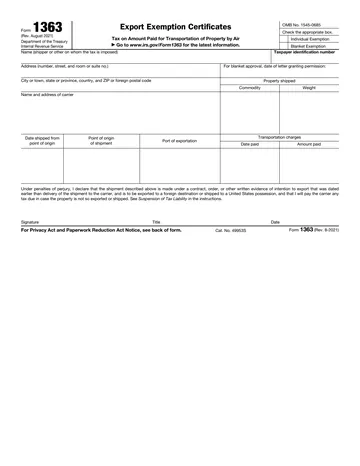
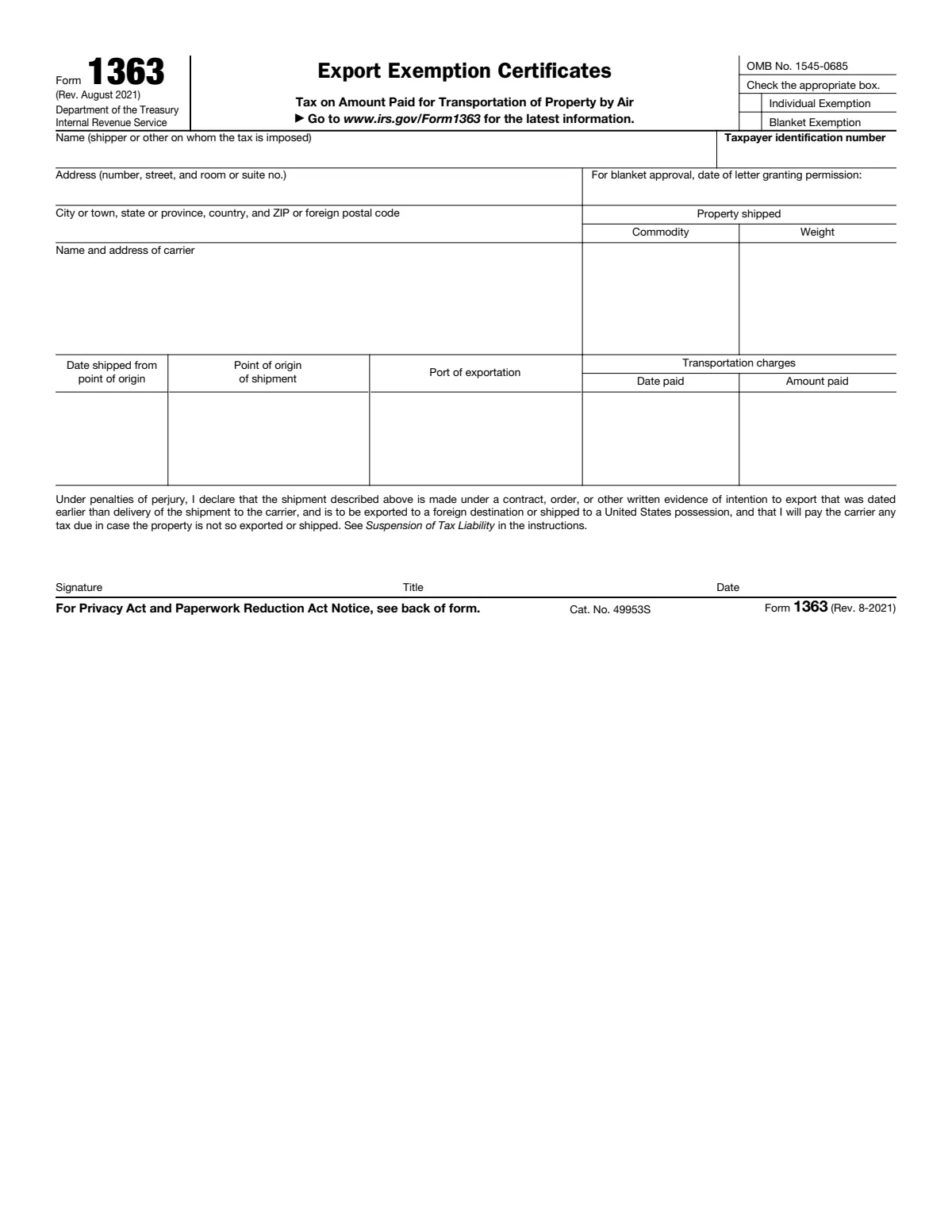
The form has no numbered lines: a box for the kind of certificate, the payer's identity, the carrier, the property and the shipment, the freight charge, and a declaration. Each box is in the table below in the order it appears.
| Box | Label | What goes there |
|---|---|---|
| Type | Check the appropriate box. | “Check the appropriate box on the form to show if this is a blanket exemption or individual shipment exemption.” A blanket certificate needs the IRS's permission first (see the date box). |
| Name | Name (shipper or other on whom the tax is imposed) | The shipper or other person paying the carrier. The 6.25% tax is on the person paying for the transportation; the carrier collects it, so the certificate comes from the payer. |
| TIN | Taxpayer identification number | The payer's EIN (or SSN for an individual); the privacy notice says section 6109 requires it. |
| Address | Address (number, street, and room or suite no.) | The payer's street address. |
| Blanket-date | For blanket approval, date of letter granting permission: | Ask for blanket permission by letter to “Department of the Treasury Internal Revenue Service Mail Stop 5701G Cincinnati, OH 45999”. “Permission to use the blanket exemption, if granted, will remain in effect until withdrawn.” |
| City | City or town, state or province, country, and ZIP or foreign postal code | City, state or province, country and ZIP or foreign postal code. |
| Carrier | Name and address of carrier | The air carrier for hire that you pay. “If permission is granted, you should complete a separate blanket certificate, for each air carrier accepting export shipments.” |
| Commodity | Commodity | “The description of property to be exported should be brief. In the case of a blanket exemption, a general description is sufficient.” |
| Weight | Weight | The weight of the property shipped. A blanket certificate may leave the per-shipment details to the shipping papers. |
| Date-shipped | Date shipped from | The date the property left its point of origin. The suspension of the tax runs “for a period of 6 months starting from the date the property is shipped from point of origin.” |
| Origin | Point of origin | The U.S. point where the shipment starts, for example an inland city flown to a port or gateway. |
| Port | Port of exportation | The port from which the property is exported, often by ship after the domestic air leg; the regulation's example is air from Chicago to New York, then boat to Europe. |
| Date-paid | Date paid | The date you paid the carrier. File the certificate with the carrier at or before payment (for a blanket certificate, on or before the first covered charge). |
| Amount-paid | Amount paid | The amount paid for the air transportation, the base of the IRS No. 28 tax. |
| Declaration | Under penalties of perjury, I declare that the shipment described above is made under a contract, order, or other written evidence of intention to export that was dated | The declaration says the shipment is made under written evidence of intent to export dated before delivery to the carrier, and that you will pay the carrier any tax due if the property is not exported or shipped to a possession. |
| Sign | Signature | Give the signed original to the carrier and keep a copy: “Don't file this form with this office. Instead, give the original to the carrier and keep a copy for your records.” |
The six-month window and proof of export
The certificate does not end the tax; it holds it off. “Form 1363 as an individual or blanket exemption suspends the liability for payment of the tax for a period of 6 months starting from the date the property is shipped from point of origin.” If the proof does not reach the carrier in time, “the temporary suspension of the liability for the payment of tax ends. The carrier should then collect the tax from you or the person who paid the transportation charge.” Proof that arrives after the carrier has collected still counts: a credit or refund is available under section 6415(a).
Form 1363 (Rev. August 2021), Suspension of Tax Liability; 26 CFR 49.4271-1(d)26 CFR 49.4271-1Code of Federal Regulations, eCFR.
Proof of exportation may be a copy of the export bill of lading, a memorandum from the vessel's captain, a customs official or the foreign consignee, or a shipper's export declaration. Instead of the documents, the payer may give the carrier a statement that it holds them, which must certify the property was exported, identify the evidence, name the foreign destination or possession, and give the address where the evidence can be inspected. A payer that is not the actual exporter gets the same statement from whoever holds the documents (26 CFR 49.4271-1(d)(4))26 CFR 49.4271-1Code of Federal Regulations, eCFR. “You don't have to consecutively number your exemption certificate(s). However, you must provide proof of exportation to the carrier along with Form 1363.”
Blanket certificates
A regular exporter can use one certificate per carrier instead of one per payment. “You may use a blanket exemption on Form 1363 if you expect to make payments for numerous export shipments over an indefinite period of time. You must demonstrate that it isn't practical to complete a separate Form 1363 for each payment.” Ask by letter to the IRS at Mail Stop 5701G in Cincinnati; the 2021 revision changed that address. Once permission is granted, check Blanket Exemption, enter the date of the IRS letter, describe the property in general terms, and file one certificate with each carrier. “If you have been granted a blanket exemption, it applies to all products exported even though different products may be exported later.” (The regulation still says the request goes to the "district director"; the form's current address is the one to use.)
The carrier's side
For the carrier, Form 1363 is the document that lets it leave a charge off its Form 720. IRS No. 28 is reported by the person receiving payment for the transportation; the carrier keeps the certificate with the record of the charge for the same three years. The tax is “a tax equal to 6.25 percent of the amount so paid for such transportation”, and it applies “only to amounts paid to a person engaged in the business of transporting property by air for hire.” (IRC 4271(a)). See the IRS No. 28 row on the Form 720 form page.
Rules that trip filers up
- Sending it to the IRS. The certificate goes to the carrier; only a blanket permission request goes to the IRS.
- No written export intent before delivery. The declaration requires a contract, order or other written evidence of intent to export, dated before the shipment was delivered to the carrier.
- Letting the six months pass. Without proof in six months the carrier collects the tax, and you then have to claim it back.
- One blanket certificate for several carriers. Each carrier needs its own blanket certificate.
- Using it for an all-air international flight. A flight that begins in the U.S. and ends abroad is outside the tax on its own; the certificate is for the domestic leg of a continuous export movement.
How it connects
- The tax: the air transportation excise tax hub, with the cargo section and the Sept. 30, 2028 end date of the current rates.
- The carrier's return: Form 720 line by line (IRS No. 28) and due dates and deposits.
- Refunds after the tax is collected: Form 8849 and excise tax refund claims.
Questions filers ask
Who signs Form 1363, the shipper or the airline?
The shipper or other person who pays the air freight charge, because the tax is imposed on that payment. The carrier receives and keeps the certificate.
Do I send Form 1363 to the IRS?
No. Give the original to the carrier and keep a copy. Only a request for blanket permission goes to the IRS, by letter to Mail Stop 5701G, Cincinnati, OH 45999.
How long do I have to prove the export?
Six months from the date the property is shipped from its point of origin. After that the carrier collects the tax, and later proof supports a credit or refund under section 6415(a).
What counts as proof of export?
A copy of the export bill of lading, a memorandum from the vessel's captain, a customs official or the foreign consignee, or a shipper's export declaration, or a statement that you hold that evidence.
Is air freight that flies straight from the U.S. to another country taxed?
No. The tax applies only to transportation that begins and ends in the United States. Form 1363 is for the domestic air leg of an export that continues by another route.