- At a glance
- The form, with hotspots
- Name, quarter and EIN
- Part I: petroleum
- Part II: chemicals
- Part III: imported chemical substances
- Part IV: ozone-depleting chemicals
- Part V: imported products
- Part VI: floor stocks
- Deposits, filing and the IRS check
- Rules that trip filers up
- How it connects
- Questions filers ask
- Sources
- Who files
- Refiners, importers, chemical makers, ODC holders
- Filed with
- Form 720, every quarter with a tax
- Petroleum rate
- $0.18 a barrel (2026)
- Form revision
- Rev. January 2026
- Pages
- 2
At a glance
Form 6627, Environmental Taxes, is where the Superfund and ozone-depleting chemical taxes are figured before they go on Form 720. The instructions say to use it “to figure the environmental taxes on domestic crude oil and imported petroleum products, chemicals (other than ozone-depleting chemicals (ODCs)), imported chemical substances, ODCs, imported products that used ODCs as materials in the manufacture or production of the product, and the floor stocks tax on ODCs.” Each of its six parts ends in a total that goes on one Form 720 line.
- Who files. Refinery operators and users of crude oil before a refinery, importers of petroleum products, makers and importers of the 42 taxable chemicals, importers of listed chemical substances, makers and importers of ODCs and of products made with them, and anyone holding ODCs on January 1 above the floor stocks thresholds. Most filers use one part.
- When. With every quarterly Form 720 that reports one of these taxes: April 30, July 31, October 31 and January 31. Part VI only with the second-quarter return.
- How. Attached to Form 720. “Attach Form 6627 to Form 720. The tax rates for these taxes are shown on Form 6627.”
- Form revision. Form 6627 (Rev. January 2026), with the Instructions for Form 6627 (Rev. January 2026). “Filers should use the Form 6627 (January 2026) revision to report their tax.” Two pages: Parts I and II on page 1, Parts III to VI on page 2.
Tap a box once for its note, again to jump to the line. Zoom in to read the small print.
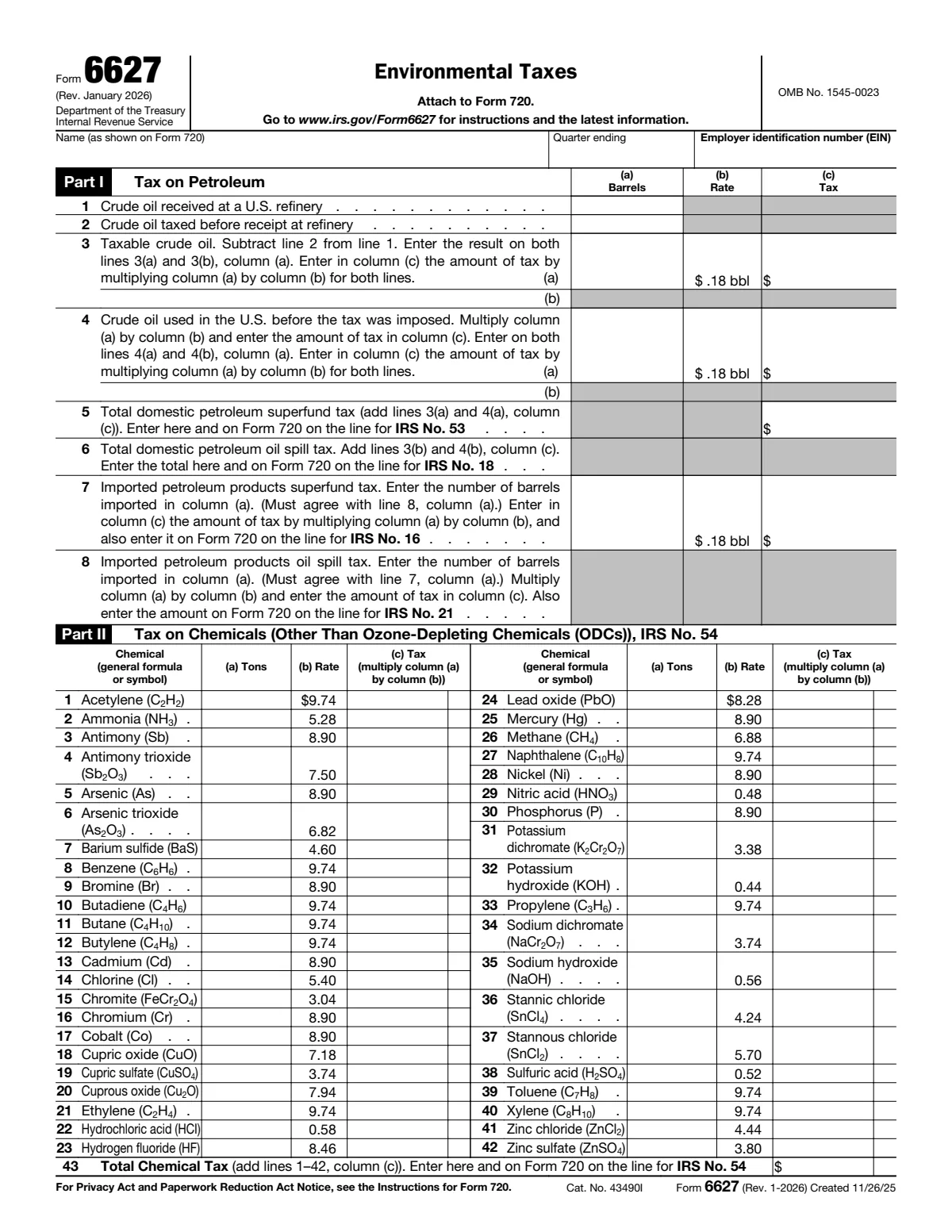
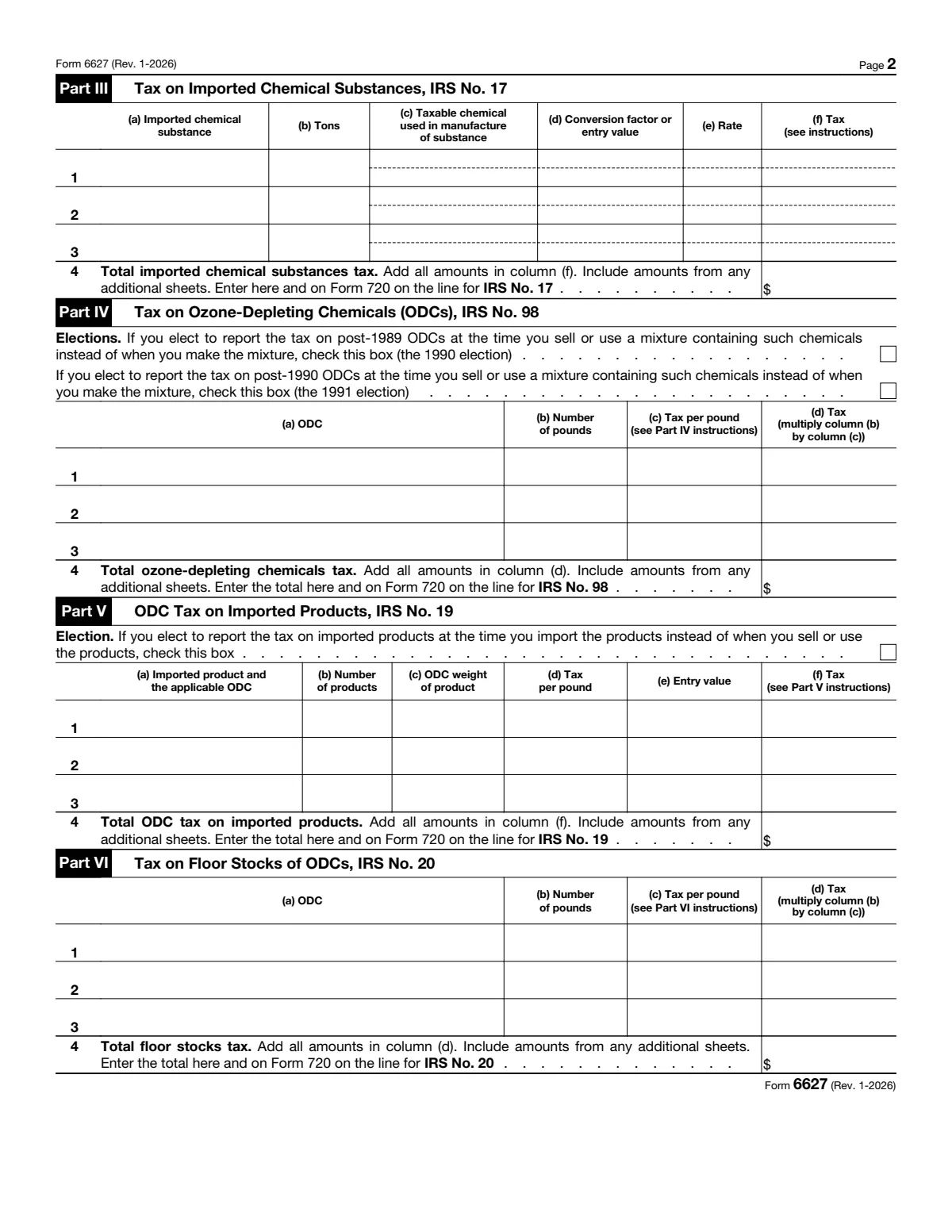
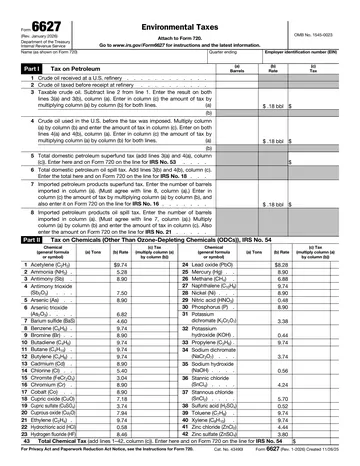
Form 6627 (Rev. January 2026), the line for each total. Part I to V taxes are Form 720 Part I taxes (deposited); IRS No. 20 is in Part II.
Name, quarter and EIN
| Line | Label | What goes there |
|---|---|---|
| 6627-name | Name (as shown on Form 720) | Form 6627 is an attachment, so it carries the same name, quarter and EIN as its Form 720. “Attach the continuation sheet with Form 6627 to Form 720, Quarterly Federal Excise Tax Return.” |
| 6627-quarter | Quarter ending | The quarter of the Form 720. The floor stocks tax in Part VI goes on the second-quarter form only. |
| 6627-ein | Employer identification number (EIN) | The EIN on the Form 720. |
Part I: petroleum
Part I carries the petroleum tax under IRC 4611IRC 4611Internal Revenue Code, Cornell LII on two Form 720 lines: IRS No. 53 for domestic crude and IRS No. 16 for imported products, both at $0.18 per barrel (2026). The form still prints the oil spill lines (3(b), 4(b), 6 and 8), which ended with 2025: the statute says “The Oil Spill Liability Trust Fund financing rate shall not apply after December 31, 2025.” Rev. Proc. 2025-32 printed a combined $0.27 a barrel for 2026, which adds that expired 9 cents; the form, its instructions and the statute give $0.18, and the statute governs (the Superfund guide sets out both). Exported crude is outside the tax for now: “the section 4611 tax on exported crude oil currently doesn’t apply”, following AOD 2023-01.
| Line | Label | What goes there |
|---|---|---|
| I-1 | Crude oil received at a U.S. refinery | The refinery operator's barrels for the quarter. “Crude oil includes crude oil condensates and natural gasoline.” “The operator of the refinery is liable for the tax.” |
| I-2 | Crude oil taxed before receipt at refinery | Barrels on line 1 that were already taxed, so the tax is imposed once. For imported crude taxed at entry, the refinery “must establish that tax was previously imposed on the imported crude oil”, and the enterer gives it the documents on request. |
| I-3a | Taxable crude oil. Subtract line 2 from line 1 ... (a) $.18 bbl | Line 1 minus line 2 in column (a), times the printed $.18 in column (b); the tax goes in column (c). “For 2026, the petroleum Superfund tax rate is $0.18 per barrel.” Part barrels: “Multiply the resulting fraction by $0.18 per barrel petroleum Superfund tax rate.” |
| I-3b | Line 3(b), the oil spill rate | The form still says to enter the barrels on both 3(a) and 3(b), but the oil spill rate is gone: “The section 4611 tax on crude oil received (domestic petroleum oil spill tax), or petroleum products entered (imported petroleum oil spill tax) expired after December 31, 2025.” Leave 3(b) blank for 2026 quarters. |
| I-4a | Crude oil used in the U.S. before the tax was imposed ... (a) $.18 bbl | Domestic crude used before it reaches a refinery. “The user is liable for the tax.” “Crude oil used for extracting oil or natural gas on the premises where the crude oil is produced is not taxable.” |
| I-4b | Line 4(b), the oil spill rate | Blank for 2026, as line 3(b). |
| I-5 | Total domestic petroleum superfund tax (add lines 3(a) and 4(a), column (c)). Enter here and on Form 720 on the line for IRS No. 53 | The sum of column (c) on lines 3(a) and 4(a), carried to IRS No. 53. “For domestic crude oil, report the petroleum Superfund tax rate on IRS No. 53.” |
| I-6 | Total domestic petroleum oil spill tax. Add lines 3(b) and 4(b), column (c). | IRS No. 18. The Form 720 line now reads Reserved for future use. “Don't enter the expired taxes on the lines for IRS Nos. 18 and 21 unless Congress extends the taxes.” A Form 720-X for a 2025 quarter still uses it. |
| I-7 | Imported petroleum products superfund tax. Enter the number of barrels imported in column (a) ... also enter it on Form 720 on the line for IRS No. 16 | The enterer's barrels times $.18, carried to IRS No. 16. “Petroleum products include crude oil, refined and residual oil, and other liquid hydrocarbon refinery products.” The form says the barrels must agree with line 8, which is moot while line 8 is blank. |
| I-8 | Imported petroleum products oil spill tax. Enter the number of barrels imported ... on Form 720 on the line for IRS No. 21 | IRS No. 21, expired with IRS No. 18. Blank for 2026 quarters. |
Part II: chemicals
Part II lists the 42 taxable chemicals of IRC 4661(b)IRC 4661Internal Revenue Code, Cornell LII, alphabetically, with each rate printed in column (b). Enter the tons sold or used in column (a) and the tax in column (c); a ton is 2,000 pounds. The table below is read from the PDF line by line and each printed rate is checked against the statute's table when this page is built; all 42 agree. The chemical taxes run from July 1, 2022 through December 31, 2031. Exempt uses (fertilizer, fuel uses of methane and butane, export and the rest) are taken as tax-free sales or later claims, explained on the Superfund taxes page.
| Line | Label | What goes there |
|---|---|---|
| II-1 | Acetylene (rate $9.74) | Tons of acetylene the manufacturer, producer or importer sold or used this quarter, in column (a); column (c) is tons times the printed $9.74, which matches the IRC 4661(b)IRC 4661Internal Revenue Code, Cornell LII table. |
| II-2 | Ammonia (rate $5.28) | Tons of ammonia the manufacturer, producer or importer sold or used this quarter, in column (a); column (c) is tons times the printed $5.28, which matches the IRC 4661(b)IRC 4661Internal Revenue Code, Cornell LII table. No tax on ammonia that is a qualified fertilizer substance (IRC 4662(b)(2))IRC 4662Internal Revenue Code, Cornell LII. |
| II-3 | Antimony (rate $8.90) | Tons of antimony the manufacturer, producer or importer sold or used this quarter, in column (a); column (c) is tons times the printed $8.90, which matches the IRC 4661(b)IRC 4661Internal Revenue Code, Cornell LII table. |
| II-4 | Antimony trioxide (rate $7.50) | Tons of antimony trioxide the manufacturer, producer or importer sold or used this quarter, in column (a); column (c) is tons times the printed $7.50, which matches the IRC 4661(b)IRC 4661Internal Revenue Code, Cornell LII table. |
| II-5 | Arsenic (rate $8.90) | Tons of arsenic the manufacturer, producer or importer sold or used this quarter, in column (a); column (c) is tons times the printed $8.90, which matches the IRC 4661(b)IRC 4661Internal Revenue Code, Cornell LII table. |
| II-6 | Arsenic trioxide (rate $6.82) | Tons of arsenic trioxide the manufacturer, producer or importer sold or used this quarter, in column (a); column (c) is tons times the printed $6.82, which matches the IRC 4661(b)IRC 4661Internal Revenue Code, Cornell LII table. |
| II-7 | Barium sulfide (rate $4.60) | Tons of barium sulfide the manufacturer, producer or importer sold or used this quarter, in column (a); column (c) is tons times the printed $4.60, which matches the IRC 4661(b)IRC 4661Internal Revenue Code, Cornell LII table. |
| II-8 | Benzene (rate $9.74) | Tons of benzene the manufacturer, producer or importer sold or used this quarter, in column (a); column (c) is tons times the printed $9.74, which matches the IRC 4661(b)IRC 4661Internal Revenue Code, Cornell LII table. |
| II-9 | Bromine (rate $8.90) | Tons of bromine the manufacturer, producer or importer sold or used this quarter, in column (a); column (c) is tons times the printed $8.90, which matches the IRC 4661(b)IRC 4661Internal Revenue Code, Cornell LII table. |
| II-10 | Butadiene (rate $9.74) | Tons of butadiene the manufacturer, producer or importer sold or used this quarter, in column (a); column (c) is tons times the printed $9.74, which matches the IRC 4661(b)IRC 4661Internal Revenue Code, Cornell LII table. |
| II-11 | Butane (rate $9.74) | Tons of butane the manufacturer, producer or importer sold or used this quarter, in column (a); column (c) is tons times the printed $9.74, which matches the IRC 4661(b)IRC 4661Internal Revenue Code, Cornell LII table. “methane or butane shall be treated as a taxable chemical only if it is used otherwise than as a fuel or in the manufacture or production of any motor fuel, diesel fuel, aviation fuel, or jet fuel” (IRC 4662(b)(1))IRC 4662Internal Revenue Code, Cornell LII. |
| II-12 | Butylene (rate $9.74) | Tons of butylene the manufacturer, producer or importer sold or used this quarter, in column (a); column (c) is tons times the printed $9.74, which matches the IRC 4661(b)IRC 4661Internal Revenue Code, Cornell LII table. |
| II-13 | Cadmium (rate $8.90) | Tons of cadmium the manufacturer, producer or importer sold or used this quarter, in column (a); column (c) is tons times the printed $8.90, which matches the IRC 4661(b)IRC 4661Internal Revenue Code, Cornell LII table. |
| II-14 | Chlorine (rate $5.40) | Tons of chlorine the manufacturer, producer or importer sold or used this quarter, in column (a); column (c) is tons times the printed $5.40, which matches the IRC 4661(b)IRC 4661Internal Revenue Code, Cornell LII table. |
| II-15 | Chromite (rate $3.04) | Tons of chromite the manufacturer, producer or importer sold or used this quarter, in column (a); column (c) is tons times the printed $3.04, which matches the IRC 4661(b)IRC 4661Internal Revenue Code, Cornell LII table. |
| II-16 | Chromium (rate $8.90) | Tons of chromium the manufacturer, producer or importer sold or used this quarter, in column (a); column (c) is tons times the printed $8.90, which matches the IRC 4661(b)IRC 4661Internal Revenue Code, Cornell LII table. |
| II-17 | Cobalt (rate $8.90) | Tons of cobalt the manufacturer, producer or importer sold or used this quarter, in column (a); column (c) is tons times the printed $8.90, which matches the IRC 4661(b)IRC 4661Internal Revenue Code, Cornell LII table. |
| II-18 | Cupric oxide (rate $7.18) | Tons of cupric oxide the manufacturer, producer or importer sold or used this quarter, in column (a); column (c) is tons times the printed $7.18, which matches the IRC 4661(b)IRC 4661Internal Revenue Code, Cornell LII table. |
| II-19 | Cupric sulfate (rate $3.74) | Tons of cupric sulfate the manufacturer, producer or importer sold or used this quarter, in column (a); column (c) is tons times the printed $3.74, which matches the IRC 4661(b)IRC 4661Internal Revenue Code, Cornell LII table. |
| II-20 | Cuprous oxide (rate $7.94) | Tons of cuprous oxide the manufacturer, producer or importer sold or used this quarter, in column (a); column (c) is tons times the printed $7.94, which matches the IRC 4661(b)IRC 4661Internal Revenue Code, Cornell LII table. |
| II-21 | Ethylene (rate $9.74) | Tons of ethylene the manufacturer, producer or importer sold or used this quarter, in column (a); column (c) is tons times the printed $9.74, which matches the IRC 4661(b)IRC 4661Internal Revenue Code, Cornell LII table. |
| II-22 | Hydrochloric acid (rate $0.58) | Tons of hydrochloric acid the manufacturer, producer or importer sold or used this quarter, in column (a); column (c) is tons times the printed $0.58, which matches the IRC 4661(b)IRC 4661Internal Revenue Code, Cornell LII table. |
| II-23 | Hydrogen fluoride (rate $8.46) | Tons of hydrogen fluoride the manufacturer, producer or importer sold or used this quarter, in column (a); column (c) is tons times the printed $8.46, which matches the IRC 4661(b)IRC 4661Internal Revenue Code, Cornell LII table. |
| II-24 | Lead oxide (rate $8.28) | Tons of lead oxide the manufacturer, producer or importer sold or used this quarter, in column (a); column (c) is tons times the printed $8.28, which matches the IRC 4661(b)IRC 4661Internal Revenue Code, Cornell LII table. |
| II-25 | Mercury (rate $8.90) | Tons of mercury the manufacturer, producer or importer sold or used this quarter, in column (a); column (c) is tons times the printed $8.90, which matches the IRC 4661(b)IRC 4661Internal Revenue Code, Cornell LII table. |
| II-26 | Methane (rate $6.88) | Tons of methane the manufacturer, producer or importer sold or used this quarter, in column (a); column (c) is tons times the printed $6.88, which matches the IRC 4661(b)IRC 4661Internal Revenue Code, Cornell LII table. Methane is taxable only if used otherwise than as a fuel or to make a motor, diesel, aviation or jet fuel (IRC 4662(b)(1))IRC 4662Internal Revenue Code, Cornell LII; it is also exempt when used to make ammonia for fertilizer. |
| II-27 | Naphthalene (rate $9.74) | Tons of naphthalene the manufacturer, producer or importer sold or used this quarter, in column (a); column (c) is tons times the printed $9.74, which matches the IRC 4661(b)IRC 4661Internal Revenue Code, Cornell LII table. |
| II-28 | Nickel (rate $8.90) | Tons of nickel the manufacturer, producer or importer sold or used this quarter, in column (a); column (c) is tons times the printed $8.90, which matches the IRC 4661(b)IRC 4661Internal Revenue Code, Cornell LII table. |
| II-29 | Nitric acid (rate $0.48) | Tons of nitric acid the manufacturer, producer or importer sold or used this quarter, in column (a); column (c) is tons times the printed $0.48, which matches the IRC 4661(b)IRC 4661Internal Revenue Code, Cornell LII table. “In the case of nitric acid, sulfuric acid, ammonia, or methane used to produce ammonia which is a qualified fertilizer substance, no tax shall be imposed under section 4661(a).” (IRC 4662(b)(2))IRC 4662Internal Revenue Code, Cornell LII. |
| II-30 | Phosphorus (rate $8.90) | Tons of phosphorus the manufacturer, producer or importer sold or used this quarter, in column (a); column (c) is tons times the printed $8.90, which matches the IRC 4661(b)IRC 4661Internal Revenue Code, Cornell LII table. |
| II-31 | Potassium dichromate (rate $3.38) | Tons of potassium dichromate the manufacturer, producer or importer sold or used this quarter, in column (a); column (c) is tons times the printed $3.38, which matches the IRC 4661(b)IRC 4661Internal Revenue Code, Cornell LII table. |
| II-32 | Potassium hydroxide (rate $0.44) | Tons of potassium hydroxide the manufacturer, producer or importer sold or used this quarter, in column (a); column (c) is tons times the printed $0.44, which matches the IRC 4661(b)IRC 4661Internal Revenue Code, Cornell LII table. |
| II-33 | Propylene (rate $9.74) | Tons of propylene the manufacturer, producer or importer sold or used this quarter, in column (a); column (c) is tons times the printed $9.74, which matches the IRC 4661(b)IRC 4661Internal Revenue Code, Cornell LII table. |
| II-34 | Sodium dichromate (rate $3.74) | Tons of sodium dichromate the manufacturer, producer or importer sold or used this quarter, in column (a); column (c) is tons times the printed $3.74, which matches the IRC 4661(b)IRC 4661Internal Revenue Code, Cornell LII table. |
| II-35 | Sodium hydroxide (rate $0.56) | Tons of sodium hydroxide the manufacturer, producer or importer sold or used this quarter, in column (a); column (c) is tons times the printed $0.56, which matches the IRC 4661(b)IRC 4661Internal Revenue Code, Cornell LII table. |
| II-36 | Stannic chloride (rate $4.24) | Tons of stannic chloride the manufacturer, producer or importer sold or used this quarter, in column (a); column (c) is tons times the printed $4.24, which matches the IRC 4661(b)IRC 4661Internal Revenue Code, Cornell LII table. |
| II-37 | Stannous chloride (rate $5.70) | Tons of stannous chloride the manufacturer, producer or importer sold or used this quarter, in column (a); column (c) is tons times the printed $5.70, which matches the IRC 4661(b)IRC 4661Internal Revenue Code, Cornell LII table. |
| II-38 | Sulfuric acid (rate $0.52) | Tons of sulfuric acid the manufacturer, producer or importer sold or used this quarter, in column (a); column (c) is tons times the printed $0.52, which matches the IRC 4661(b)IRC 4661Internal Revenue Code, Cornell LII table. Also exempt when used for fertilizer, and when “produced solely as a byproduct of and on the same site as air pollution control equipment” (IRC 4662(b)(3))IRC 4662Internal Revenue Code, Cornell LII. |
| II-39 | Toluene (rate $9.74) | Tons of toluene the manufacturer, producer or importer sold or used this quarter, in column (a); column (c) is tons times the printed $9.74, which matches the IRC 4661(b)IRC 4661Internal Revenue Code, Cornell LII table. |
| II-40 | Xylene (rate $9.74) | Tons of xylene the manufacturer, producer or importer sold or used this quarter, in column (a); column (c) is tons times the printed $9.74, which matches the IRC 4661(b)IRC 4661Internal Revenue Code, Cornell LII table. |
| II-41 | Zinc chloride (rate $4.44) | Tons of zinc chloride the manufacturer, producer or importer sold or used this quarter, in column (a); column (c) is tons times the printed $4.44, which matches the IRC 4661(b)IRC 4661Internal Revenue Code, Cornell LII table. |
| II-42 | Zinc sulfate (rate $3.80) | Tons of zinc sulfate the manufacturer, producer or importer sold or used this quarter, in column (a); column (c) is tons times the printed $3.80, which matches the IRC 4661(b)IRC 4661Internal Revenue Code, Cornell LII table. |
| II-43 | Total Chemical Tax (add lines 1 to 42, column (c)). Enter here and on Form 720 on the line for IRS No. 54 | The Part II total, carried to IRS No. 54. “Enter here and on Form 720 on the line for IRS No. 54” |
Part III: imported chemical substances
Part III taxes imported substances made from the Part II chemicals. “The imported chemical substance tax is equal to the chemical tax that would have been imposed on the taxable chemicals (listed in Part II of Form 6627) used as materials in the manufacture of the substance if such substance had been manufactured in the United States.” Lines 1 to 3 hold one substance each (a continuation sheet in the same format holds more), and the columns give three methods, in order: your own conversion factors, the IRS rate, or 10% of the appraised entry value. The list grew by 60 substances on Jan. 1, 2026 and more on Oct. 1, 2026; the imported substances guide tracks it and explains which rate applies. In the instructions' table, 30 rows still show an asterisk instead of a rate (no IRS rate yet), so for those substances it is your own factors or 10% of entry value. The substance lookup shows how to figure your own rate from the conversion factors.
| Line | Label | What goes there |
|---|---|---|
| III-a | Column (a) Imported chemical substance | “Enter the imported chemical substance subject to tax.” Only substances on the IRS list are taxable; see the Superfund substance lookup. |
| III-b | Column (b) Tons | “Enter the number of tons of the substance imported and sold or used.” |
| III-c | Column (c) Taxable chemical used in manufacture of substance | Each Part II chemical used to make the substance, one per line. “If using an IRS-provided tax rate or a tax rate based on 10% of the appraised entry value of the substance, there’s no need to enter information in column (c).” |
| III-d | Column (d) Conversion factor or entry value | “Enter the conversion factor for each taxable chemical or the appraised entry value of the total amount of the substance.” |
| III-e | Column (e) Rate | The Part II rate for each chemical; or the IRS rate from the instructions' table; or 10% for the entry value method. |
| III-f | Column (f) Tax (see instructions) | “Multiply the number of tons in column (b) by the conversion factor in column (d) by the rate in column (e) for each taxable chemical listed.” With an IRS rate, tons times rate; with neither, entry value times 10%. |
| III-4 | Total imported chemical substances tax. Add all amounts in column (f). Enter here and on Form 720 on the line for IRS No. 17 | Carried to IRS No. 17, with any continuation sheets. |
Part IV: ozone-depleting chemicals
Part IV is the IRC 4681IRC 4681Internal Revenue Code, Cornell LII tax on ODCs sold or used by their manufacturer or importer. The instructions print the 2026 tax per pound for each ODC (column (c)), already multiplied by its ozone-depletion factor, and Part VI uses a second chart for the floor stocks tax. Both charts, read from the instructions:
| ODC | Part IV tax per pound, 2026 | Part VI floor stocks tax per pound, 2026 |
|---|---|---|
| CFC-11 | $19.3 | $0.45 |
| CFC-12 | $19.3 | $0.45 |
| CFC-113 | $15.44 | $0.36 |
| CFC-114 | $19.3 | $0.45 |
| CFC-115 | $11.58 | $0.27 |
| Halon-1211 | $57.9 | $1.35 |
| Halon-1301 | $193 | $4.50 |
| Halon-2402 | $115.8 | $2.70 |
| Carbon tetrachloride | $21.225 | $0.495 |
| Methyl chloroform | $1.925 | $0.045 |
| CFC-13, CFC-111, CFC-112, and CFC-211 through CFC-217 | $19.3 | $0.45 |
| Line | Label | What goes there |
|---|---|---|
| IV-1990 | Elections: post-1989 ODCs (the 1990 election) | Normally, making a mixture is a use of the ODC in it. “If this election is made, the tax on the post-1989 ODCs (listed earlier) contained in the mixture is imposed on the date of sale or use of the mixture.” “This election may be revoked only with the consent of the IRS.” |
| IV-1991 | Elections: post-1990 ODCs (the 1991 election) | The same choice for the post-1990 ODCs (carbon tetrachloride, methyl chloroform and the other CFCs in the chart). Check the second box to make it. |
| IV-a | Column (a) ODC | Each ozone-depleting chemical the manufacturer or importer sold or used. |
| IV-b | Column (b) Number of pounds | Pounds sold or used in the quarter. |
| IV-c | Column (c) Tax per pound (see Part IV instructions) | “Enter the tax per pound using the chart earlier.” The chart already includes the ozone-depletion factor: “Do not multiply the tax per pound by the ozone-depletion factor.” |
| IV-d | Column (d) Tax (multiply column (b) by column (c)) | Pounds times tax per pound. |
| IV-4 | Total ozone-depleting chemicals tax. Enter the total here and on Form 720 on the line for IRS No. 98 | Carried to IRS No. 98. The 2026 base rate is $19.30 times the ozone-depletion factor per pound (2026). |
Part V: imported products
Part V taxes products imported after ODCs were used to make them, if the product is on the IRS imported products table. The tax follows the ODC weight in the product, by the exact method or the table method, or falls back to 1% of entry value.
| Line | Label | What goes there |
|---|---|---|
| V-election | Election: tax imported products at the time you import them | “Generally, an imported taxable product is taxed when sold or used by the importer.” The election moves the tax to entry for all products held and later entered, and can be revoked only with IRS consent. |
| V-a | Column (a) Imported product and the applicable ODC | “Use additional lines if there is more than one ODC.” The product must be on the IRS imported products table (26 CFR 52.4682-3(f)(6))26 CFR 52.4682-3Code of Federal Regulations, eCFR. |
| V-b | Column (b) Number of products | The number of taxable products imported. |
| V-c | Column (c) ODC weight of product | Pounds of ODC in each product, by the exact method (your own supported weights) or the table method. Leave blank for the value method. |
| V-d | Column (d) Tax per pound | The Part IV chart rate. “If you are using the value method, enter 1% (0.01).” |
| V-e | Column (e) Entry value | The entry value of the products, for the value method only. |
| V-f | Column (f) Tax (see Part V instructions) | Products x ODC weight x tax per pound, or 1% x entry value. “If the weight can’t be determined under the exact method or table method (see below), the tax is 1% of the entry value of the product (value method).” |
| V-4 | Total ODC tax on imported products. Enter the total here and on Form 720 on the line for IRS No. 19 | Carried to IRS No. 19. |
Part VI: floor stocks
Part VI is the floor stocks tax on ODCs held on January 1 by anyone other than the maker or importer. The Code says “The taxes imposed by this subsection on January 1 of any calendar year shall be paid on or before June 30 of such year.” It is reported once a year, on the second-quarter Form 720, and is the one environmental tax in Form 720 Part II.
IRC 4682(h)IRC 4682Internal Revenue Code, Cornell LII; 26 CFR 40.6302(c)-1(e)(1)(iii); Instructions for Form 6627 (Rev. January 2026), Part VI.
| Line | Label | What goes there |
|---|---|---|
| VI-a | Column (a) ODC | Each ODC you held on January 1 for sale or for use in further manufacture, if you are not its manufacturer, producer or importer (IRC 4682(h))IRC 4682Internal Revenue Code, Cornell LII. |
| VI-b | Column (b) Number of pounds | Pounds held on January 1. You owe the tax only above the thresholds, for example “At least 400 pounds of ODCs, other than halons or methyl chloroform, subject to the floor stocks tax.” |
| VI-c | Column (c) Tax per pound (see Part VI instructions) | The floor stocks rate from the Part VI chart (much lower than the Part IV rate). “Enter the tax per pound using the chart above.” |
| VI-d | Column (d) Tax (multiply column (b) by column (c)) | Pounds times tax per pound. |
| VI-4 | Total floor stocks tax. Add all amounts in column (d). Enter the total here and on Form 720 on the line for IRS No. 20 | Carried to IRS No. 20 in Part II of Form 720. “Report the tax on Form 6627 and Form 720 for the second calendar quarter of 2026. Payment of the tax is due by June 30, 2026.” The Form 720 instructions point to the wrong part here; see below. |
Part VI, not Part IV. The Form 720 instructions (Rev. June 2026) tell you to enter “the amount from column (d) of Form 6627, Part IV, line 4,” on the line for IRS No. 20. On Form 6627 (Rev. January 2026), Part IV, line 4 is the ODC tax for IRS No. 98; the floor stocks total is “Part VI Tax on Floor Stocks of ODCs, IRS No. 20”, line 4. Use the Part VI, line 4 total for IRS No. 20, and the Part IV total for IRS No. 98. A floor stocks holder who copies the Part IV figure reports the wrong tax.
Deposits, filing and the IRS check
Every total in Parts I to V is a Form 720 Part I tax, deposited semimonthly through EFTPS unless the quarter's Part I net liability is $2,500 or less (26 CFR 40.6302(c)-1). The floor stocks tax is different: the regulation lists “Section 4682(h) (relating to floor stocks tax on ozone-depleting chemicals);” among the taxes with no deposit, while the Form 720 instructions say it “generally requires a single deposit”. Both put the payment by June 30, so paying by June 30 meets both. Two safe harbor limits matter here: a newly listed substance was not taxed in the look-back quarter, and after a rate increase the safe harbor must be figured “if the increased rate of tax had been in effect for the look-back quarter”. See due dates and deposits.
The IRS checks the attachment line by line. Its code and edit manual says “Form 6627, Environmental Taxes, must be attached.” when an environmental line has an entry, and “If the IRS Number(s) reported on Form 6627 and Form 720 do not agree, change Form 720 to agree with the IRS Number reported on Form 6627.” A Form 6627 that matches each Form 720 line avoids a letter. Corrections to an earlier quarter go on Form 720-X with a corrected Form 6627 computation.
Rules that trip filers up
- Using $0.27 a barrel for 2026. That figure adds the expired oil spill rate. Lines 3(a), 4(a) and 7 print $.18, and the statute ends the oil spill rate after 2025.
- Filling in lines 3(b), 4(b), 6 and 8. They are for 2025 and earlier quarters only. Form 720 now prints Reserved for future use on IRS Nos. 18 and 21.
- Taxing crude twice. Imported crude taxed at entry goes on line 2, with the enterer's documents to back it.
- Multiplying the ODC rate by the depletion factor. The charts already include it.
- Carrying Part IV to IRS No. 20. Use the Part VI total, as explained above.
- Using the IRS rate when you know the chemistry. The IRS rate applies only if you do not have enough information to determine the conversion factor; the importer may always figure its own.
- An old substance list. The Rev. January 2026 instructions do not show the October 2026 additions; check the IRS's Superfund page.
How it connects
- The taxes behind every part: the Superfund taxes guide, Form 6627 section, with petroleum, chemicals, imported substances and ODCs.
- Where the totals land: Form 720 line by line, IRS Nos. 53, 16, 54, 17, 98, 19 and 20.
- Deposits: Schedule A and due dates and deposits. Registration for tax-free chemical exchanges: Form 637, letter G.
Questions filers ask
What is Form 6627 used for?
To figure the environmental excise taxes: the petroleum Superfund tax, the tax on 42 chemicals, the tax on imported chemical substances, the ODC taxes and the ODC floor stocks tax. Each part's total goes on a Form 720 line, and Form 6627 is attached to Form 720.
What is the petroleum Superfund rate on Form 6627 for 2026?
$0.18 a barrel, printed on lines 3(a), 4(a) and 7. The oil spill rate on lines 3(b), 4(b), 6 and 8 expired after Dec. 31, 2025; leave those lines blank for 2026.
Where does the ODC floor stocks tax go on Form 720?
On IRS No. 20 in Part II of the second-quarter Form 720, from Form 6627, Part VI, line 4. The Form 720 instructions say Part IV, line 4, but on the January 2026 Form 6627 the floor stocks total is in Part VI. Pay it by June 30.
Do I have to list every chemical on Part II?
Only the chemicals you sold or used in the quarter. Enter the tons on that chemical's line; the rate is printed. Line 43 totals column (c) and goes on IRS No. 54.
How do I figure the tax on an imported chemical substance?
With your own conversion factors if you have the information; otherwise the IRS rate from the instructions' table or the IRS website; and if there is no IRS rate, 10% of the appraised entry value.
Is Form 6627 tax deposited?
Yes, for Parts I to V: they are Form 720 Part I taxes, deposited semimonthly unless the quarter's Part I net liability is $2,500 or less. The Part VI floor stocks tax is paid by June 30 and reported on the July 31 return.