- Who files
- The person assessed, or a representative with Form 2848
- When
- Usually after an IRS notice
- Filed with
- The notice address, or the service center for that return
- Form revision
- Rev. December 2024
- Pages
- 2
At a glance
Form 843 is the IRS's general claim form. “Use Form 843 to claim a refund or request an abatement of certain taxes, penalties, additions to tax, interest, and fees.” For a business that files Form 720, 730 or 2290 its job is narrow: it asks the IRS to remove or refund a penalty or interest, and it is the form for a refund of the dyed fuel penalty. It is not the form for excise tax you overpaid.
- Who files. The person the penalty, interest or tax was assessed against, or a representative with Form 2848 attached: “If your authorized representative files Form 843, the original or copy of Form 2848, Power of Attorney and Declaration of Representative, must be attached.”
- When. Usually after an IRS notice. “If you received an IRS notice notifying you of a change to an item on your tax return, or that you owe interest, a penalty, or addition to tax, follow the instructions on the notice. You may not have to file Form 843.”
- Where. In response to a notice, “the return address from which the notice was sent.” Otherwise, for penalties, the service center where the return for that tax is filed (see where to file).
- Form revision. Form 843 (Rev. December 2024), with the Instructions for Form 843 (Rev. December 2024): two pages, redesigned for the December 2024 revision. Current as of November 2026.
Form 843 or another form?
The instructions put the excise rule in two sentences: “Use Form 720-X, Amended Quarterly Federal Excise Tax Return, to make adjustments to liability reported on Forms 720 you have filed for previous quarters.” and “Use Form 8849 to claim a refund of excise taxes other than those resulting from adjustments to your reported liabilities.” Fuel used in a nontaxable use is claimed on Form 8849, Form 720 Schedule C or Form 4136. Form 843 is left with penalties, interest, the trust fund recovery penalty and the dyed fuel penalty. The Form 720 instructions agree: Schedule C is not for interest abatement under section 6404(e) or penalty abatement under section 6404(f); “Instead, use Form 843, Claim for Refund and Request for Abatement.”
Form 843 (Rev. December 2024) and its instructions, Do not use Form 843 when you must use a different tax form; Instructions for Form 720 (Rev. June 2026).
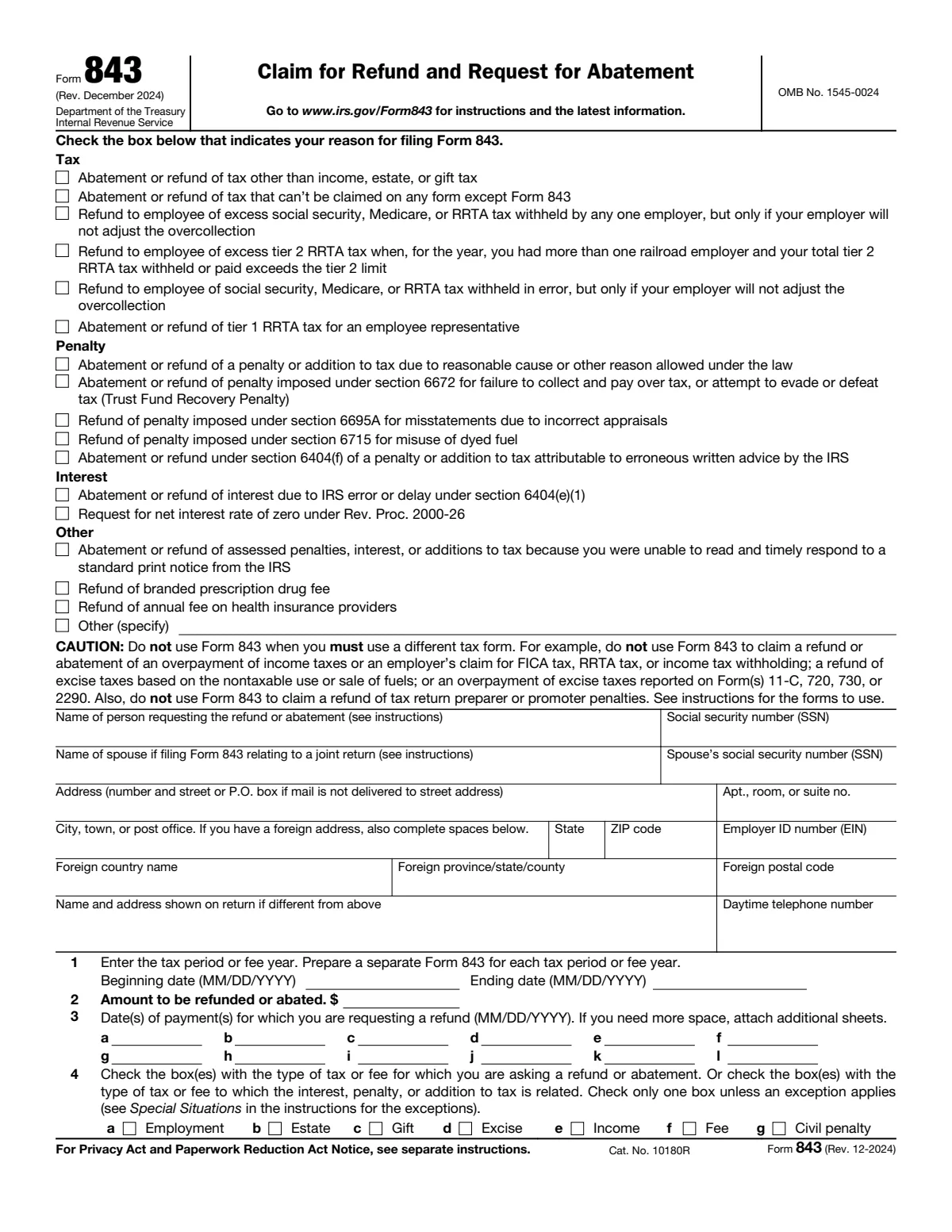
Tap a box once for its note, again to jump to the line. Zoom in to read the small print.
The reason boxes
The top of page 1 lists the reasons for filing in four groups: Tax, Penalty, Interest and Other. “Check the box at the top of your Form 843 that provides your reason for filing the form.” “Do not check more than one box.” For excise filers the boxes that matter are the penalty boxes (reasonable cause, section 6672 and section 6715) and, rarely, the interest box. The employee boxes are grouped into one hotspot because they never apply to excise taxes.
| Box | Label | What it is for |
|---|---|---|
| R-tax | Abatement or refund of tax other than income, estate, or gift tax | The general box for a tax that is not income, estate or gift tax. For excise filers it is narrower than it looks: the caution below the boxes sends an overpayment of tax reported on Form 720, 730, 2290 or 11-C, and any fuel use refund, to other forms. |
| R-only843 | Abatement or refund of tax that can’t be claimed on any form except Form 843 | For a tax with no claim form of its own. The instructions list the forms to use instead before you check it (see the caution row). |
| R-employee | Abatement or refund of tier 1 RRTA tax for an employee representative | Four boxes for employees: excess social security, Medicare or RRTA tax withheld by one employer, excess tier 2 RRTA, tax withheld in error, and tier 1 RRTA for an employee representative. They do not apply to excise taxes. |
| R-penalty | Abatement or refund of a penalty or addition to tax due to reasonable cause or other reason allowed under the law | The usual excise box: a failure to file, failure to pay or failure to deposit penalty on Form 720, or the erroneous claim penalty, abated for reasonable cause or another reason the law allows (including administrative waivers such as first-time abatement, if the IRS grants it). |
| R-6672 | Abatement or refund of penalty imposed under section 6672 for failure to collect and pay over tax, or attempt to evade or defeat | The trust fund recovery penalty also reaches excise taxes a business collects from customers. To claim a refund you first pay a divisible part: “One transaction if the claim relates to a TFRP for excise taxes.” |
| R-6695A | Refund of penalty imposed under section 6695A for misstatements due to incorrect appraisals | For appraisers. Not used for excise taxes. |
| R-6715 | Refund of penalty imposed under section 6715 for misuse of dyed fuel | The Form 720 instructions send this claim here, not to Schedule C: “Also, use Form 843 to request a refund of the penalty under section 6715 for misuse of dyed fuel.” The penalty is per act, the greater of $1,000 or “$10 for each gallon of the dyed fuel involved.” |
| R-6404f | Abatement or refund under section 6404(f) of a penalty or addition to tax attributable to erroneous written advice by the IRS | “The IRS can abate or refund any portion of a penalty or addition to tax caused by erroneous advice furnished to you in writing by an officer or employee of the IRS acting in their official capacity.” Attach your written request, the IRS's written advice and any report of adjustments; check box b on line 7. |
| R-6404e | Abatement or refund of interest due to IRS error or delay under section 6404(e)(1) | Interest caused by an unreasonable IRS error or delay in a managerial or ministerial act, but only on taxes that need a notice of deficiency. The instructions say “Interest related to employment taxes or other excise taxes cannot be abated.” |
| R-netzero | Request for net interest rate of zero under Rev. Proc. 2000-26 | Asks the IRS to net interest where you owed and were owed tax for the same period (section 6621(d)). Leave line 1 blank and do not complete lines 3, 6 and 7; more than one box may be checked on lines 4 and 5. |
| R-visual | standard print notice from the IRS | Penalties, interest or additions to tax assessed because you could not read a standard print notice. Explain the disability and the notice on line 8. |
| R-bpd | Refund of branded prescription drug fee | Refund of the branded prescription drug fee; enter the fee year on line 1 and check line 4f and line 5m. |
| R-hip | Refund of annual fee on health insurance providers | Refund of the annual fee on health insurance providers. |
| R-other | Other (specify) | If your reason is not listed, check this box and state it. Do not use it to get around the form you are supposed to use; the instructions say not to check it when another tax form is required. |
| Caution | CAUTION: Do not use Form 843 when you must use a different tax form. | The printed caution lists “a refund of excise taxes based on the nontaxable use or sale of fuels; or an overpayment of excise taxes reported on Form(s) 11-C, 720, 730, or 2290”. Those go on Form 720-X, Form 8849 or Form 4136 (see the table above the form). |
Name, number and address
Use the name and EIN of the account the IRS assessed. For a Form 720 penalty that is the EIN on the Form 720; single-owner disregarded entities and QSubs file excise returns under their own EIN, so their penalties sit on that EIN too (see the Form 720 form page).
| Line | Label | What goes there |
|---|---|---|
| Name | Name of person requesting the refund or abatement | For a business, its legal name as on the Form 720 or the notice. A representative signs only with Form 2848 attached. |
| SSN | Social security number (SSN) | “An entity, such as a partnership or corporation, filing this form will include the entity's Employer Identification Number (EIN) instead of an SSN or ITIN.” |
| Spouse | Name of spouse if filing Form 843 relating to a joint return | Only for a claim tied to a joint income tax return. Excise claims leave it blank. |
| Spouse-SSN | Spouse’s social security number (SSN) | Joint return claims only. |
| Address | Address (number and street or P.O. box if mail is not delivered to street address) | A P.O. box only if mail is not delivered to the street. If you move later, tell the IRS on Form 8822-B (businesses). |
| City | City, town, or post office. If you have a foreign address, also complete spaces below. | City, state and ZIP code. A foreign address puts only the city here. |
| EIN | Employer ID number (EIN) | The EIN of the entity whose account carries the penalty or tax: for a Form 720 penalty, the EIN on that return. |
| Foreign | Foreign country name | Do not abbreviate the country name; follow the country's practice for the postal code and province. |
| Name-return | Name and address shown on return if different from above | Helps the IRS find the account when the name or address has changed since the return or notice. |
| Phone | Daytime telephone number | A daytime number for questions about the claim. |
Lines 1 to 8 and signing
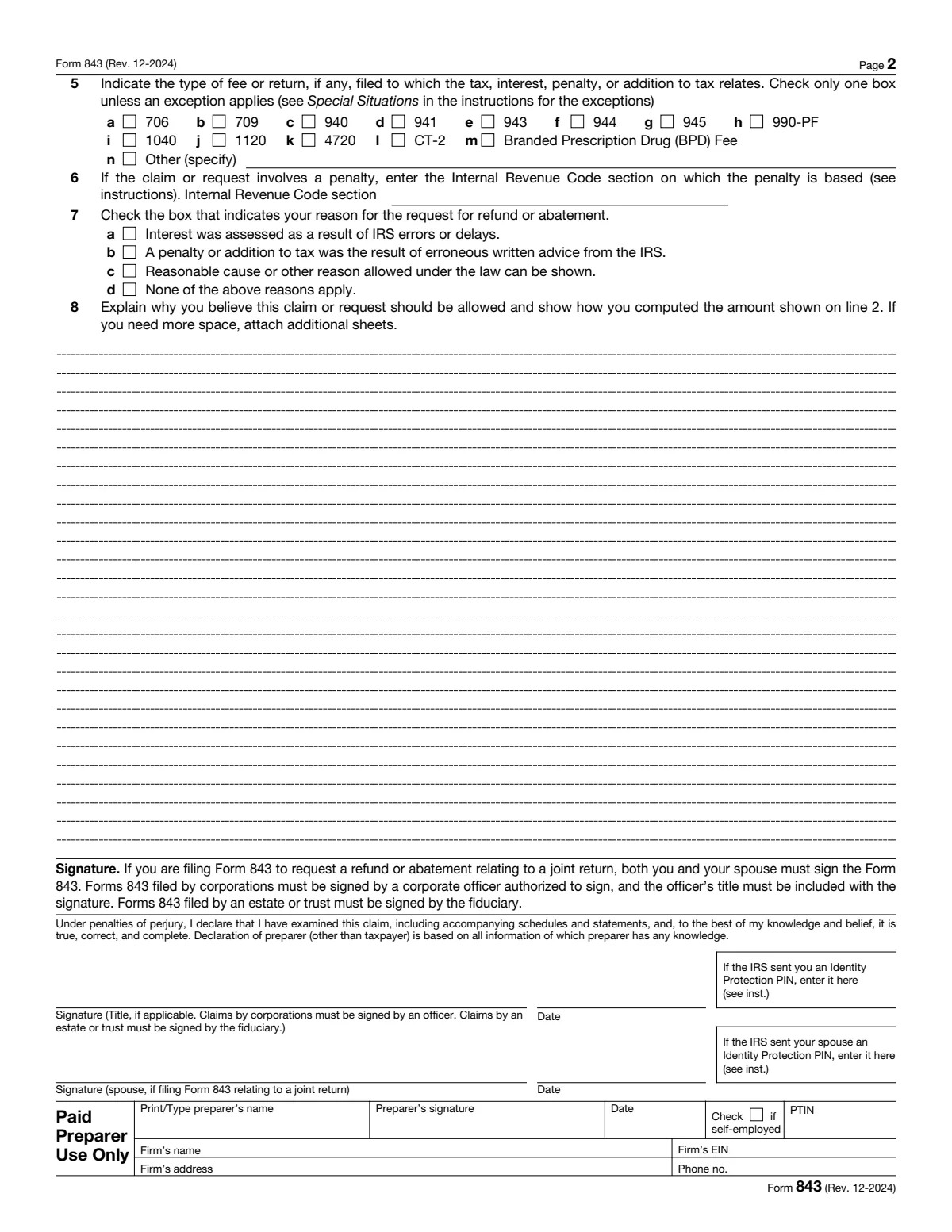
The numbered lines identify the period, the amount, the payments, the kind of tax and return, the penalty's Code section, your reason and your explanation. Line 8 carries the claim: a short, dated account of what happened and why it meets the standard, with the documents that prove it.
| Line | Label | What goes there |
|---|---|---|
| 1 | 1 Enter the tax period or fee year. Prepare a separate Form 843 for each tax period or fee year. | The beginning and ending dates of the period, for a Form 720 penalty the quarter (for example 04/01/2026 to 06/30/2026). “Generally, you must file a separate Form 843 for each tax period or fee year or type of tax or fee.” |
| 2 | 2 Amount to be refunded or abated. | “Enter the dollar amount for which you are requesting a refund or an abatement.” For a penalty, use the amount on the notice; interest on an abated penalty follows it. |
| 3 | 3 Date(s) of payment(s) for which you are requesting a refund (MM/DD/YYYY). If you need more space, attach additional sheets. | “If you are requesting a refund of payments you have already made, enter the date of each payment.” Leave it blank for an abatement of an unpaid amount. |
| 4 | 4 Check the box(es) with the type of tax or fee for which you are asking a refund or abatement. Or check the box(es) with the | Check d, Excise, for a Form 720, 730, 2290 or 11-C penalty or for the dyed fuel penalty. “Check only one box unless an exception applies” (the interest and net zero requests are the exceptions). |
| 5 | 5 Indicate the type of fee or return, if any, filed to which the tax, interest, penalty, or addition to tax relates. Check only one box | The boxes cover 706, 709, 940, 941, 943, 944, 945, 990-PF, 1040, 1120, 4720, CT-2 and the branded prescription drug fee. Form 720, 730, 2290 and 11-C are not listed, so the choice left is n, Other, with the form number written in. The line asks for the return only if there is one, so a penalty not tied to a return, such as the dyed fuel penalty, may leave it blank. |
| 6 | 6 If the claim or request involves a penalty, enter the Internal Revenue Code section on which the penalty is based | “Generally, you can find the Code section on the Notice of Assessment you received from the IRS.” Form 720 penalties are usually IRC 6651IRC 6651Internal Revenue Code, Cornell LII (late filing or paying), 6656 (failure to deposit) or 6715 (dyed fuel). |
| 7 | 7 Check the box that indicates your reason for the request for refund or abatement. | Box c, reasonable cause, is the one most excise penalty requests use. “If a, b, and c do not apply, check box d.” |
| 8 | 8 Explain why you believe this claim or request should be allowed and show how you computed the amount shown on line 2. If | “Explain in detail your reasons for filing this claim or request. Show your computation for the credit, refund, or abatement.” For a deposit penalty, explain each late deposit and what happened; for a dyed fuel penalty, the inspection facts and the gallons; put your name and EIN on any added sheet. |
| Sign | Signature (Title, if applicable. Claims by corporations must be signed by an officer. Claims by an Date | “Forms 843 filed by corporations must be signed by a corporate officer authorized to sign, and the officer's title must be included with the signature.” Enter an Identity Protection PIN only if the IRS sent one. |
| Preparer | Firm’s name | A paid preparer completes and signs this block and gives you a copy; someone who prepares it without charge does not sign. |
Excise penalties: abatement and first-time abate
Form 720 penalties for late filing, late payment and late deposits are covered on our Form 720 penalties page. Two rules from the Form 720 instructions shape a Form 843 request. First, do not argue the case on the return: “If you receive a notice about a penalty after you file this return, reply to the notice with an explanation and we will determine if you meet reasonable-cause criteria.” “Don't include an explanation when you file your return”. Second, the deposit penalty has its own standard: no penalty where the failure is due to “reasonable cause and not due to willful neglect” (IRC 6656(a)).
Instructions for Form 720 (Rev. June 2026), penalties; Instructions for Form 843 (Rev. December 2024).
Our sister site TaxProc.com explains first-time abatement, the IRS's administrative waiver for a first penalty, and how to ask for it. Two cautions for Form 720. The minimum late filing penalty in IRC 6651(a)IRC 6651Internal Revenue Code, Cornell LII that TaxProc.com discusses for income tax does not apply here: “The minimum penalty applies only to income tax returns. It does not apply to employment tax, excise tax, gift tax, or estate tax returns.” And the excise penalty sections of the Internal Revenue Manual do not say whether first-time abatement reaches a Form 720 penalty; the failure to file manual says only that “The first-time-abate provisions do not apply to returns with an event-based filing requirement”, and points to IRM 20.1.1. Ask on line 8 if the business has a clean history, and give the reasonable cause facts as well.
The dyed fuel penalty
The section 6715 penalty for selling or using dyed diesel or dyed kerosene in a taxable use is assessed by an IRS fuel compliance officer after an inspection. If the 30-day appeal window passes, the penalty is paid and then claimed back on this form; the IRS's examination manual lists “Form 843, Claim for Refund and Request for Abatement, for dyed diesel fuel penalty claims” among the forms its excise examiners handle (IRM 4.24.18). The dyed fuel page covers the inspection, the letters and the appeal. For the relief period of Oct. 1 to Dec. 31, 2026, the IRS said it will not impose dyed diesel penalties on highway use, and “Taxpayers who believe they qualify for relief but receive a penalty notice should follow the instructions in the notice or contact the IRS for assistance.” (IR-2026-122). Truckers can read IFTACompliance.com on dyed diesel inspection and penalty letters.
Where to file and time limits
Mail a Form 843 that answers a notice to the address on the notice. Without a notice, a penalty request goes to “the service center where you would be required to file a current year tax return for the tax to which your claim or request relates.” For Form 720 that is the IRS in Ogden: “Department of the Treasury Internal Revenue Service Ogden, UT 84201-0009”. A refund claim has a deadline: “Generally, you must file a claim for a credit or refund within 3 years from the date you filed your original return or 2 years from the date you paid the tax, whichever is later.” Pub. 556 has more on claims and appeal rights.
Rules that trip filers up
- Claiming an excise tax overpayment on Form 843. The printed caution excludes an overpayment of excise taxes reported on Form 11-C, 720, 730 or 2290 and refunds based on the nontaxable use or sale of fuels. Use Form 720-X for a prior Form 720 quarter and Form 8849 for a refund.
- Several quarters on one form. File one Form 843 per tax period, except where the special situations allow more.
- Expecting interest abatement on excise tax. Section 6404(e) relief reaches only taxes that need a notice of deficiency; most excise interest is outside it.
- No signature authority. A corporation's claim is signed by an officer with title; a representative attaches Form 2848.
- A trust fund penalty claim with nothing paid. For an excise trust fund recovery penalty, pay the part tied to one transaction first; see TaxProc.com on the trust fund recovery penalty.
How it connects
- Penalties on the quarterly return: Form 720 penalties and Form 720; deposit rules on due dates and deposits.
- The other claim forms: Form 720-X (guide), Form 8849 (guide) and Form 4136; how they fit together on excise tax refund claims.
- Dyed fuel: dyed fuel rules and penalties.
Questions filers ask
Can I use Form 843 to get back excise tax I overpaid on Form 720?
No. The form's caution excludes an overpayment of excise taxes reported on Form 11-C, 720, 730 or 2290. Correct a prior quarter's liability on Form 720-X, and claim a refund of excise taxes on Form 8849.
Which boxes does an excise filer check to ask for penalty abatement?
At the top, the penalty box for reasonable cause or other reason allowed under the law. Then line 4d, Excise; line 5n, Other, with the form number; line 6, the Code section from the notice; line 7c, reasonable cause; and the facts on line 8.
Is the dyed diesel penalty refunded on Form 843?
Yes. The Form 720 instructions say to use Form 843 to request a refund of the section 6715 penalty for misuse of dyed fuel. Check the section 6715 box at the top and line 4d, Excise.
Does first-time abatement apply to Form 720 penalties?
The IRS's excise penalty manuals do not say. Ask on line 8 if the business has a clean record, and give the reasonable cause facts too. The IRC 6651(a)IRC 6651Internal Revenue Code, Cornell LII minimum late filing penalty does not apply to Form 720.
Where do I send Form 843 for a Form 720 penalty?
If it answers a notice, to the address on the notice. Otherwise to the service center where you file Form 720: the IRS in Ogden, UT 84201-0009.
Can interest on excise tax be abated for IRS delay?
Usually not. Section 6404(e) covers taxes that require a notice of deficiency, and the instructions say interest related to employment taxes or other excise taxes cannot be abated under it.
Sources
- Form 843, Claim for Refund and Request for Abatement (Rev. December 2024), PDF
- Instructions for Form 843 (Rev. December 2024)
- About Form 843
- Instructions for Form 720 (Rev. June 2026)
- IRM 20.1.2, Failure to File/Failure to Pay Penalties
- IRM 4.24.18, Excise examinations
- 26 U.S.C. 6715, dyed fuel penalty
- IR-2026-122, dyed diesel fuel relief (Oct. 14, 2026)