- At a glance
- What the annual return reconciles
- The form, with hotspots
- The top of the return and the columns
- Parts I and II: the year's activities
- Parts III to VI: surcharge, districts and the reconciliation
- Amended returns and extensions
- Penalties and interest
- Rules that trip filers up
- How it connects
- Questions filers ask
- Sources
- Who files
- Every GET licensee, every year
- Due
- 20th day of the 4th month after year end
- Filed with
- Hawaii Tax Online or Dept. of Taxation
- Form revision
- Rev. 2025
- Pages
- 2
At a glance
Form G-49 is Hawaii's annual general excise and use tax return and reconciliation. “All taxpayers must file form G-49 annually.” It restates the whole year's gross income, exemptions and tax by activity and compares the tax with what was paid on the periodic Form G-45 returns. The Hawaii page explains the GET and the state's other excise taxes.
- Who files. “Every person engaging in business in Hawaii is required to have a GET license” and file the returns. That includes nonprofits, partnerships and disregarded entities, and anyone owing use tax on imports.
- When. “Deadline to file Form G-49 is the 20th day of the fourth month following your tax year end.” April 20 for calendar year filers; a weekend or holiday moves it to the next business day.
- How. Online through Hawaii Tax Online, or on paper to the Hawaii Department of Taxation, P.O. Box 1425, Honolulu, HI 96806-1425. Annual returns of taxpayers whose GET liability exceeds $4,000 must be filed electronically.
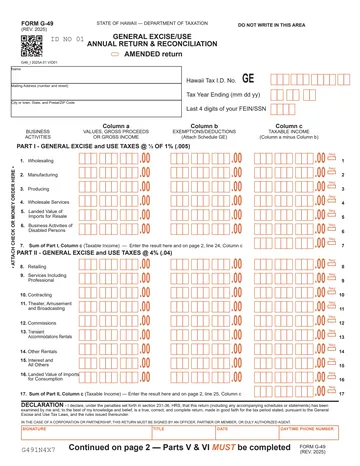
- Form revision. Form G-49 (Rev. 2025) (the image here is the printable copy), with the General Instructions for Filing the General Excise/Use Tax Returns (Rev. 2025). “Use Rev. 2025 form for tax years ending on or after January 1, 2026.”
- Small filers. A taxpayer whose total GET for the year is $100 or less need not file periodic returns, but still files the G-49.
Hawaii Department of Taxation, GET page and General Instructions for the GE/Use Tax Returns (Rev. 2025). Weekend and holiday due dates move to the next business day.
What the annual return reconciles
The G-49 is not a sum of the G-45s; it is the year as it actually was. “Since the annual return is a reconciliation of the ‘actual’ gross income, exemptions, taxable income, and taxes due with the ‘reported’ figures filed on the periodic returns, entries on the annual return will differ from the periodic returns if an error was made on a periodic return.” The rates are the same as on the G-45:
| Activity | GET rate (as of November 2026) | Where on the return |
|---|---|---|
| Retail sales of goods and services, renting, contracting, commissions, all others | 4.5%, including a 0.5% county surcharge | Part II (4%) plus Part IV (0.5% by county) |
| Wholesaling goods, manufacturing, producing, wholesale services, imports for resale, business activities of disabled persons | 0.50% | Part I |
| Insurance commissions | 0.15% | Part III |
“*This 4.5% rate includes a 0.5% county surcharge. The county surcharge does not apply to activities taxed at the 0.5% rate (for example selling wholesale goods) or insurance commissions.” Income on which someone else withheld GET for you, left off the G-45s, is included here. “DO NOT confuse this Annual Return and Reconciliation with the Net Income Tax Return.”
The instructions' Oahu example shows how the pass-on and the two rates fit: a $100.00 retail sale with $4.16 GET and $0.55 county tax passed on is charged at $104.71; the gross income reported is the amount including what was passed on, taxed “x 4% GE tax rate x .04” and then “x 0.5% Oahu county tax rate x .005”, for a total of $4.71. In the Department's words, “Gross income includes any cost passed on to the customer and represented to be the GET.”
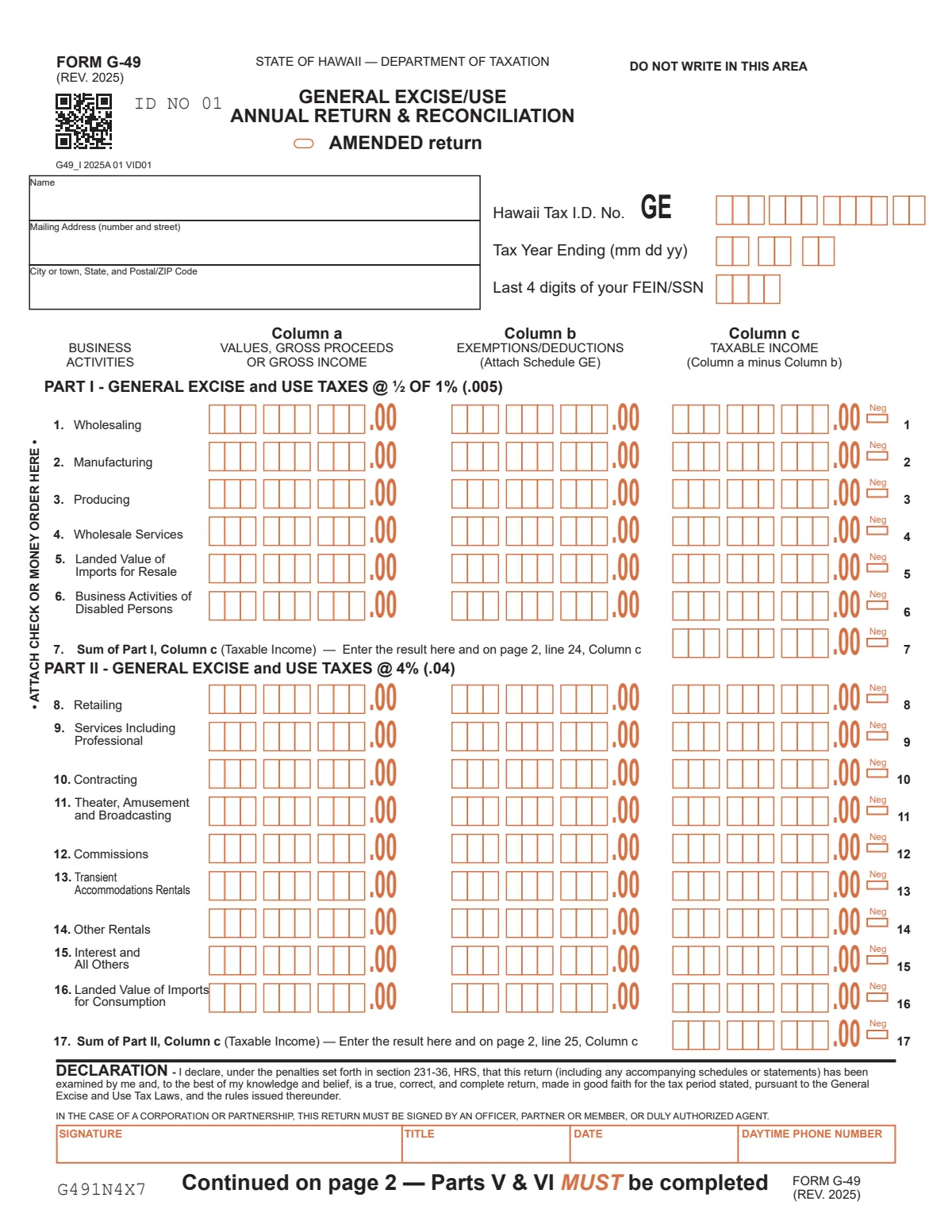
Tap a box once for its note, again to jump to the line. Zoom in to read the small print.
The top of the return and the columns
The G-49 asks for the full mailing address (new on the Rev. 2025 form) and the tax year end as month, day and year. The same scanning rules apply as on the G-45: ink inside the boxes, whole dollars in columns a to c, a fresh color print each time.
| Box | Label | What goes there |
|---|---|---|
| Amended | AMENDED return | Darken it to amend a G-49 already filed; enter every correct amount. “If you are amending Form G-49, it is not necessary to also amend the associated Form G-45s.” |
| Name | Name | The licensee's name; individuals write the last name first. |
| Address | Mailing Address (number and street) | The Rev. 2025 G-49 asks for the current mailing address. Foreign addresses put the city in the City/Town field and the province, state and country in the space provided. |
| City | City or town, State, and Postal/ZIP Code | City, state and ZIP or postal code. |
| TaxID | Hawaii Tax I.D. No. | Your Hawaii Tax I.D. number for the GE account. |
| TaxYear | Tax Year Ending (mm dd yy) | “Enter the numeric (two digit) month, day and year your tax year ends.” |
| FEIN | Last 4 digits of your FEIN/SSN | The last four digits of the FEIN or SSN. |
| cols | Column a Column b | Column a is gross income (or landed value for use tax), column b exemptions and deductions, column c the difference. “The Department is requiring taxpayers to round off cents to the nearest whole dollar for all dollar entries in Columns a, b, and c.” Exemptions need Schedule GE: without it they are denied. |
Parts I and II: the year's activities
Each line holds the whole year: for example, “if you correctly reported $1,000 in gross income on Wholesaling for both the first and second semiannual periods, then the gross income reported on Wholesaling on the annual return will be $2,000 ($1,000 + $1,000).” Column c may be negative on one activity if another activity's positive amount covers it, as long as the net is positive.
| Line | Label | What goes there |
|---|---|---|
| 1 | 1. Wholesaling | Sales to licensed buyers who resell, or who incorporate the goods into a product they sell, and the other wholesale sales in HRS 237-4. 0.5%. Report gross income for the whole year in column a. |
| 2 | 2. Manufacturing | Gross proceeds from manufacturing, compounding, canning, processing or refining an article for sale. Sugar processing and pineapple canning go here. 0.5%. Report gross income for the whole year in column a. |
| 3 | 3. Producing | Raising and producing agricultural products in their natural state, natural resource products, fishing and aquaculture, for sale or shipment out of the state. 0.5%. Report gross income for the whole year in column a. |
| 4 | 4. Wholesale Services | Services sold to a licensed seller, contractor or transient accommodations operator that resells them, where the six conditions in the instructions are met. 0.5%. Report gross income for the whole year in column a. |
| 5 | 5. Landed Value of Imports for Resale | Use tax: the landed value of goods or services imported for resale (or lease), less in column b what is resold at wholesale. 0.5%. Report gross income for the whole year in column a. |
| 6 | 6. Business Activities of Disabled Persons | Gross income of a certified disabled person (Form N-172 on file); column b takes the first $2,000 of gross income as an exemption. 0.5%. Report gross income for the whole year in column a. |
| 7 | 7. Sum of Part I, Column c (Taxable Income) | Add Part I column c (lines 1 to 6) and enter it here and on page 2, line 24, column c. |
| 8 | 8. Retailing | Gross sales of goods that do not qualify as wholesale: sales to consumers, to retailers who use rather than resell, and to unlicensed sellers. 4%. Report gross income for the whole year in column a. |
| 9 | 9. Services Including Professional | Gross income from services, professional and transportation services included. Services sold to the federal government are taxable. 4%. Report gross income for the whole year in column a. |
| 10 | 10. Contracting | Contractors, architects, engineers, land surveyors, landscape architects and pest control operators. 4%. Report gross income for the whole year in column a. |
| 11 | 11. Theater, Amusement and Broadcasting | Income from theaters, amusement parks, dance halls, broadcasting stations and other places offering amusements. 4%. Report gross income for the whole year in column a. |
| 12 | 12. Commissions | Agents' and brokers' commissions. Amounts passed on to subagents generally are not deductible by the agent. 4%. Report gross income for the whole year in column a. |
| 13 | 13. Transient Accommodations Rentals | Gross rentals that are also subject to the transient accommodations tax; fees that are not rent (food, cancellation) go on other lines. 4%. Report gross income for the whole year in column a. |
| 14 | 14. Other Rentals | Long-term rentals, equipment rentals and other leases not under the transient accommodations tax. 4%. Report gross income for the whole year in column a. |
| 15 | 15. Interest and All Others | Business interest and any business income not on another line (advertising space, royalties, a covenant not to compete). 4%. Report gross income for the whole year in column a. |
| 16 | 16. Landed Value of Imports for Consumption | Use tax on goods, services or contracting imported for use in Hawaii, unless exempt or reported as imports for resale. 4%. Report gross income for the whole year in column a. |
| 17 | 17. Sum of Part II, Column c (Taxable Income) | Add Part II column c (lines 8 to 16) and enter it here and on page 2, line 25, column c. The same amount, split by county, goes in Part IV. |
| Sign | SIGNATURE TITLE DATE DAYTIME PHONE NUMBER | Sign with title, date and daytime phone. The declaration is made under section 231-36, HRS; a corporation or partnership's return is signed by an officer, partner, member or duly authorized agent. |
Parts III to VI: surcharge, districts and the reconciliation
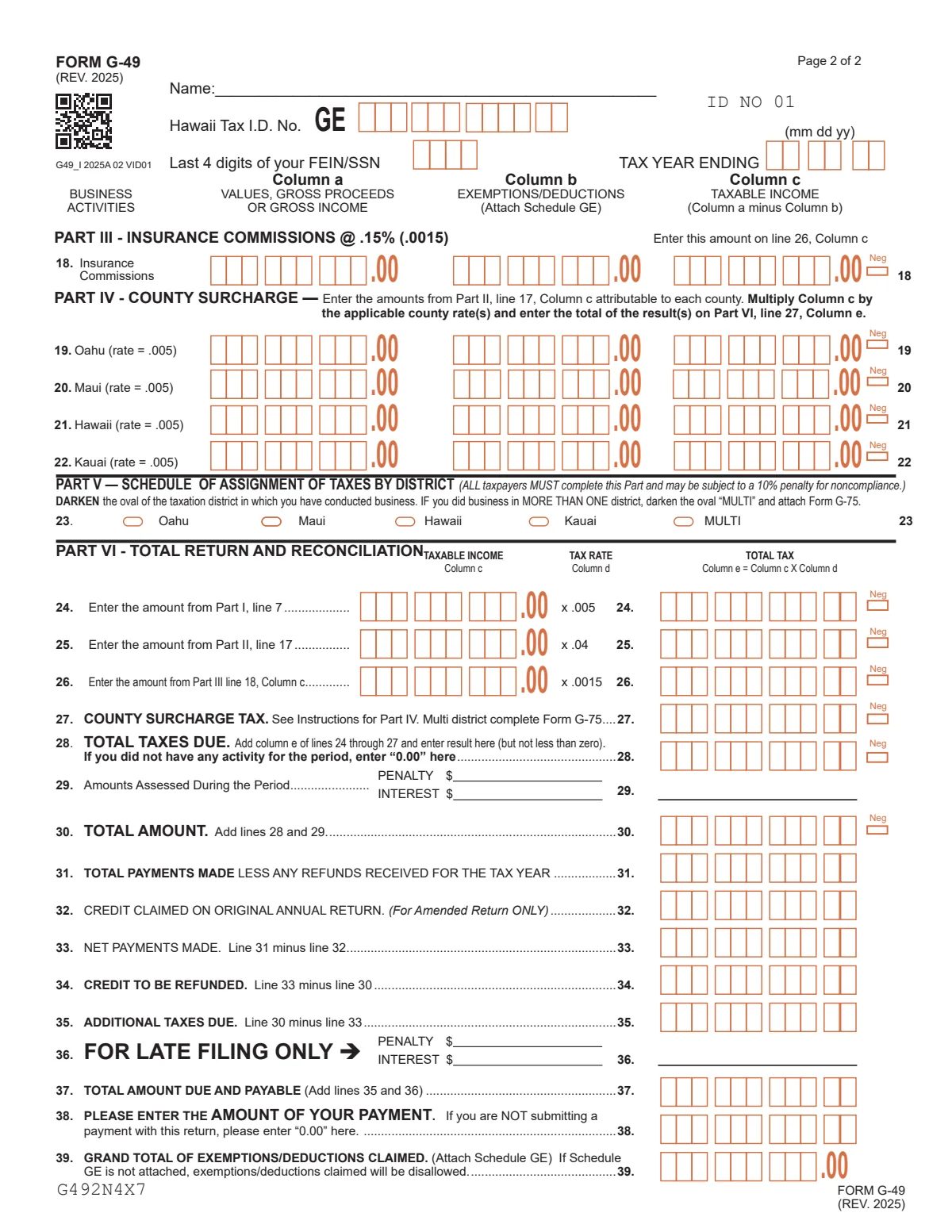
Lines 18 to 28 work as on the G-45. Lines 29 to 37 reconcile: the year's tax and assessed penalties against the payments made, ending in a refund (line 34) or a balance due (line 35). “If the periodic returns were completed correctly and the taxes due paid in full, the total taxes due (line 28) will, in many cases, be the same as the total payments made less any refunds received for the tax year (line 31) and no additional tax will be due.”
| Line | Label | What goes there |
|---|---|---|
| Top2 | Hawaii Tax I.D. No. | Complete the top of page 2 as entered on page 1, so the two pages stay together when scanned. |
| 18 | 18. Insurance | Insurance commissions of persons licensed as insurance producers under chapter 431, HRS. Column c also goes to line 26. No county surcharge. |
| 19 | 19. Oahu (rate = .005) | Part IV takes the 4% taxable income from line 17, column c, by county. One district: enter the line 17 amount on that county's line; several: use Form G-75's amounts. |
| 20 | 20. Maui (rate = .005) | Maui County's 0.5% surcharge took effect Jan. 1, 2024. |
| 21 | 21. Hawaii (rate = .005) | Hawaii County's surcharge is 0.5% from Jan. 1, 2020 (0.25% in 2019). |
| 22 | 22. Kauai (rate = .005) | Kauai County's 0.5% surcharge has applied since Jan. 1, 2019. Column b holds any county surcharge exemptions from the instructions' list. |
| 23 | Oahu Maui | Every taxpayer completes Part V: “ALL taxpayers MUST complete Part V and may be subject to a penalty of 10% of the combined State and county surcharge taxes for noncompliance.” With more than one district, darken MULTI and attach Form G-75. |
| 24 | 24. Enter the amount from Part I, line 7 | Multiply line 7's taxable income by .005 and enter the tax, including cents, in column e. Zero: enter 0.00. |
| 25 | 25. Enter the amount from Part II, line 17 | Multiply line 17 by .04. The 4% here is the state rate; the county surcharge is figured separately on line 27. |
| 26 | 26. Enter the amount from Part III line 18, Column c | Multiply line 18's column c by .0015. |
| 27 | 27. COUNTY SURCHARGE TAX. | One district with a surcharge: multiply line 17c by that county's rate. MULTI: total Form G-75, line 27, columns a to d. |
| 28 | 28. TOTAL TAXES DUE. | Add column e of lines 24 to 27. “CAUTION: LINE 28 MUST BE FILLED IN.” With no activity, enter 0.00. |
| 29 | 29. Amounts Assessed During the Period | “Add all the penalties and interest which have been assessed on taxes owed on the periodic tax returns,” and enter the total. |
| 30 | 30. TOTAL AMOUNT. Add lines 28 and 29 | The year's tax plus the assessed penalties and interest. |
| 31 | 31. TOTAL PAYMENTS MADE LESS ANY REFUNDS RECEIVED FOR THE TAX YEAR | Payments with the periodic returns, delinquency notices and assessment notices, less refunds received for the year. |
| 32 | 32. CREDIT CLAIMED ON ORIGINAL ANNUAL RETURN. | Amended returns only: the credit claimed on the original G-49. |
| 33 | 33. NET PAYMENTS MADE. | Payments, less any credit claimed on the original annual return. |
| 34 | 34. CREDIT TO BE REFUNDED. | If net payments exceed the total amount, the difference is refunded. |
| 35 | 35. ADDITIONAL TAXES DUE. | If the year's total exceeds net payments, the difference is due. |
| 36 | FOR LATE FILING ONLY | For a late G-49 with tax due, compute the penalty and interest, or leave them blank for the Department to bill. |
| 37 | 37. TOTAL AMOUNT DUE AND PAYABLE | Add lines 35 and 36. |
| 38 | 38. PLEASE ENTER THE AMOUNT OF YOUR PAYMENT. | The amount of the check or money order sent with the return, payable to the Hawaii State Tax Collector; 0.00 if none. |
| 39 | 39. GRAND TOTAL OF EXEMPTIONS/DEDUCTIONS CLAIMED. | The grand total from Schedule GE for the year. “If Schedule GE is not attached, exemptions/deductions claimed will be disallowed” |
Amended returns and extensions
To amend, darken the oval at the top of page 1 and re-enter every correct amount; enter the credit claimed on the original G-49 on line 32. “If you are amending Form G-49, it is not necessary to also amend the associated Form G-45s.” An extension of time to file the G-49 is requested on Form GEW-TA-RV-6; “Approval of an extension request is not automatic.” It does not extend the time to pay, so send the estimated additional tax with the request.
Penalties and interest
- Late filing. 5% of the tax due a month or part of a month, up to 25%.
- Late payment after a timely return. 20% of tax unpaid 60 days after the due date.
- Electronic filing. 2% of line 28 for failing to file electronically when required, unless waived on Form L-110.
- Part V. 10% of the combined state and county tax for leaving the district assignment blank.
- Losing GET benefits. “If you are required to have a GET license but fail to obtain one or you fail to file Form G-49 within 12 months of the prescribed due date, you may be denied GET benefits such as exemptions,” deductions or lower tax rates (section 237-9.3, HRS).
Rules that trip filers up
- Copying the G-45 totals. The G-49 reports the actual year; corrections to any G-45 show up here.
- Leaving out withheld income. Gross income on which a promoter or contractor withheld GET is included on the G-49.
- Payments on line 31. Include payments with the periodic returns and with any delinquency or assessment notices, less refunds.
- Exemptions without Schedule GE. They are disallowed.
- Missing the 12-month window. A G-49 filed more than 12 months late can cost the exemptions, deductions and lower rates.
How it connects
- Hawaii's taxes: the Hawaii excise tax page, with the GET license, rates and the filing table.
- The periodic return: Form G-45 line by line.
- Other states: the state excise tax guide and the state hub.
Questions filers ask
When is Form G-49 due?
The 20th day of the fourth month after the tax year ends: April 20 for a calendar year. A weekend or holiday due date moves to the next business day.
Do I file Form G-49 if I filed all my G-45s?
Yes. All filers must file the annual return and reconciliation in addition to the periodic returns, even if no additional tax is due.
Can I get an extension for Form G-49?
You can request one on Form GEW-TA-RV-6. Approval is not automatic, and it does not extend the time to pay: send the estimated additional tax with the request.
Do I have to amend my G-45s if I amend the G-49?
No. The instructions say it is not necessary to also amend the associated Forms G-45 when amending Form G-49.
What if my exemptions exceed my gross income on an activity?
Enter column b equal to column a. A negative column c on one activity is allowed if another activity's positive amount offsets it and the net is positive. You cannot claim a refund of more than the tax paid for the year.
What does line 31 include?
All taxes paid for the year with the periodic returns, delinquency notices and assessment notices, less any refunds received for the year.
Sources
- Form G-49, Annual Return and Reconciliation of General Excise/Use Tax Return (Rev. 2025)
- General Instructions for Filing the General Excise/Use Tax Returns (Rev. 2025)
- Hawaii Department of Taxation, General Excise Tax (GET)
- Hawaii Department of Taxation, GET FAQs
- Hawaii Department of Taxation, General Excise and Use Tax forms