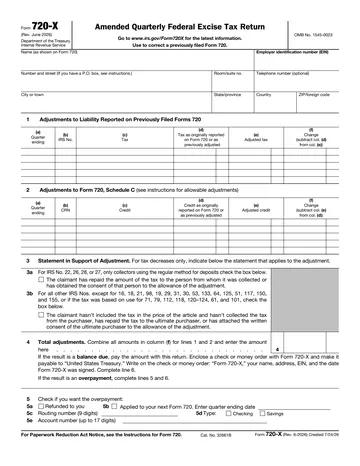
- At a glance
- The form, with hotspots
- Name, EIN and address
- Line 1: adjustments to liability
- Line 2: Schedule C adjustments
- Line 3: the statement for a decrease
- Lines 4 and 5: balance due or overpayment
- Line 6 and the signature
- An adjustment worked out
- Form 720-X or another form
- Rules that trip filers up
- How it connects
- Questions filers ask
- Sources
- Who files
- A Form 720 filer correcting an earlier quarter
- Filed with
- Next Form 720, or alone to Cincinnati, OH
- Refund limit
- 3 years from filing or 2 from payment
- Form revision
- Rev. June 2026
- Pages
- 2
At a glance
Form 720-X is the amended return for the quarterly federal excise tax return. The instructions state its job in one line: “Use Form 720-X to make adjustments to liability reported on Forms 720 you have filed for previous quarters.” It raises or lowers the tax reported for an IRS No. in an earlier quarter, and it can change two kinds of Schedule C credit. It is not the place for ordinary refund claims on fuel or articles: those go on Form 8849, Schedule C or Form 4136. The Form 720-X guide explains when to amend and what happens after; this page walks the form itself.
- Who files. A Form 720 filer that reported too much or too little for an IRS No. in a past quarter. A remittance transfer provider may use it to correct transcription or calculation errors, but “Don’t use Form 720-X to claim amounts when a remittance transfer is cancelled or expired.”
- When. Increases as soon as you find them, since interest runs from the original due date. Decreases within the refund period: “Generally, adjustments that decrease your tax liability for a prior quarter must be made within 3 years from the time the return was filed or 2 years from the time the tax was paid, whichever is later.”
- Where. Alone, to “Department of the Treasury Internal Revenue Service Cincinnati, OH 45999-0009”. “Otherwise, attach Form 720-X to your next Form 720.” The IRS's e-file program for excise taxes covers Form 720; the instructions give only the paper addresses for Form 720-X.
- Form revision. Form 720-X (Rev. June 2026), with the Instructions for Form 720-X (Rev. June 2026). Two pages: lines 1 to 5 on page 1, the explanation and signatures on page 2.
- Income tax. “You must include in gross income (income tax return) any overpayment from line 4 of Form 720-X if you took a deduction on the income tax return that included the amount of the taxes and that deduction reduced the income tax liability.”
Tap a box once for its note, again to jump to the line. Zoom in to read the small print.
Name, EIN and address
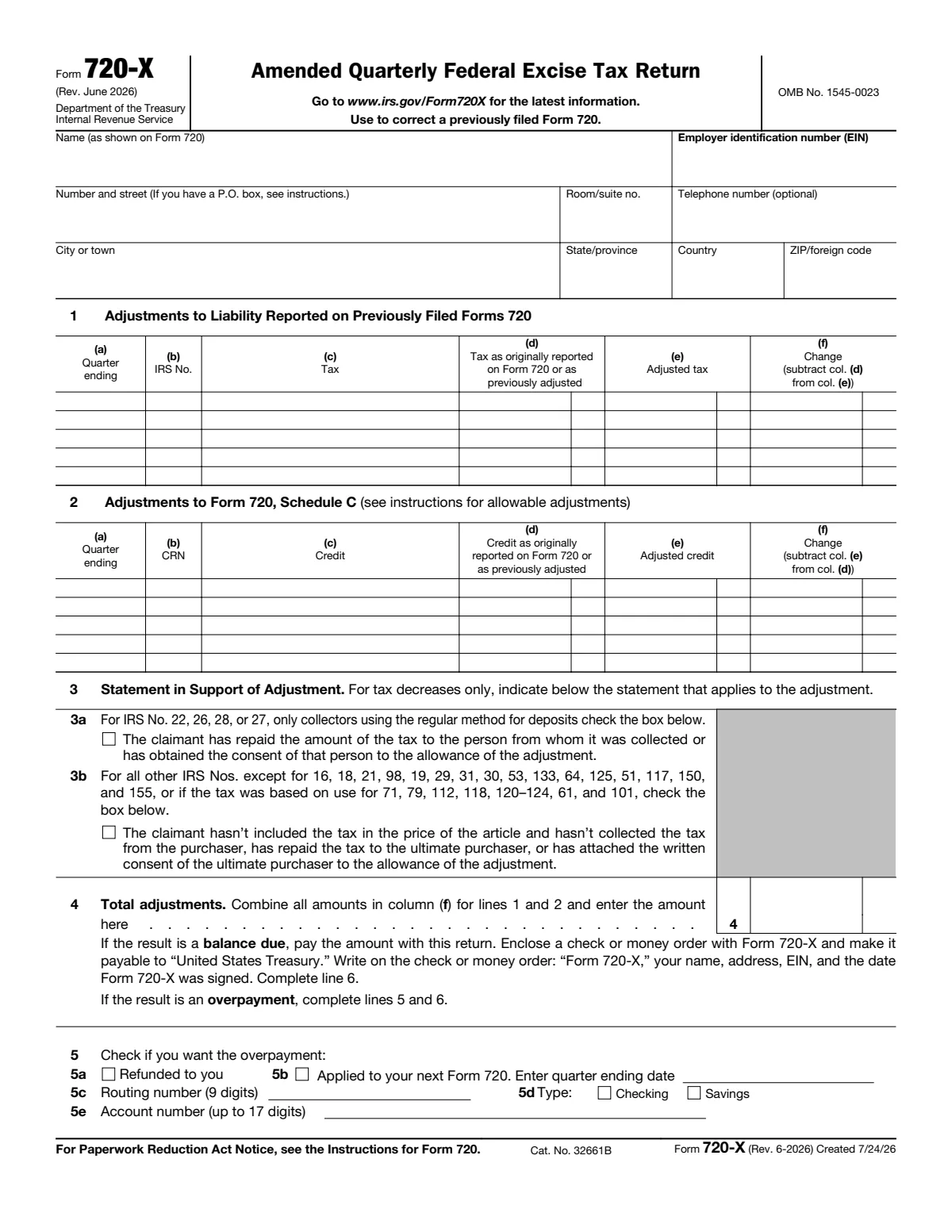
The top block ties the amendment to the account. Use the same name and EIN as the Form 720 you are correcting; the IRS posts the change to that quarter of that account (its manual tells staff to input any adjustment “for the quarter in which the tax was originally reported, or should have been reported”).
| Line | Label | What goes there |
|---|---|---|
| X-name | Name (as shown on Form 720) | The filer's legal name exactly as it appears on the Form 720 being corrected, so the adjustment posts to the right account. |
| X-ein | Employer identification number (EIN) | The EIN from the original return. A disregarded entity or QSub that filed Form 720 under its own EIN corrects it under that EIN. |
| X-street | Number and street (If you have a P.O. box, see instructions.) Room/suite no. | “If the post office doesn’t deliver mail to the street address and you have a P.O. box, show the box number instead of the street address.” |
| X-phone | Telephone number (optional) | Optional. A number where the person who prepared the adjustment can be reached. |
| X-city | City or town, State/province, Country, ZIP/foreign code | “Don’t abbreviate the country name.” Follow the country's practice for the postal code and the province or state. |
Line 1: adjustments to liability
Line 1 is a small table: one row per IRS No. per quarter. The six columns take you from what you reported to what you should have reported. Increases and decreases can sit on the same form, and column (f) keeps the sign: a decrease goes in parentheses.
| Line | Label | What goes there |
|---|---|---|
| 1 | Adjustments to Liability Reported on Previously Filed Forms 720 | One line for each change to a tax you reported. “Report each adjustment separately on line 1.” Five lines are printed; use line 6 or attached sheets with your name and EIN for more. Corrections to several quarters can share one Form 720-X if each quarter is clearly identified. |
| 1a | Column (a) Quarter ending | “Enter the quarter ending date of the Form 720 you’re amending.” “Enter the date in the MMDDYYYY format.” The first quarter of 2026 is 03312026. |
| 1b | Column (b) IRS No. | The IRS No. of the tax being corrected, as on Form 720 (for example 62 for gasoline). The IRS No. lookup lists every number with its line on Form 720. A new IRS No. that was never reported is still entered here, but see the late filing point under Rules below. |
| 1c | Column (c) Tax | The tax's name for that IRS No. (for example Gasoline). The instructions give no further rule for this column. |
| 1d | Column (d) Tax as originally reported on Form 720 or as previously adjusted | “Enter the tax amount for the IRS No. entered in column (b) as originally reported on Form 720 or as later adjusted by you or the IRS.” |
| 1e | Column (e) Adjusted tax | “Enter the adjusted tax liability that should have been reported for the IRS No. in column (b).” |
| 1f | Column (f) Change (subtract col. (d) from col. (e)) | If column (e) is more, the difference is an increase. If column (d) is more, it is a decrease: “Show the decrease in parentheses.” |
Line 2: Schedule C adjustments
Schedule C credits are generally final once claimed. The instructions say not to use Form 720-X “to make changes to claims made on Form 720, Schedule C, except for the section 4051(d) tire credit and section 6426 credits.” In practice the tire credit is the live case: a truck dealer that finds another taxable sale for IRS No. 33 reports the extra tax on line 1 and the matching tire credit on line 2. The fuel mixture and alternative fuel credits under section 6426 ended after 2024 (SAF after Sept. 30, 2025), so line 2 now only corrects credits for those earlier periods.
| Line | Label | What goes there |
|---|---|---|
| 2 | Adjustments to Form 720, Schedule C (see instructions for allowable adjustments) | Most Schedule C claims cannot be changed here. The instructions allow two kinds: the section 4051(d) tire credit and the section 6426 credits, which “have expired for sale, uses, or removals after 2024.” The SAF credit under section 6426(k) ended for sales or uses after Sept. 30, 2025. |
| 2a | Column (a) Quarter ending | The quarter ending date of the Schedule C claim you are adjusting, in MMDDYYYY format. |
| 2b | Column (b) CRN | The credit reference number. For the tire credit: “Enter CRN 366 in column 2(b).” The tire credit is the tax on tires sold on a taxable vehicle reported on IRS No. 33, so it moves with that line: “if you report an additional taxable vehicle on line 1 for IRS No. 33, the applicable tire credit is reported on line 2.” |
| 2c | Column (c) Credit | The name of the credit (for example, tire credit). |
| 2d | Column (d) Credit as originally reported on Form 720 or as previously adjusted | The credit as first taken on Schedule C, or as later adjusted. |
| 2e | Column (e) Adjusted credit | The credit as it should have been taken. |
| 2f | Column (f) Change (subtract col. (e) from col. (d)) | Column (d) minus column (e). The order is the reverse of line 1, because a smaller credit means more tax: a credit that goes down shows as an increase in tax. |
Line 3: the statement for a decrease
A decrease is a refund claim, and refunds of a tax that was passed on to a customer carry conditions. Line 3 is where you certify them. Check the box that fits, or none if the IRS No. is on the excluded list in line 3b.
| Line | Label | What goes there |
|---|---|---|
| 3 | Statement in Support of Adjustment. For tax decreases only, indicate below the statement that applies to the adjustment. | Only for decreases. An increase needs no statement. The two boxes carry the conditions of sections 6415 and 6416(a), which the IRS manual says apply to claims made on Form 720-X. |
| 3a | For IRS No. 22, 26, 28, or 27, only collectors using the regular method for deposits check the box below. | For collected communications and air taxes. The box certifies: “The claimant has repaid the amount of the tax to the person from whom it was collected or has obtained the consent of that person to the allowance of the adjustment.” Collectors using the alternative method do not use Form 720-X for this: “Form 720-X can't be used for this purpose.” They adjust their separate accounts instead, while “Collectors using the regular method for deposits must use Form 720-X to request a credit or refund.” |
| 3b | For all other IRS Nos. except for 16, 18, 21, 98, 19, 29, 31, 30, 53, 133, 64, 125, 51, 117, 150, and 155, or if the tax was based on use for 71, 79, 112, 118, 120 to 124, 61, and 101, check the box below. | The usual box for a manufacturer, retailer or fuel tax decrease: “The claimant hasn’t included the tax in the price of the article and hasn’t collected the tax from the purchaser, has repaid the tax to the ultimate purchaser, or has attached the written consent of the ultimate purchaser to the allowance of the adjustment.” The listed IRS Nos. (the petroleum, ODC, ship, obligations, foreign insurance, PCORI, waterways, recapture, stock buyback and remittance transfer lines) need no box. |
The IRS manual's own list of IRS Nos. outside the section 6416(a) condition is not the same as the form's. It lists “all other IRS Nos. except 18, 19, 20, 21, 29, 30, 31, 51, 64, 98, 117, 125 and 133”: it includes IRS No. 20 (the ODC floor stocks tax) and leaves out 16, 53, 150 and 155, which the June 2026 form excludes. The form is newer than that passage. Follow the form, and if your decrease is on IRS No. 20, check line 3b only if you can make its statement.
Lines 4 and 5: balance due or overpayment
Line 4 nets the changes. A positive total is more tax: pay it with the form, by check or money order to the United States Treasury. A negative total is an overpayment, and line 5 says what to do with it.
| Line | Label | What goes there |
|---|---|---|
| 4 | Total adjustments. Combine all amounts in column (f) for lines 1 and 2 and enter the amount here | The net of every column (f) entry. If it is a balance due, pay it with the form: “Enclose a check or money order with Form 720-X and make it payable to ‘United States Treasury.’” Write Form 720-X, your name, address, EIN and the date signed on the check, and complete line 6. If it is an overpayment, complete lines 5 and 6. |
| 5 | Check if you want the overpayment: | Check 5a or 5b, not both. If neither is checked, the IRS manual has staff refund it. “If you owe other federal tax, interest, or penalty, the overpayment will first be applied to the unpaid amounts.” |
| 5a | Refunded to you | “If you want your overpayment refunded to you, check the box for line 5a.” |
| 5b | Applied to your next Form 720. Enter quarter ending date | Check it and enter the quarter ending date of the next Form 720. Then carry it there: “be sure to include the overpayment amount on lines 6 and 7 on your next Form 720.” Line 6 of Form 720 is overpayments from previous quarters and line 7 is the part that came from Form 720-X. |
| 5c | Routing number (9 digits) | New on the June 2026 form, for a refund by direct deposit. The instructions warn: “Although the form has been updated the Direct Deposit functionality is not yet available.” Check the IRS's About Form 720-X page before relying on it. |
| 5d | Type: Checking / Savings | Check one box for the account type. |
| 5e | Account number (up to 17 digits) | The account for the direct deposit refund, once the IRS turns the feature on. |
An increase also reopens the deposit question for that quarter. Part I taxes should have been deposited semimonthly, so the IRS manual tells its staff, for increases, to “Address the late deposit penalty and assess if applicable.” and not to restrict interest. For decreases it says “Credit interest is allowable on an overpayment of tax liability reported on a Form 720 filed for previous quarters.” A balance due can also be paid electronically through EFTPS when the form is attached to a Form 720; the instructions describe only the check for a separately filed form.
Line 6 and the signature
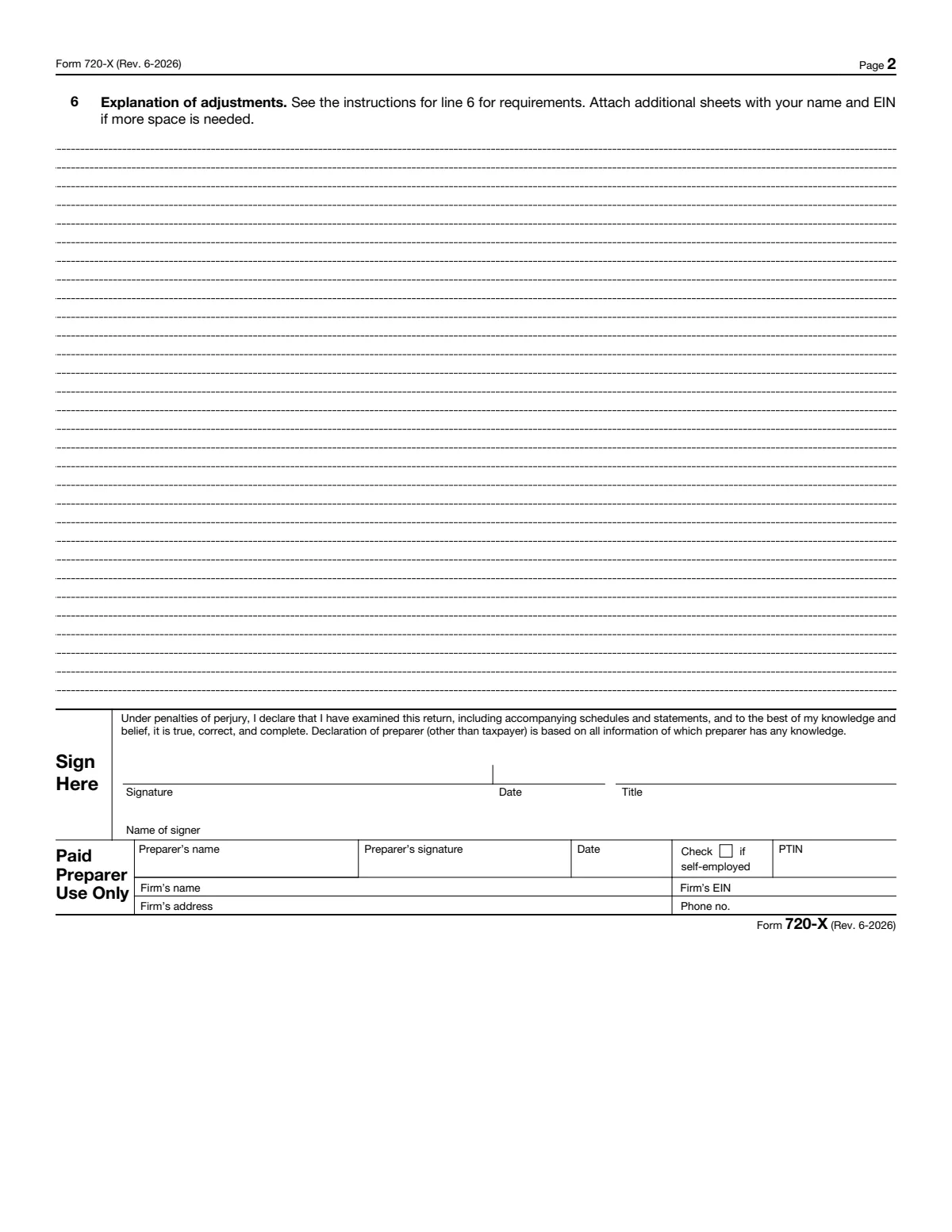
Page 2 is mostly line 6, a blank box for the explanation. It is not optional for a decrease: the IRS reads it to decide the claim. Give each adjustment its own paragraph with the quarter, the IRS No., why the original figure was wrong and the arithmetic.
| Line | Label | What goes there |
|---|---|---|
| 6 | Explanation of adjustments. See the instructions for line 6 for requirements. | For line 1: “For each adjustment, you must include a detailed description of the adjustment and the computation of the amount.” For line 2 the explanation adds your registration number and the gallons (or gallon equivalents) times the credit rate, with the information the Form 720 instructions ask for (use the June 2026 revision; the Form 720-X instructions still cite May 2026). The IRS manual adds that supporting evidence does not have to be sent with the claim, but keep it: a decrease is a refund claim and the IRS may ask for it. |
| X-sign | Sign Here: Signature, Date, Title, Name of signer | “Form 720-X must be signed by a person authorized by the entity to sign this return.” “You must sign Form 720-X even if it’s filed with Form 720 to apply an overpayment.” |
| X-preparer | Paid Preparer Use Only: name, signature, date, PTIN, firm's name, address, EIN, phone | Only a preparer who was paid and is not the filer's employee. The preparer signs by hand on paper and enters a PTIN, not the firm's number. |
Form 720-X and its instructions (Rev. June 2026).
An adjustment worked out
A position holder reported 1,250,000 gallons of gasoline on IRS No. 62 for the first quarter of 2026. Its reconciliation later shows 1,240,000 gallons were removed at the rack. The gasoline rate is $.184 per gallon (Through Sept. 30, 2028) (irs_nos.py, from Form 720), so:
| Column | Entry | How |
|---|---|---|
| (a) Quarter ending | 03312026 | MMDDYYYY, as the instructions require |
| (b) IRS No. | 62 | Gasoline |
| (c) Tax | Gasoline | The tax's name |
| (d) Tax as originally reported | $230,000.00 | 1,250,000 gallons x $0.184 |
| (e) Adjusted tax | $228,160.00 | 1,240,000 gallons x $0.184 |
| (f) Change | ($1,840.00) | A decrease, in parentheses |
Line 4 shows ($1,840.00). IRS No. 62 is not on the line 3b exclusion list, so the filer checks line 3b only if it did not pass the tax on, repaid the buyer, or has the buyer's written consent; a position holder that billed the tax to its rack customers usually needs that consent. It checks 5b and enters 06302026 to apply the overpayment to the second-quarter Form 720, then includes $1,840.00 on lines 6 and 7 of that return and attaches this Form 720-X to it. Line 6 explains the gallon count with the computation. The claim is timely: the first-quarter 2026 return was due April 30, 2026, so the three-year window runs into 2029.
Form 720-X or another form
The excise forms divide the work, and using the wrong one gets the claim sent back. Form 720-X changes reported liability. Form 8849 refunds tax on fuel and articles that ended up in an exempt use or sale, and its instructions say not to use it “To make adjustments to liability reported on Forms 720 filed for prior quarters; instead, use Form 720X, Amended Quarterly Federal Excise Tax Return.” The Form 720 instructions add one more use of Form 720-X: a refund of the fractional aircraft surtax (IRS No. 13) also goes on it, not on Schedule C.
Instructions for Form 720-X (Rev. June 2026), Purpose of Form; Instructions for Form 720 (Rev. June 2026); Instructions for Schedule 6 (Form 8849) (Rev. June 2026).
Interest abatement under section 6404(e) and penalty abatement under section 6404(f) go on Form 843, not Form 720-X. The Form 843 form page covers it.
Rules that trip filers up
- Fixing a past quarter on this quarter's Form 720. “Don't enter adjustments on Form 720.” The adjustment belongs to the quarter it corrects.
- Adding an IRS No. you never reported. The IRS manual says “Each IRS No. is a separate return for all purposes.” A Form 720-X that adds a tax missing from a timely Form 720 is treated as a late return for that tax, and “the second return may be subject to a late filing penalty”. See Form 720 penalties.
- Forgetting lines 6 and 7 of the next Form 720. Checking 5b does nothing by itself; the overpayment has to be claimed on the next return.
- Using a 5b credit to cover deposits. An amended return's overpayment does not reduce the net liability on Schedule A for deposit purposes (see the Schedule A page).
- Changing a Schedule C fuel claim. Only the tire credit and the expired section 6426 credits can be adjusted on line 2.
- An old cross reference. The June 2026 Form 720-X instructions twice point to the “Instructions for Form 720 (Rev. May 2026)” for line 2. The current revision is June 2026: use the Instructions for Form 720 (Rev. June 2026) for the Schedule C rules and CRNs behind a line 2 adjustment.
- Amending Form 7208. A stock buyback correction is a corrected Form 7208 marked Amended, attached “to your Form 720-X, Amended Quarterly Federal Excise Tax Return, for the quarter to which your previously filed Form 7208 was attached” (see the Form 7208 page).
- Expecting a direct deposit. The routing and account lines are on the form, but the IRS says the feature is not yet available.
How it connects
- The guide behind this form: Form 720-X: amending a quarterly federal excise return.
- The return it corrects: Form 720 line by line, the Form 720 guide, due dates and deposits and penalties.
- Refunds that are not amendments: Form 8849 and its schedules, the Form 8849 guide, Form 4136 and excise refund claims.
- Every IRS No. with its rate: the IRS No. lookup.
Questions filers ask
How do I amend a Form 720?
File Form 720-X for the quarter you are correcting. Report each change on line 1 by IRS No., with the original and corrected tax, explain it on line 6, and sign. Mail it alone to the IRS in Cincinnati, OH 45999-0009, or attach it to your next Form 720.
How long do I have to file Form 720-X for a refund?
Generally 3 years from when the Form 720 was filed or 2 years from when the tax was paid, whichever is later. Increases have no deadline of this kind, but interest and possible penalties run from the original due date.
Can I take the overpayment on my next Form 720?
Yes. Check line 5b, enter the next quarter ending date, and include the amount on lines 6 and 7 of that Form 720. The IRS first applies it to any other federal tax, interest or penalty you owe.
Can I use Form 720-X to change a Schedule C claim?
Only the section 4051(d) tire credit (CRN 366) and the section 6426 credits, which expired after 2024. Other fuel claims are not amended on Form 720-X.
Do I need line 3 for a tax increase?
No. Line 3 is for decreases only. Check 3a for regular method communications and air tax collectors, 3b for most other taxes, and no box for the IRS Nos. the form lists as excluded.
Can a remittance transfer provider use Form 720-X?
Only to correct transcription or calculation errors on a Form 720. Refunds of the tax on cancelled or expired transfers are claimed by the sender on Form 8849, Schedule 6 (CRN 475).