- Who files
- Manufacturers, producers and importers of firearms and ammunition
- Due
- April 30, July 31, Oct. 31, Jan. 31
- Filed with
- TTB, St. Louis, or Pay.gov
- Form revision
- 09/2025
- Pages
- 2, plus 5 pages of instructions
At a glance
TTB F 5300.26 is the Federal Firearms and Ammunition Quarterly Excise Tax Return. “You must file to report Federal Firearms and Ammunition Excise Tax (FAET) required by 26 U.S.C. 418126 U.S.C. 4181United States Code, Cornell LII.” The tax is on the sale or business use of pistols, revolvers, other firearms and shells and cartridges by the manufacturer, producer or importer, at 10% or 11% of the sale price. The current revision is TTB F 5300.26 (09/2025); earlier editions are obsolete.
- Who files. Manufacturers, producers and importers of taxable articles, for each calendar quarter in which they owe tax. “You are not required to file a return in any quarter that you do not owe tax.” A taxpayer that has filed before but owed nothing all year files an annual return, unless it has filed a final return (27 CFR 53.151(a)(2))27 CFR 53.151Code of Federal Regulations, eCFR.
- When. April 30, July 31, Oct. 31 and Jan. 31 for the four quarters, and Jan. 31 for an annual return. Unlike the alcohol and tobacco returns, a weekend or holiday moves the FAET due date later: “your return and payment is due on the next succeeding day that is not a Saturday, Sunday, or legal holiday.”
- Payment. With the return. Semimonthly deposits ended in 2010; TTB says “Taxpayers must only make deposits through tax period 08/01/2010” to 08/15/2010. The CFR still prints the old deposit sections (27 CFR 53.157 and 53.159)27 CFR 53.157Code of Federal Regulations, eCFR27 CFR 53.159Code of Federal Regulations, eCFR; they no longer apply.
- Where and how. Through TTB forms on Pay.gov, or on paper: “Prepare this form in duplicate. Keep one copy for your records and mail the original to:” TTB, Excise Tax, P.O. Box 979055, St. Louis, MO 63197-9000. “Your return is timely if it is mailed by the due date.”
- Records. “You must keep records to support all entries made on this return for at least 3 years from the date you filed this tax return.”
TTB 2026 schedule of quarterly FAET due dates; TTB F 5300.26 instruction D; 27 CFR 53.153(c)27 CFR 53.153Code of Federal Regulations, eCFR: a weekend or holiday due date moves to the next business day.
Tap a box once for its note, again to jump to the line. Zoom in to read the small print.
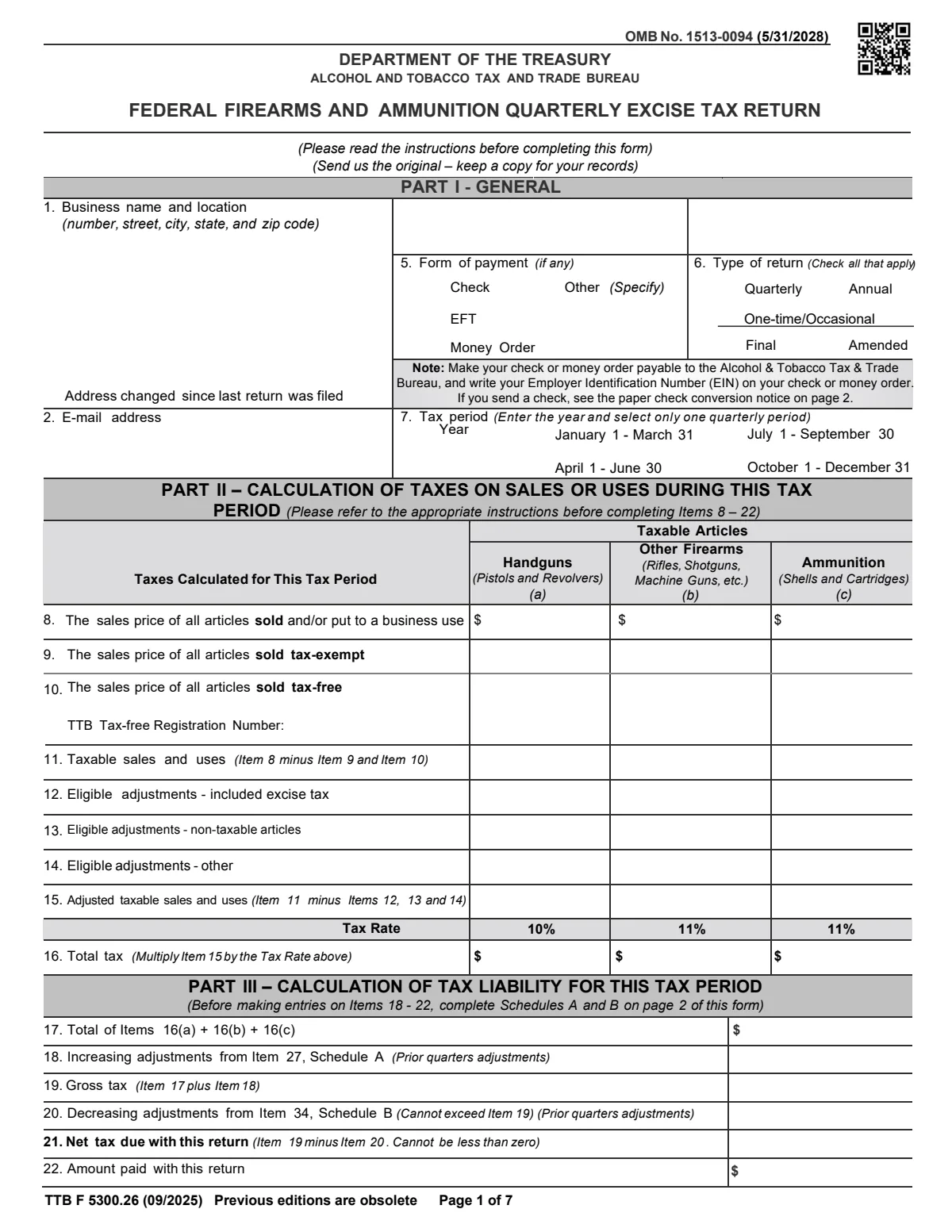
Part I: items 1 to 7
Part I identifies the taxpayer, the payment and the period. On the 09/2025 PDF the two boxes at the top right have no printed labels; the PDF's own field names, and the specific instructions, show that they are item 3 (the EIN) and item 4 (a daytime telephone number).
| Line | Label | What goes there |
|---|---|---|
| 1 | 1. Business name and location (number, street, city, state, and zip code) | The taxpayer: “If you are the manufacturer, producer, or importer of pistols, revolvers, other firearms, or shells and cartridges (articles), you are required to file a return in any calendar quarter that you owe tax”. For imports, the beneficial owner files: “The beneficial owner is always the taxpayer for FAET purposes”. |
| 1-addr | Address changed since last return was filed | Check it when the address has changed. A change of name or address is also reported to TTB within 30 days by letter, as TTB's FAET compliance page explains. |
| 2 | 2. E-mail address | An address TTB can use about this return. |
| 3 | 3. Employer Identification Number (EIN) (label from the PDF's field name; not printed on the 09/2025 image) | “You are required to have an Employer Identification Number(EIN) if you are engaged in a business that requires you to regularly file FAET returns.” “You mayuse your Social SecurityNumber (SSN) ONLY if you file an occasional or one-time return.” (The form's own typo, "mayuse", is TTB's.) Write the same EIN on any check or money order. |
| 4 | 4. Daytime telephone number including area code (label from the PDF's field name; not printed on the 09/2025 image) | A daytime number with area code. The specific instructions on pages 4 to 6 skip item 4; the PDF's field for it is named “4.Daytime telephone number INCLUDING AREA CODE”. |
| 5 | 5. Form of payment (if any): Check, EFT, Money Order, Other (Specify) | Check how you pay. “If you pay tax by Electronic Funds Transfer (EFT), contact the NRC for specific information.” EFT is optional for the FAET, but a taxpayer who elects it keeps paying by EFT for at least four consecutive calendar quarters (TTB Procedure 2011-1). “If your payment is made by Electronic Fund Transfer (EFT), your return must be mailed to the above address by the due date.” |
| 6 | 6. Type of return (Check all that apply): Quarterly, Annual, One-time/Occasional, Final, Amended | “Select Annual if you filed a return in the past, but do not owe tax for an entire calendar year.” A final return goes in when you permanently stop FAET operations, with a statement naming who keeps the records, where they are, and whether and to whom the business was transferred. A one-time or occasional return is for a person who owes tax but is not in the FAET business. An amended return is complete: “(For an amended return, complete all items on return, not just the amended items).” |
| 7 | 7. Tax period (Enter the year and select only one quarterly period) | “Enter the year of the tax return period and select one quarter. If you are filing an annual return enter the year only.” |
Part II: items 8 to 16
Part II works out the tax in three columns: (a) handguns (pistols and revolvers), (b) other firearms (rifles, shotguns, machine guns and the rest) and (c) ammunition (shells and cartridges). “Enter in Part II only sales and uses occurring during the tax period specified in Item 7.” The firearms excise tax page explains what is taxable, the 50-firearm small maker exemption and the open question on NFA firearms after Pub. L. 119-21.
TTB F 5300.26 (09/2025), Part II and its specific instructions.
| Line | Label | What goes there |
|---|---|---|
| 8 | 8. The sales price of all articles sold and/or put to a business use: (a) handguns, (b) other firearms, (c) ammunition | Your gross sales of articles you made, produced or imported, by column, including tax-free and tax-exempt sales. “Include FAET if it is included in the sales price.” “Except for leases and certain installment sales, you must include all sales regardless of whether your customers paid you.” Business use counts too: loans for display or demonstration and use in further manufacture of an untaxed article are taxed, at the lowest established wholesale price if you sell the articles regularly. Column (b) takes rifles, carbines, machine guns, shotguns and fowling pieces. |
| 9 | 9. The sales price of all articles sold tax-exempt | The part of item 8 sold tax-exempt, under 27 CFR 53.6227 CFR 53.62Code of Federal Regulations, eCFR (for example, sales to the Defense Department or Coast Guard paid with appropriated funds). No registration is needed for these. |
| 10 | 10. The sales price of all articles sold tax-free | The part of item 8 sold tax-free under 26 U.S.C. 422126 U.S.C. 4221United States Code, Cornell LII (further manufacture, export, supplies for vessels or aircraft, state and local governments, nonprofit educational organizations). Sales you made tax-paid to a buyer who later used them tax-free do not go here; take those in Schedule B or on TTB F 5620.8 once the article is in the tax-free use. |
| 10-reg | TTB Tax-free Registration Number: | Required with any item 10 amount. TTB's FAET compliance page says to report tax-free sales in item 8 first and then in item 10 “along with your TTB Tax-Free Registration Number”. The registration is an approved TTB F 5300.28; selling tax-free without it “may result in additional taxes, penalties, and interest.” |
| 11 | 11. Taxable sales and uses (Item 8 minus Item 9 and Item 10) | Item 8 less items 9 and 10, by column. |
| 12 | 12. Eligible adjustments - included excise tax | “Companies that use a ‘tax included price’ may deduct the excise tax associated with the sales/uses in this line Item.” |
| 13 | 13. Eligible adjustments - non-taxable articles | Extra and identical parts and accessories, and non-taxable articles sold with a taxable one, when they are in the article's price and not billed separately. Example from the instructions: a pistol sold with a holster is entered at the unit price in item 8, and the holster's share comes off here. |
| 14 | 14. Eligible adjustments - other | Exclusions: transportation, delivery, insurance and installation charges actually incurred to deliver the article, and local advertising charges when the conditions are met. Inclusions go here too, as increases: charges required as a condition of the sale, tools and dies, a required warranty, and coverings, containers and packing (27 CFR 53.91)27 CFR 53.91Code of Federal Regulations, eCFR. So are constructive sale price adjustments for retail, consignment and non-arm's-length sales (26 U.S.C. 4216(b))26 U.S.C. 4216United States Code, Cornell LII. Enter the net for each column. “Do not use these items to subtract the sales price (including FAET) that you paid to another manufacturer or importer.” |
| 15 | 15. Adjusted taxable sales and uses (Item 11 minus Items 12, 13 and 14) | Item 11 less items 12, 13 and 14, by column. The tax base. |
| rate | Tax Rate 10% / 11% / 11% | The rates in 26 U.S.C. 418126 U.S.C. 4181United States Code, Cornell LII: “Articles taxable at 10 percent”: pistols and revolvers. “Articles taxable at 11 percent”: other firearms, shells and cartridges. Small makers of firearms (fewer than 50 a year) are exempt from the firearm tax, not the ammunition tax (26 U.S.C. 4182(c))26 U.S.C. 4182United States Code, Cornell LII. |
| 16 | 16. Total tax (Multiply Item 15 by the Tax Rate above) | Item 15 times 10%, 11% and 11%. |
TTB F 5300.26 (09/2025), instructions for items 9 and 10; TTB FAET Reference Guide.
Part III: items 17 to 22
Part III adds the three column taxes and applies the schedules. “(Before making entries on Items 18 - 22, complete Schedules A and B on page 2 of this form)”
| Line | Label | What goes there |
|---|---|---|
| 17 | 17. Total of Items 16(a) + 16(b) + 16(c) | The quarter's tax before adjustments. |
| 18 | 18. Increasing adjustments from Item 27, Schedule A (Prior quarters adjustments) | Underpayments from earlier quarters, with penalties and interest. “Errors you made in calculating the tax you owed in a previous tax return period which resulted in an underpayment of your tax.” |
| 19 | 19. Gross tax (Item 17 plus Item 18) | Item 17 plus item 18. |
| 20 | 20. Decreasing adjustments from Item 34, Schedule B (Cannot exceed Item 19) (Prior quarters adjustments) | “The amount you show here cannot exceed the amount shown in Item 19.” “Any excess must be carried over as a credit in Schedule B on your next tax return, or you can file TTB F 5620.8,Claim, for refund.” See TTB claims, overpayments. |
| 21 | 21. Net tax due with this return (Item 19 minus Item 20. Cannot be less than zero) | The amount owed for the quarter. No deposits are made during the quarter: “Tax deposits are no longer required. Tax payments are now due with your quarterly tax return.” |
| 22 | 22. Amount paid with this return | What you pay. Pay through Pay.gov or by check or money order payable to the Alcohol and Tobacco Tax and Trade Bureau, with your EIN on it. |
Schedules A and B, and signature
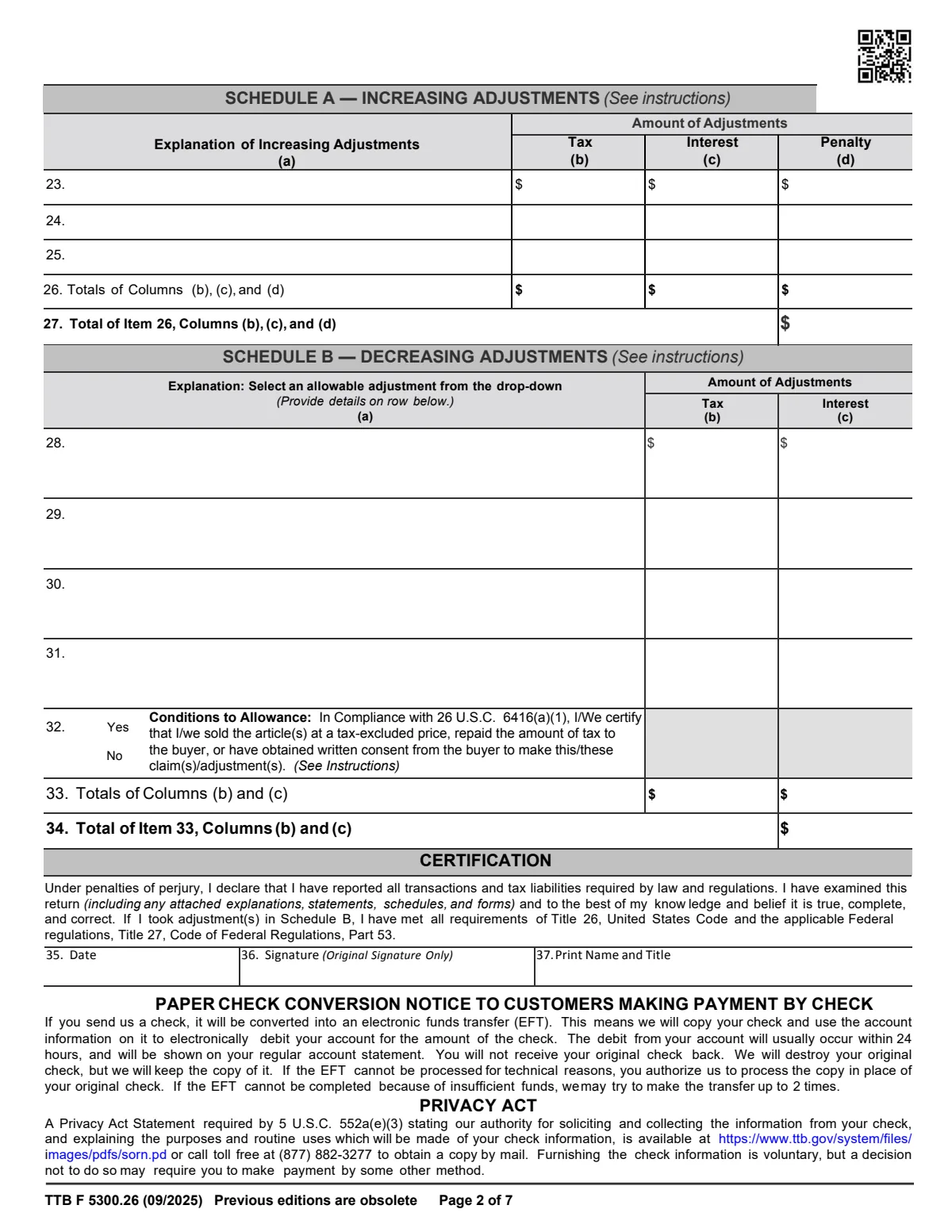
Schedule A carries underpayments from earlier quarters; Schedule B carries overpayments and credits, each tagged with a type from the form's drop-down list. A credit can instead be claimed as a refund on TTB F 5620.8: “you may claim the overpayment as a credit in Schedule B, Decreasing Adjustments, or you can file TTB F 5620.8, Claim, for a refund within the applicable statute of limitations”. Interest is computed at the rate in 26 U.S.C. 662126 U.S.C. 6621United States Code, Cornell LII. When to take a credit and when to file a claim: TTB claims, overpayments.
| Line | Label | What goes there |
|---|---|---|
| 23 | 23. (Schedule A): Explanation of Increasing Adjustments (a), Tax (b), Interest (c), Penalty (d) | Each underpayment from an earlier quarter on its own line, with the interest (at the rate in 26 U.S.C. 662126 U.S.C. 6621United States Code, Cornell LII) and any penalty. An amended return for that quarter is the other way to fix it. |
| 24 | 24. | A second increasing adjustment. |
| 25 | 25. | A third increasing adjustment. |
| 26 | 26. Totals of Columns (b), (c), and (d) | Add each column of items 23 to 25. |
| 27 | 27. Total of Item 26, Columns (b), (c), and (d) | The three totals added; carry to item 18. |
| 28 | 28. (Schedule B): Explanation: Select an allowable adjustment from the drop-down (Provide details on row below.) (a), Tax (b), Interest (c) | Pick the type from the form's list, then explain it on the row below. The fillable PDF offers seven types: 1. No liability exists or FAET paid in error; 2. Exportation, Uses and resale of articles (tax-free sales by manufacturer); 3. Tax-paid FAET articles used for further manufacture; 4. Return of tax-paid installment account causing overpayment of FAET; 5. Price readjustment; 6. Special rule (See instructions); 7. Other. “You may not make adjustments earlier than the period in which they arose.” The instructions do not say what type 6, Special rule, covers; ask the NRC before using it. |
| 29 | 29. | A second decreasing adjustment, with its type and explanation. |
| 30 | 30. | A third decreasing adjustment. |
| 31 | 31. | A fourth decreasing adjustment. |
| 32 | 32. Yes / No. Conditions to Allowance: In Compliance with 26 U.S.C. 6416(a)(1)26 U.S.C. 6416United States Code, Cornell LII, I/We certify ... | Answer only when a Schedule B line uses type 1 or type 2. Under 26 U.S.C. 6416(a)(1)26 U.S.C. 6416United States Code, Cornell LII the credit is allowed only if you did not pass the tax on to the buyer, repaid it to the ultimate purchaser, or have the buyer's written consent on file with TTB (or, for type 2, repaid or have the consent of the ultimate vendor). Without one of these, TTB denies the adjustment. |
| 33 | 33. Totals of Columns (b) and (c) | Add each column of items 28 to 31. |
| 34 | 34. Total of Item 33, Columns (b) and (c) | The two totals added; carry to item 20. |
| 35 | 35. Date | The date of signing. |
| 36 | 36. Signature (Original Signature Only) | “This form must have an original, authorized signature.” The instructions list who may sign: you for a sole proprietor, a responsible member or officer for a partnership or LLC, a principal officer for a corporation, the fiduciary for a trust or estate, or an agent with a power of attorney on file with TTB. |
| 37 | 37. Print Name and Title | The name and title of the signer in item 36. |
Rules that trip filers up
- Making deposits. There are none: the quarter's tax is paid with the return. Old deposit rules in 27 CFR part 5327 CFR part 53Code of Federal Regulations, eCFR are history, not law in force.
- Using the alcohol weekend rule. FAET due dates move to the next business day; TTB F 5000.24 due dates move to the day before.
- Leaving out unpaid sales. Except for leases and certain installment sales, every sale counts in item 8 whether or not the customer has paid.
- Subtracting tax-paid purchases. A maker that buys tax-paid articles and builds them into another does not subtract them in items 12 to 14; it takes a Schedule B credit (type 3) or files TTB F 5620.8.
- Tax-free sales without a registration number. Item 10 needs the TTB tax-free registration number.
- Credits without the 6416 certification. Type 1 and type 2 adjustments need item 32 answered, and the conditions met.
- Changing methods quietly. TTB's notice to FAET payers advises calling TTB before changing how you calculate the tax.
- Amended returns with only the changed items. An amended return is filled in completely.
How it connects
- The tax itself, its rates, exemptions and 2026 changes: firearms excise tax (FAET).
- Tax-free sales registration: TTB F 5300.28. Refund claims: TTB F 5620.8 and TTB claims and drawback.
- The TTB as a whole: TTB excise taxes. The alcohol and tobacco return: TTB F 5000.24.
- Sport fishing equipment and archery taxes, which fund the same wildlife programs, are IRS taxes on Form 720, Part II, not on this form.
Questions filers ask
Do I file TTB F 5300.26 if I made no taxable sales this quarter?
No quarterly return is required for a quarter with no tax. But if you have filed before and owe nothing for the whole calendar year, you file an annual return for that year, unless you filed a final return.
Are FAET deposits still required?
No. Since the Firearms Excise Tax Improvement Act of 2010, the tax is paid with the quarterly return. The last deposit period was Aug. 1 to 15, 2010.
When is the third-quarter 2026 return due?
Nov. 2, 2026. Oct. 31, 2026 was a Saturday, and FAET due dates move to the next business day. The fourth-quarter 2026 return is due Feb. 1, 2027.
Where do tax-free sales go?
In item 8 with all other sales, and again in item 10, with your TTB tax-free registration number. Tax-exempt sales, such as sales to the military with appropriated funds, go in item 9 instead.
Can I use my Social Security number?
Only on a one-time or occasional return. A business that regularly files FAET returns needs an EIN.
How do I correct an earlier quarter?
Either take the change on your next return (an underpayment in Schedule A, an overpayment in Schedule B) or file an amended return for that quarter, checking Amended in item 6 and completing every item. A refund can also be claimed on TTB F 5620.8.
Sources
- TTB F 5300.26, Federal Firearms and Ammunition Quarterly Excise Tax Return (09/2025), PDF with instructions
- TTB, FAET forms
- TTB, 2026 FAET due dates
- TTB, FAET Reference Guide
- TTB, FAET compliance (tax-free sales)
- 27 CFR part 53, Manufacturers excise taxes: firearms and ammunition (53.151 to 53.159)
- 26 U.S.C. 4181, Imposition of tax
- 26 U.S.C. 4182, Exemptions