- Who files
- Distillers, wineries, brewers, tobacco and papers and tubes makers
- Due
- 14th day after the period ends
- Filed with
- TTB, St. Louis, or Pay.gov
- Form revision
- TTB F 5000.24sm (11/2016)
- Pages
- 2 (form, then item 35 and instructions)
At a glance
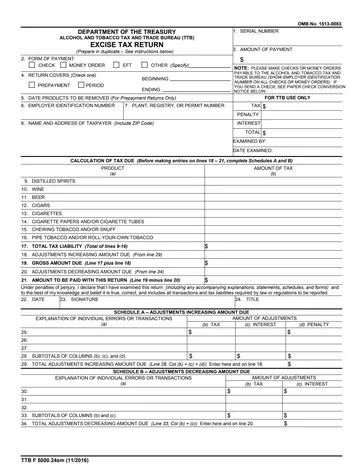
TTB F 5000.24 is the federal excise tax return for alcohol and tobacco. Distilled spirits plants, bonded wineries, breweries, tobacco products factories and cigarette papers and tubes factories report the tax on products they remove for consumption or sale and pay it to the Alcohol and Tobacco Tax and Trade Bureau (TTB). The current PDF is the "smart form" TTB F 5000.24sm (11/2016); TTB's own tips page links it as the Excise Tax Return, and the CBMA changes did not bring a new one: “No new tax return forms are required.”
- Who files. The proprietor of each taxable premises, one return per premises. Tobacco manufacturers file semimonthly whether or not they owe: “regardless of whether tobacco products are removed or whether tax is due for that particular return period”, unless TTB authorizes them in writing to skip returns with no tax due (27 CFR 40.162)27 CFR 40.162Code of Federal Regulations, eCFR.
- Return periods. Semimonthly is the rule (1st to 15th, 16th to the end of the month, three periods in September). Alcohol taxpayers who expect no more than $50,000 in tax this year, and owed no more than $50,000 last year, may file quarterly; at $1,000 or less, annually (26 U.S.C. 5061(d)(4); 27 CFR 19.235, 24.271, 25.164)26 U.S.C. 5061United States Code, Cornell LII27 CFR 19.235Code of Federal Regulations, eCFR27 CFR 24.271Code of Federal Regulations, eCFR27 CFR 25.164Code of Federal Regulations, eCFR. The TTB return period finder applies the tests.
- Due date. The 14th day after the period ends. A due date on a Saturday, Sunday or legal holiday moves to the day before, not after (27 CFR 19.236)27 CFR 19.236Code of Federal Regulations, eCFR. September has its own dates, set out on the TTB excise tax return guide.
- Where and how. Electronically through TTB forms on Pay.gov (TTB recommends it), or on paper to “TTB Excise Tax P.O. Box 790353 St. Louis, MO 63179-0353”. TTB warns: “Please DO NOT mail returns and/or payments to the National Revenue Center in Cincinnati, Ohio.”
- Prepayment returns. The same form doubles as a prepayment return when tax must be paid before removal, for example a proprietor without a bond covering deferred payment. Check Prepayment in item 4 and fill in item 5.
- Brewers in TTB's pilot. Brewers approved for the Tax Simplification Pilot file pilot forms on Pay.gov “in lieu of the Excise Tax Return, TTB F 5000.24” and the brewer's report of operations.
TTB due dates for tax returns (2026). Quarterly and annual periods are for alcohol taxpayers under the $50,000 and $1,000 tests; tobacco manufacturers file semimonthly only.
Tap a box once for its note, again to jump to the line. Zoom in to read the small print.
Items 1 to 8
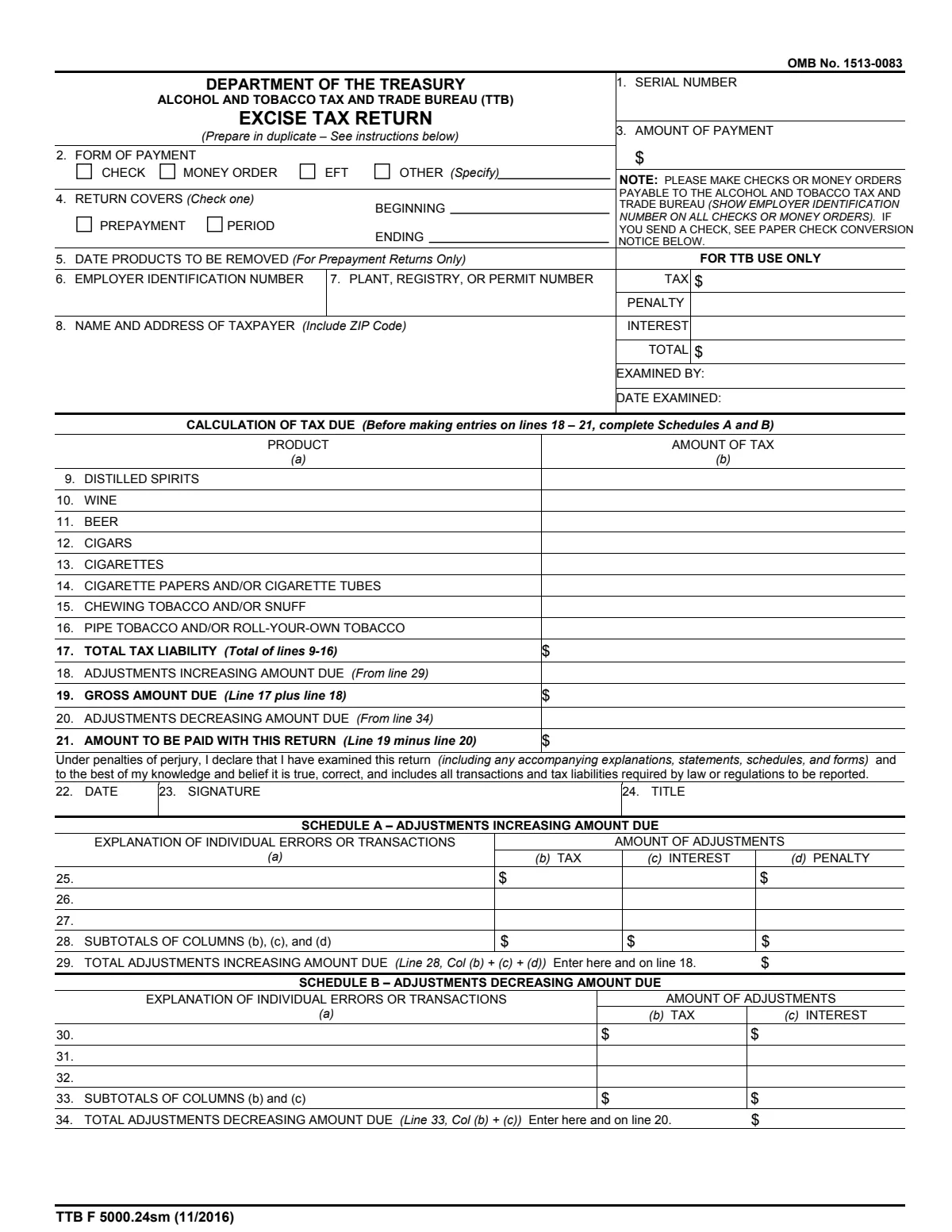
The top of the form identifies the return, the payment and the premises. Items 6 to 8 may come pre-printed on forms TTB mails; correct any error in place. A filer on Pay.gov fills in the same items on screen.
| Line | Label | What goes there |
|---|---|---|
| 1 | 1. SERIAL NUMBER | Number the returns for each premises in a series that restarts every January. TTB's tips: “The serial number in item 1 must begin with the year, then followed by number 1 at the beginning of operations, and again at the beginning of each calendar year.” After the first year the serial matches the period on the TTB due date schedule (for example TR-2026-1). Prepayment returns run in their own series, P-1, P-2 and so on, restarting each Jan. 1. |
| 2 | 2. FORM OF PAYMENT (check, money order, EFT, other) | Check the box for how you pay. “Check ‘other’ and specify ‘none’ if filing a zero balance return.” A taxpayer liable for $5 million or more in alcohol taxes in a calendar year must pay by electronic fund transfer the next year (26 U.S.C. 5061(e))26 U.S.C. 5061United States Code, Cornell LII; tobacco has the same test (26 U.S.C. 5703(b)(3))26 U.S.C. 5703United States Code, Cornell LII. |
| 3 | 3. AMOUNT OF PAYMENT | The amount you send with this return, which is line 21. Checks and money orders are made payable to the Alcohol and Tobacco Tax and Trade Bureau with the EIN written on them, as the note under item 3 says. A paper check is converted to an electronic debit. |
| 4 | 4. RETURN COVERS (Check one) Prepayment / Period, Beginning, Ending | Check Prepayment or Period and enter the dates. “Return periods will be the 1st through 15th day of the month and the 16th through the last day of the month, except for September, which requires 3 returns for semimonthly filers.” Quarterly and annual filers enter the quarter or the calendar year. |
| 5 | 5. DATE PRODUCTS TO BE REMOVED (For Prepayment Returns Only) | Only on a prepayment return: the date the products on which you are prepaying will be removed. A period return leaves it blank. |
| 6 | 6. EMPLOYER IDENTIFICATION NUMBER | The EIN of the proprietor, the same one written on the check. “Failure to enter the assigned EIN on TTB F 5000.24, may result in a $50.00 penalty for each occurrence” (27 CFR 19.242)27 CFR 19.242Code of Federal Regulations, eCFR. A proprietor without an EIN applies on IRS Form SS-4. |
| 7 | 7. PLANT, REGISTRY, OR PERMIT NUMBER | The registry or permit number of the premises this return covers. Each premises files its own return: a separate return goes in for each plant, winery, brewery or factory “from which you make removals subject to tax.” If TTB pre-printed items 6 to 8 and they are wrong, cross out the error and print the correct entry beside it. |
| 8 | 8. NAME AND ADDRESS OF TAXPAYER (Include ZIP Code) | “Item 8 should show the complete premises address as shown on your approved notice or permit.” |
| TTB-use | FOR TTB USE ONLY (Tax, Penalty, Interest, Total, Examined by, Date examined) | TTB's own boxes. Leave them blank. |
Lines 9 to 16: the tax by product
Each product line carries the tax, not the quantity: column (b) is the amount of tax. A period return includes every liability of the period. The TTB excise tax return guide walks the same lines in order. The table gives the federal rates as of November 2026; they are fixed in the Code and are not indexed (see the TTB tax and fee rates). The alcohol excise tax and tobacco excise tax pages explain the rates, and the CBMA guide covers who qualifies for the reduced rates and credits.
| Line | Product | Federal rate | Source |
|---|---|---|---|
| 9 | Distilled spirits | $13.50 a proof gallon; CBMA reduced rates $2.70 (first 100,000 proof gallons) and $13.34 (up to 22,230,000) | 26 U.S.C. 500126 U.S.C. 5001United States Code, Cornell LII; TTB rate table, 2018 to present |
| 10 | Wine | By tax class; still wine at 16% alcohol or less $1.07 a wine gallon, before the CBMA credit | 26 U.S.C. 504126 U.S.C. 5041United States Code, Cornell LII; TTB rate table |
| 11 | Beer | $18 a barrel; CBMA reduced rates $3.50 (a domestic brewer's first 60,000 barrels) and $16 | 26 U.S.C. 505126 U.S.C. 5051United States Code, Cornell LII; TTB rate table |
| 12 | Cigars | Small $50.33 per 1,000; large 52.75% of the sale price, not over $402.60 per 1,000 | 26 U.S.C. 570126 U.S.C. 5701United States Code, Cornell LII; TTB rate table |
| 13 | Cigarettes | Small $50.33 per 1,000 ($1.01 a pack of 20); large $105.69 per 1,000 | 26 U.S.C. 570126 U.S.C. 5701United States Code, Cornell LII; TTB rate table |
| 14 | Papers and tubes | Papers $0.0315 and tubes $0.0630 per 50 or part of 50 (up to 6 1/2 inches long) | 26 U.S.C. 570126 U.S.C. 5701United States Code, Cornell LII; TTB rate table |
| 15 | Chewing tobacco and snuff | Chewing $0.5033 a pound; snuff $1.51 a pound | 26 U.S.C. 570126 U.S.C. 5701United States Code, Cornell LII; TTB rate table |
| 16 | Pipe and roll-your-own | Pipe $2.8311 a pound; roll-your-own $24.78 a pound | 26 U.S.C. 570126 U.S.C. 5701United States Code, Cornell LII; TTB rate table |
| Line | Label | What goes there |
|---|---|---|
| 9 | 9. DISTILLED SPIRITS | Proof gallons removed for consumption or sale times the rate. Under the Craft Beverage Modernization Act, TTB says “For beer and distilled spirits, the CBMA reduced rates should be used to calculate the tax due for eligible products removed.” So the reduced rates ($2.70 and $13.34 a proof gallon) are built into line 9, not entered as a credit. Credits under 26 U.S.C. 501026 U.S.C. 5010United States Code, Cornell LII for wine and flavors content come off the line 9 figure. |
| 10 | 10. WINE | Wine gallons removed times the rate for each tax class. The CBMA wine credit works the other way from spirits and beer: “the CBMA tax credit, for eligible products removed, should be calculated in Schedule B, with the resulting decreasing adjustment incorporated into line 20.” So line 10 is the tax before the credit. How the credit is figured: CBMA on the return. |
| 11 | 11. BEER | Barrels times the rate, at the CBMA reduced rates where they apply. The form's instructions base line 11 on net taxable removals: the barrels removed for consumption or sale, minus the “total number of barrels returned to the brewery from which removed during the same period”. |
| 12 | 12. CIGARS | Small cigars at $50.33 per thousand; large cigars at 52.75% of the sale price, capped at $402.60 per thousand ($0.4026 a cigar). The cap and the price rules are in 27 CFR 40.2227 CFR 40.22Code of Federal Regulations, eCFR. |
| 13 | 13. CIGARETTES | Small cigarettes at $50.33 per thousand ($1.01 a pack of 20); large cigarettes at $105.69 per thousand. |
| 14 | 14. CIGARETTE PAPERS AND/OR CIGARETTE TUBES | Papers at $0.0315 and tubes at $0.0630 for each 50 or part of 50. “Tax rate for less than 50 papers is the same. The tax is not prorated.” |
| 15 | 15. CHEWING TOBACCO AND/OR SNUFF | Pounds removed: chewing tobacco at $0.5033 a pound, snuff at $1.51 a pound. |
| 16 | 16. PIPE TOBACCO AND/OR ROLL-YOUR-OWN TOBACCO | Pounds removed: pipe tobacco at $2.8311 a pound, roll-your-own at $24.78 a pound. |
Lines 17 to 24: the amount due
Lines 17 to 21 net the product taxes against the two schedules, and lines 22 to 24 are the signature block. Complete Schedules A and B before these lines, as the form's own heading says.
TTB F 5000.24sm (11/2016), lines 9 to 34, and its instructions 8 to 10.
| Line | Label | What goes there |
|---|---|---|
| 17 | 17. TOTAL TAX LIABILITY (Total of lines 9-16) | Add lines 9 to 16. A period return includes every liability of the period, even tax you already prepaid; the prepayment comes off on Schedule B. TTB asks for an entry on “Lines 17, 19, and 21, even if the amount is zero.” |
| 18 | 18. ADJUSTMENTS INCREASING AMOUNT DUE (From line 29) | The total of Schedule A. Leave it empty only when Schedule A shows NONE. |
| 19 | 19. GROSS AMOUNT DUE (Line 17 plus line 18) | Line 17 plus line 18. |
| 20 | 20. ADJUSTMENTS DECREASING AMOUNT DUE (From line 34) | The total of Schedule B: prepayments, approved claims taken as credits, the CBMA wine credit and other allowed decreases. |
| 21 | 21. AMOUNT TO BE PAID WITH THIS RETURN (Line 19 minus line 20) | The amount due, which is also item 3. Paid by check or money order with a paper return, or electronically. On Pay.gov, “Electronic payments must be made by 8:55 PM ET the business day before the due date”. |
| 22 | 22. DATE | The date of signing. |
| 23 | 23. SIGNATURE | Signed under penalties of perjury by a person with authority on file. TTB's Pay.gov page says you must have TTB F 5100.1 (signing authority) or TTB F 5000.8 (power of attorney) on file to file electronically, and its tips page adds “Stamped or photocopied signatures cannot be accepted.” |
| 24 | 24. TITLE | The signer's title, matching the authority on file. |
Schedules A and B, and item 35
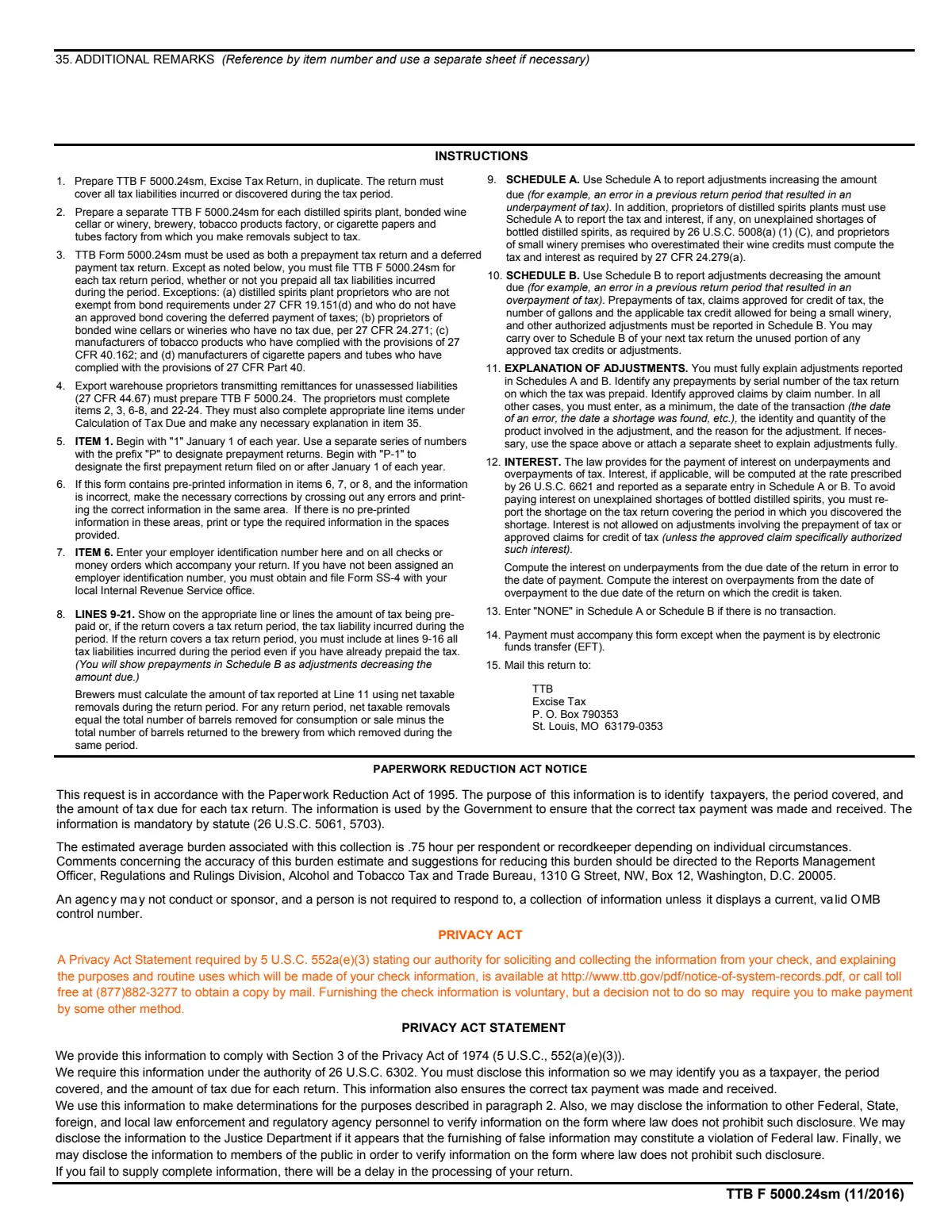
The schedules carry corrections from earlier periods and the amounts that reduce this period's payment. Interest goes in its own column: the form's instructions compute it at the rate under 26 U.S.C. 662126 U.S.C. 6621United States Code, Cornell LII, from the due date of the return in error to the date of payment for an underpayment, and from the date of the overpayment to the due date of the return taking the credit. Interest is not allowed on prepayment adjustments or approved claims unless the claim approval says so. A refund instead of a credit is claimed on TTB F 5620.8 (see TTB claims and drawback). The return guide on Schedules A and B covers both schedules.
| Line | Label | What goes there |
|---|---|---|
| 25 | 25. (Schedule A, first line): (a) explanation, (b) tax, (c) interest, (d) penalty | Schedule A reports increases. The form's examples: an error in a past period that underpaid the tax, the tax and interest on unexplained shortages of bottled spirits (26 U.S.C. 5008(a)(1)(C))26 U.S.C. 5008United States Code, Cornell LII, and a wine credit taken in excess (the form cites 27 CFR 24.279(a)27 CFR 24.279Code of Federal Regulations, eCFR, written for the pre-CBMA small winery credit; the same increasing adjustment applies to the CBMA wine credit). Each line needs a full explanation: the date of the transaction, the product and quantity, and the reason. |
| 26 | 26. (Schedule A, second line) | A second increasing adjustment, explained the same way. |
| 27 | 27. (Schedule A, third line) | A third increasing adjustment. Use item 35 or a separate sheet for more. |
| 28 | 28. SUBTOTALS OF COLUMNS (b), (c), and (d) | Add each column of lines 25 to 27. |
| 29 | 29. TOTAL ADJUSTMENTS INCREASING AMOUNT DUE (Line 28, Col (b) + (c) + (d)) Enter here and on line 18. | The three subtotals added; carry to line 18. |
| 30 | 30. (Schedule B, first line): (a) explanation, (b) tax, (c) interest | Schedule B reports decreases. “Prepayments of tax, claims approved for credit of tax, the number of gallons and the applicable tax credit allowed for being a small winery, and other authorized adjustments must be reported in Schedule B.” The 2016 form still says small winery: that credit is now the CBMA wine credit (26 U.S.C. 5041(c))26 U.S.C. 5041United States Code, Cornell LII, and TTB says to take it here, in Schedule B, flowing to line 20 (see CBMA on the return). Name each prepayment by the serial number of the prepayment return and each approved claim by its claim number. |
| 31 | 31. (Schedule B, second line) | A second decreasing adjustment, explained the same way. |
| 32 | 32. (Schedule B, third line) | A third decreasing adjustment. “You may carry over to Schedule B of your next tax return the unused portion of any approved tax credits or adjustments.” |
| 33 | 33. SUBTOTALS OF COLUMNS (b) and (c) | Add each column of lines 30 to 32. |
| 34 | 34. TOTAL ADJUSTMENTS DECREASING AMOUNT DUE (Line 33, Col (b) + (c)) Enter here and on line 20. | The two subtotals added; carry to line 20. “Enter ‘NONE’ in Schedule A or Schedule B if there is no transaction.” |
| 35 | 35. ADDITIONAL REMARKS (Reference by item number and use a separate sheet if necessary) | Explanations that do not fit in Schedules A and B, each tied to its item number. Export warehouse proprietors who send remittances for unassessed liabilities (27 CFR 44.67)27 CFR 44.67Code of Federal Regulations, eCFR also explain their payment here. |
Errors TTB sees most
TTB's Tips for Form 5000.24 page lists the errors it finds most often on excise tax returns. In short:
- Serial numbers that do not restart each January or do not match the period on the due date schedule.
- No payment method in item 2, including on a zero return, which checks Other and writes none.
- Missing dates in item 4, or the wrong September period. On Pay.gov, TTB says “Select the EFT period only if you are required to submit electronic payments. Taxpayers who voluntarily submit electronic payments must select the Non- EFT period”, and a wrong choice can make the next return late.
- A mailing address in item 8 that is not the premises address on the permit or notice.
- Blank totals. Lines 17, 19 and 21 need an entry even when they are zero; lines 18 and 20 need a matching Schedule A or B.
- A signer without authority on file with TTB, or a stamped or copied signature.
- The wrong address. Paper returns go to the St. Louis box, not to the National Revenue Center.
Late returns and payments draw penalties and interest. TTB's penalty page sets out the failure to file penalty as “a penalty equal to 5% of the tax not paid by the due date for each month or part of a month that the return is late”, and the late payment and deposit penalties with it; see TTB excise taxes.
How it connects
- The return step by step, with the September periods and Pay.gov: the TTB excise tax return guide. Which period you file: the TTB return period finder.
- The taxes behind the lines: alcohol excise tax, CBMA reduced rates and credits and tobacco excise tax.
- Permits, bonds and claims: TTB excise taxes, TTB permits and bonds and TTB claims and drawback, with the claim form TTB F 5620.8.
- The other TTB return: TTB F 5300.26 for firearms and ammunition. Federal excise taxes outside the TTB go on Form 720.
Questions filers ask
Is TTB F 5000.24sm the same as TTB F 5000.24?
Yes for filing purposes. The PDF TTB posts is the smart form version, TTB F 5000.24sm (11/2016), and TTB's tips page links it as TTB F 5000.24, Excise Tax Return. TTB's CBMA guidance says either form may be used, on paper or through Pay.gov.
Do I file a return if I removed nothing this period?
Tobacco manufacturers do, every semimonthly period, unless TTB has authorized them in writing to skip periods with no tax due. For alcohol, the form's instructions excuse bonded wineries with no tax due (27 CFR 24.271)27 CFR 24.271Code of Federal Regulations, eCFR; other proprietors file for each period of their return period, and a zero return checks Other in item 2 and writes none.
Where does the CBMA reduced rate or credit go?
For spirits and beer, figure line 9 or line 11 at the reduced rates. For wine, report the tax before the credit on line 10 and take the credit in Schedule B, which flows to line 20.
Can one return cover several breweries or plants?
No. A separate return is filed for each distilled spirits plant, winery, brewery, tobacco products factory and cigarette papers and tubes factory from which you remove taxable products. Eligibility for quarterly or annual periods, though, is figured on the combined liability of all locations.
How do I fix an error on an earlier return?
Report it on your next return: an underpayment in Schedule A, with interest, and an overpayment in Schedule B. Each adjustment needs the date of the error, the product and quantity, and the reason. A refund claim instead goes on TTB F 5620.8.
When is payment by EFT required?
When you were liable for $5 million or more in alcohol taxes (or in tobacco taxes) in a calendar year, you pay by electronic fund transfer in the following year. Others may pay through Pay.gov or by check.
Sources
- TTB F 5000.24sm, Excise Tax Return (11/2016), PDF
- TTB, Tips for Form 5000.24
- TTB, Due dates for tax returns (2026)
- TTB, Pay.gov filing and payment
- TTB, Tax and fee rates
- TTB, CBMA frequently asked questions (TR-G1, TR-G7)
- 27 CFR part 19 (distilled spirits returns), 19.235 to 19.243
- 27 CFR part 40 (tobacco returns), 40.162 to 40.165a
- 26 U.S.C. 5061, Method of collecting tax