- Who files
- Fuel businesses that must register; vendors, buyers, sellers
- Filed with
- IRS Excise Operations, Cincinnati (fax or mail)
- Penalty
- $10,000 plus $1,000 a day (required letters)
- Form revision
- Rev. December 2025
- Pages
- 2, plus the 3-page letter chart
At a glance
Form 637 is the IRS application to register for excise tax activities. “Use Form 637 to apply for excise tax registration for activities under sections 4101, 4222, 4662, and 4682.” The fuel letters are mandatory for the businesses in the bulk transfer and terminal system; the others unlock a tax-free sale or a refund claim. This page walks the two pages of the form and every row of the activity letter chart on pages 2 to 5.
- Who files. “The following persons must be registered.” Pipeline and vessel operators (X), enterers, position holders, refiners and terminal operators (S), blenders (M), and producers or importers of alcohol, biodiesel, renewable diesel, SAF, clean transportation fuel and second generation biofuel. Vendors, card issuers, manufacturers and buyers register to sell tax free or to claim.
- When. Before the activity. “The application must be reviewed and approved before you’re registered for any activity, and bond may be required.”
- Where. “Fax Form 637 to 855-887-7735 or send to:” Department of the Treasury, Internal Revenue Service, Excise Operations Unit, Form 637, Mail Stop 5701G, Cincinnati, OH 45999.
- Penalty. “The penalty for failure to register, if you’re required to register, is $10,000 for the initial failure, and $1,000 for each day following that you fail to register.”
- Form revision. Form 637 (Rev. December 2025). Its instructions are printed on pages 6 and 7; there is no separate instructions booklet.
Tap a box once for its note, again to jump to the line. Zoom in to read the small print.
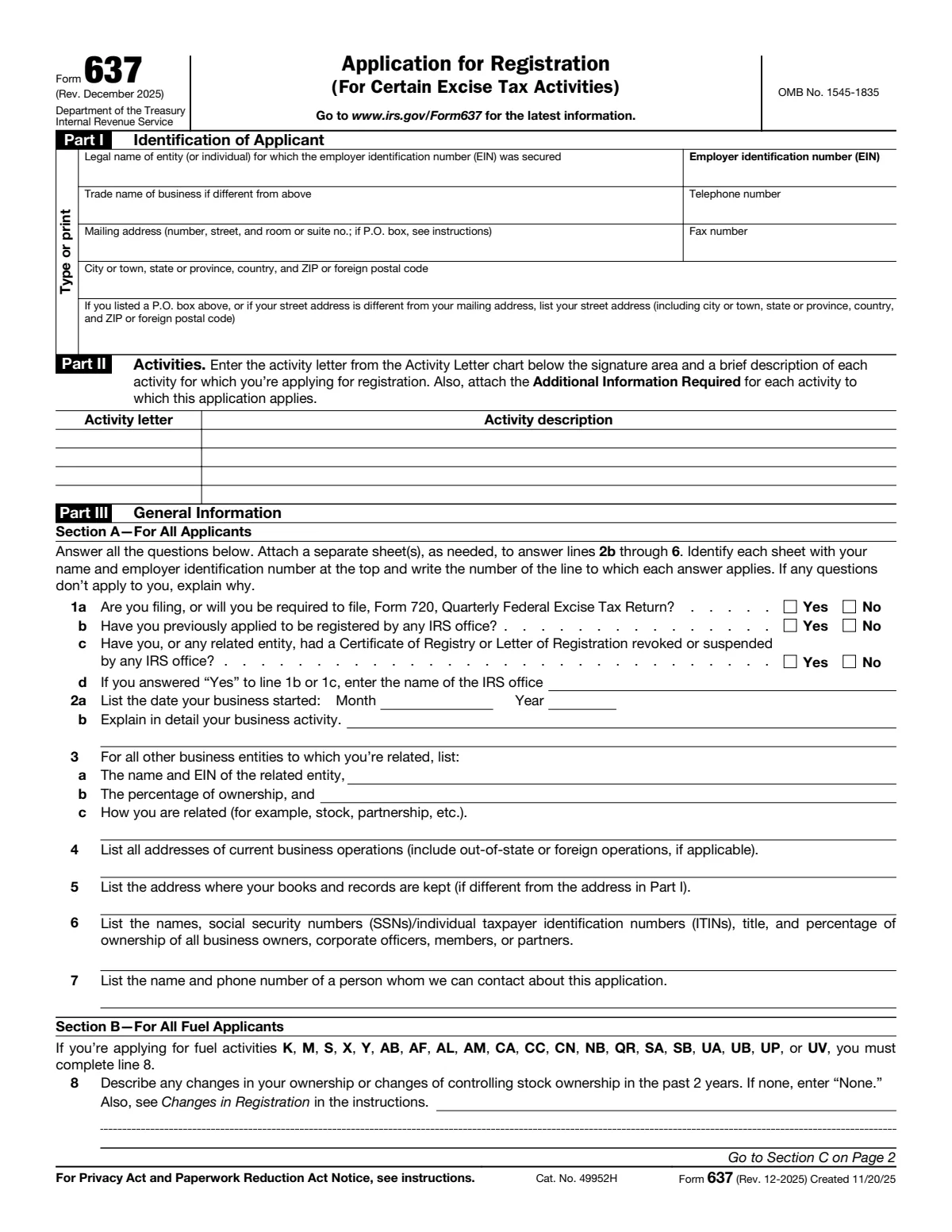
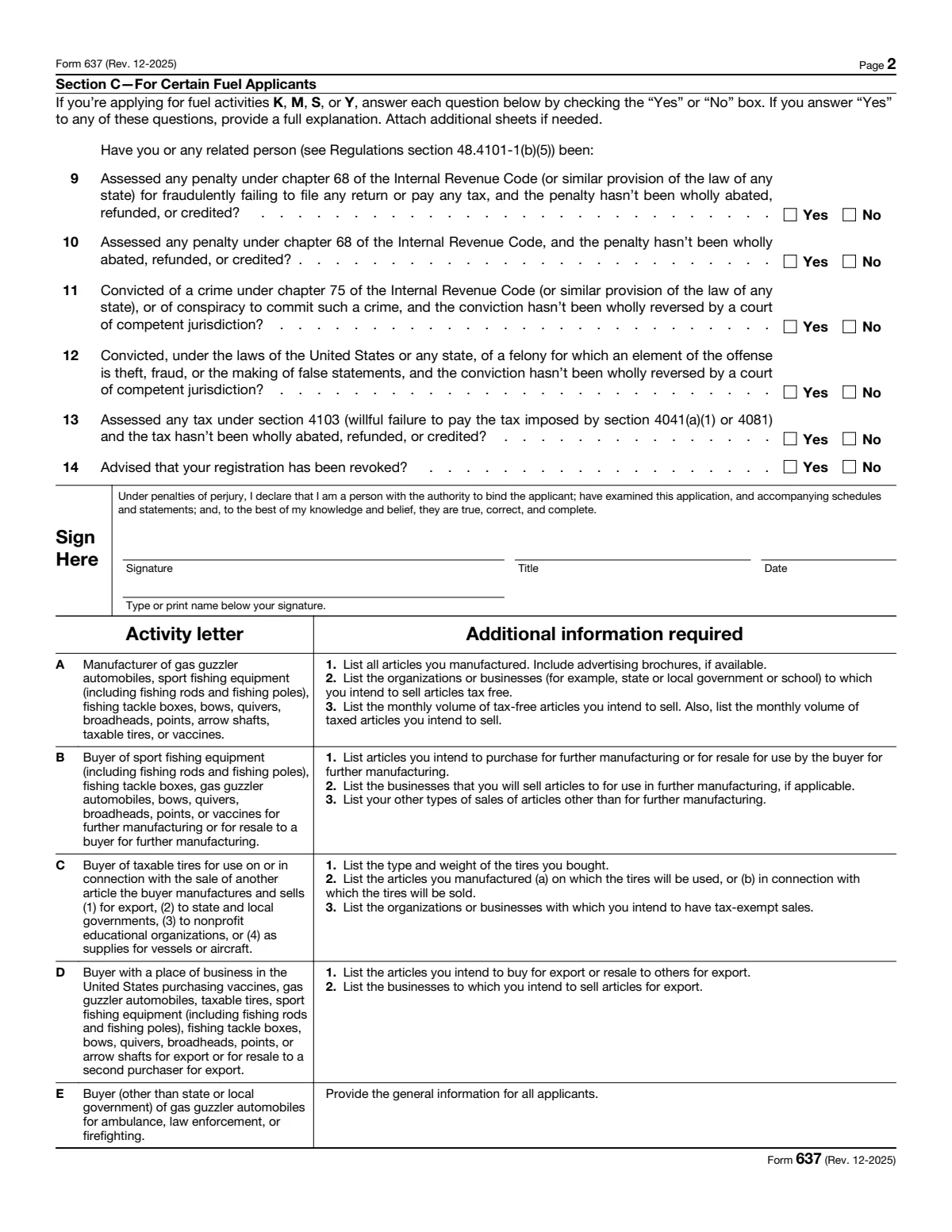
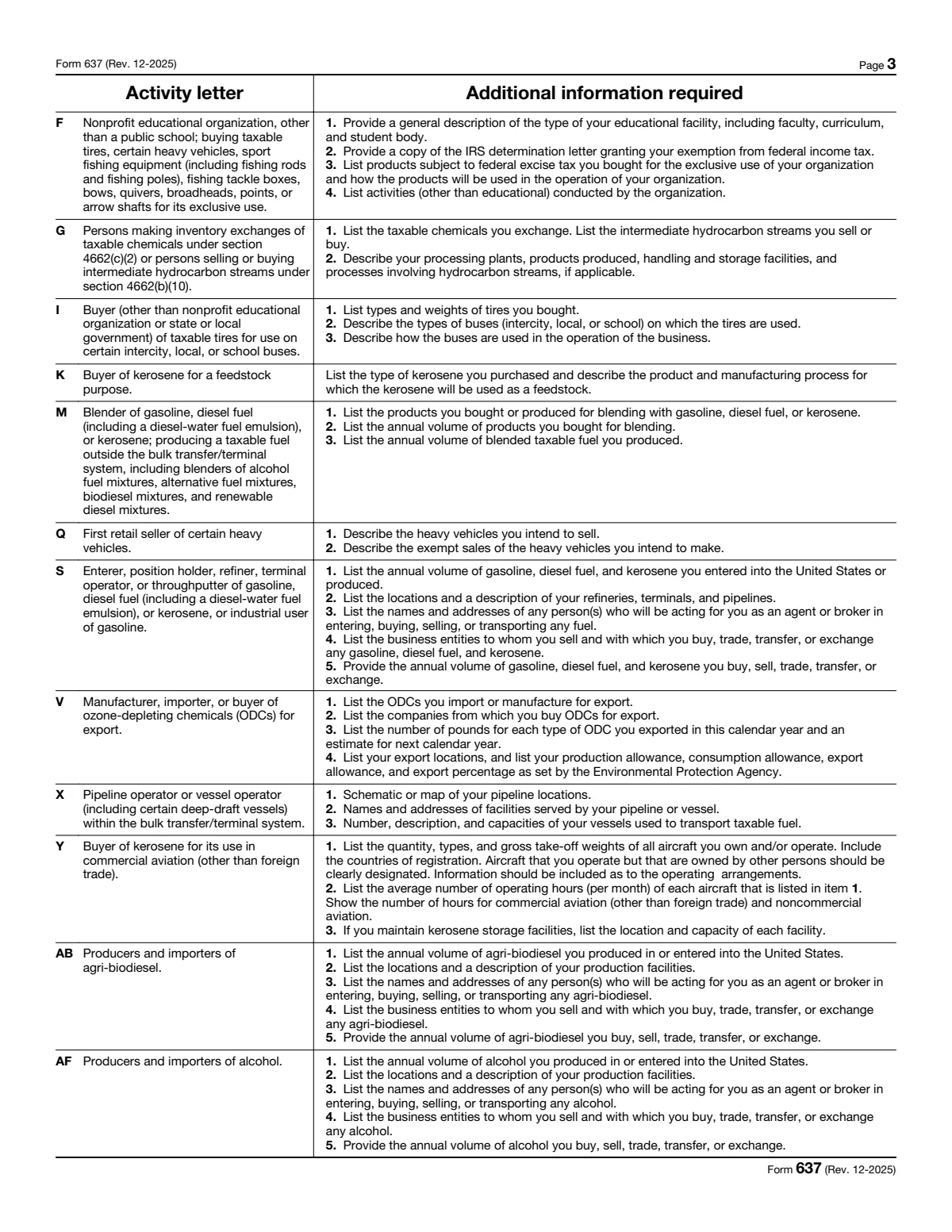
Form 637 (Rev. December 2025), Purpose of Form and the Activity Letter chart; IRM 4.24.2.1.1.
Part I: identification
Registration follows the EIN. A parent and its subsidiaries with their own EINs apply separately, and a disregarded entity with an EIN registers under that EIN.
| Line | Label | What goes there |
|---|---|---|
| 637-name | Legal name of entity (or individual) for which the employer identification number (EIN) was secured | The name the IRS has on file for the EIN. “Each business unit that has, or is required to have, a separate EIN is treated as a separate person.” |
| 637-ein | Employer identification number (EIN) | “Enter your EIN. If you don’t have an EIN, you may apply for one online by going to www.irs.gov/EIN.” The IRS manual says intake returns an application with a missing or wrong EIN. |
| 637-trade | Trade name of business if different from above | The DBA name, if any. |
| 637-phone | Telephone number | A number for the reviewer, who may call to arrange an interview or site visit. |
| 637-mail | Mailing address (number, street, and room or suite no.; if P.O. box, see instructions) | “If the post office doesn’t deliver mail to your street address and you have a P.O. box, show the box number instead of the street address.” |
| 637-fax | Fax number | Optional. |
| 637-city | City or town, state or province, country, and ZIP or foreign postal code | For the mailing address. |
| 637-street | If you listed a P.O. box above, or if your street address is different from your mailing address, list your street address | The physical address: the review “may include inspection of your premises during normal business hours without advance notice”. |
Part II: activities
| Line | Label | What goes there |
|---|---|---|
| 637-II | Part II Activities. Enter the activity letter from the Activity Letter chart ... and a brief description of each activity | One row per letter (four printed rows; attach more). “Also, attach the Additional Information Required for each activity to which this application applies.” The letters are in the chart further down this page, each with its own row in the table below. The IRS manual says intake returns an application with no activity letter. |
Part III: general information
Section A is for everyone; Section B (line 8) for most fuel letters; Section C (lines 9 to 14) only for K, M, S and Y. Attach a sheet for lines 2b to 6, with your name and EIN at the top of each and the line number. The answers feed the IRS's tests: for fuel registrations the regulation looks at the activity, acceptable risk and adequate security, and the IRS manual says “It is required that a field visit be conducted at the principal business location and/or production facility of the applicant for activities K, M, S, X, AB, AF, CA, CN, NB, SA, and SB.”
| Line | Label | What goes there |
|---|---|---|
| 637-1a | Are you filing, or will you be required to file, Form 720, Quarterly Federal Excise Tax Return? | Yes for most fuel letters: a registrant reports on Form 720. The IRS watches new registrants for a first deposit and a first Form 720 (see the CP 241 monitoring). |
| 637-1b | Have you previously applied to be registered by any IRS office? | Yes if you applied before, approved or not. |
| 637-1c | Have you, or any related entity, had a Certificate of Registry or Letter of Registration revoked or suspended by any IRS office? | Covers related entities too. A Yes is explained on an attached sheet. |
| 637-1d | If you answered “Yes” to line 1b or 1c, enter the name of the IRS office | Also used when reregistering after an ownership change: “On line 1d, enter your current registration number.” |
| 637-2a | List the date your business started: Month Year | Month and year. |
| 637-2b | Explain in detail your business activity. | On an attached sheet with your name and EIN at the top and the line number. “If any questions don’t apply to you, explain why.” |
| 637-3 | For all other business entities to which you’re related, list: | (a) name and EIN, (b) ownership percentage, (c) how related. The IRS reviews the tax history of related persons too. |
| 637-4 | List all addresses of current business operations (include out-of-state or foreign operations, if applicable). | Every location, so the reviewer can plan a site visit. |
| 637-5 | List the address where your books and records are kept (if different from the address in Part I). | Only if different. |
| 637-6 | List the names, social security numbers (SSNs)/individual taxpayer identification numbers (ITINs), title, and percentage of ownership of all business owners, corporate officers, members, or partners. | All of them. The tax history checks run on these people as well. |
| 637-7 | List the name and phone number of a person whom we can contact about this application. | The contact for information requests. An unanswered request leads to denial. |
| 637-8 | Section B: Describe any changes in your ownership or changes of controlling stock ownership in the past 2 years. If none, enter “None.” | For letters K, M, S, X, Y, AB, AF, AL, AM, CA, CC, CN, NB, QR, SA, SB, UA, UB, UP and UV. After approval, a fuel registrant “must reregister with the IRS if there’s a change of more than 50% of the ownership of a registrant”, unless its stock is regularly traded on an established securities market. |
| 637-9 | Section C, line 9: Assessed any penalty under chapter 68 ... for fraudulently failing to file any return or pay any tax ... | “If you’re applying for fuel activities K, M, S, or Y, answer each question below by checking the ‘Yes’ or ‘No’ box.” “If you answer ‘Yes’ to any of these questions, provide a full explanation.” The questions cover you and any related person under 26 CFR 48.4101-1(b)(5)26 CFR 48.4101-1Code of Federal Regulations, eCFR. |
| 637-10 | Line 10: Assessed any penalty under chapter 68 ... and the penalty hasn't been wholly abated, refunded, or credited? | Any unabated chapter 68 penalty, not just fraud. |
| 637-11 | Line 11: Convicted of a crime under chapter 75 ... or of conspiracy to commit such a crime ... | Tax crimes, federal or a similar state law, unless reversed. |
| 637-12 | Line 12: Convicted ... of a felony for which an element of the offense is theft, fraud, or the making of false statements ... | Any such felony, federal or state, unless reversed. |
| 637-13 | Line 13: Assessed any tax under section 4103 ... | “willful failure to pay the tax imposed by section 4041(a)(1) or 4081”, if not abated, refunded or credited. |
| 637-14 | Advised that your registration has been revoked? | Yes if the IRS has ever told you a registration was revoked. |
| 637-sign | Sign Here: Signature, Title, Date, Type or print name below your signature | “Form 637 must be signed by a person with authority to bind the applicant.” For a corporation that means “the president, vice-president, treasurer, assistant treasurer, chief accounting officer, or any other officer duly authorized to act for the corporation”; for a partnership, a general partner. |
Form 637 (Rev. December 2025), How To Apply and Where To Apply.
The activity letters, one by one
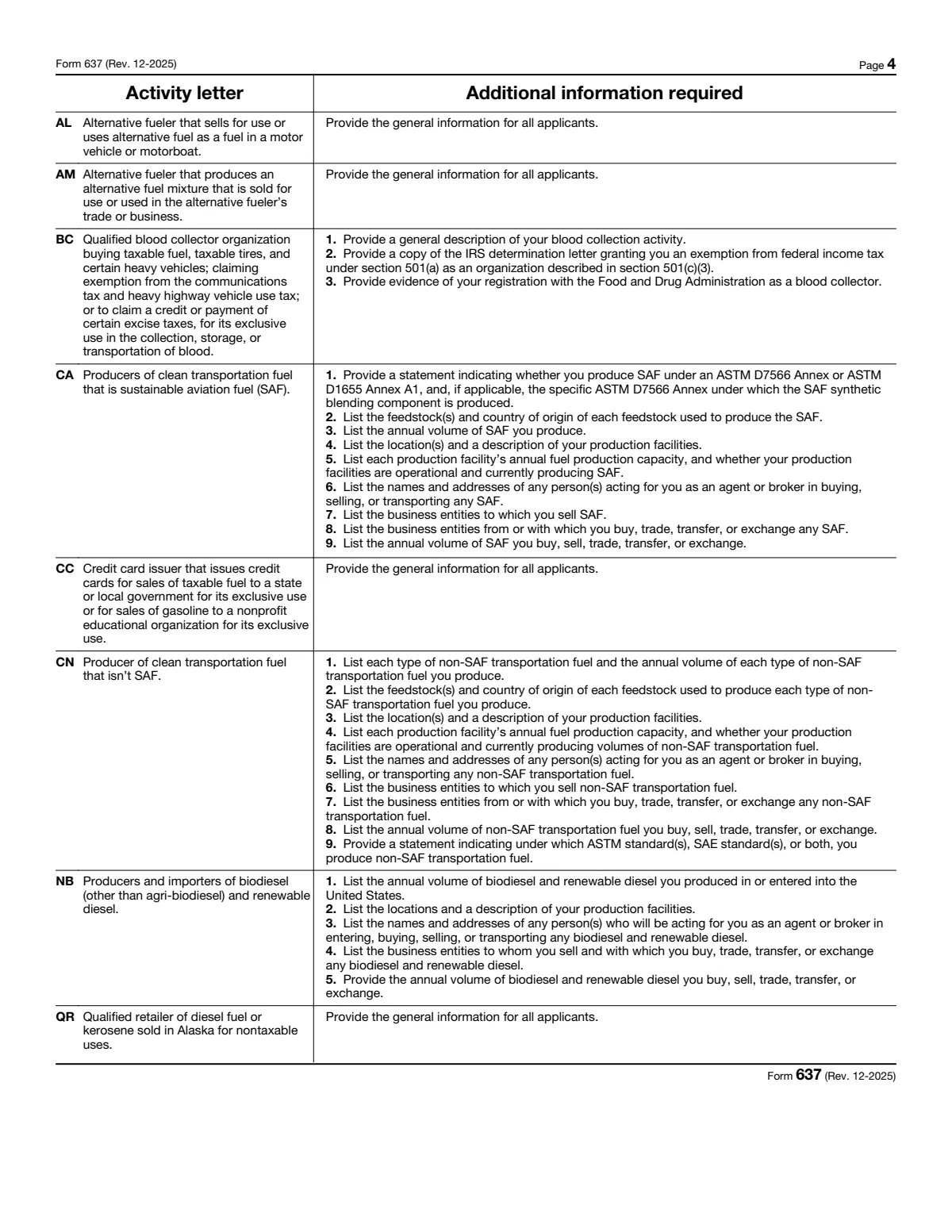
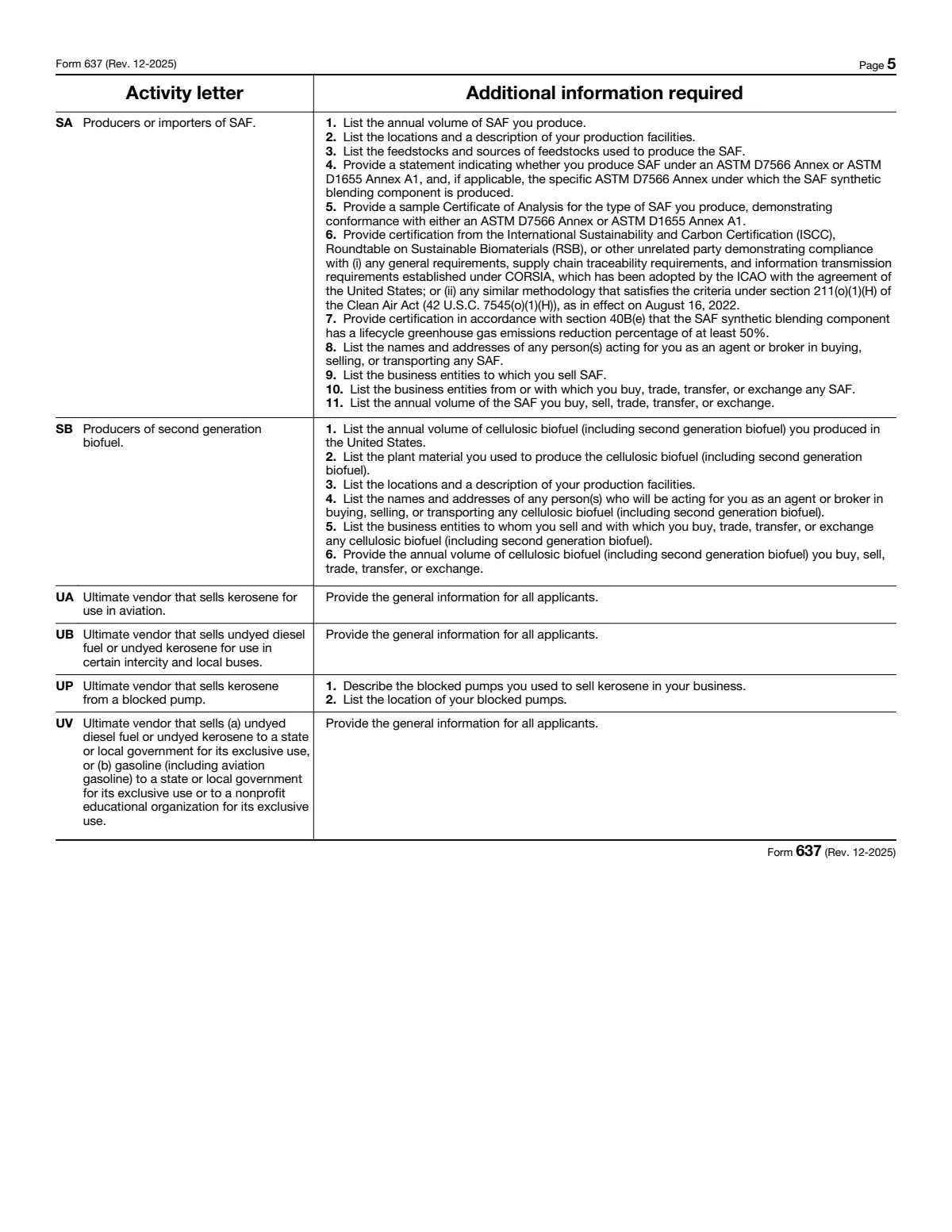
The chart below the signature area (pages 2 to 5) lists every letter and the additional information it needs. Each row is read from the form itself; the third column says what the letter is for and repeats the chart's list of attachments. Letters marked Must register are on the instructions' list of required registrations; the Form 637 guide groups them by business.
| Letter | Activity, as the chart prints it | What it is for and what to attach |
|---|---|---|
| 637-A | A: Manufacturer of gas guzzler automobiles, sport fishing equipment (including fishing rods and fishing poles), fishing tackle boxes, bows, quivers, broadheads, points, arrow shafts, taxable tires, or vaccines. | The maker registers to sell tax free: to a state or local government, a nonprofit school, for export, or to another registered manufacturer. See exempt sales of manufactured articles. Attach: 1. List all articles you manufactured. Include advertising brochures, if available. 2. List the organizations or businesses (for example, state or local government or school) to which you intend to sell articles tax free. 3. List the monthly volume of tax-free articles you intend to sell. Also, list the monthly volume of taxed articles you intend to sell. |
| 637-B | B: Buyer of sport fishing equipment (including fishing rods and fishing poles), fishing tackle boxes, gas guzzler automobiles, bows, quivers, broadheads, points, or vaccines for further manufacturing or for resale to a buyer for further manufacturing. | Lets the buyer purchase taxable articles tax free for use in further manufacturing, or for resale to such a buyer. Attach: 1. List articles you intend to purchase for further manufacturing or for resale for use by the buyer for further manufacturing. 2. List the businesses that you will sell articles to for use in further manufacturing, if applicable. 3. List your other types of sales of articles other than for further manufacturing. |
| 637-C | C: Buyer of taxable tires for use on or in connection with the sale of another article the buyer manufactures and sells (1) for export, (2) to state and local governments, (3) to nonprofit educational organizations, or (4) as supplies for vessels or aircraft. | A manufacturer buying tires for articles it sells for export, to governments, to nonprofit schools or as vessel or aircraft supplies. Attach: 1. List the type and weight of the tires you bought. 2. List the articles you manufactured (a) on which the tires will be used, or (b) in connection with which the tires will be sold. 3. List the organizations or businesses with which you intend to have tax-exempt sales. |
| 637-D | D: Buyer with a place of business in the United States purchasing vaccines, gas guzzler automobiles, taxable tires, sport fishing equipment (including fishing rods and fishing poles), fishing tackle boxes, bows, quivers, broadheads, points, or arrow shafts for export or for resale to a second purchaser for export. | A buyer with a U.S. place of business buying for export or for resale to an exporter. Attach: 1. List the articles you intend to buy for export or resale to others for export. 2. List the businesses to which you intend to sell articles for export. |
| 637-E | E: Buyer (other than state or local government) of gas guzzler automobiles for ambulance, law enforcement, or firefighting. | Ambulance, law enforcement or firefighting buyers other than state and local governments; the manufacturer registers under A. See the gas guzzler guide. Attach: Provide the general information for all applicants. |
| 637-F | F: Nonprofit educational organization, other than a public school; buying taxable tires, certain heavy vehicles, sport fishing equipment (including fishing rods and fishing poles), fishing tackle boxes, bows, quivers, broadheads, points, or arrow shafts for its exclusive use. | A nonprofit school other than a public school buying taxable articles for its exclusive use; attach the IRS determination letter. Attach: 1. Provide a general description of the type of your educational facility, including faculty, curriculum, and student body. 2. Provide a copy of the IRS determination letter granting your exemption from federal income tax. 3. List products subject to federal excise tax you bought for the exclusive use of your organization and how the products will be used in the operation of your organization. 4. List activities (other than educational) conducted by the organization. |
| 637-G | G: Persons making inventory exchanges of taxable chemicals under section 4662(c)(2) or persons selling or buying intermediate hydrocarbon streams under section 4662(b)(10). | For the Superfund chemical taxes (section 4662): tax-free inventory exchanges and intermediate hydrocarbon streams. See Superfund exemptions and Form 6627. Attach: 1. List the taxable chemicals you exchange. List the intermediate hydrocarbon streams you sell or buy. 2. Describe your processing plants, products produced, handling and storage facilities, and processes involving hydrocarbon streams, if applicable. |
| 637-I | I: Buyer (other than nonprofit educational organization or state or local government) of taxable tires for use on certain intercity, local, or school buses. | A business buying tires for intercity, local or school buses. Attach: 1. List types and weights of tires you bought. 2. Describe the types of buses (intercity, local, or school) on which the tires are used. 3. Describe how the buses are used in the operation of the business. |
| 637-K | K: Buyer of kerosene for a feedstock purpose. | May register. A Section C applicant. Attach: List the type of kerosene you purchased and describe the product and manufacturing process for which the kerosene will be used as a feedstock. |
| 637-M | M: Blender of gasoline, diesel fuel (including a diesel-water fuel emulsion), or kerosene; producing a taxable fuel outside the bulk transfer/terminal system, including blenders of alcohol fuel mixtures, alternative fuel mixtures, biodiesel mixtures, and renewable diesel mixtures. | Must register. Must register. A Section C applicant, and the IRS manual requires a field visit. Attach: 1. List the products you bought or produced for blending with gasoline, diesel fuel, or kerosene. 2. List the annual volume of products you bought for blending. 3. List the annual volume of blended taxable fuel you produced. |
| 637-Q | Q: First retail seller of certain heavy vehicles. | For tax-free sales of trucks and trailers; see the heavy truck tax page. Attach: 1. Describe the heavy vehicles you intend to sell. 2. Describe the exempt sales of the heavy vehicles you intend to make. |
| 637-S | S: Enterer, position holder, refiner, terminal operator, or throughputter of gasoline, diesel fuel (including a diesel-water fuel emulsion), or kerosene, or industrial user of gasoline. | Must register. Must register (a throughputter that is not a position holder, and an industrial user of gasoline, may). A Section C applicant; the field visit is required. Needed for the bulk transfer and terminal system and for Schedule 5 claims. Attach: 1. List the annual volume of gasoline, diesel fuel, and kerosene you entered into the United States or produced. 2. List the locations and a description of your refineries, terminals, and pipelines. 3. List the names and addresses of any person(s) who will be acting for you as an agent or broker in entering, buying, selling, or transporting any fuel. 4. List the business entities to whom you sell and with which you buy, trade, transfer, or exchange any gasoline, diesel fuel, and kerosene. 5. Provide the annual volume of gasoline, diesel fuel, and kerosene you buy, sell, trade, transfer, or exchange. |
| 637-V | V: Manufacturer, importer, or buyer of ozone-depleting chemicals (ODCs) for export. | For tax-free export sales of ozone-depleting chemicals (section 4682); attach the EPA allowances. Attach: 1. List the ODCs you import or manufacture for export. 2. List the companies from which you buy ODCs for export. 3. List the number of pounds for each type of ODC you exported in this calendar year and an estimate for next calendar year. 4. List your export locations, and list your production allowance, consumption allowance, export allowance, and export percentage as set by the Environmental Protection Agency. |
| 637-X | X: Pipeline operator or vessel operator (including certain deep-draft vessels) within the bulk transfer/terminal system. | Must register. Must register. A field visit is required. Attach: 1. Schematic or map of your pipeline locations. 2. Names and addresses of facilities served by your pipeline or vessel. 3. Number, description, and capacities of your vessels used to transport taxable fuel. |
| 637-Y | Y: Buyer of kerosene for its use in commercial aviation (other than foreign trade). | A Section C applicant. The registration behind IRS No. 77 on Form 720: “The line for IRS No. 77 is only applicable to registered commercial aviation operators (Form 637 ‘Y’ Registrant).” Attach: 1. List the quantity, types, and gross take-off weights of all aircraft you own and/or operate. Include the countries of registration. Aircraft that you operate but that are owned by other persons should be clearly designated. Information should be included as to the operating arrangements. 2. List the average number of operating hours (per month) of each aircraft that is listed in item 1. Show the number of hours for commercial aviation (other than foreign trade) and noncommercial aviation. 3. If you maintain kerosene storage facilities, list the location and capacity of each facility. |
| 637-AB | AB: Producers and importers of agri-biodiesel. | Must register. Must register. Attach: 1. List the annual volume of agri-biodiesel you produced in or entered into the United States. 2. List the locations and a description of your production facilities. 3. List the names and addresses of any person(s) who will be acting for you as an agent or broker in entering, buying, selling, or transporting any agri-biodiesel. 4. List the business entities to whom you sell and with which you buy, trade, transfer, or exchange any agri-biodiesel. 5. Provide the annual volume of agri-biodiesel you buy, sell, trade, transfer, or exchange. |
| 637-AF | AF: Producers and importers of alcohol. | Must register. Must register. Attach: 1. List the annual volume of alcohol you produced in or entered into the United States. 2. List the locations and a description of your production facilities. 3. List the names and addresses of any person(s) who will be acting for you as an agent or broker in entering, buying, selling, or transporting any alcohol. 4. List the business entities to whom you sell and with which you buy, trade, transfer, or exchange any alcohol. 5. Provide the annual volume of alcohol you buy, sell, trade, transfer, or exchange. |
| 637-AL | AL: Alternative fueler that sells for use or uses alternative fuel as a fuel in a motor vehicle or motorboat. | Sells or uses alternative fuel as a motor vehicle or motorboat fuel. “The section 6426 and section 6427 credits and payments for alternative fuels and alternative fuel mixtures expired for sales, uses, or removals after 2024.” Attach: Provide the general information for all applicants. |
| 637-AM | AM: Alternative fueler that produces an alternative fuel mixture that is sold for use or used in the alternative fueler's trade or business. | Produces an alternative fuel mixture sold or used in its business. The mixture credit and payment also ended after 2024. Attach: Provide the general information for all applicants. |
| 637-BC | BC: Qualified blood collector organization buying taxable fuel, taxable tires, and certain heavy vehicles; claiming exemption from the communications tax and heavy highway vehicle use tax; or to claim a credit or payment of certain excise taxes, for its exclusive use in the collection, storage, or transportation of blood. | A section 501(c)(3) blood collector registered with the FDA, for tax-free purchases and claims for its exclusive use. Attach: 1. Provide a general description of your blood collection activity. 2. Provide a copy of the IRS determination letter granting you an exemption from federal income tax under section 501(a) as an organization described in section 501(c)(3). 3. Provide evidence of your registration with the Food and Drug Administration as a blood collector. |
| 637-CA | CA: Producers of clean transportation fuel that is sustainable aviation fuel (SAF). | Must register. Must register. For the section 45Z clean fuel production credit on fuel sold after 2024 (Form 637, What's New). Attach: 1. Provide a statement indicating whether you produce SAF under an ASTM D7566 Annex or ASTM D1655 Annex A1, and, if applicable, the specific ASTM D7566 Annex under which the SAF synthetic blending component is produced. 2. List the feedstock(s) and country of origin of each feedstock used to produce the SAF. 3. List the annual volume of SAF you produce. 4. List the location(s) and a description of your production facilities. 5. List each production facility's annual fuel production capacity, and whether your production facilities are operational and currently producing SAF. 6. List the names and addresses of any person(s) acting for you as an agent or broker in buying, selling, or transporting any SAF. 7. List the business entities to which you sell SAF. 8. List the business entities from or with which you buy, trade, transfer, or exchange any SAF. 9. List the annual volume of SAF you buy, sell, trade, transfer, or exchange. |
| 637-CC | CC: Credit card issuer that issues credit cards for sales of taxable fuel to a state or local government for its exclusive use or for sales of gasoline to a nonprofit educational organization for its exclusive use. | Needed to claim on Schedule 8 for fuel bought with the issuer's card by governments and nonprofit schools. Attach: Provide the general information for all applicants. |
| 637-CN | CN: Producer of clean transportation fuel that isn't SAF. | Must register. Must register, for the section 45Z credit. Attach: 1. List each type of non-SAF transportation fuel and the annual volume of each type of non-SAF transportation fuel you produce. 2. List the feedstock(s) and country of origin of each feedstock used to produce each type of non- SAF transportation fuel you produce. 3. List the location(s) and a description of your production facilities. 4. List each production facility's annual fuel production capacity, and whether your production facilities are operational and currently producing volumes of non-SAF transportation fuel. 5. List the names and addresses of any person(s) acting for you as an agent or broker in buying, selling, or transporting any non-SAF transportation fuel. 6. List the business entities to which you sell non-SAF transportation fuel. 7. List the business entities from or with which you buy, trade, transfer, or exchange any non-SAF transportation fuel. 8. List the annual volume of non-SAF transportation fuel you buy, sell, trade, transfer, or exchange. 9. Provide a statement indicating under which ASTM standard(s), SAE standard(s), or both, you produce non-SAF transportation fuel. |
| 637-NB | NB: Producers and importers of biodiesel (other than agri-biodiesel) and renewable diesel. | Must register. Must register. Attach: 1. List the annual volume of biodiesel and renewable diesel you produced in or entered into the United States. 2. List the locations and a description of your production facilities. 3. List the names and addresses of any person(s) who will be acting for you as an agent or broker in entering, buying, selling, or transporting any biodiesel and renewable diesel. 4. List the business entities to whom you sell and with which you buy, trade, transfer, or exchange any biodiesel and renewable diesel. 5. Provide the annual volume of biodiesel and renewable diesel you buy, sell, trade, transfer, or exchange. |
| 637-QR | QR: Qualified retailer of diesel fuel or kerosene sold in Alaska for nontaxable uses. | Diesel or kerosene sold in Alaska for nontaxable uses. Attach: Provide the general information for all applicants. |
| 637-SA | SA: Producers or importers of SAF. | Must register. Must register. The section 40B SAF credit covered mixtures sold or used after 2022 and before Jan. 1, 2025 (Form 637, Reminder). Attach: 1. List the annual volume of SAF you produce. 2. List the locations and a description of your production facilities. 3. List the feedstocks and sources of feedstocks used to produce the SAF. 4. Provide a statement indicating whether you produce SAF under an ASTM D7566 Annex or ASTM D1655 Annex A1, and, if applicable, the specific ASTM D7566 Annex under which the SAF synthetic blending component is produced. 5. Provide a sample Certificate of Analysis for the type of SAF you produce, demonstrating conformance with either an ASTM D7566 Annex or ASTM D1655 Annex A1. 6. Provide certification from the International Sustainability and Carbon Certification (ISCC), Roundtable on Sustainable Biomaterials (RSB), or other unrelated party demonstrating compliance with (i) any general requirements, supply chain traceability requirements, and information transmission requirements established under CORSIA, which has been adopted by the ICAO with the agreement of the United States; or (ii) any similar methodology that satisfies the criteria under section 211(o)(1)(H) of the Clean Air Act (42 U.S.C. 7545(o)(1)(H))42 U.S.C. 7545United States Code, Cornell LII, as in effect on August 16, 2022. 7. Provide certification in accordance with section 40B(e) that the SAF synthetic blending component has a lifecycle greenhouse gas emissions reduction percentage of at least 50%. 8. List the names and addresses of any person(s) acting for you as an agent or broker in buying, selling, or transporting any SAF. 9. List the business entities to which you sell SAF. 10. List the business entities from or with which you buy, trade, transfer, or exchange any SAF. 11. List the annual volume of the SAF you buy, sell, trade, transfer, or exchange. |
| 637-SB | SB: Producers of second generation biofuel. | Must register. Must register. Attach: 1. List the annual volume of cellulosic biofuel (including second generation biofuel) you produced in the United States. 2. List the plant material you used to produce the cellulosic biofuel (including second generation biofuel). 3. List the locations and a description of your production facilities. 4. List the names and addresses of any person(s) who will be acting for you as an agent or broker in buying, selling, or transporting any cellulosic biofuel (including second generation biofuel). 5. List the business entities to whom you sell and with which you buy, trade, transfer, or exchange any cellulosic biofuel (including second generation biofuel). 6. Provide the annual volume of cellulosic biofuel (including second generation biofuel) you buy, sell, trade, transfer, or exchange. |
| 637-UA | UA: Ultimate vendor that sells kerosene for use in aviation. | Needed for Schedule 2, line 3. Attach: Provide the general information for all applicants. |
| 637-UB | UB: Ultimate vendor that sells undyed diesel fuel or undyed kerosene for use in certain intercity and local buses. | Needed for Schedule 2, lines 1b and 2c. Attach: Provide the general information for all applicants. |
| 637-UP | UP: Ultimate vendor that sells kerosene from a blocked pump. | Needed for Schedule 2, line 2b. Attach: 1. Describe the blocked pumps you used to sell kerosene in your business. 2. List the location of your blocked pumps. |
| 637-UV | UV: Ultimate vendor that sells (a) undyed diesel fuel or undyed kerosene to a state or local government for its exclusive use, or (b) gasoline (including aviation gasoline) to a state or local government for its exclusive use or to a nonprofit educational organization for its exclusive use. | Needed for Schedule 2, lines 1a, 2a, 4a, 4b, 5a, 5b, and 3d and 3e for type of use 14. Attach: Provide the general information for all applicants. |
After you file
“If your application is approved, the IRS will issue a Letter of Registration.” The letter lists the activities, the effective date and the registration number. The IRS manual adds “A copy of the Form 637 application is not considered proof of registration. Letter 3689 should be retained as proof of registration.” There is no renewal, but changes must be reported: “Notify the IRS office within 10 days if any information submitted with an application changes.” “A registrant may not sell, lease, or otherwise allow another person to use its registration.”
Customers check you, and you check them. “To confirm the status of a registration, go to https://apps.irs.gov/app/exciseTax/.” The public tool is the Online Form 637 Registration Status Check. A seller making a tax-free sale keeps the buyer's certificate with the registration number; the tax-free sales guide's certificates section lists which certificate goes with which sale, and the Form 637 tax-free sales checklist is a template for the file. Denials, the 10-day appeal and revocations are covered in the Form 637 guide.
Rules that trip filers up
- Starting before approval. A required fuel registration must be in place before the activity; the penalty runs per day and, per the IRS manual, per activity letter.
- Leaving out the chart's attachments. “You must send all of the required information or the processing of your application will be delayed.”
- No activity letter, a wrong EIN or no signer. The IRS manual has intake return those applications unprocessed.
- The wrong signer. Only a person who can bind the applicant: an officer, a general partner, a member manager of an LLC taxed as a partnership.
- Forgetting to reregister. A change of more than 50% of ownership of a fuel registrant needs a new Form 637 and a new number; failing to reregister carries the same penalty.
- Applying for a second activity on a new form. “To apply for another activity or to cancel a registration, you must contact the IRS office in which you’re registered.”
How it connects
- The guide behind this form: Form 637: IRS excise tax registration, with the status check and the penalty.
- What the registration unlocks: tax-free sales, vendor and card issuer claims on Form 8849, and the registrant lines on Form 720 (IRS No. 77, Schedule T).
- The taxes behind the non-fuel letters: manufacturers taxes, heavy truck tax and Superfund taxes.
Questions filers ask
How do I apply for an IRS excise tax registration?
File Form 637 with the activity letters you need and the additional information the chart lists for each, signed by a person who can bind the business. Fax it to 855-887-7735 or mail it to the Excise Operations Unit, Mail Stop 5701G, Cincinnati, OH 45999.
Which activity letter does a position holder or terminal operator need?
Letter S, which covers enterers, position holders, refiners, terminal operators, throughputters and industrial users of gasoline. Pipeline and vessel operators use X, and blenders M.
Is a copy of Form 637 proof of registration?
No. The IRS issues a Letter of Registration (Letter 3689) with your registration number, activities and effective date. Keep it; the IRS manual calls it the proof of registration.
Who answers Section C?
Only applicants for letters K, M, S and Y. Each Yes needs a full explanation, and the questions cover related persons too.
Do I need to file a new Form 637 when ownership changes?
A fuel registrant must reregister after a change of more than 50% of its ownership, unless its stock is regularly traded on an established securities market. Enter the current registration number on line 1d.
How can I check a customer's registration?
Use the IRS Online Form 637 Registration Status Check at apps.irs.gov, and keep the buyer's certificate with its registration number for each tax-free sale.