- Who files
- Arizona liquor wholesalers, one return per license
- Due
- 20th of the next month
- Filed with
- ADOR, Liquor Tax, by mail
- Form revision
- ADOR 11080 (3/16)
- Pages
- 4, plus 2 pages of instructions
At a glance
Form 815 is the Arizona Department of Revenue's (ADOR) monthly return for the liquor luxury tax at the wholesale tier. Arizona taxes liquor at one level only: “Arizona imposes a ‘luxury’ tax only at the second tier level (i.e. on the wholesaler for sales of liquor within the state).” So the wholesaler, not the producer or the retailer, files this return.
- Who files. “You must file this return and pay the luxury tax if you are a wholesaler of spirituous or vinous liquor selling spirituous or vinous liquor within the state of Arizona.” Malt is different: wholesalers “purchasing malt liquors for resale within the State” file and pay on their purchases. Craft distilleries, farm wineries, microbreweries, cider producers and direct shippers selling at retail use Form 835 instead.
- When. “This return and the tax shown is due not later than the 20th day of the 1st month following the month for which this return is made and is delinquent if the tax is not paid within ten (10) days after the due date.” “Prepare this return for each month regardless of whether or not any tax is due.”
- How and where. On paper, with payment, to the address printed at the foot of the form: Arizona Department of Revenue, Liquor Tax, PO Box 29019, Phoenix, AZ 85038-9019. ADOR posts the form on its liquor tax forms page (Form 815 PDF). Include your taxpayer ID on the check.
- Units. “Report all alcoholic beverages in wine gallons. Round to the nearest one-hundredth of a gallon.” The instructions carry a case conversion chart for metric bottle sizes (a 12-bottle case of 750 milliliter bottles is 2.3775 gallons).
- Form revision. ADOR 11080 (3/16), four form pages and two pages of instructions; ADOR's form page shows a publish date of 03/01/2016, still current as of November 2026.
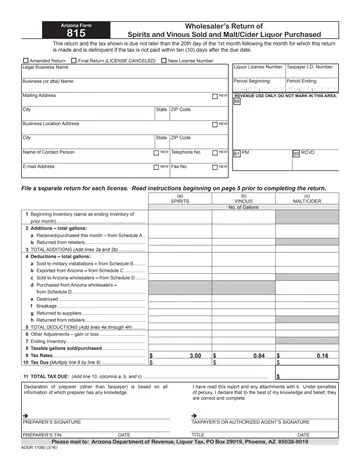
Form 815 line 9 and its first lines; ADOR liquor luxury tax page, read Nov. 22, 2026.
Tap a box once for its note, again to jump to the line. Zoom in to read the small print.
Header
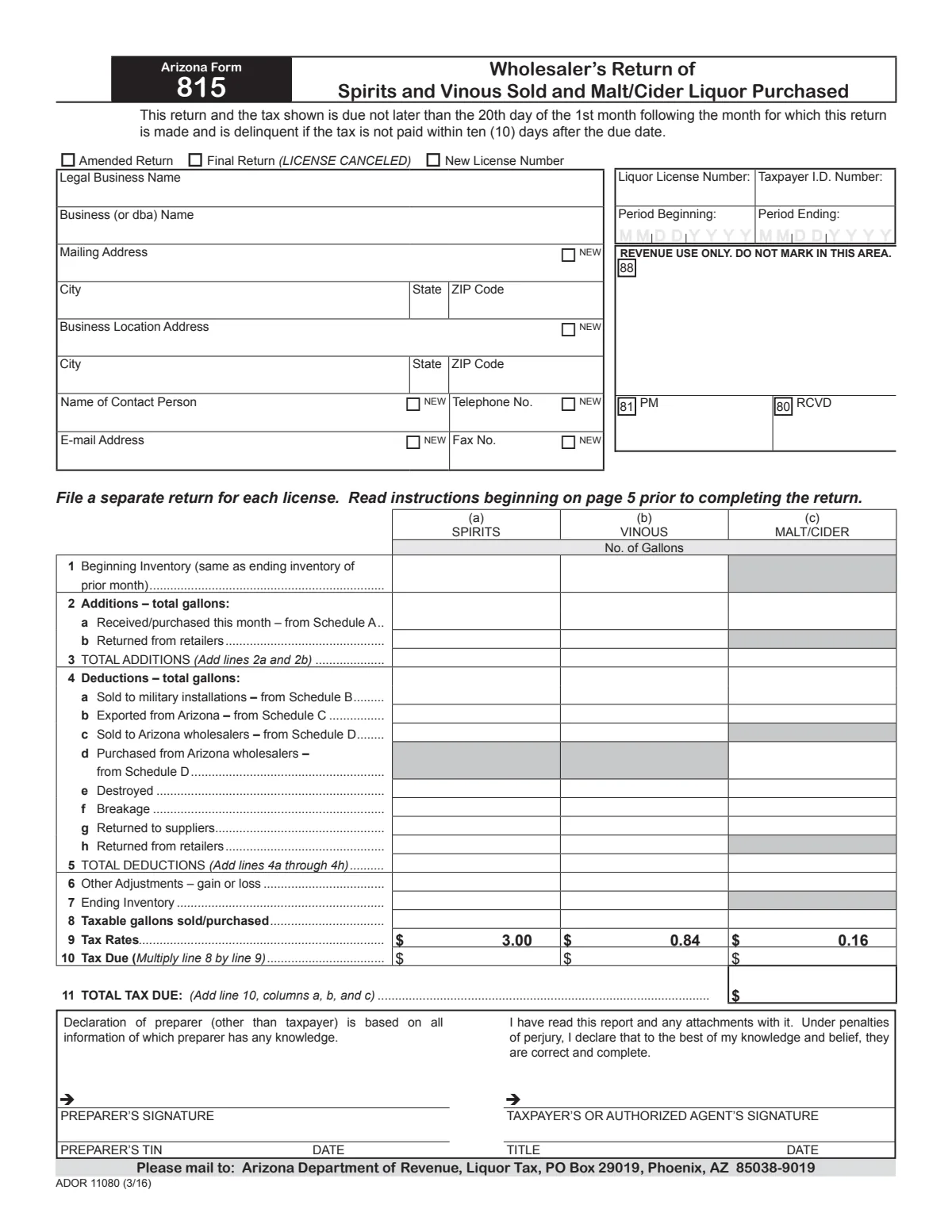
The header identifies the license. Arizona wants one return per license, so a wholesaler with two licensed warehouses files two Forms 815. The fillable PDF computes the yellow total cells (lines 3, 5, 8, 10 and 11); ADOR's note on the form says to print it with its own Print button so the totals calculate.
| Line | Label | What goes there |
|---|---|---|
| Status | Amended Return; Final Return (LICENSE CANCELED); New License Number | Check Amended Return to correct a return already filed, Final Return when the liquor license is canceled, and New License Number when the license number has changed. Leave all three blank on an ordinary return. |
| Names | Legal Business Name; Business (or dba) Name | The licensee's legal name and its trade name. “File a separate return for each license.” |
| Mailing | Mailing Address, City, State, ZIP Code | The mailing address. The NEW box beside it tells ADOR the address changed. |
| Location | Business Location Address, City, State, ZIP Code | The street address of the licensed location, which may differ from the mailing address. |
| Contact | Name of Contact Person; Telephone No.; E-mail Address; Fax No. | The person who can answer questions about the return, with phone, email and fax. Each has a NEW box for a change. |
| License-TIN | Liquor License Number; Taxpayer I.D. Number | The liquor license number and the taxpayer identification number. “A taxpayer identification number is either your Federal Employer Identification Number (EIN) or your Social Security Number (SSN), if you are a sole proprietor with no employees.” |
| Period | Period Beginning; Period Ending | The first and last day the return covers, in the MM DD YYYY boxes. The box below them is for ADOR's use only. |
Lines 1 to 11
Lines 2 and 4 are headings ("Additions" and "Deductions"); their lettered lines carry the numbers. Three cells are shaded on purpose: malt/cider has no beginning or ending inventory and no retailer returns, and spirits and vinous have no line 4d. That follows from how the tax is measured: spirits and wine by what left inventory, malt and cider by what the wholesaler bought.
Arizona Form 815 (ADOR 11080, 3/16) and its instructions.
| Line | Label | What goes there |
|---|---|---|
| 1 | Beginning Inventory (same as ending inventory of prior month) | “For spirits and vinous, enter the ending inventory amount from line 7 of the previous month's report.” If the two do not agree, attach an explanation. The malt/cider column is shaded: malt is taxed on purchases, so it carries no inventory. |
| 2a | 2a Received/purchased this month, from Schedule A | “On Schedule A, enter all beverages you have received or purchased this month.” Carry the Schedule A total here. Malt bought from other Arizona wholesalers must be listed on Schedule A too, or it cannot be deducted on line 4d. |
| 2b | 2b Returned from retailers | “Enter any spirits or vinous returned by your retailers during the month on line 2b and on line 4h.” The malt/cider cell is shaded. |
| 3 | TOTAL ADDITIONS (Add lines 2a and 2b) | Line 2a plus line 2b, in each column. |
| 4a | 4a Sold to military installations, from Schedule B | “On Schedule B, enter any tax-free sales to the military during the month.” Attach the schedule; a computer list may replace it. |
| 4b | 4b Exported from Arizona, from Schedule C | “On Schedule C, enter any beverage sold out of state during the month.” |
| 4c | 4c Sold to Arizona wholesalers, from Schedule D | Spirits and vinous only: “enter on Schedule D all spirits and vinous sold to other licensed Arizona wholesalers during the month.” Transfers between licensed locations of the same company go here too, with documentation. |
| 4d | 4d Purchased from Arizona wholesalers, from Schedule D | Malt/cider only (the spirits and vinous cells are shaded): “enter on Schedule D all purchases of malt/cider from other licensed Arizona wholesalers during the month.” The wholesaler that sold it to you already paid the tax. “You cannot list any malt as a deduction on this schedule unless you listed them on Schedule A” |
| 4e | 4e Destroyed | “Enter any beverage that you destroyed during the month.” |
| 4f | 4f Breakage | “Enter any beverage that broke during the month.” |
| 4g | 4g Returned to suppliers | “Enter any beverage that you returned to your suppliers during the month.” |
| 4h | 4h Returned from retailers | The same amount as line 2b. Listing it as both an addition and a deduction keeps the inventory math straight while the tax on the returned product is not paid twice. |
| 5 | TOTAL DEDUCTIONS (Add lines 4a through 4h) | Lines 4a through 4h, each column. |
| 6 | 6 Other Adjustments: gain or loss | “List any adjustments for the prior month and attach a written explanation.” |
| 7 | Ending Inventory | “For spirits and vinous, enter your month's ending inventory from your company records.” Next month's line 1 must match it. |
| 8 | 8 Taxable gallons sold/purchased | Two formulas. “For spirits and vinous, add lines 1 and 3. Subtract lines 5 and 7, and adjust for line 6.” “For malt/cider, subtract line 5 from line 3, and adjust for line 6.” So spirits and wine are taxed on what left inventory (sales); malt and cider on what was bought for resale. |
| 9 | 9 Tax Rates | Preprinted on the form: $3.00 a gallon for spirits, $0.84 for vinous and $0.16 for malt/cider. ADOR's tax page lists the same rates under A.R.S. 42-3052, as of November 2026, plus “more than 24% alcohol (per gallon) $4.00” for stronger wine. The form's instructions say instead to “Contact the Luxury Tax Section of the Arizona Department of Revenue for the rate on any vinous with an alcohol content of more than 24% by volume”. The statute governs; ask ADOR before filing wine over 24%. |
| 10 | 10 Tax Due (Multiply line 8 by line 9) | “For each column (a), (b), and (c), multiply the number of gallons entered on line 8 by the rate on line 9.” |
| 11 | 11 TOTAL TAX DUE: (Add line 10, columns a, b, and c) | “Add the amounts in columns (a), (b), and (c) of line 10. Enter this amount as the Total Tax Due.” |
| Sign | Preparer's signature, TIN, date; Taxpayer's or authorized agent's signature, title, date | “The Licensee or Authorized Agent must sign the return.” “If you pay a preparer to complete this return, the preparer must sign the return and include his or her identification number.” |
Schedules A to D and the continuation page
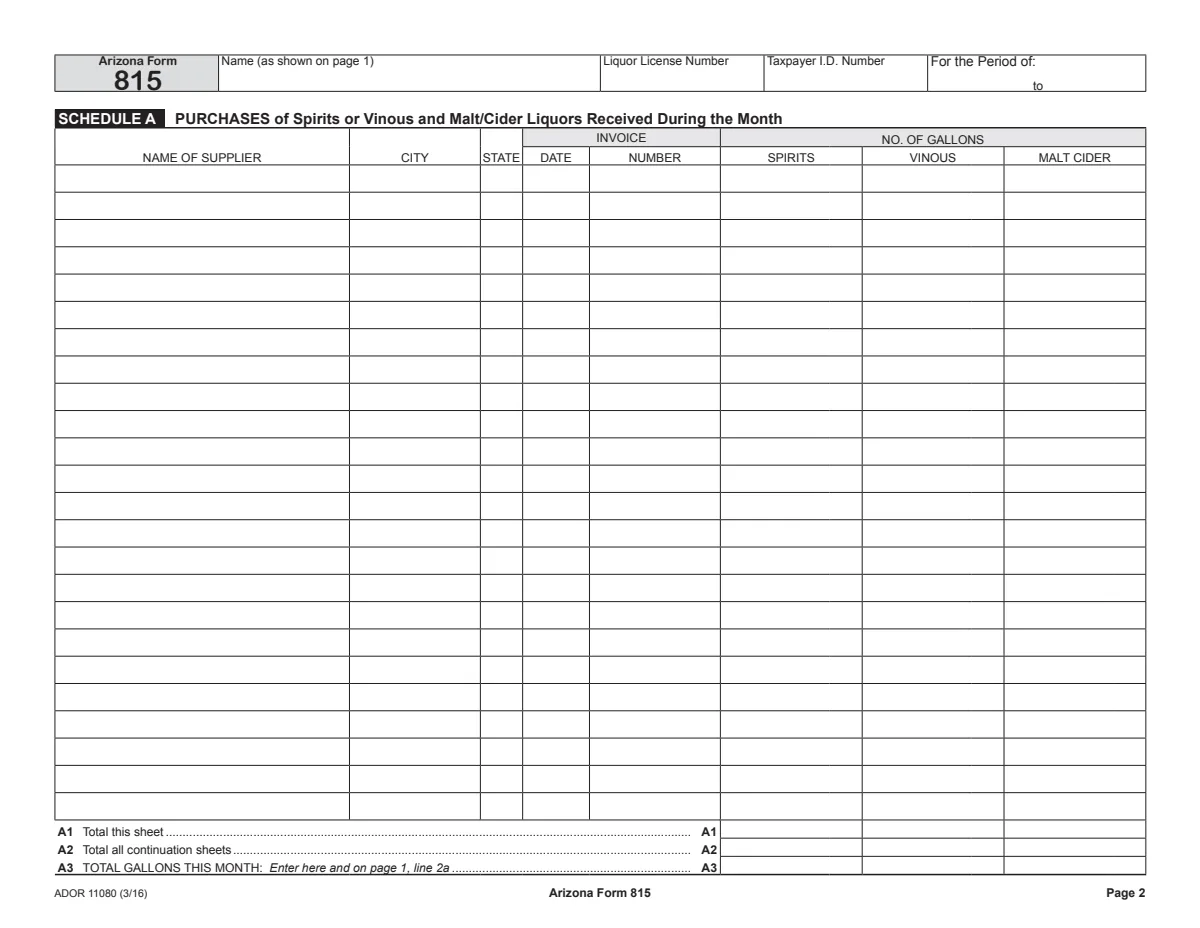
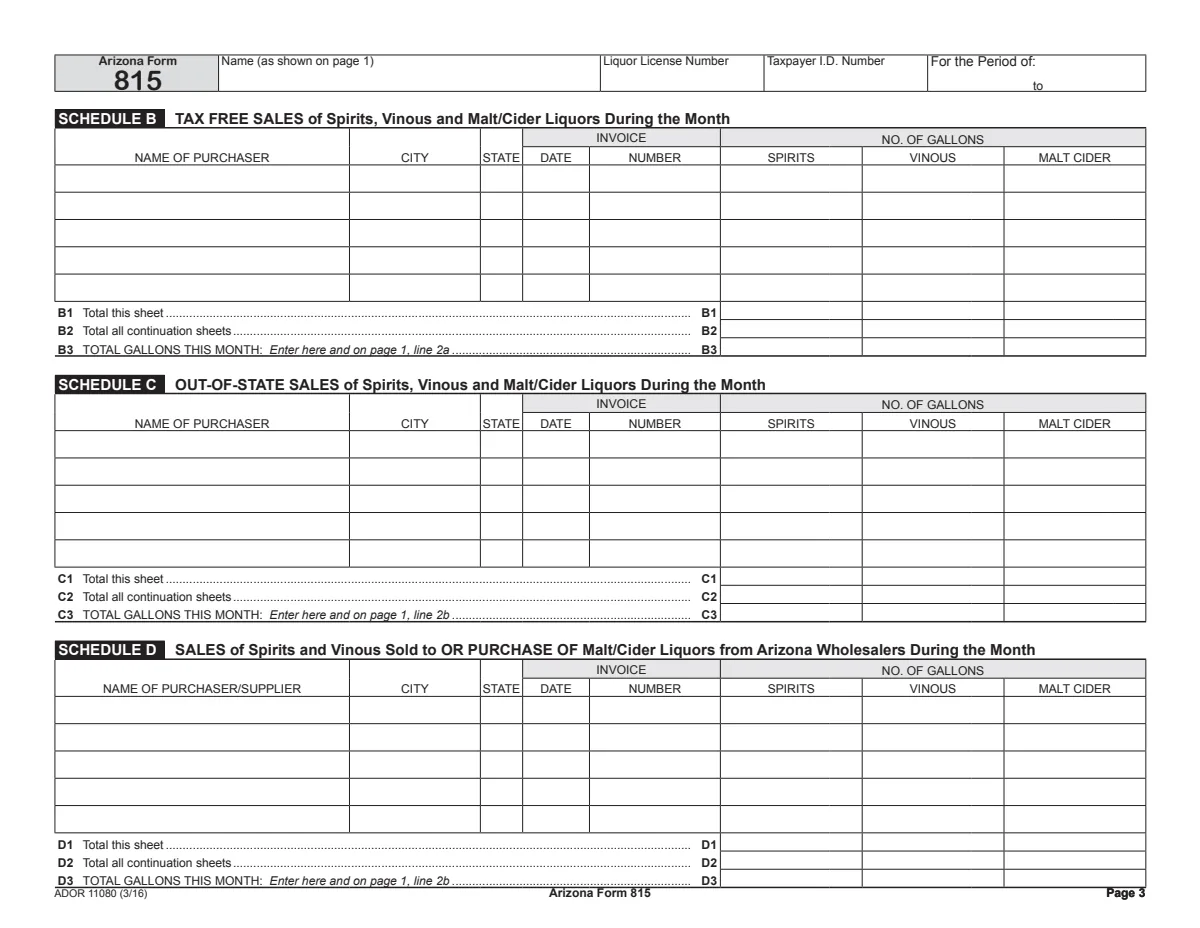
Each schedule lists invoices and totals them on lines 1 to 3. The totals feed page 1. Watch the printed cross-references: the form tells you to carry B3 to “Enter here and on page 1, line 2a” and C3 and D3 to line 2b, but the instructions put the same figures on the deduction lines: Schedule B on line 4a, Schedule C on line 4b and Schedule D on lines 4c and 4d. Follow the instructions.
| Line | Label | What goes there |
|---|---|---|
| ID-2 | Name (as shown on page 1); Liquor License Number; Taxpayer I.D. Number; For the Period of | Repeat the name, license number, taxpayer ID and period from page 1 on each schedule page so the pages can be matched. |
| Sch-A | Schedule A, detail rows | “On Schedule A, enter all beverages you have received or purchased this month.” One row per invoice: supplier, city, state, invoice date and number, and gallons of spirits, vinous and malt/cider. |
| A1 | A1 Total this sheet | The rows on this sheet added. |
| A2 | A2 Total all continuation sheets | The totals of any continuation sheets. |
| A3 | A3 TOTAL GALLONS THIS MONTH | Line 1 plus line 2: carry it to page 1, line 2a. |
| ID-3 | Page 3 header | As on page 2. |
| Sch-B | Schedule B, detail rows | One row per tax-free sale to a military installation: purchaser, city, state, invoice date and number, gallons. |
| B1 | B1 Total this sheet | The rows on this sheet added. |
| B2 | B2 Total all continuation sheets | The totals of any continuation sheets. |
| B3 | B3 TOTAL GALLONS THIS MONTH | Line 1 plus line 2: carry it to page 1, line 4a. |
| Sch-C | Schedule C, detail rows | One row per sale shipped out of Arizona. |
| C1 | C1 Total this sheet | The rows on this sheet added. |
| C2 | C2 Total all continuation sheets | The totals of any continuation sheets. |
| C3 | C3 TOTAL GALLONS THIS MONTH | Line 1 plus line 2: carry it to page 1, line 4b. |
| Sch-D | Schedule D, detail rows | One row per invoice: spirits and vinous sold to another licensed Arizona wholesaler, or malt/cider bought from one. |
| D1 | D1 Total this sheet | The rows on this sheet added. |
| D2 | D2 Total all continuation sheets | The totals of any continuation sheets. |
| D3 | D3 TOTAL GALLONS THIS MONTH | Line 1 plus line 2: carry it to page 1, lines 4c and 4d. |
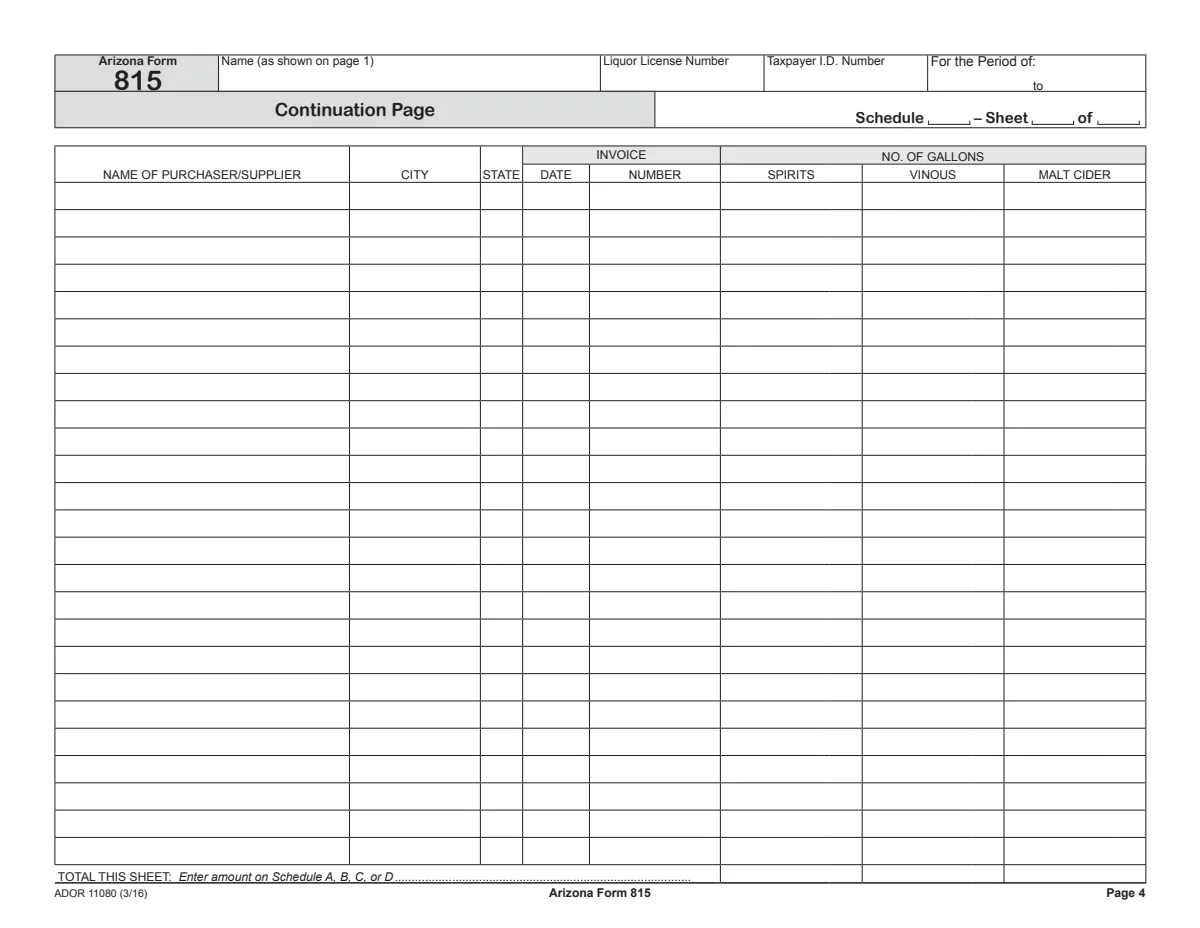
| ID-4 | Page 4 header | As on page 2. |
| Cont | Continuation Page: Schedule __ Sheet __ of __ | Extra rows for Schedule A, B, C or D when one sheet is not enough. Fill in the schedule letter and the sheet number at the top right. |
| Cont-T | TOTAL THIS SHEET: Enter amount on Schedule A, B, C, or D | The continuation sheet's total. Add all sheets' totals on the schedule's line 2. |
Rules that trip filers up
- Malt bought from another Arizona wholesaler. List it on Schedule A (line 2a) and again on Schedule D (line 4d). If it is not on Schedule A first, line 4d cannot take it, and you pay tax the selling wholesaler already paid.
- Inventory must chain. Line 1 equals last month's line 7, and line 2b equals line 4h. Attach an explanation whenever either pair does not match.
- Late payment. “State law imposes a penalty plus interest on the amount of tax due on each return if your payment is late.” For not filing, “State law imposes a 5% penalty per month if you fail to file. The combined penalties, however, cannot exceed 25%.”
- Records. Keep a copy with the supporting documents “for at least four years, subject to inspection by the Department.” Since Aug. 9, 2017 distillers and out-of-state producers keep their sale invoices rather than sending them with returns (“Liquor distillers, out-of-state producers and manufacturers are only required to maintain a copy of the sale invoice in their records.”).
- Producers do not file. “Out-of-state producers are not subject to Arizona luxury liquor tax and therefore are not required to file a return.”
How it connects
- Arizona's alcohol, tobacco, fuel and marijuana taxes: Arizona excise tax, alcohol section.
- The return for craft producers and direct shippers: Arizona Form 835. Other states' alcohol returns: Colorado DR 0442 and Connecticut O-255.
- The federal tax paid upstream by the producer or importer: alcohol excise tax and TTB F 5000.24. Rates in every state: alcohol tax by state.
Questions filers ask
When is Arizona Form 815 due?
By the 20th day of the month after the month reported. The tax is delinquent if it is not paid within ten days after that due date.
Who files Form 815 and who files Form 835?
Wholesalers file Form 815 every month. Arizona craft distilleries, farm wineries, microbreweries and cider producers that sell at retail or to retailers, and direct shipment licensees, file Form 835 once a year.
Why is beer taxed on purchases but spirits on sales?
The form's instructions measure spirits and vinous by line 1 plus additions less deductions and ending inventory, and malt/cider by additions less deductions. Malt liquor is taxed when a wholesaler buys it for resale.
What is the rate for wine over 24% alcohol?
ADOR's tax page lists $4.00 a gallon. The form's instructions say to contact ADOR's Luxury Tax Section for that rate, so confirm it before filing.
Can I file Form 815 online?
The saved ADOR pages give only the mailing address: returns go with payment to ADOR, Liquor Tax, PO Box 29019, Phoenix, AZ 85038-9019.