- At a glance
- Who files and what counts
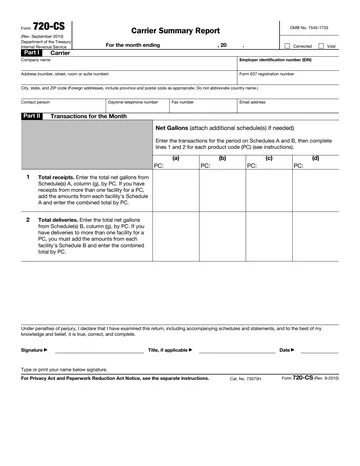
- The form, with hotspots
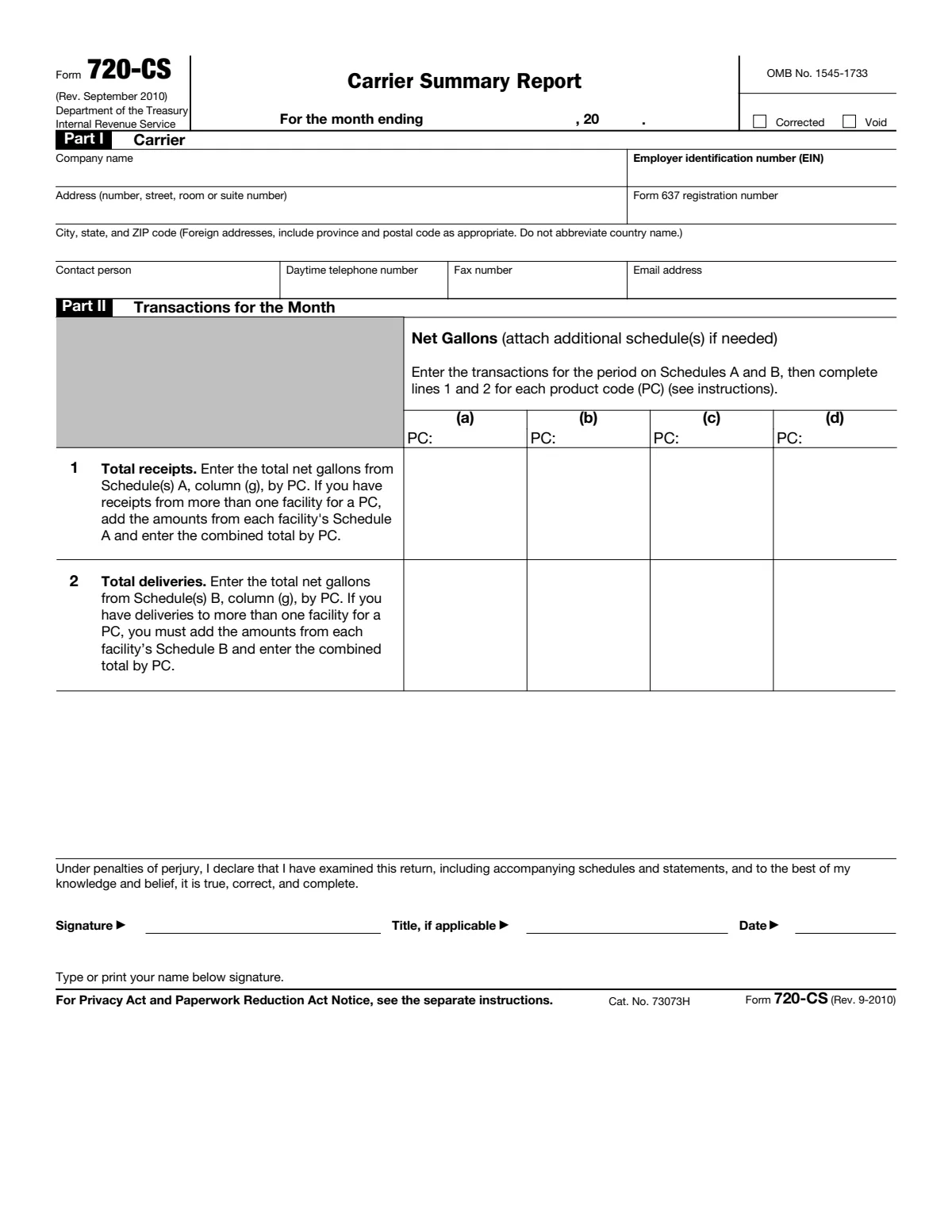
- Header and Part I
- Part II: transactions for the month
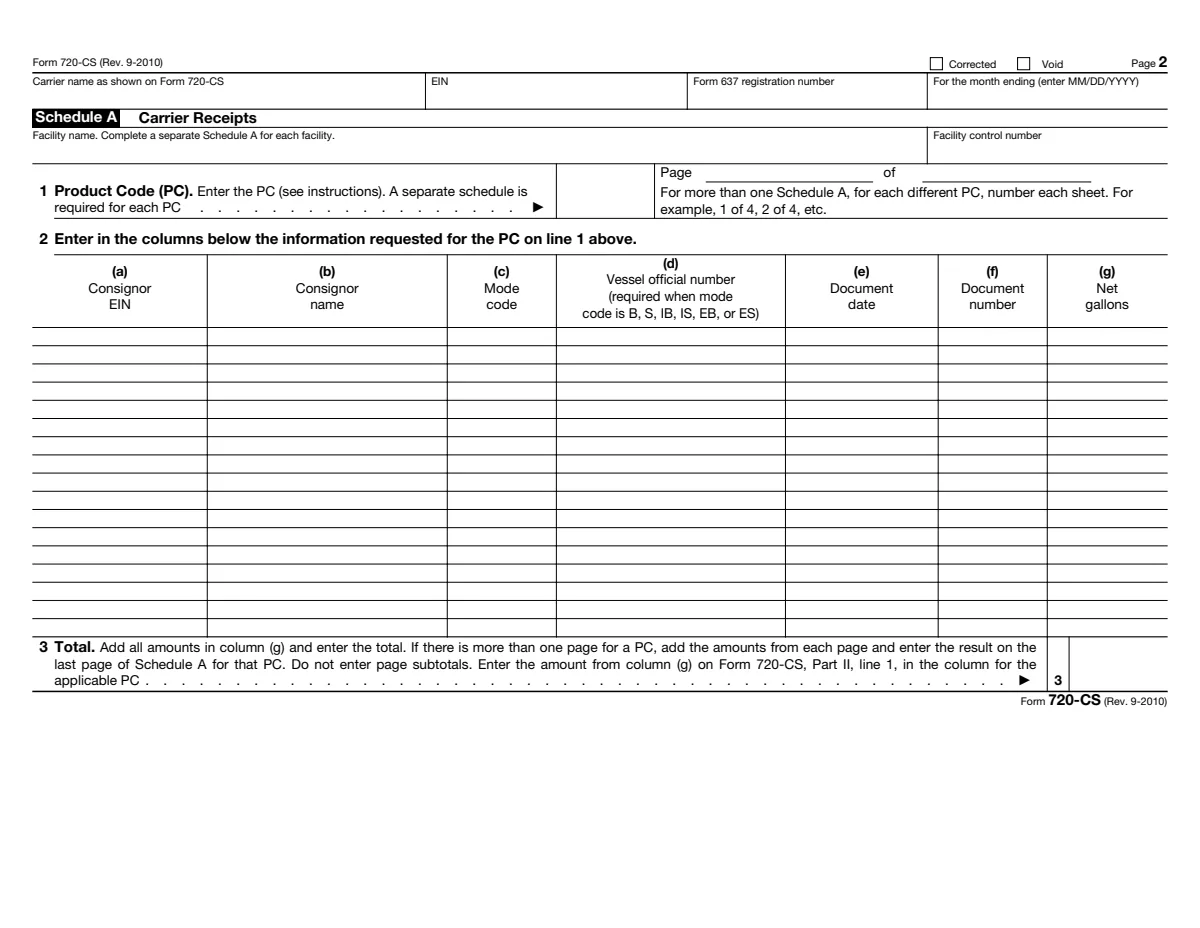
- Schedule A: receipts from a facility
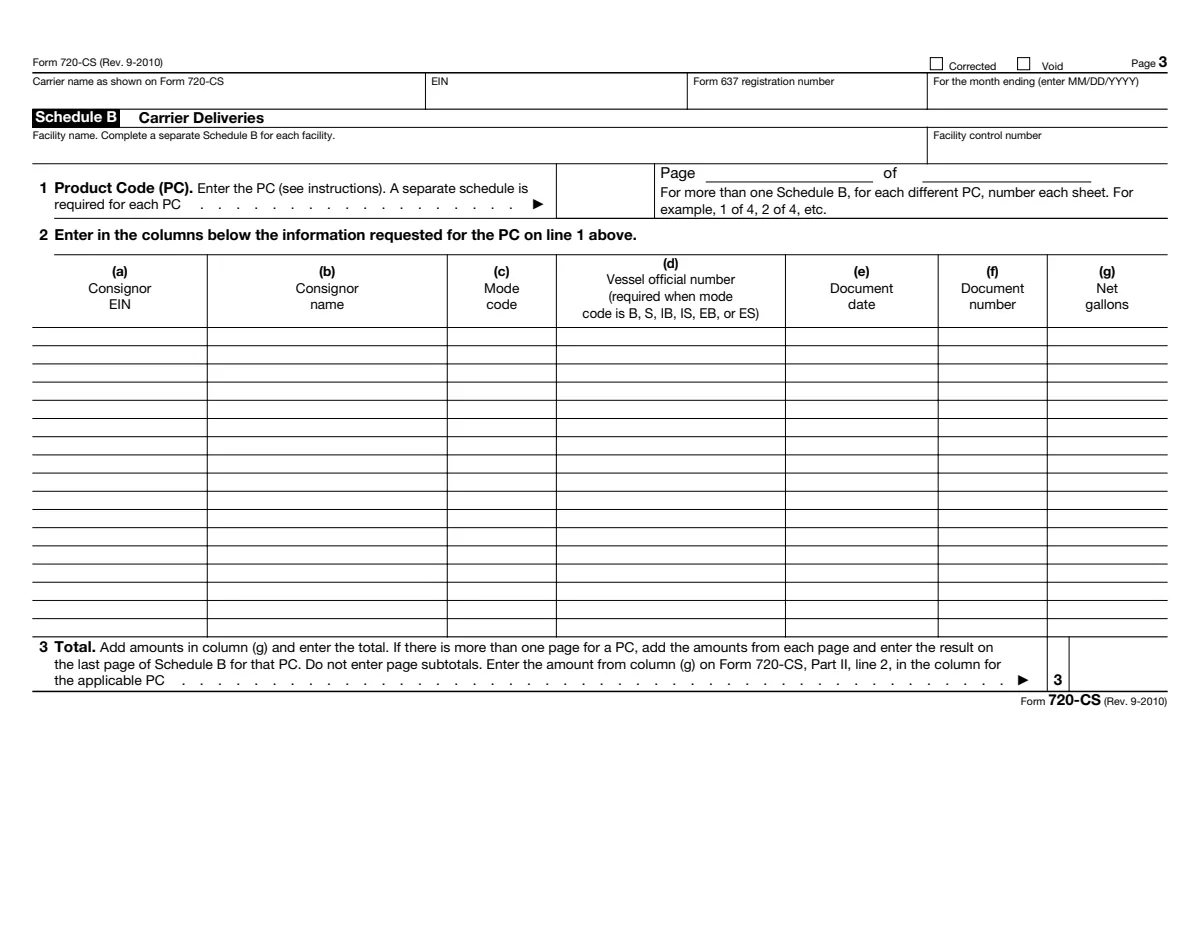
- Schedule B: deliveries to a facility
- Mode and product codes
- Deadlines, extensions and the penalty
- Rules that trip carriers up
- How it connects
- Questions filers ask
- Sources
- Who files
- Barge, ship and pipeline carriers
- Due
- Last day of the following month
- Filed with
- ExSTARS (25+ transactions) or IRS Cincinnati
- Form revision
- Rev. September 2010
- Pages
- 3
At a glance
Form 720-CS is the bulk carrier's monthly information return. “Use Form 720-CS if you're a bulk transport carrier to report monthly receipts and disbursements of all liquid products at a storage location designated by a facility control number (FCN).” Like the terminal operator's Form 720-TO, it reports gallons, not tax. The IRS's manual explains why it exists: the monthly reports are “compared to the fuel tax information entered on Form 720, Quarterly Federal Excise Tax Return.”
- Who files. Barge, ship and pipeline carriers that pick up or deliver reportable liquid products at a terminal or any other facility with an FCN (see below).
- When. “Form 720-CS must be filed monthly.” It is due the last day of the following month; the regulation sets the same date (26 CFR 48.4101-2)26 CFR 48.4101-2Code of Federal Regulations, eCFR. “If any due date for filing a return falls on a Saturday, Sunday, or legal holiday, you may file the return on the next business day.”
- How. Electronically through ExSTARS, which is required at 25 or more transactions a month, or on paper to “Internal Revenue Service Attn: Excise Unit Stop 5701G Cincinnati, OH 45999”, sent flat and unstapled by First-Class Mail or a designated private delivery service.
- Form revision. Form 720-CS (Rev. September 2010), with the Instructions for Form 720-CS (Rev. July 2017). Three pages: page 1 (Parts I and II), Schedule A (receipts) and Schedule B (deliveries). Both are still the current revisions on the IRS's Form 720-CS page as of November 2026.
- Records. “Keep copies of information returns you have filed with the IRS or the data to reconstruct them for at least 3 years from the date of the return.”
Who files and what counts
“Form 720-CS is required to be filed by bulk transport carriers (barges, ships, and pipelines) who receive or deliver reportable liquid products in or out of storage at a terminal, or any other location designated by an FCN.” Two limits narrow it: “Pipelines only file receipt or delivery transactions at an approved terminal.” And “Bulk transport carriers don't report crude oil movements.”
A liquid product is “Any liquid that is transported into storage at any facility.” That is much wider than taxable fuel: the product code table runs from gasoline and diesel to benzene, propane, asphalt and soy oil. The facility is any storage location the IRS has given a facility control number, which covers “approved refineries (RCN), terminals (TCN), biodiesel production facilities (BCN), or ethanol production facilities (ECN).”
The statute behind the report is IRC 4101(d)IRC 4101Internal Revenue Code, Cornell LII, which lets the IRS require information reporting by registered persons and adds: “Any person who is required to report under this subsection and who has 25 or more reportable transactions in a month shall file such report in electronic format.” (IRC 4101(d)). Carriers are registrants, so the report and the Form 637 registration go together.
One source reads differently. The IRS's ExSTARS manual says “Pipeline operators are required to report bulk deliveries to and from any approved terminal with a Terminal Control Number (TCN) on Form 720-TO.” and “Vessel and pipeline operators are not issued an FCN but must file ExSTARS Form 720-CS reports.” The Form 720-CS instructions, which are the filing directions, list pipelines among the carriers that file Form 720-CS, limited to transactions at approved terminals. Follow the instructions, and ask the ExSTARS help desk if your pipeline's reporting is unclear.
Instructions for Form 720-CS and Form 720-TO (Rev. July 2017).
Instructions for Form 720-CS (Rev. July 2017); IRC 4101(d)IRC 4101Internal Revenue Code, Cornell LII; 26 CFR 48.4101-226 CFR 48.4101-2Code of Federal Regulations, eCFR.
Tap a box once for its note, again to jump to the line. Zoom in to read the small print.
Header and Part I
Part I identifies the carrier. The EIN and the Form 637 registration number are what tie this report to the carrier's registration and to the terminal operators' reports, so use them exactly as issued.
| Line | Label | What goes there |
|---|---|---|
| Month | For the month ending | The month the receipts and deliveries happened. “The report is due the last day of the month following the month in which the transaction occurs.” |
| Corrected | Corrected | To correct a paper report, send page 1 and the wrong schedule with Void checked and the transaction marked, then “complete another first page of Form 720-CS along with the corrected schedule(s) with the” Corrected box checked. “On the corrected schedule(s), only enter the information for the transaction you're correcting.” Electronic filers correct under Pub. 3536. |
| Company | Company name | The bulk transport carrier filing the report: the barge, ship or pipeline operator, not the consignor that hired it. |
| EIN | Employer identification number (EIN) | Enter your EIN. If you applied for one and do not have it by the due date, write "Applied for". A missing or incorrect EIN is one of the failures the penalty covers. |
| Address | Address (number, street, room or suite number) | “Include the suite, room, or other unit number after the street address.” |
| Reg637 | Form 637 registration number | “Enter the assigned IRS number.” The instructions point to 26 CFR 48.4101-1(c)(1)26 CFR 48.4101-1Code of Federal Regulations, eCFR, which requires pipeline operators, position holders, terminal operators and vessel operators to be registered; without a number, apply on Form 637. |
| City | City, state, and ZIP code | For a foreign address, enter the city, province or state, and country, and do not abbreviate the country. |
| Contact | Contact person | “Enter the name, daytime telephone number, fax number, and email address for the person who should be contacted to discuss this information return.” |
| Phone | Daytime telephone number | The contact person's daytime number. |
| Fax | Fax number | The contact person's fax number. |
| Email address | The contact person's email address. |
Part II: transactions for the month
Part II is the summary. “Part II is used to report a monthly summary of the receipts and disbursements from FCNs by product code.” Fill in the schedules first, then add up column (g) of each schedule by product code. Unlike Form 720-TO, there is no inventory reconciliation: a carrier reports what it picked up and what it delivered, not what it holds.
| Line | Label | What goes there |
|---|---|---|
| PC | PC: | “Enter the transactions for the period on Schedules A and B, then complete” lines 1 and 2 for each product code (PC). Product codes come from Table 2 of the instructions; “Use only the product codes listed in Table 2.” |
| 1 | 1 Total receipts. Enter the total net gallons from | Net gallons the carrier received from facilities during the month: the column (g) totals of every Schedule A for the product, added together when you picked up the same product at more than one facility. |
| 2 | 2 Total deliveries. Enter the total net gallons | Net gallons delivered to facilities during the month: the column (g) totals of every Schedule B for the product, combined across facilities. |
| Sign | Type or print your name below signature. | “Form 720-CS must be signed by a person who has authority to sign.” Type or print the name below the signature. |
Schedule A: receipts from a facility
“Use this schedule to report each receipt of reportable liquid product at a facility.” A receipt, for the carrier, is product it loads out of a terminal, refinery or other facility. The document number in column (f) is the one the terminal operator gave you, and the terminal operator reports the same number on its Form 720-TO, Schedule B.
| Box | Label | What goes there |
|---|---|---|
| A-top | Carrier name as shown on Form 720-CS | The carrier name as on page 1, its EIN, its Form 637 registration number and the month ending (MM/DD/YYYY). |
| A-fac | Facility name. Complete a separate Schedule A for each facility. | “A separate Schedule A must be used for each facility and product code.” |
| A-FCN | Facility control number | “A number that designates a storage location within the motor fuel distribution system, or the bulk transfer/terminal system, or renewable fuel production facilities.” Terminals carry a TCN, refineries an RCN, biodiesel plants a BCN and ethanol plants an ECN; the IRS publishes the list. |
| A-page | Page | For more than one Schedule A for a product code, number each sheet. |
| A-1 | 1 Product Code (PC). Enter the PC (see instructions). A separate schedule is | A product code from Table 2. “Product code 122 (blending components, other) includes gasoline blendstocks as defined in Regulations section 48.4081-1(c)(3)(i) but not listed in the product code table.” |
| A-2 | 2 Enter in the columns below the information requested for the PC on line 1 above. | Each row is one receipt. Zero gallon rows have no place here: list only actual transactions. |
| A-a | Consignor | “Column (a). Enter the EIN of the company hiring the carrier.” Ask consignors for it on Form W-9 or your own form (foreign persons use a Form W-8); the IRS's ExSTARS EIN request form is Form W-13. |
| A-b | name | “Column (b). Enter the name of the company hiring the carrier.” “Consignor. The person that hires the carrier to transport liquid product.” |
| A-c | Mode | The mode code from Table 1: B barge, S ship (Great Lake or ocean), PL pipeline, and for imports IB, IS or IP and exports EB, ES or EP. Truck and rail codes are not on the carrier's table. |
| A-d | Vessel official number | “If the mode code in column (c) is either a barge (B, IB, or EB) or a ship (S, IS, or ES), enter the vessel official number.” Domestic vessels use the Coast Guard number; international ships the IMO number. |
| A-e | Document | The date from the document whose number goes in column (f). The instructions print “Enter the date from the document in column (e) (mmddyyyy).” for Schedule A, pointing the column at itself; the Schedule B text and the form layout show the date comes from the column (f) document. |
| A-f | Document | The identifying number of the document the terminal operator gave the carrier (a bill of lading, manifest, inspection report or other shipping document). “Both the carrier and terminal operator must report the same document number.” |
| A-g | Net | “Column (g). Enter the actual net gallons received from the facility.” Net gallons are corrected to 60 degrees Fahrenheit and 14.7 psi. |
| A-3 | 3 Total. Add | Add column (g) for the product code; with several pages, enter the total on the last page only, with no page subtotals, and carry it to Part II, line 1, in that product's column. |
Schedule B: deliveries to a facility
“Use this schedule to report each delivery of reportable liquid products to an FCN.” The terminal operator reports the same delivery as a receipt on its Form 720-TO, Schedule A, with the same document number. The boxes repeat Schedule A's; the notes below show where they differ.
| Box | Label | What goes there |
|---|---|---|
| B-top | Carrier name as shown on Form 720-CS | The carrier name as on page 1, its EIN, its Form 637 registration number and the month ending (MM/DD/YYYY). |
| B-fac | Facility name. Complete a separate Schedule B for each facility. | “A separate Schedule B must be used for each FCN and each product code.” |
| B-FCN | Facility control number | “A number that designates a storage location within the motor fuel distribution system, or the bulk transfer/terminal system, or renewable fuel production facilities.” Terminals carry a TCN, refineries an RCN, biodiesel plants a BCN and ethanol plants an ECN; the IRS publishes the list. |
| B-page | Page | For more than one Schedule B for a product code, number each sheet. |
| B-1 | 1 Product Code (PC). Enter the PC (see instructions). A separate schedule is | A product code from Table 2. Use the same codes as on Schedule A; liquids used for blending that are not listed are product code 122, and other unlisted liquids product code 092. |
| B-2 | 2 Enter in the columns below the information requested for the PC on line 1 above. | Each row is one delivery. Zero gallon rows have no place here: list only actual transactions. |
| B-a | Consignor | “Column (a). Enter the EIN of the company hiring the carrier.” Ask consignors for it on Form W-9 or your own form (foreign persons use a Form W-8); the IRS's ExSTARS EIN request form is Form W-13. |
| B-b | name | “Column (b). Enter the name of the company hiring the carrier.” “Consignor. The person that hires the carrier to transport liquid product.” |
| B-c | Mode | The mode code from Table 1: B barge, S ship (Great Lake or ocean), PL pipeline, and for imports IB, IS or IP and exports EB, ES or EP. Truck and rail codes are not on the carrier's table. |
| B-d | Vessel official number | “If the mode code in column (c) is either a barge (B, IB, or EB) or a ship (S, IS, or ES), enter the vessel official number.” Domestic vessels use the Coast Guard number; international ships the IMO number. |
| B-e | Document | “Column (e). Enter the date from the document in column (f) (mmddyyyy).” |
| B-f | Document | The identifying number of the document the carrier gave the terminal operator when the product was delivered (the facility receipts document, a pipeline ticket, barge ticket or inspection report). “Both the carrier and terminal operator must report the same document number.” |
| B-g | Net | “Column (g). Enter the actual net gallons delivered to the terminal.” Net gallons are corrected to 60 degrees Fahrenheit and 14.7 psi. |
| B-3 | 3 Total. Add | Add column (g) for the product code; with several pages, enter the total on the last page only, with no page subtotals, and carry it to Part II, line 2, in that product's column. |
Mode and product codes
Table 1 of the instructions lists the carrier's mode codes. Imports and exports use only the listed codes, and reporting the country of origin or destination is optional. “An import is only reported when the product is first entered into the United States.”
| Mode | Meaning | Import code | Export code |
|---|---|---|---|
| B | barge | IB (import by barge) | EB (export by barge) |
| S | ship (Great Lake or ocean) | IS (import by ship) | ES (export by ship) |
| PL | pipeline | IP (import by pipeline) | EP (export by pipeline) |
Product codes come from Table 2: for example 065 gasoline, 167 diesel fuel #2 low sulfur undyed, 130 jet fuel and 054 propane. Renewable mixtures carry a letter and the percentage (E for ethanol, B for biodiesel, D for dyed biodiesel), so a fuel of 79% ethanol is E79. “Product code 092 is used for other unlisted liquids.” Gallons are net gallons, “Liquid product measured in U.S. gallons corrected to a temperature of 60° Fahrenheit or 15° Celsius and to a pressure of 14.7 pounds per square inch (psi).”
Deadlines, extensions and the penalty
- Extensions. “First time request for a 30-day extension will be granted, if received in writing on or before the due date of the report.” The request is made on Form 8809-EX; the IRS's manual says filers “must file Form 8809-EX, Request for Extension of Time to File an ExSTARS Information Return, to request an extension of time to file.”
- The penalty. A late report, a report missing required information or one with wrong information costs a flat amount for each failure: “such person shall pay a penalty of $10,000 in addition to the tax (if any).” (IRC 6725). “No penalty shall be imposed under this section with respect to any failure if it is shown that such failure is due to reasonable cause.” The instructions add that the penalty “also applies if you report an incorrect employer identification number (EIN) or fail to report an EIN where required.”
- Fast corrections. The IRS's manual treats a filing as correct as of its original date “if errors are corrected within 15 calendar days”, when the original was timely. It also warns that late or wrong reports may lead to suspension or revocation of the approved status of the facility or the Form 637 registration.
Rules that trip carriers up
- Different document numbers. The carrier and the terminal operator must report the same document number; a mismatch is what the IRS's matching looks for.
- Zeros. “Don't enter 0 (zero) or ‘None’ in data entry boxes when no entry is required.”
- Page subtotals. With several sheets for a product code, the line 3 total goes on the last sheet only.
- One schedule for two facilities. Each facility and each product code gets its own Schedule A or B.
- Consignor EINs. “EINs are used to associate and verify transactions you report to the IRS.” Collect them before the month closes, and keep W-9 information confidential, as the instructions require.
How it connects
- The terminal side of the same transactions: Form 720-TO line by line.
- Registration: the Form 637 registration guide and the Form 637 form page.
- The tax the reports are matched against: the federal fuel excise tax hub and Form 720 line by line.
- Extensions: Form 8809-EX. Examinations: excise tax audits.
Questions filers ask
Who has to file Form 720-CS?
Bulk transport carriers (barges, ships and pipelines) that receive or deliver reportable liquid products at a terminal or other facility with an FCN. Pipelines report only transactions at approved terminals, and crude oil movements are not reported.
When is Form 720-CS due?
Monthly, by the last day of the month after the month of the transactions. A weekend or legal holiday due date moves to the next business day.
Must Form 720-CS be filed electronically?
Yes, at 25 or more reportable transactions in a month (IRC 4101(d))IRC 4101Internal Revenue Code, Cornell LII, through ExSTARS under Pub. 3536. Smaller filers may use the paper form.
What is the penalty for a late or wrong Form 720-CS?
$10,000 for each failure under IRC 6725IRC 6725Internal Revenue Code, Cornell LII (late, incomplete or incorrect), unless the failure is due to reasonable cause.
How do I get more time?
File Form 8809-EX by the due date. A first 30-day extension request with a reason is granted; more time is given only for extreme hardship or a catastrophic event.
Do truck carriers file Form 720-CS?
No. The form's bulk transport carriers are barges, ships and pipelines, and its mode table has no truck or rail codes. Truck and rail loads at a terminal appear on the terminal operator's Form 720-TO.
Sources
- Form 720-CS, Carrier Summary Report (Rev. September 2010), PDF
- Instructions for Form 720-CS (Rev. July 2017)
- About Form 720-CS
- Publication 3536, Motor Fuel Excise Tax EDI Guide
- 26 U.S.C. 4101, registration and information reporting
- 26 U.S.C. 6725, failure to report information under section 4101
- 26 CFR 48.4101-2, information reporting
- IRM 4.24.26, ExSTARS