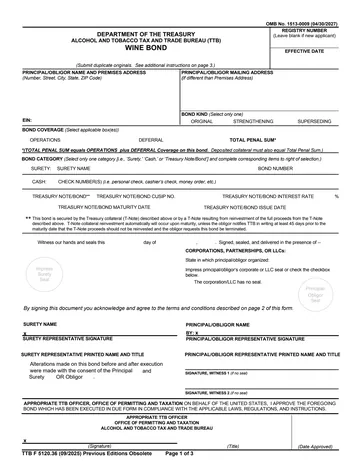
- Who files
- Bonded wine premises proprietors not exempt
- Due
- Before operating; 30 days after the $50,000 trigger
- Filed with
- TTB Office of Permitting and Taxation
- Form revision
- 09/2025
- Pages
- 3
At a glance
TTB F 5120.36 is the Wine Bond: the proprietor's, and its surety's, promise to pay the federal excise tax on wine at a bonded winery or bonded wine cellar. The regulation requires it: “the proprietor must give bond on TTB F 5120.36, Wine Bond, to cover the liability for excise taxes imposed by the Internal Revenue Code of 1986, on wines produced or received by the proprietor.” One form carries both kinds of coverage: “The tax deferral bond and the wine bond may be submitted on the same TTB F 5120.36.”
- Who files. The proprietor of bonded wine premises, unless exempt as a small deferred-basis taxpayer (below).
- When. Before operating: “A person may not commence or continue any business or operation relating to wine until all bonds and consents of surety required under this part with respect to the business or operation have been approved by the appropriate TTB officer.”
- How. “(Submit duplicate originals. See additional instructions on page 3.)” TTB's bond forms page adds: “The bonds you submit to TTB must have original ink signatures and not copied signatures.”
- Form revision. TTB F 5120.36 (09/2025), three pages (the bond, its terms, its instructions), with the separate one-page Wine Bond Instructions (TTB F 5120.36i, 09/2007).
Who needs a wine bond
Since a December 2015 amendment (Pub. L. 114-113), small taxpayers are exempt: during any period they qualify for annual or quarterly returns, a taxpayer “shall not be required to furnish any bond covering operations or withdrawals of distilled spirits or wines for nonindustrial use or of beer.” (IRC 5551(d)). The wine rule: a proprietor paying on a deferred basis “is not required to provide a bond or bonds to cover operations and withdrawals of wine for nonindustrial use” while eligible for an annual or quarterly return period (27 CFR 24.146(d))27 CFR 24.146Code of Federal Regulations, eCFR.
Growth ends the exemption. A winery whose tax for the calendar year passes $50,000 must bond, with a short grace period: it is treated as bonded if it submits the bond “no later than 30 days following the first date on which the aggregate amount of tax due from the proprietor during the relevant calendar year exceeds $50,000.” The grace period does not cover tax deferral: until TTB approves the deferral bond, the winery cannot remove wine on deferred tax beyond the limit in the rule. Industrial use wine needs a bond regardless. The full picture is on the TTB permits and bonds guide.
27 CFR 24.14627 CFR 24.146Code of Federal Regulations, eCFR, 24.154; 26 U.S.C. 5551(d)26 U.S.C. 5551United States Code, Cornell LII; TTB F 5120.36 instructions.
How much coverage
“The penal sum named in the bond will be in accordance with 27 CFR Part 24.” The table in 27 CFR 24.14827 CFR 24.148Code of Federal Regulations, eCFR sets the floors and ceilings:
| Coverage | Basis (27 CFR 24.148)27 CFR 24.148Code of Federal Regulations, eCFR | Minimum | Maximum |
|---|---|---|---|
| Wine operations | “Not less than the tax on all wine or spirits possessed, in transit, or unaccounted for at any one time, taking into account the appropriate small producer wine tax credit” | $1,000 | $50,000; $100,000 where the liability exceeds $250,000 |
| Tax deferral | “Where the unpaid tax amounts to more than $500, not less than the amount of tax which, at any one time, has been determined but not paid.” | $500 | $250,000 |
Operations coverage can also secure a little deferred tax: the form's conditions let “up to $500 of the operations coverage of a $1,000 bond” (and $1,000 of a bond of $2,000 or more) apply to tax determined but not paid. Above that, the deferral amount on the bond covers it. TTB's own worksheet for the operations amount is listed on its bond forms page as “TTB F 5120.36 Worksheet UNDER REVIEW - updated version to be published shortly”, and as of November 2026 that link opens the bond form itself.
Tap a box once for its note, again to jump to the line. Zoom in to read the small print.
Line by line
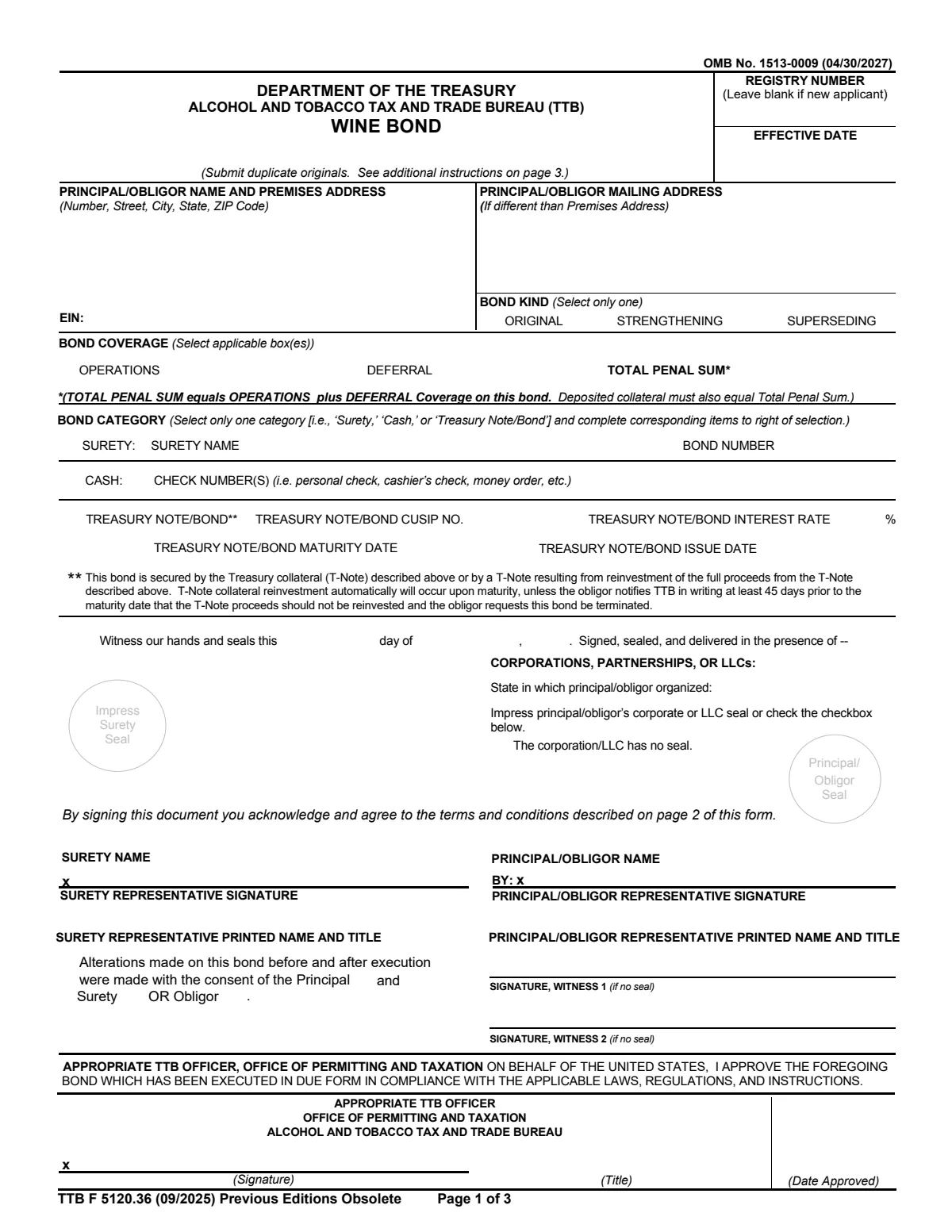
Page 1 is the bond itself. The separate instructions sheet numbers its items 1 to 9 in the order of the boxes; page 3 of the form adds the rules for names, signatures, seals and collateral.
| Box | Label | What goes there |
|---|---|---|
| Registry | REGISTRY NUMBER | “Assigned by TTB BW (TTB will enter for original bonds)”. On a strengthening or superseding bond, enter your existing BW registry number. |
| Effective | EFFECTIVE DATE | “Date coverage will begin.” “If no effective date is inserted in the space provided, the date of execution will be the effective date of the bond.” |
| Premises | PRINCIPAL/OBLIGOR NAME AND PREMISES ADDRESS | “Sole owner enters his/her name and operating trade name, if any; partnership enters names of all partners and operating trade name, if any.” “Location of wine premises cannot be a Post Office Box.” |
| Mailing | PRINCIPAL/OBLIGOR MAILING ADDRESS | Business or mailing address, if different. “The mailing address may include a Post Office Box.” |
| EIN | EIN: | “Employer Identification Number assigned by the Internal Revenue Service.” |
| Kind | BOND KIND | Original is “used only for new establishments or changes of ownership.” Strengthening “increases the existing coverage.” Superseding “replaces the existing coverage.” |
| Operations | OPERATIONS | Wine operations coverage “covers tax liability of wine and wine spirits on hand and in transit to premises.” “Operations coverage is determined by using the ‘Bond worksheet.’” “Use the appropriate tax rate for the premises.” |
| Deferral | DEFERRAL | Tax deferral coverage secures tax determined on removal but paid later. “If more than $1,000 Tax Deferral coverage is needed it can be shown in the Deferral dollar amount.” |
| Total | TOTAL PENAL SUM* | “*(TOTAL PENAL SUM equals OPERATIONS plus DEFERRAL Coverage on this bond. Deposited collateral must also equal Total Penal Sum.)” |
| Surety | SURETY: | “Surety Company must be a federally approved surety.” TTB's bond forms page links Treasury's list of approved sureties (Circular 570). “Evidence of Power of Attorney for Surety must be attached to each Surety Bond.” |
| Cash | CASH: | Cash collateral by check, cashier's check or money order, payable to the Alcohol and Tobacco Tax and Trade Bureau for deposit in a Treasury holding account, as the form's instruction 5 describes. |
| Treasury | TREASURY NOTE/BOND** | Treasury collateral, identified by CUSIP number, rate, maturity and issue dates. It rolls over at maturity “unless the obligor notifies TTB in writing at least 45 days prior to the maturity date that the T-Note proceeds should not be reinvested and the obligor requests this bond be terminated.” |
| Date | Witness our hands and seals this | The execution date. With no effective date entered above, this date becomes the effective date. |
| SuretySeal | Impress | The surety's signature is attested under its corporate seal (instruction 4). |
| State | State in which principal/obligor organized: | Corporations, partnerships and LLCs give the state of organization, above the signature lines. |
| Seal | The corporation/LLC has no seal. | “If the corporation or LLC has no seal, that fact will be noted.” Without a seal, two witnesses sign (below). |
| SuretySign | SURETY NAME | The surety's name and its representative's signature, with the power of attorney attached. |
| PrincipalSign | PRINCIPAL/OBLIGOR NAME | The proprietor's name and signature. A partnership signs in the firm name by all partners or an authorized partner; an LLC by its managing member or an authorized member; a corporation by an authorized officer, with proof of authority filed with the bond. |
| SuretyName | SURETY REPRESENTATIVE PRINTED NAME AND TITLE | The surety representative's printed name and title. |
| PrincipalName | PRINCIPAL/OBLIGOR REPRESENTATIVE PRINTED NAME AND TITLE | The signer's printed name and title. |
| Alterations | Alterations made on this bond before and after execution | “If any alteration or erasure is made in the bond before or after its execution, check the box next to the alteration statement on page 1 and make sure that the Principal and Surety or Sureties OR Obligor initial the statement.” |
| Witnesses | SIGNATURE, WITNESS 1 | “Each signature will be made in the presence of two persons (except where corporate or LLC seals are affixed), who must sign their names as witnesses.” |
| TTB | APPROPRIATE TTB OFFICER | TTB's signature, title and approval date. “If the bond is approved, a copy will be returned to the principal/obligor.” |
What you agree to on page 2
“By signing this document you acknowledge and agree to the terms and conditions described on page 2 of this form.” Page 2 defines the parties (“PRINCIPAL. The proprietor of the wine premises covered by a surety bond.” “OBLIGOR. The proprietor of the wine premises covered by a collateral bond.”) and lists what the proprietor must do: comply with the law and regulations, pay penalties and fines, pay the tax on wine removed and on all wine and spirits in transit to or on the premises, account for wine removed without tax, and pay the tax on an adjacent wine vinegar plant. The surety gives up the right to make the United States pursue the proprietor first: “The surety hereby waives any right or privilege it may have of requiring, upon notice, or otherwise, that the United States will first commence action”.
Filing, Permits Online and changes
- Paper. “File duplicate original bonds with the Office of Permitting and Taxation, Alcohol and Tobacco Tax and Trade Bureau, 550 Main St., Ste. 8970, Cincinnati, OH 45202-3222.” “When downloading TTB bond forms, please remember that you must submit your bonds as 2-sided documents.”
- Permits Online. For a bond change on a winery application filed online, TTB's amendment list says “You must upload a Wine Bond (TTB F 5120.36) in Permits Online.” (Permits Online). The bond forms page still asks for inked, two-sided originals, and neither page says how the two fit together.
- Too small a bond. “In any instance where the penal sum of the bond on file becomes insufficient, the principal shall either give a strengthening bond with the same surety to attain a sufficient penal sum or give a new bond covering the entire liability.”
- Other changes. “Consents of surety to changes in the terms of bonds will be executed on TTB Form 5000.18” (TTB F 5000.18).
- Sureties. “Surety bonds required by this part may be obtained only from corporate sureties which hold certificates of authority from and are subject to the limitations prescribed by the Secretary as set forth in the current revision of Treasury Department Circular 570” (27 CFR 24.149)27 CFR 24.149Code of Federal Regulations, eCFR.
- Phone. The form prints two numbers for the Office of Permitting and Taxation: “1-877-822-3277 regarding allowable types of collateral.” in instruction 5 and “1-877-882-3277 (toll free).” in instruction 9. TTB's other forms print (877) 882-3277, so 822 looks like a typo.
Rules that trip wineries up
- A P.O. box for the premises. Not allowed; the mailing address may be one.
- Copied signatures. TTB wants original ink, two-sided, in duplicate.
- No seal and no witnesses. Without a corporate or LLC seal, each signature needs two witnesses.
- Collateral short of the penal sum. Deposited collateral must equal the total penal sum.
- Missing the $50,000 trigger. The 30-day grace period runs from the first date the year's tax passes $50,000.
- Old instructions. The separate instruction sheet is dated 09/2007 and points to an old Treasury address for the surety list; use the list linked from TTB's bond forms page.
How it connects
- Permits, bonds and the bond exemption: the TTB permits and bonds guide.
- The wine tax and its return: the federal alcohol excise tax hub and TTB F 5000.24 line by line.
- All TTB taxes: the TTB hub. Claims: TTB claims.
Questions filers ask
Does every winery need TTB F 5120.36?
No. A winery paying on a deferred basis and eligible for annual or quarterly returns does not need a bond for wine for nonindustrial use. It needs one once its tax for the calendar year passes $50,000, or for industrial use wine.
How much is a wine bond?
Operations coverage of not less than the tax on wine and spirits on hand, in transit or unaccounted for, from $1,000 to $50,000 ($100,000 where the liability exceeds $250,000); tax deferral coverage from $500 to $250,000 (27 CFR 24.148)27 CFR 24.148Code of Federal Regulations, eCFR.
Can one TTB F 5120.36 cover operations and deferral?
Yes. The regulation lets the tax deferral bond and the wine bond be submitted on the same TTB F 5120.36; the total penal sum is the two added together.
What if my tax passes $50,000 during the year?
Submit the wine bond within 30 days of the first date the year's tax passes $50,000. You are treated as bonded until TTB acts, but the grace period does not cover tax deferral bonds.
Can I use cash instead of a surety?
Yes. The bond may be secured by a corporate surety, by Treasury notes or bonds, or by cash (a check or money order payable to TTB), and deposited collateral must equal the total penal sum.
How do I increase my wine bond?
File a strengthening bond with the same surety, or a new superseding bond for the whole liability; other changes in terms use a consent of surety on TTB F 5000.18.
Sources
- TTB F 5120.36, Wine Bond (09/2025), PDF
- Wine Bond Instructions, TTB F 5120.36i (09/2007), PDF
- TTB bond forms
- 27 CFR part 24, bonds and consents of surety (24.145 to 24.157)
- 27 CFR 24.148, penal sums of bonds
- 26 U.S.C. 5551, general provisions relating to bonds
- TTB, alcohol producer amendments (Permits Online)