- Who files
- Arizona craft producers and direct shipment licensees selling at retail or to retailers
- Due
- 20th of the first month after the year
- Filed with
- ADOR, Liquor Tax, by mail
- Form revision
- ADOR 11081 (2/24)
- Pages
- 3, plus 1 page of instructions
At a glance
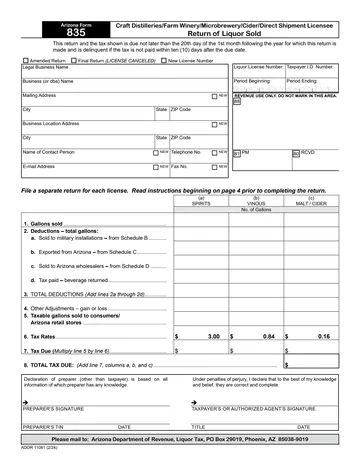
Form 835, the Return of Liquor Sold, is Arizona's liquor luxury tax return for producers that sell around the wholesale tier. ADOR's liquor tax page puts it this way: “Form 835 should be used by craft distilleries, farm wineries, direct shipment licensees and microbreweries making sales at retail or to retail licensees.” Those producers “are not subject to the three-tier distribution system and may sell to retailers or consumers within the state directly”, so the tax a wholesaler would otherwise pay on Form 815 falls on them.
- Who files. “You must file this return and pay the luxury tax if you are a domestic craft distillery, a domestic farm winery, a domestic microbrewery, or a domestic cider producer who manufactures or produces on the premises and sells at retail or to retail licensees within the State of Arizona, or a direct shipment licensee that sells at retail or to retail licensees within the State of Arizona.”
- When. Once a year: “You must file this return yearly and pay the tax shown no later than the 20th day of the 1st month following the year for which this return is made.” The tax is delinquent if not paid within ten days after that. “Prepare this return for each year regardless of whether or not any tax is due.”
- How and where. On paper, with payment, to Arizona Department of Revenue, Liquor Tax, PO Box 29019, Phoenix, AZ 85038-9019, from ADOR's liquor tax forms page (Form 835 PDF). One return per license.
- Form revision. ADOR 11081 (2/24): a one-page return, one page of Schedules B, C and D, a continuation page and one page of instructions. There is no Schedule A: a producer reports what it sold, not what it bought.
Arizona Form 835 (ADOR 11081, 2/24), first lines and general instructions. Dates are for a calendar year return.
Tap a box once for its note, again to jump to the line. Zoom in to read the small print.
Header
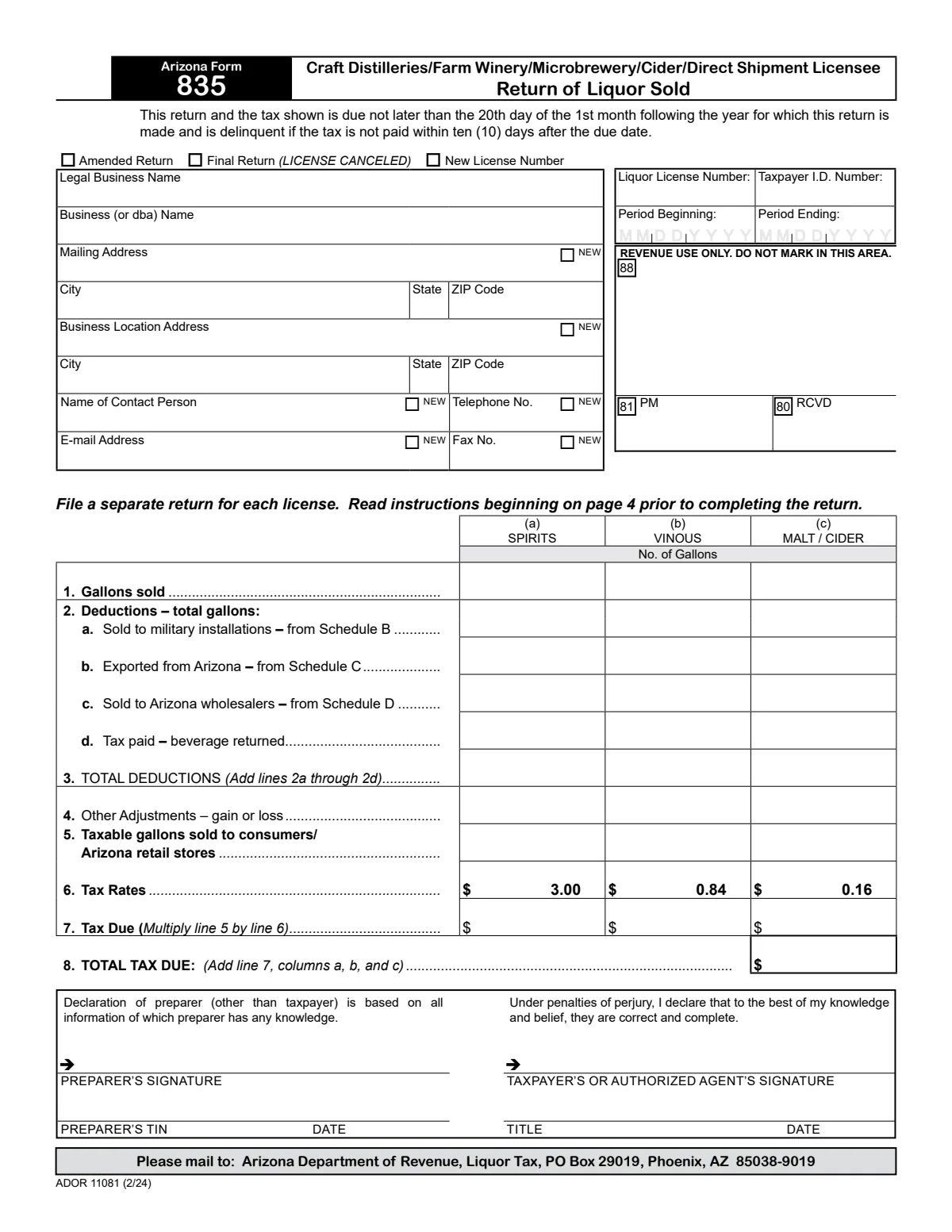
The header is the same as Form 815's. The period boxes hold the first and last day of the year reported.
| Line | Label | What goes there |
|---|---|---|
| Status | Amended Return; Final Return (LICENSE CANCELED); New License Number | Check Amended Return to correct a return already filed, Final Return when the liquor license is canceled, and New License Number when the license number has changed. Leave all three blank on an ordinary return. |
| Names | Legal Business Name; Business (or dba) Name | The licensee's legal name and its trade name. “File a separate return for each license.” |
| Mailing | Mailing Address, City, State, ZIP Code | The mailing address. The NEW box beside it tells ADOR the address changed. |
| Location | Business Location Address, City, State, ZIP Code | The street address of the licensed location, which may differ from the mailing address. |
| Contact | Name of Contact Person; Telephone No.; E-mail Address; Fax No. | The person who can answer questions about the return, with phone, email and fax. Each has a NEW box for a change. |
| License-TIN | Liquor License Number; Taxpayer I.D. Number | The liquor license number and the taxpayer identification number. “A taxpayer identification number is either your Federal Employer Identification Number (EIN) or your Social Security Number (SSN), if you are a sole proprietor with no employees.” |
| Period | Period Beginning; Period Ending | The first and last day the return covers, in the MM DD YYYY boxes. The box below them is for ADOR's use only. |
Lines 1 to 8
The return starts from gallons sold (line 1), takes out the sales Arizona does not tax at this level (line 2), and taxes the rest: what went to consumers and to Arizona retail licensees. Line 2 itself is a heading.
| Line | Label | What goes there |
|---|---|---|
| 1 | 1. Gallons sold | “Line 1: Enter the total gallons sold for the year.” Report wine gallons in each column: spirits, vinous and malt/cider. |
| 2a | 2a. Sold to military installations, from Schedule B | “From Schedule B, enter any tax-free sales to military installations during the year.” |
| 2b | 2b. Exported from Arizona, from Schedule C | “From Schedule C, enter any beverage sold out of state during the year.” |
| 2c | 2c. Sold to Arizona wholesalers, from Schedule D | “From Schedule D, enter any beverage sold to other licensed Arizona wholesalers during the year.” Those wholesalers report and pay on Form 815. |
| 2d | 2d. Tax paid, beverage returned | “Enter any tax paid for any beverage returned during the year.” |
| 3 | 3. TOTAL DEDUCTIONS (Add lines 2a through 2d) | “Line 3: Add lines 2a through 2d, and enter the total.” |
| 4 | 4. Other Adjustments: gain or loss | “Line 4: List any adjustments for the prior year and attach a written explanation.” |
| 5 | 5. Taxable gallons sold to consumers/Arizona retail stores | “Line 5: Subtract line 3 from line 1. Add or subtract any amounts on line 4.” |
| 6 | 6. Tax Rates | Preprinted: $3.00 a gallon for spirits, $0.84 for vinous and $0.16 for malt/cider, the same rates as Form 815 and ADOR's tax page as of November 2026. For wine over 24% alcohol the instructions say “Contact the Luxury Tax Section of the Arizona Department of Revenue for the rate on any vinous with an alcohol content of more than 24% by volume”; ADOR's tax page lists $4.00 a gallon. |
| 7 | 7. Tax Due (Multiply line 5 by line 6) | “Line 7: For each column (a), (b), and (c), multiply the number of gallons entered on line 5 by the rate on line 6.” |
| 8 | 8. TOTAL TAX DUE: (Add line 7, columns a, b, and c) | “Line 8: Add the amounts in columns (a), (b), and (c) of line 7. Enter this amount as the Total Tax Due.” |
| Sign | Preparer's signature, TIN, date; Taxpayer's or authorized agent's signature, title, date | “The Licensee or Authorized Agent must sign the return.” A paid preparer signs too and adds an identification number. |
Schedules B to D and the continuation page
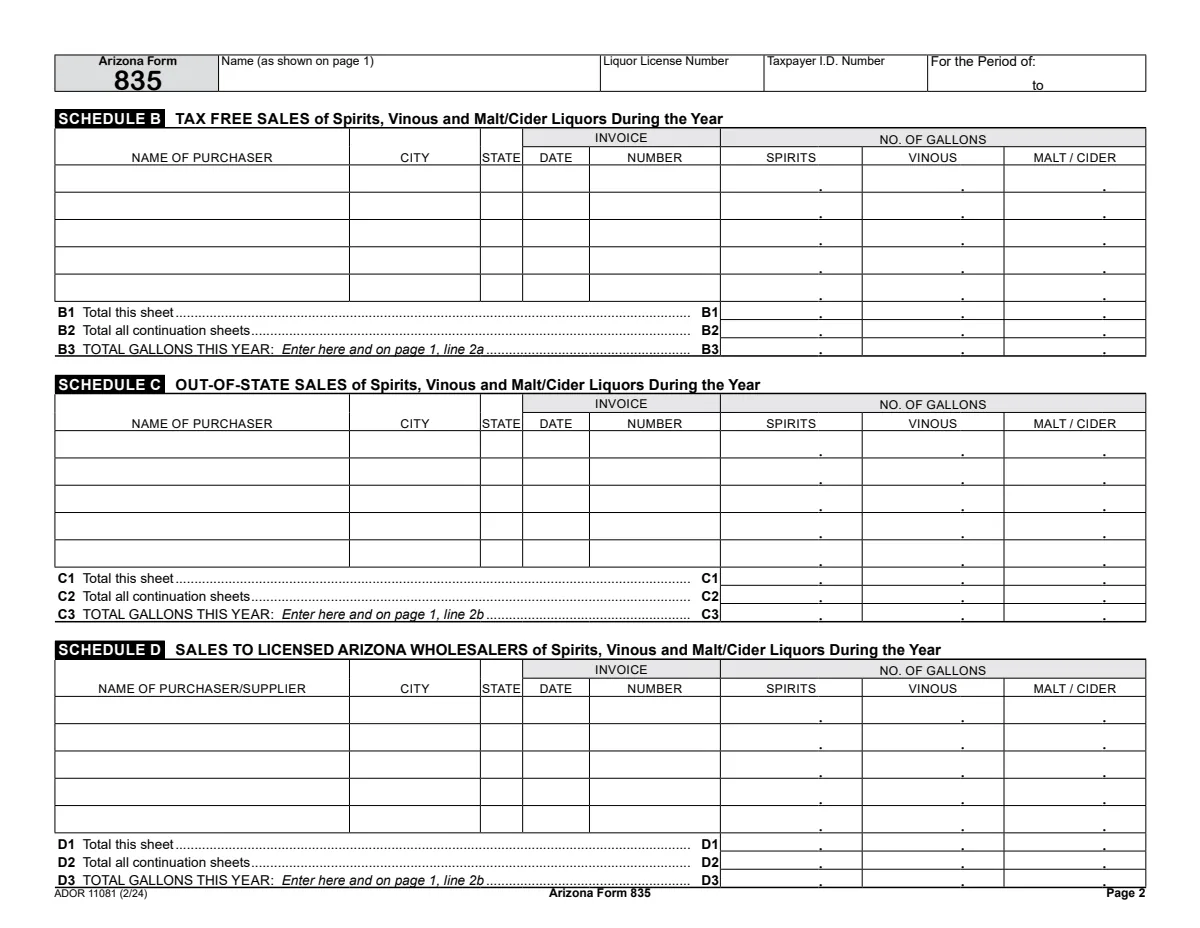
The schedules list each sale by invoice for the year and total it on lines 1 to 3. One printed cross-reference is off: D3 says “D3 TOTAL GALLONS THIS YEAR: Enter here and on page 1, line 2b”, but line 2b is exports (Schedule C). The instructions put Schedule D on line 2c, and that is where it belongs.
| Line | Label | What goes there |
|---|---|---|
| ID-2 | Name (as shown on page 1); Liquor License Number; Taxpayer I.D. Number; For the Period of | Repeat the page 1 identification on the schedule page. |
| Sch-B | Schedule B, detail rows | One row per tax-free sale to a military installation: purchaser, city, state, invoice date and number, gallons. |
| B1 | B1 Total this sheet | The rows on this sheet added. |
| B2 | B2 Total all continuation sheets | The totals of any continuation sheets. |
| B3 | B3 TOTAL GALLONS THIS YEAR | Line 1 plus line 2: carry it to page 1, line 2a. |
| Sch-C | Schedule C, detail rows | One row per sale shipped out of Arizona. |
| C1 | C1 Total this sheet | The rows on this sheet added. |
| C2 | C2 Total all continuation sheets | The totals of any continuation sheets. |
| C3 | C3 TOTAL GALLONS THIS YEAR | Line 1 plus line 2: carry it to page 1, line 2b. |
| Sch-D | Schedule D, detail rows | One row per invoice: spirits and vinous sold to a licensed Arizona wholesaler. |
| D1 | D1 Total this sheet | The rows on this sheet added. |
| D2 | D2 Total all continuation sheets | The totals of any continuation sheets. |
| D3 | D3 TOTAL GALLONS THIS YEAR | Line 1 plus line 2: carry it to page 1, line 2c (the form prints line 2b). |
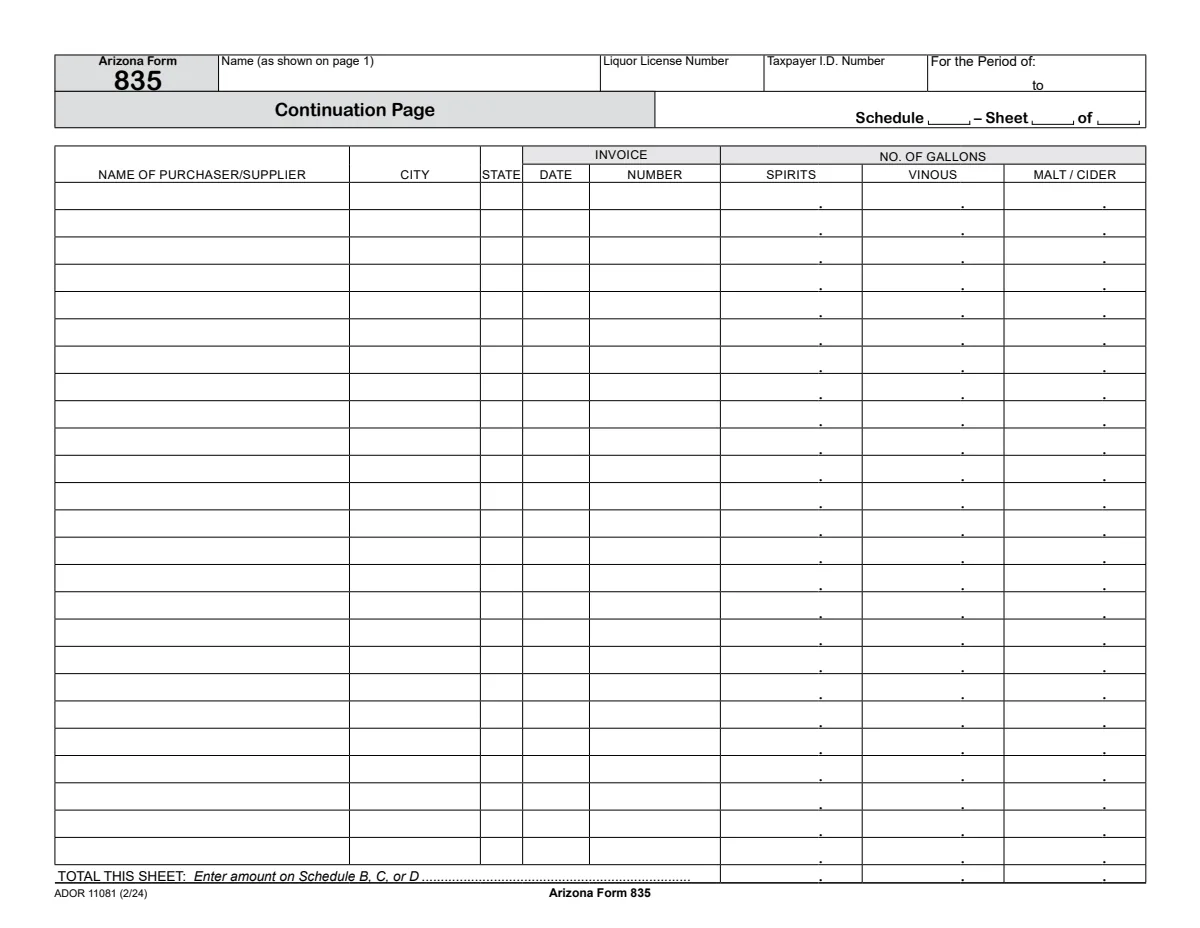
| ID-3 | Page 3 header | As on page 2. |
| Cont | Continuation Page: Schedule __ Sheet __ of __ | Extra rows for Schedule B, C or D when one sheet is not enough. |
| Cont-T | TOTAL THIS SHEET: Enter amount on Schedule B, C, or D | The continuation sheet's total. |
Rules that trip filers up
- It is annual, not monthly. Form 815 is monthly; Form 835 covers the year. Its printed due line reads “due not later than the 20th day of the 1st month following the year for which this return is made”.
- Penalties. “State law imposes a penalty plus interest on the amount of tax due on each return if your payment is late.” For not filing, “State law imposes a 5% penalty per year if you fail to file. The combined penalties, however, cannot exceed 25%.”
- TPT too. Producers that sell at retail also owe transaction privilege tax, a separate sales-type tax: “Retailers can apply for a TPT license online at AZTaxes.gov.”
- Records. Keep a copy with the supporting documents for at least four years.
How it connects
- Arizona's alcohol taxes and licenses: Arizona excise tax, alcohol section.
- The wholesaler's monthly return: Arizona Form 815. Arizona's other excise return on this site: MET-1.
- The federal side for small producers: alcohol excise tax and TTB F 5000.24; rates in every state: alcohol tax by state.
Questions filers ask
How often is Arizona Form 835 filed?
Once a year. The return and tax are due by the 20th day of the first month after the year, and the tax is delinquent ten days after that.
Who files Form 835?
Arizona craft distilleries, farm wineries, microbreweries and cider producers that sell at retail or to retail licensees in Arizona, and direct shipment licensees that do the same.
Do sales to an Arizona wholesaler count?
They go on Schedule D and line 2c as a deduction. The wholesaler pays the luxury tax on those gallons on Form 815.
What rates apply on Form 835?
The same as Form 815: $3.00 a gallon for spirits, $0.84 for wine up to 24% alcohol and $0.16 for malt liquor and cider, as of November 2026.
Is Form 835 the same as the TPT return?
No. Form 835 pays the liquor luxury tax. Retail sales also carry transaction privilege tax, reported separately on AZTaxes.gov.