- At a glance
- Who needs Schedule A
- One per activity or one per EIN?
- The form, with hotspots
- Header and certification
- Lines 1 to 4: gasoline, aviation gasoline, diesel, kerosene
- Lines 5 to 8: aviation kerosene and registered vendors
- Lines 9 to 13: reserved lines, alternative fuel, card issuers
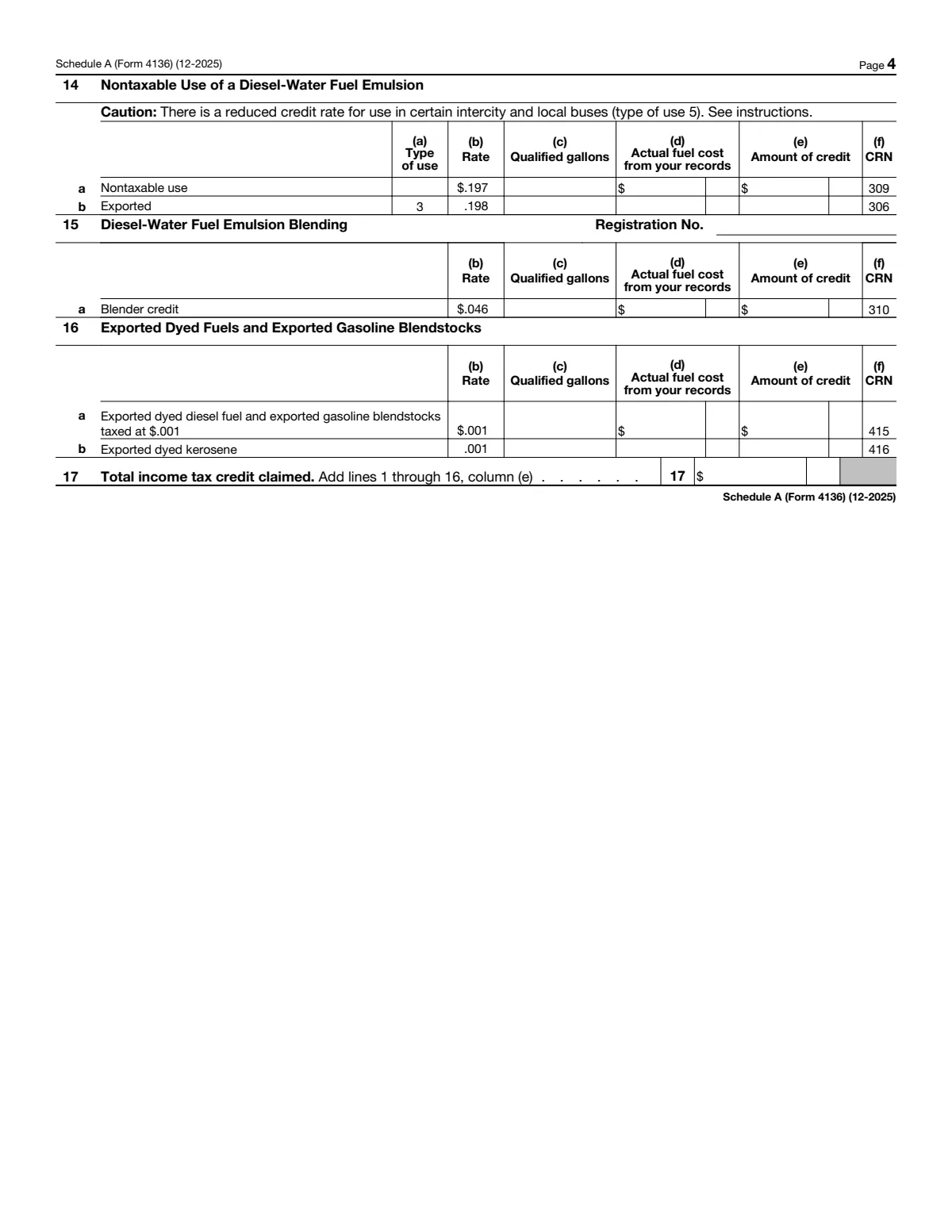
- Lines 14 to 17: emulsions, exported dyed fuel, total
- Worked example
- Rules that trip filers up
- How it connects
- Questions filers ask
- Sources
- Who files
- Form 4136 filers with 2+ business activities
- Due
- With the income tax return
- Filed with
- Form 4136, on the income tax return
- Form revision
- December 2025
- Pages
- 4
At a glance
Schedule A (Form 4136) is the Business Activity Report for Credit for Federal Tax Paid on Fuels. It is listed under What's New in the 2025 instructions, which are titled "Instructions for Form 4136 and Schedule A", and the Form 4136 (2025) itself sends filers to it in Part I, line (B). “If you have more than one qualifying business activity, complete and file a separate Schedule A (Form 4136) for each business activity,” The schedule repeats Form 4136's credit lines for one business activity at a time; “The lines on Schedule A (Form 4136) are the same as the Form 4136 and you can refer to the Specific Instructions for Form 4136 on how to complete Schedule A (Form 4136).”
- Who files. A Form 4136 filer with more than one qualifying business activity: a farmer who also runs a construction business, say.
- Attached to. “Attach to your Form 4136.” Form 4136 goes with the income tax return; the Form 4136 form page walks that form line by line.
- When. With the income tax return for the year. For tax year 2025, the IRS says returns with Form 4136 “cannot be e-filed before Feb. 22, 2026.” (its e-filing notice for tax year 2025).
- Form revision. Schedule A (Form 4136) (December 2025), four pages, with the Instructions for Form 4136 and Schedule A (2025).
- Records. “You must keep records to support any credits claimed on this return for at least 3 years from the date the return is due or filed, whichever is later.”
Who needs Schedule A
Form 4136 starts with three questions. Line (A) asks whether you have a qualifying business activity at all; answer No and you do not file. Line (B) asks how many you have. With one, you complete Form 4136 alone. With two or more, each activity gets a Schedule A, the totals go on Form 4136, and Form 4136, Part I describes the activity that uses the most fuel: “Combine the totals from all Schedule(s) A (Form 4136) on Form 4136, Part II and” “enter information about the business activity (for example, farming, construction) generating the most qualifying fuel usage on Form 4136, Part I, lines (C) through (F).”
The fuel tax credit is a business credit. The instructions warn that a taxpayer who uses gasoline in a vehicle “for personal use, commuting to work, or driving for ride sharing services” does not qualify. Partnerships do not file Form 4136 or its schedule at all; “Partnerships (other than electing large partnerships) can't file this form.” They give each partner the gallons, rate and use on Schedule K-1 instead. The rules behind each credit are on the Form 4136 guide.
One per activity or one per EIN?
The 2025 sources say two slightly different things. The form's line (B) and the opening of the instructions count activities: “If you have more than one qualifying business or business activity with qualifying usage of qualifying fuels eligible for FTC, you must use a separate Schedule A (Form 4136) for each business or business activity.” The Schedule A paragraph near the end of the instructions counts EINs: “If you have more than one business with qualifying use of qualifying fuels, complete and file a separate Schedule A (Form 4136) for each EIN.”
The two agree when each activity has its own EIN. They part when one EIN runs two activities (a farm and a custom hauling business under one sole proprietor's EIN, for example) or one activity has no EIN. The form's line (B) says "for each business activity", and the schedule's header asks for a business name and an EIN "(if applicable)", which fits one schedule per activity. The instructions do not reconcile the two; this page follows the form's wording.
Instructions for Form 4136 and Schedule A (2025); Schedule A (Form 4136) (December 2025).
Tap a box once for its note, again to jump to the line. Zoom in to read the small print.
Header and certification
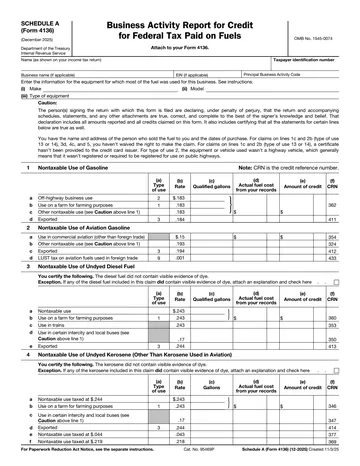
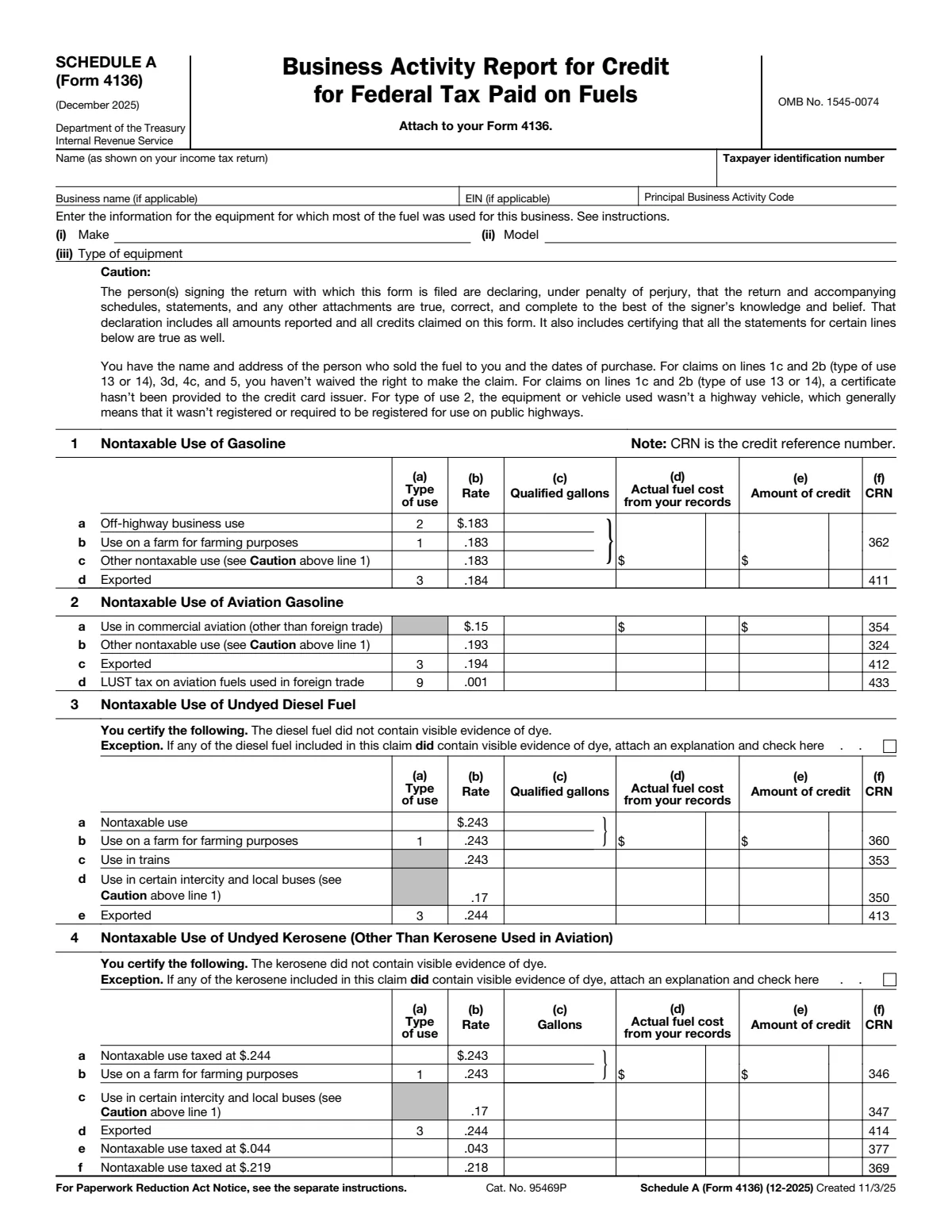
The header identifies the taxpayer (as on the return) and then the activity this schedule covers. The caution block replaces a signature: whoever signs the income tax return certifies the schedule too.
| Line | Label | What goes there |
|---|---|---|
| Name | Name (as shown on your income tax return) | The same name as on Form 4136 and the income tax return (Form 1040, 1120, 1120-S, 1041 or another). Schedule A is an attachment to an attachment: it goes with Form 4136, which goes with the return. |
| TIN | Taxpayer identification number | The same number as on the return and Form 4136. |
| BizName | Business name (if applicable) | The trade or business name of the activity on this Schedule A: the farm, the construction company, the fishing boat operation. Each activity gets its own schedule. |
| EIN | EIN (if applicable) | On Form 4136 the matching line is (D), and its instruction reads: “Enter on line D the EIN that was issued to you on Form SS-4. Don't enter your SSN on this line.” The lines on Schedule A follow the Form 4136 rules. |
| PBAC | Principal Business Activity Code | The six-digit principal business activity code for this activity, as on Form 4136, line (E): “Enter on line E the six-digit principal business activity code.” |
| Equip | Enter the information for the equipment for which most of the fuel was used for this business. See instructions. | Make, model and type of the equipment that burned most of this activity's fuel. The Form 4136 instruction for line (F) asks for the equipment “which used most of the fuel that provided your principal source of income on the business reported on line C.” |
| Caution | The person(s) signing the return with which this form is filed are declaring, under penalty of perjury, | There is no signature on Schedule A; the signature on the income tax return covers it. That declaration “includes all amounts reported and all credits claimed on this form.” It also certifies you have the seller's name and address and the purchase dates, and, for type of use 2, that the equipment was not a highway vehicle. |
| cols | Qualified gallons Actual fuel cost | Column (a): the type of use (from the Type of Use Table in the Form 4136 instructions) where the line asks for one. Column (b): the printed rate. Column (c): gallons. Column (d), new for 2025: actual fuel cost from your records. Column (e): “Generally, multiply the rate by the number of gallons.” Column (f): the credit reference number (CRN), printed. |
Lines 1 to 4: gasoline, aviation gasoline, diesel, kerosene
Each credit line shows the rate and the credit reference number (CRN) as the December 2025 schedule prints them; both are read from the IRS PDF for this page. Where lines are bracketed on the form (1a to 1c, 3a and 3b, 4a and 4b, 7a and 7b), they share one amount in column (e) and one CRN. Column (d), actual fuel cost, is new for 2025: “The IRS uses an average cost per gallon to estimate the fuel costs you paid during the year for permitted farming purposes or off-highway business use.” “Don't include any receipts or explanation with your tax return.”
| Line | Label | What goes there |
|---|---|---|
| 1a | a Off-highway business use | Gasoline used in a business other than in a highway vehicle registered or required to be registered. Lines 1a to 1c share one amount and one CRN. Rate printed: $.183 a gallon. Type of use printed: 2. CRN: 362. Full line rules: Form 4136, line 1a. |
| 1b | b Use on a farm for farming purposes | Gasoline used on a farm for farming purposes. Rate printed: $.183 a gallon. Type of use printed: 1. CRN: 362. Full line rules: Form 4136, line 1b. |
| 1c | c Other nontaxable use (see Caution above line 1) | For types of use 4, 5, 7, 11, 13, 14 or 15. “For type of use 13 or 14, the claimant must not have waived the right to make a claim.” Rate printed: $.183 a gallon. CRN: 362. Full line rules: Form 4136, line 1c. |
| 1d | d Exported | Gasoline exported during the period. “Taxpayers making a claim for exported taxable fuel must keep proof of exportation with their records.” Rate printed: $.184 a gallon. Type of use printed: 3. CRN: 411. Full line rules: Form 4136, line 1d. |
| 2a | a Use in commercial aviation (other than foreign trade) | “The ultimate purchaser of the aviation gasoline is the only person eligible to make this claim.” Rate printed: $.15 a gallon. CRN: 354. Full line rules: Form 4136, line 2a. |
| 2b | b Other nontaxable use (see Caution above line 1) | Types of use 1, 2, 9, 10, 11, 13, 14 or 15; also aviation gasoline used outside the propulsion system of an aircraft. Rate printed: $.193 a gallon. CRN: 324. Full line rules: Form 4136, line 2b. |
| 2c | c Exported | Aviation gasoline exported during the period. Rate printed: $.194 a gallon. Type of use printed: 3. CRN: 412. Full line rules: Form 4136, line 2c. |
| 2d | d LUST tax on aviation fuels used in foreign trade | Only the leaking underground storage tank tax comes back here, for aviation fuel used in foreign trade. Rate printed: $.001 a gallon. Type of use printed: 9. CRN: 433. Full line rules: Form 4136, line 2d. |
| 3-dye | Exception. If any of the diesel fuel included in this claim did contain visible evidence of dye, attach an explanation and check here | Claiming on line 3 certifies “The diesel fuel did not contain visible evidence of dye.” If some did, attach an explanation and check the box. |
| 3a | a Nontaxable use | “The ultimate purchaser of the diesel fuel is the only person eligible to make this claim.” “Type of use 8 includes use as heating oil and use in a motorboat.” Rate printed: $.243 a gallon. CRN: 360. Full line rules: Form 4136, line 3a. |
| 3b | b Use on a farm for farming purposes | Diesel used on a farm for farming purposes. Lines 3a and 3b share one amount and one CRN. Rate printed: $.243 a gallon. Type of use printed: 1. CRN: 360. Full line rules: Form 4136, line 3b. |
| 3c | c Use in trains | Diesel fuel used in trains during the period. Rate printed: $.243 a gallon. CRN: 353. Full line rules: Form 4136, line 3c. |
| 3d | d Use in certain intercity and local buses (see Caution above line 1) | Diesel used in certain intercity and local buses (type of use 5); the claimant must not have waived the right to make the claim. Rate printed: $.17 a gallon. CRN: 350. Full line rules: Form 4136, line 3d. |
| 3e | e Exported | Diesel fuel exported during the period; keep proof of export. Rate printed: $.244 a gallon. Type of use printed: 3. CRN: 413. Full line rules: Form 4136, line 3e. |
| 4-dye | Exception. If any of the kerosene included in this claim did contain visible evidence of dye, attach an explanation and check here | Claiming on line 4 certifies “The kerosene did not contain visible evidence of dye.” If some did, attach an explanation and check the box. |
| 4a | a Nontaxable use taxed at $.244 | Types of use 2, 6, 7, 8, 11, 13, 14 or 15. “The ultimate purchaser of the kerosene is the only person eligible to make this claim.” Rate printed: $.243 a gallon. CRN: 346. Full line rules: Form 4136, line 4a. |
| 4b | b Use on a farm for farming purposes | “Line 4b doesn't include claims for kerosene used in aviation for farming purposes;” those go on line 5. Rate printed: $.243 a gallon. Type of use printed: 1. CRN: 346. Full line rules: Form 4136, line 4b. |
| 4c | c Use in certain intercity and local buses (see Caution above line 1) | Kerosene used in certain intercity and local buses; the claimant must not have waived the right to make the claim. Rate printed: $.17 a gallon. CRN: 347. Full line rules: Form 4136, line 4c. |
| 4d | d Exported | Kerosene exported during the period; keep proof of export. Rate printed: $.244 a gallon. Type of use printed: 3. CRN: 414. Full line rules: Form 4136, line 4d. |
| 4e | e Nontaxable use taxed at $.044 | For lines 4e and 4f the kerosene must have been used for type of use 2. Rate printed: $.043 a gallon. CRN: 377. Full line rules: Form 4136, line 4e. |
| 4f | f Nontaxable use taxed at $.219 | Kerosene taxed at the $.219 rate, used for type of use 2 during the period. Rate printed: $.218 a gallon. CRN: 369. Full line rules: Form 4136, line 4f. |
Lines 5 to 8: aviation kerosene and registered vendors
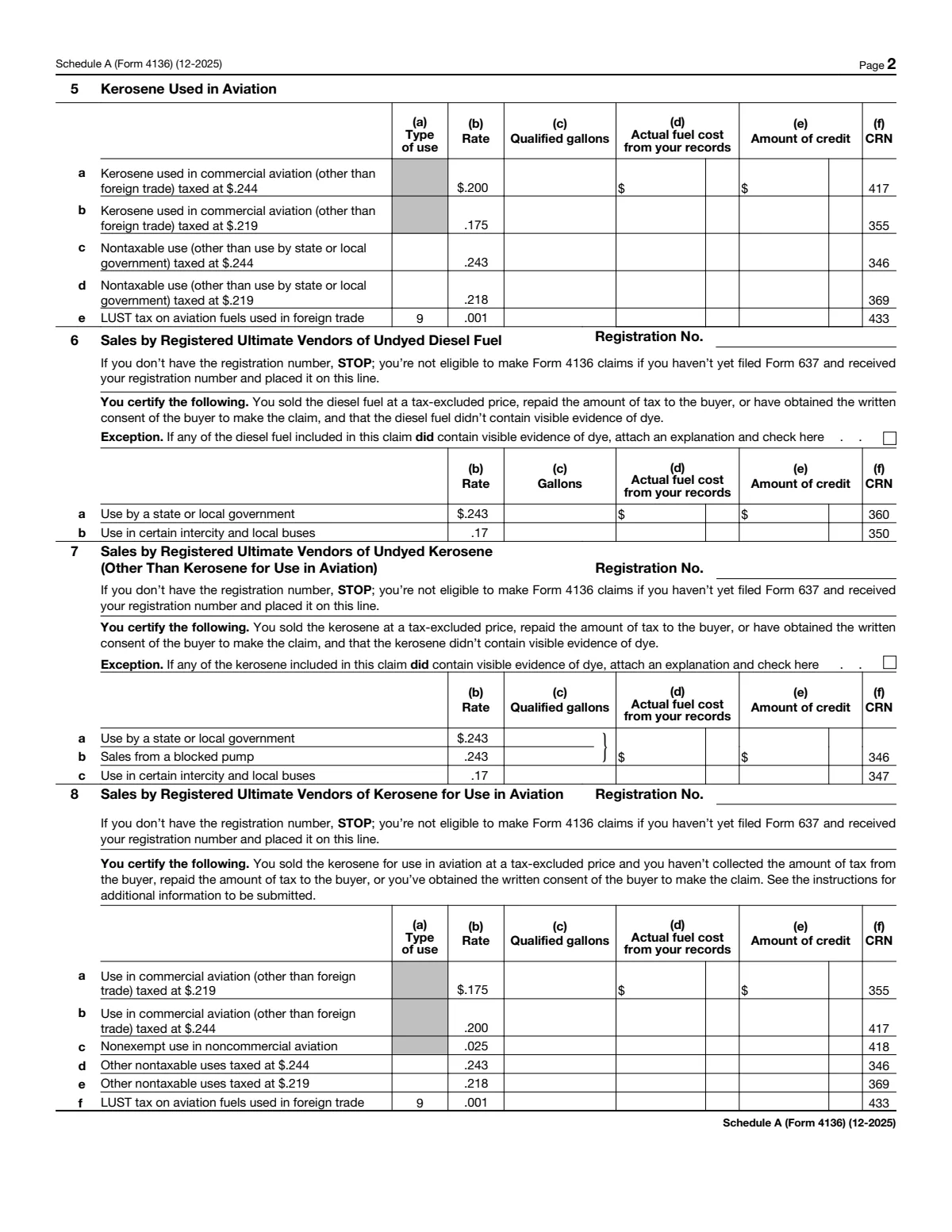
Lines 6 to 8 belong to registered ultimate vendors, not to the business that used the fuel. “You can't make a claim on lines 6 through 8 if you haven't received your IRS-issued Form 637 registration number and placed it on the applicable lines.” Registration is on Form 637.
| Line | Label | What goes there |
|---|---|---|
| 5a | a Kerosene used in commercial aviation (other than foreign trade) taxed at $.244 | The ultimate purchaser of kerosene used in commercial aviation (other than foreign trade) claims lines 5a and 5b. Rate printed: $.200 a gallon. CRN: 417. Full line rules: Form 4136, line 5a. |
| 5b | b Kerosene used in commercial aviation (other than foreign trade) taxed at $.219 | Commercial aviation use of kerosene taxed at the $.219 rate. Rate printed: $.175 a gallon. CRN: 355. Full line rules: Form 4136, line 5b. |
| 5c | c Nontaxable use (other than use by state or local government) taxed at $.244 | Types of use 1, 9, 10, 11, 13, 15 or 16, by the ultimate purchaser; claiming certifies you did not waive the claim. Rate printed: $.243 a gallon. CRN: 346. Full line rules: Form 4136, line 5c. |
| 5d | d Nontaxable use (other than use by state or local government) taxed at $.219 | As line 5c, for kerosene taxed at $.219. Rate printed: $.218 a gallon. CRN: 369. Full line rules: Form 4136, line 5d. |
| 5e | e LUST tax on aviation fuels used in foreign trade | “This claim is made in addition to the claim made on lines 5c and 5d for type of use 9.” Rate printed: $.001 a gallon. Type of use printed: 9. CRN: 433. Full line rules: Form 4136, line 5e. |
| 6 | Sales by Registered Ultimate Vendors of Undyed Diesel Fuel | “You can't make a claim on lines 6 through 8 if you haven't received your IRS-issued Form 637 registration number and placed it on the applicable lines.” Claiming certifies you sold at a tax-excluded price, repaid the tax or have the buyer's written consent, and the fuel had no visible dye. |
| 6a | a Use by a state or local government | The registered ultimate vendor claims, holding the buyer's certificate (Model Certificate P in Pub. 510); attach a statement of each governmental unit's name, TIN and gallons. Rate printed: $.243 a gallon. CRN: 360. Full line rules: Form 4136, line 6a. |
| 6b | b Use in certain intercity and local buses | Only with the buyer's unexpired waiver (Model Waiver N in Pub. 510). Rate printed: $.17 a gallon. CRN: 350. Full line rules: Form 4136, line 6b. |
| 7 | Sales by Registered Ultimate Vendors of Undyed Kerosene | Enter the registration number with its prefix. Claiming certifies the tax-excluded price, repayment or consent, and no visible dye. |
| 7a | a Use by a state or local government | Holding the buyer's certificate; attach the statement of each governmental unit's name, TIN and gallons. Rate printed: $.243 a gallon. CRN: 346. Full line rules: Form 4136, line 7a. |
| 7b | b Sales from a blocked pump | Keep a statement, if required, with the date of sale, buyer's name and address and gallons. Rate printed: $.243 a gallon. CRN: 346. Full line rules: Form 4136, line 7b. |
| 7c | c Use in certain intercity and local buses | Only with the buyer's unexpired waiver (Model Waiver N). Rate printed: $.17 a gallon. CRN: 347. Full line rules: Form 4136, line 7c. |
| 8 | Sales by Registered Ultimate Vendors of Kerosene for Use in Aviation | Enter your UA registration number (UV if type of use 14). Claiming certifies the tax-excluded price and that you did not collect the tax, repaid it, or have the buyer's written consent; see the instructions for the information to submit. |
| 8a | a Use in commercial aviation (other than foreign trade) taxed at $.219 | Only with the buyer's unexpired waiver (Model Waiver L). Rate printed: $.175 a gallon. CRN: 355. Full line rules: Form 4136, line 8a. |
| 8b | b Use in commercial aviation (other than foreign trade) taxed at $.244 | Only with the buyer's unexpired waiver (Model Waiver L). Rate printed: $.200 a gallon. CRN: 417. Full line rules: Form 4136, line 8b. |
| 8c | c Nonexempt use in noncommercial aviation | The vendor must hold the ultimate purchaser's certificate (Model Certificate Q). Rate printed: $.025 a gallon. CRN: 418. Full line rules: Form 4136, line 8c. |
| 8d | d Other nontaxable uses taxed at $.244 | Types of use 1, 9, 10, 11, 13, 14, 15 or 16, with the buyer's waiver. Rate printed: $.243 a gallon. CRN: 346. Full line rules: Form 4136, line 8d. |
| 8e | e Other nontaxable uses taxed at $.219 | As line 8d, for kerosene taxed at $.219. Rate printed: $.218 a gallon. CRN: 369. Full line rules: Form 4136, line 8e. |
| 8f | f LUST tax on aviation fuels used in foreign trade | Type of use 9, in addition to the claim on line 8d or 8e. Rate printed: $.001 a gallon. Type of use printed: 9. CRN: 433. Full line rules: Form 4136, line 8f. |
Lines 9 to 13: reserved lines, alternative fuel, card issuers
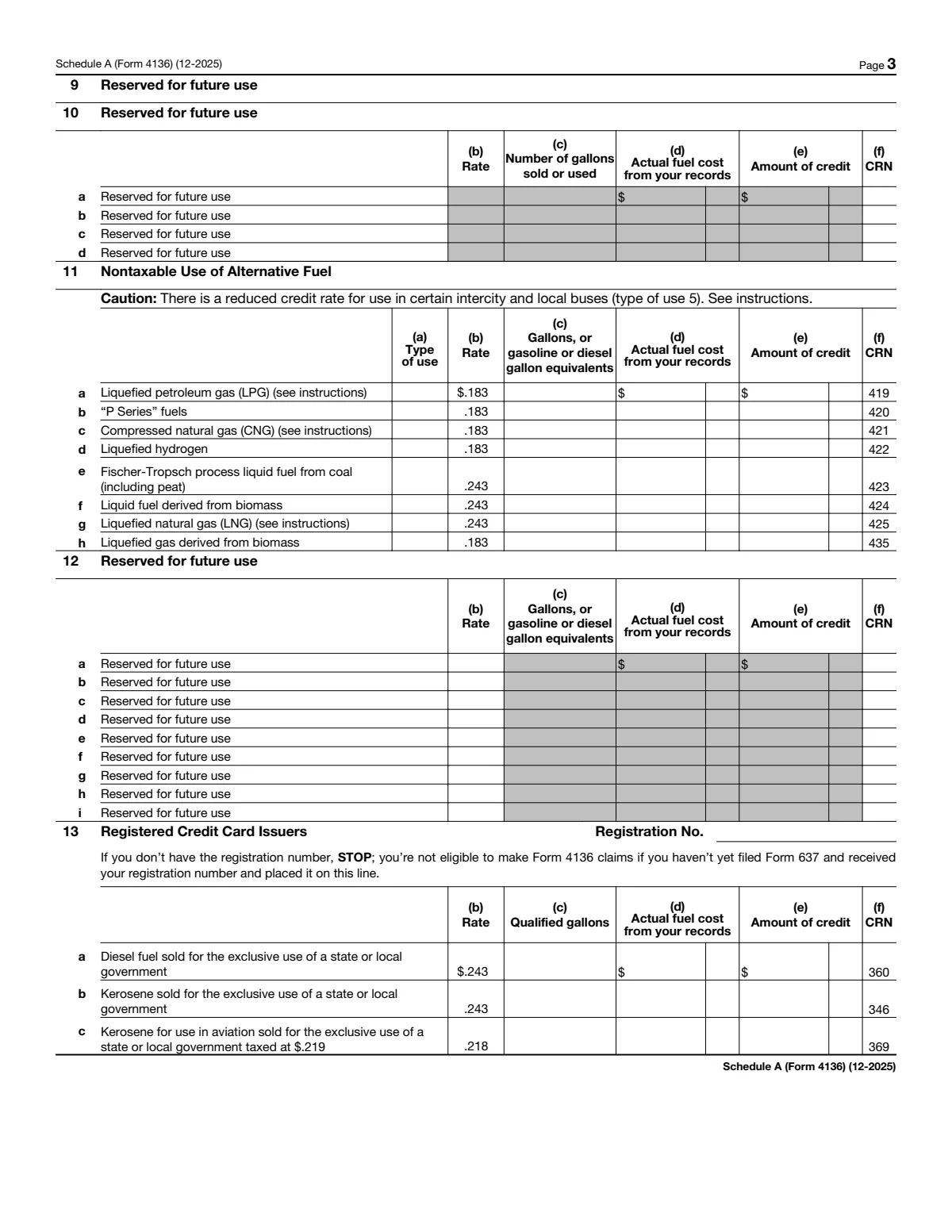
Three blocks on this page are now blank. The 2025 instructions explain lines 10 and 12: the biodiesel and renewable diesel mixture credits “expired for sales, uses, or removals after 2024. Part II, lines 10a through 10c, are reserved for future use.” The sustainable aviation fuel line (10d) is reserved too, and the alternative fuel credit lines 12a to 12i likewise. Line 11, the nontaxable use of taxed alternative fuel, is still live.
| Line | Label | What goes there |
|---|---|---|
| 9 | Reserved for future use | Reserved for future use on the 2025 schedule. |
| 10 | Reserved for future use | These were the biodiesel, renewable diesel and sustainable aviation fuel lines. “You can't claim SAF credit on Form 4136 after 2024.” |
| 11a | a Liquefied petroleum gas (LPG) (see instructions) | Alternative fuel in types of use 1, 2, 4, 5, 6, 7, 11, 13, 14 or 15. LPG, CNG and LNG are entered in gasoline or diesel gallon equivalents. Bus use (type 5) has its own lower rate in the instructions. Rate printed: $.183 a gallon. CRN: 419. Full line rules: Form 4136, line 11a. |
| 11b | b “P Series” fuels | Alternative fuel claim by the ultimate purchaser. Rate printed: $.183 a gallon. CRN: 420. Full line rules: Form 4136, line 11b. |
| 11c | c Compressed natural gas (CNG) (see instructions) | Compressed natural gas, entered in gasoline gallon equivalents. Rate printed: $.183 a gallon. CRN: 421. Full line rules: Form 4136, line 11c. |
| 11d | d Liquefied hydrogen | Alternative fuel claim by the ultimate purchaser. Rate printed: $.183 a gallon. CRN: 422. Full line rules: Form 4136, line 11d. |
| 11e | e Fischer-Tropsch process liquid fuel from coal (including peat) | Alternative fuel claim by the ultimate purchaser. Rate printed: $.243 a gallon. CRN: 423. Full line rules: Form 4136, line 11e. |
| 11f | f Liquid fuel derived from biomass | Alternative fuel claim by the ultimate purchaser. Rate printed: $.243 a gallon. CRN: 424. Full line rules: Form 4136, line 11f. |
| 11g | g Liquefied natural gas (LNG) (see instructions) | Liquefied natural gas, entered in diesel gallon equivalents. Rate printed: $.243 a gallon. CRN: 425. Full line rules: Form 4136, line 11g. |
| 11h | h Liquefied gas derived from biomass | Alternative fuel claim by the ultimate purchaser. Rate printed: $.183 a gallon. CRN: 435. Full line rules: Form 4136, line 11h. |
| 12 | 12 Reserved for future use | The alternative fuel and alternative fuel mixture credits “expired for sales, uses, or removals after 2024.” |
| 13 | Registered Credit Card Issuers | Only a registered credit card issuer claims here, holding the buyer's certificate (Model Certificate R); enter the CC registration number. |
| 13a | a Diesel fuel sold for the exclusive use of a state or local government | Purchased with a card issued to the government buyer for its exclusive use. Rate printed: $.243 a gallon. CRN: 360. Full line rules: Form 4136, line 13a. |
| 13b | b Kerosene sold for the exclusive use of a state or local government | Purchased with a card for the government's exclusive use. Rate printed: $.243 a gallon. CRN: 346. Full line rules: Form 4136, line 13b. |
| 13c | c Kerosene for use in aviation sold for the exclusive use of a state or local government taxed at $.219 | Kerosene taxed at $.244 instead: write "Taxed at $.244" beside column (b) and use $.243. Rate printed: $.218 a gallon. CRN: 369. Full line rules: Form 4136, line 13c. |
Lines 14 to 17: emulsions, exported dyed fuel, total
Line 17 is the activity's total. It does not go to the income tax return by itself: the Schedule A lines are combined, line by line, into Form 4136, Part II, and Form 4136, line 17 carries the total to the return.
| Line | Label | What goes there |
|---|---|---|
| 14a | a Nontaxable use | Types of use 1, 2, 5, 6, 7, 8, 11, 13, 14 or 15, by the ultimate purchaser; bus use (type 5) has a lower rate in the instructions. Rate printed: $.197 a gallon. CRN: 309. Full line rules: Form 4136, line 14a. |
| 14b | b Exported | Exported during the period; keep proof of export. Rate printed: $.198 a gallon. Type of use printed: 3. CRN: 306. Full line rules: Form 4136, line 14b. |
| 15 | Diesel-Water Fuel Emulsion Blending | Enter your M registration number. Without a Form 637 number there is no claim on line 15. |
| 15a | a Blender credit | The blender attaches a statement certifying, among other things, at least 14% water and an EPA-registered additive. Rate printed: $.046 a gallon. CRN: 310. Full line rules: Form 4136, line 15a. |
| 16a | a Exported dyed diesel fuel and exported gasoline blendstocks taxed at $.001 | Only the exporter of the dyed fuel claims; the rate is the LUST tax. Rate printed: $.001 a gallon. CRN: 415. Full line rules: Form 4136, line 16a. |
| 16b | b Exported dyed kerosene | As line 16a, for dyed kerosene. Rate printed: $.001 a gallon. CRN: 416. Full line rules: Form 4136, line 16b. |
| 17 | Total income tax credit claimed. Add lines 1 through 16, column (e) | The credit for this activity. Carry each line, not just this total, into Form 4136: the totals from every Schedule A are combined on Form 4136, Part II. |
Worked example
A sole proprietor farms and also runs a construction business. In 2025 the farm used 1,200 gallons of gasoline on the farm for farming purposes (line 1b, type of use 1), and the construction business used 800 gallons in off-highway equipment (line 1a, type of use 2). Both lines carry the rate the schedule prints, $0.183 a gallon. Two activities means two Schedules A, combined on Form 4136:
| Schedule A, farm | Schedule A, construction | Form 4136, Part II | |
|---|---|---|---|
| Line 1b, gasoline on a farm | 1,200 gallons x $0.183 = $219.60 | $219.60 | |
| Line 1a, gasoline off-highway | 800 gallons x $0.183 = $146.40 | $146.40 | |
| Line 17 total | $219.60 | $146.40 | $366.00 |
Lines 1a to 1c share one bracketed amount and CRN 362 on each schedule. Form 4136, Part I, lines (C) to (F) then describe the farm, the activity with more fuel. If the fuel cost was deducted as a business expense, the instructions add: “Include any credit or refund of excise taxes on fuels in your gross income if you claimed the total cost of the fuel (including the excise taxes) as an expense deduction that reduced your income tax liability.”
Rules that trip filers up
- Claiming twice. “You can't claim any amounts on Form 4136 that you claimed on Form 8849; Form 8864; or Form 720, Schedule C.”
- Personal driving. Commuting, personal use and ride sharing do not qualify.
- Vendor lines without a registration number. Lines 6 to 8, 13 and 15 need the Form 637 number on the line.
- Reserved lines. Lines 9, 10 and 12 take nothing for 2025.
- More types of use than the line holds. “If you need more space for any line (for example, for more types of use), prepare a separate statement using the same format as the line.”
- Exports without proof. Keep the export bill of lading, the carrier's certificate, a foreign customs certificate or the consignee's statement.
- False claims. “Falsely claiming the FTC will result in severe consequences, including civil and criminal penalties.”
How it connects
- The form it attaches to: Form 4136 line by line, with the full rule for every credit line.
- The rules behind the credit: the Form 4136 guide and the federal fuel excise tax hub.
- Quarterly refunds instead of a credit: the Form 8849 guide and Form 8849 form page.
- Registration for vendor and blender lines: Form 637.
Questions filers ask
Does Form 4136 have a Schedule A?
Yes. The IRS publishes Schedule A (Form 4136), Business Activity Report for Credit for Federal Tax Paid on Fuels (December 2025), and the 2025 instructions list it under What's New. Form 4136, Part I, line (B) sends filers with more than one qualifying business activity to it.
Do I need Schedule A with only one business?
No. With one qualifying business activity you complete Form 4136 alone. Schedule A is for the second and later activities, one schedule each, with the totals combined on Form 4136.
Where do the Schedule A totals go?
Into Form 4136, Part II, line by line, combined across all your Schedules A. Form 4136, line 17 then goes to the income tax return (for example Schedule 3 (Form 1040)).
Is Schedule A filed per activity or per EIN?
The form and the first instruction paragraph say per business activity; a later instruction paragraph says per EIN. They agree when each activity has its own EIN. The form's wording is per activity.
Can a partnership file Schedule A?
No. Partnerships other than electing large partnerships cannot file Form 4136; they report the gallons, rate and use to partners on Schedule K-1, and the partners claim the credit.
When can I e-file a 2025 return with Form 4136 and Schedule A?
The IRS said it would begin accepting e-filed tax year 2025 returns that include Form 4136 on Feb. 22, 2026.