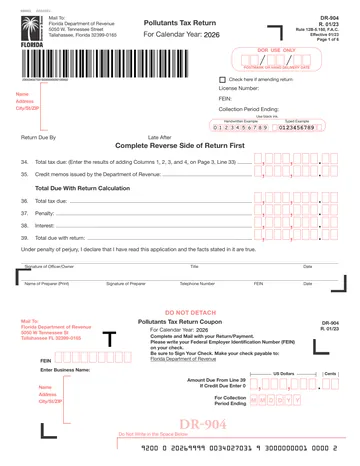
- Who files
- Florida terminal suppliers, importers, wholesalers, pollutant makers
- Due
- 1st of the next month; late after the 20th
- Filed with
- Florida DOR, online
- Form revision
- R. 01/23
- Pages
- 6 (sample), 2 to complete
At a glance
Form DR-904 is Florida's “Pollutants Tax Return”. Florida taxes pollutants, mainly petroleum products, but also solvents, lubricants, ammonia and other chemicals, when they are first sold, produced in or imported into the state. The money goes to three funds, which the return shows as separate columns: coastal protection, water quality and inland protection, with a fourth column for the dry cleaning tax on perchloroethylene. “Pollutants tax is imposed on each barrel or unit of pollutant when first sold, produced in, or imported into Florida.”
- Who files. Licensed terminal suppliers, importers and wholesalers, and anyone who imports or makes taxable pollutants other than petroleum products.
- When. Due on the 1st and late after the 20th of the month after the collection period, even with no tax due.
- How. Online through Florida eServices; filers who paid $5,000 or more in the prior state fiscal year (July 1 to June 30) must file and pay electronically. The posted PDF is a sample: “This form cannot be used for filing your tax return.” Taxpayer Services sends a personalized paper form on request.
- Form. DR-904 (R. 01/23, calendar year 2026), with its instructions in the same PDF. The Department's pollutants page covers licensing.
Tap a box once for its note, again to jump to the line. Zoom in to read the small print.
Who files and how often
The return is monthly by default. The instructions allow less frequent filing for small amounts, on written request: “A quarterly return and payment when the tax paid for the preceding quarter did not exceed $100.” A semiannual return is allowed when the prior six months' tax did not exceed $200, and an annual return when the prior 12 months' tax did not exceed $400.
Florida DR-904 (R. 01/23) general information.
The four taxes and their rates
“The rate for the Tax on Coastal Protection, the Tax on Water Quality, and the Tax on Inland Protection are provided in s. 206.9935, F.S.” The perchloroethylene rate is in s. 376.75. The rates are printed on page 3 by schedule and column (as of the R. 01/23 form for 2026):
| Schedule | Product | Unit | Coastal protection | Water quality | Inland protection | Perchloroethylene |
|---|---|---|---|---|---|---|
| A | Solvents (and perchloroethylene) | Gallon | Shaded | $0.059 | Shaded | $5.00 |
| B | Motor oil and other lubricants | Gallon | Shaded | $0.025 | Shaded | Shaded |
| C | Ammonia | Barrel | $0.02 | $0.02 | Shaded | Shaded |
| D | Gasoline and gasohol | Barrel | $0.02 | $0.05 | $0.80 | Shaded |
| E | Diesel and other pollutants | Barrel | $0.02 | $0.05 | $0.80 | Shaded |
Several products are exempt from some of the funds: solvents, motor oil and lubricants owe no coastal or inland protection tax, and residual oils, asphalt oil, petrochemical feedstocks, pesticides, ammonia and chlorine owe no inland protection tax. Biodiesel (B100) is not a pollutant.
Page 1: header, signature and coupon
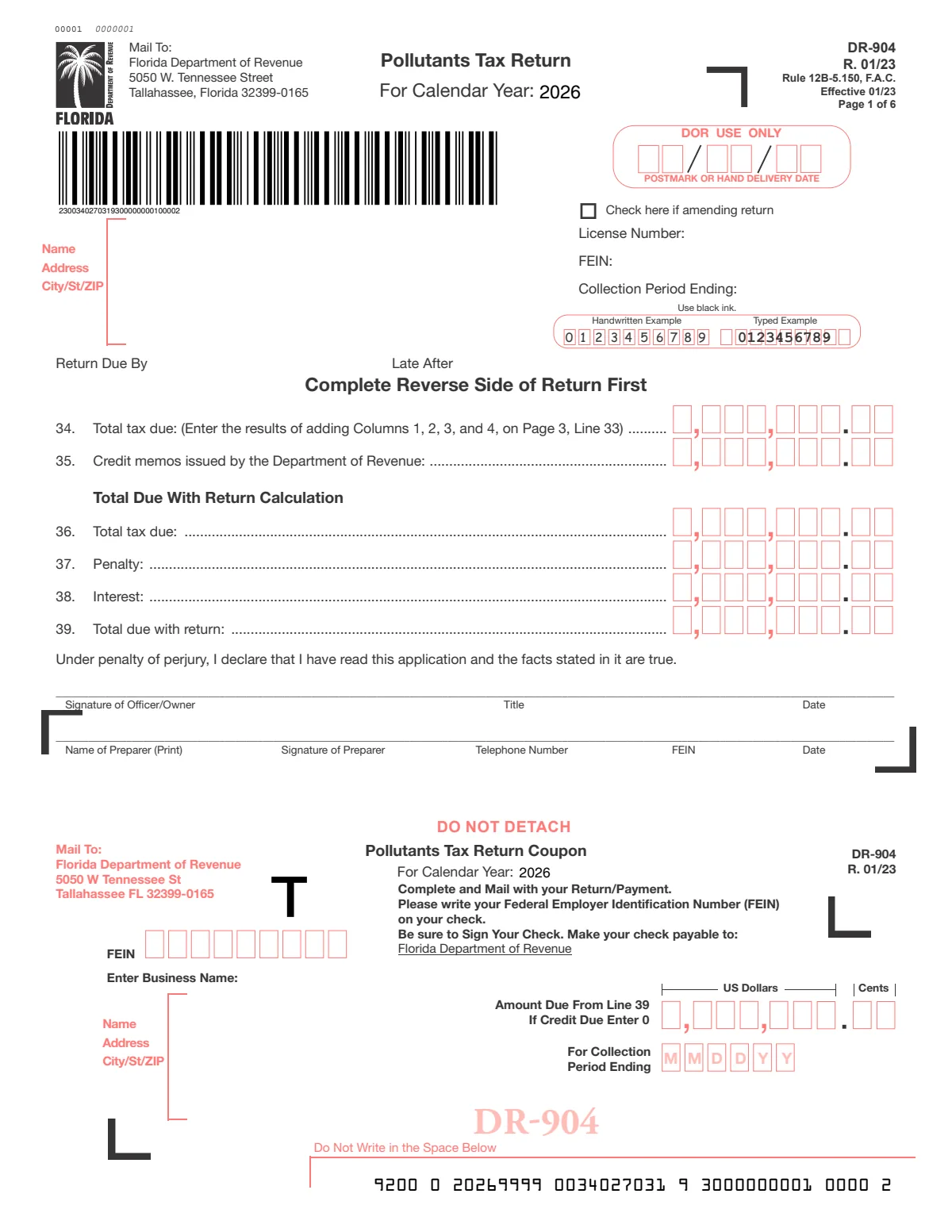
Page 1 carries the identifiers, the totals from page 3, the signature and the payment coupon. Complete page 3 first, as the form says.
| Line | Label | What goes there |
|---|---|---|
| Amending | Check here if amending return | Check it when the return corrects one already filed. |
| IDs | License Number: FEIN: Collection Period Ending: | Your Florida pollutants license number, FEIN and the last day of the collection period. |
| Name | Name / Address / City/St/ZIP | The licensee's name and address. |
| Due-Late | Return Due By / Late After | “Your tax return is due to the Department on the 1st day of the month following the collection period.” It is late if delivered or postmarked after the 20th. |
| Officer | Signature of Officer/Owner, Title, Date | “You must sign and date your DR-904.” An officer or owner signs, with title and date. |
| Preparer | Name of Preparer (Print) Signature of Preparer Telephone Number FEIN Date | The preparer's printed name, signature, telephone number, FEIN and date, if someone else prepared the return. |
| C-FEIN | FEIN | Your FEIN, one digit per box. |
| C-Name | Enter Business Name: | The business name and address. |
| C-Amount | Amount Due From Line 39 / If Credit Due Enter 0 | The amount from line 39, or 0 if a credit is due. |
| C-Period | For Collection Period Ending (MM DD YY) | The last day of the collection period. |
Page 3: Schedules A to E
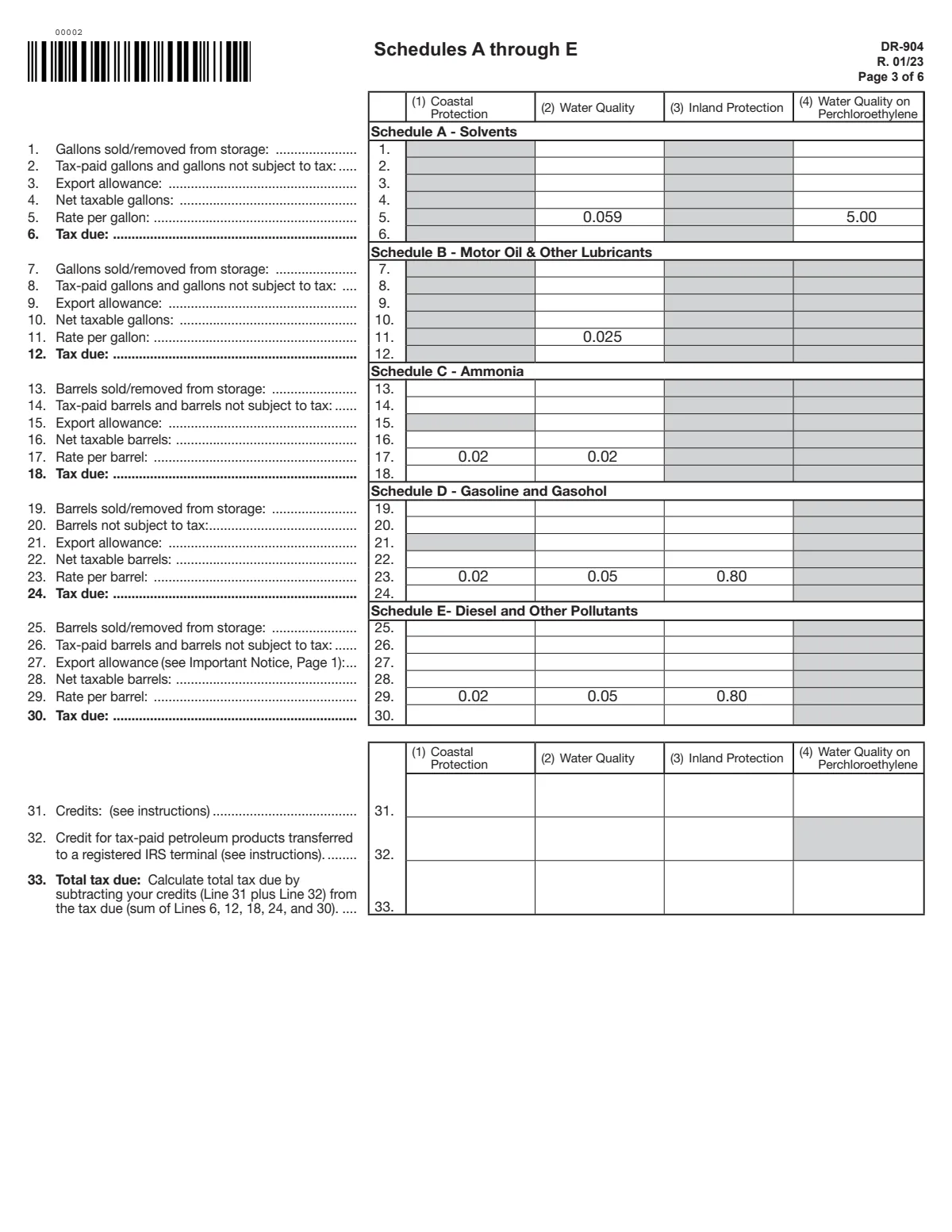
Each schedule runs the same six steps by column: quantity sold or removed, less tax-paid and nontaxable quantities, less exports, gives the net taxable quantity, times the printed rate, gives the tax. Solvents and lubricants are counted in gallons; ammonia, gasoline and diesel in 42 gallon barrels.
| Line | Label | What goes there |
|---|---|---|
| Columns | (1) Coastal Protection; (2) Water Quality; (3) Inland Protection; (4) Water Quality on Perchloroethylene | The four taxes, each in its own column: coastal protection, water quality, inland protection, and water quality on perchloroethylene. “The applicable tax rates are entered by the Department.” |
Schedule A: solvents
Solvents and perchloroethylene, in gallons. Perchloroethylene sold to a dry cleaner pays both the 5.9 cent solvent rate and the $5.00 dry cleaning rate.
| Line | Label | What goes there |
|---|---|---|
| 1 | 1. Gallons sold/removed from storage: | “Enter all tax-paid and unpaid gallons of solvents sold or removed from storage during the collection period.” |
| 2 | 2. Tax-paid gallons and gallons not subject to tax: | “Add the gallons on which tax has been paid during the month to the gallons on which the tax is not imposed and enter the result on Line 2.” |
| 3 | 3. Export allowance: | “Enter the gallons exported during the month and the gallons consumed in production.” |
| 4 | 4. Net taxable gallons: | Line 1 minus lines 2 and 3: the tax-unpaid gallons subject to tax. |
| 5 | 5. Rate per gallon: | Printed: 0.059 in the water quality column (solvents, 5.9 cents a gallon) and 5.00 in the perchloroethylene column. “Perchloroethylene sold to or imported into Florida by a dry-cleaning business is taxed at 5.9¢ per gallon for water quality tax as a solvent” and also at $5.00 a gallon as a dry cleaning solvent. |
| 6 | 6. Tax due: | Line 4 times line 5, in each column. |
Schedule B: motor oil and other lubricants
Motor oil and lubricants, in gallons, taxed for water quality only.
| Line | Label | What goes there |
|---|---|---|
| 7 | 7. Gallons sold/removed from storage: | “Enter all tax-paid and unpaid gallons of motor oil and other lubricants sold or removed from storage during the collection period.” |
| 8 | 8. Tax-paid gallons and gallons not subject to tax: | Gallons on which tax was already paid during the month, plus gallons on which the tax is not imposed. |
| 9 | 9. Export allowance: | “Enter the gallons that have been exported during the month.” |
| 10 | 10. Net taxable gallons: | Line 7 minus lines 8 and 9: the tax-unpaid gallons subject to tax. |
| 11 | 11. Rate per gallon: | Printed: 0.025 a gallon in the water quality column. “Motor oil and other lubricants are subject to the tax for water quality.” |
| 12 | 12. Tax due: | Line 10 times line 11. |
Schedule C: ammonia
Ammonia, in barrels, taxed for coastal protection and water quality.
| Line | Label | What goes there |
|---|---|---|
| 13 | 13. Barrels sold/removed from storage: | “Enter all tax-paid and unpaid barrels of ammonia sold or removed from storage during the collection period.” |
| 14 | 14. Tax-paid barrels and barrels not subject to tax: | Barrels on which tax was already paid during the month, plus barrels on which the tax is not imposed. |
| 15 | 15. Export allowance: | Barrels exported during the month. The coastal protection column is shaded. |
| 16 | 16. Net taxable barrels: | Line 13 minus lines 14 and 15. |
| 17 | 17. Rate per barrel: | Printed: 0.02 a barrel for coastal protection and 0.02 for water quality. “Ammonia is subject to the taxes for coastal protection and water quality.” |
| 18 | 18. Tax due: | Line 16 times line 17, by column. |
Schedule D: gasoline and gasohol
Gasoline, gasohol and fuel grade ethanol, in barrels, taxed for all three funds. A worked example: 10,000 net taxable barrels times $0.02, $0.05 and $0.80 give $200, $500 and $8,000 by column, $8,700 in all.
| Line | Label | What goes there |
|---|---|---|
| 19 | 19. Barrels sold/removed from storage: | “Enter all barrels of tax paid and unpaid gasoline and gasohol sold or removed from storage during the collection period.” Fuel grade ethanol is reported here too. |
| 20 | 20. Barrels not subject to tax: | Barrels on which tax was paid during the month, plus barrels on which the tax is not imposed. (The form prints "Barrels not subject to tax".) |
| 21 | 21. Export allowance: | Barrels exported during the month. Coastal protection is shaded: no export allowance there. |
| 22 | 22. Net taxable barrels: | Line 19 minus lines 20 and 21. |
| 23 | 23. Rate per barrel: | Printed: 0.02 coastal protection, 0.05 water quality and 0.80 inland protection, per barrel. Together $0.87 a barrel, which is about 2.071 cents a gallon at 42 gallons to the barrel, the figure in TIP 25B05-05: “a pollutants tax of 2.071 cents per gallon”. |
| 24 | 24. Tax due: | Line 22 times line 23, by column. |
Schedule E: diesel and other pollutants
Diesel and every other pollutant not on Schedules A to D, in barrels.
| Line | Label | What goes there |
|---|---|---|
| 25 | 25. Barrels sold/removed from storage: | “Enter all tax-paid and unpaid barrels of pollutants sold or removed from storage during the collection period.” Schedule E covers diesel and all other pollutants, including biodiesel blends (the biodiesel part is not taxed). |
| 26 | 26. Tax-paid barrels and barrels not subject to tax: | Barrels on which tax was paid during the month, plus barrels on which the tax is not imposed. |
| 27 | 27. Export allowance (see Important Notice, Page 1): | Barrels exported during the month. The line refers to an "Important Notice, Page 1" that the posted sample does not include. |
| 28 | 28. Net taxable barrels: | Line 25 minus lines 26 and 27. |
| 29 | 29. Rate per barrel: | Printed: 0.02, 0.05 and 0.80 a barrel, as on Schedule D. |
| 30 | 30. Tax due: | Line 28 times line 29, by column. |
Lines 31 to 33: credits and total by column
| Line | Label | What goes there |
|---|---|---|
| 31 | 31. Credits: (see instructions) | Credits for tax-paid pollutants later exported, bunkered into vessels in interstate or foreign commerce, or (for solvents) consumed in making a product that is not a pollutant. “Note: The credit shall not exceed tax due.” A refund on Form DR-309660 is the alternative. |
| 32 | 32. Credit for tax-paid petroleum products transferred to a registered IRS terminal (see instructions) | For licensed terminal suppliers that bought tax-paid gasoline, gasohol or fuel grade ethanol imported by truck or rail and moved it into a registered IRS terminal: the gallons on Schedule 1A of the terminal supplier return, divided by 42, times 0.02, 0.05 and 0.80 by column. |
| 33 | 33. Total tax due: Calculate total tax due by subtracting your credits (Line 31 plus Line 32) from the tax due (sum of Lines 6, 12, 18, 24, and 30). | Each column's tax (lines 6, 12, 18, 24 and 30) less its credits (lines 31 and 32). The instructions word it the other way round: “Subtract the sum of Line 6 plus Line 12 plus Line 18 plus Line 24 plus Line 30 from Lines 31 and 32 under each column”. Follow the form: tax less credits. |
Lines 34 to 39: total due
Back on page 1, the four column totals become one amount, less credit memos, plus penalty and interest.
| Line | Label | What goes there |
|---|---|---|
| 34 | 34. Total tax due: (Enter the results of adding Columns 1, 2, 3, and 4, on Page 3, Line 33) | “Enter the results of adding Columns 1, 2, 3, and 4, on Page 3, Line 33.” |
| 35 | 35. Credit memos issued by the Department of Revenue: | Credit memos the Department issued for an overpayment. “The Department will issue a credit memo in all cases where tax due has inadvertently been overpaid.” |
| 36 | 36. Total tax due: | “Subtract Line 35 from Line 34 and enter the result.” |
| 37 | 37. Penalty: | If the return or payment is late, 10 percent of the tax due for each month or part of a month late, up to 50 percent; “The minimum penalty, even for a zero ‘0’ return, is $10.00.” |
| 38 | 38. Interest: | Interest on late payment: the tax due times the days late times the daily rate the Department publishes. |
| 39 | 39. Total due with return: | “Enter the sum of Lines 36, 37, and 38.” |
Rules that trip filers up
- Gallons on the barrel schedules. Schedules C, D and E are in barrels of 42 gallons.
- Credits over the tax. A credit cannot exceed the tax due; ask for a refund instead.
- Terminal transfers on line 31. The credit for tax-paid product moved into an IRS terminal goes on line 32, not line 31.
- Line 33 the wrong way round. Subtract the credits from the tax, as the form prints it.
- Skipping a zero month. The return is due even when no tax is due, and a late zero return still draws the $10 minimum penalty.
- Filing the sample. The posted PDF cannot be used to file.
How it connects
- Florida's other excise taxes, including the pollutants tax in context: Florida excise tax, other taxes section.
- The wholesaler fuel return that sits beside it: Florida DR-309632.
- The federal Superfund tax on petroleum and chemicals, a different tax: Superfund excise taxes.
Questions filers ask
What is the Florida pollutants tax rate on gasoline?
$0.87 a barrel on the 2026 return: $0.02 coastal protection, $0.05 water quality and $0.80 inland protection. TIP 25B05-05 states it as 2.071 cents a gallon.
Who files Form DR-904?
Terminal suppliers, importers and wholesalers licensed under Chapter 206, and anyone who imports or makes taxable pollutants other than petroleum products.
When is the DR-904 due?
On the 1st of the month after the collection period; it is late if delivered or postmarked after the 20th. Small filers can ask in writing to file quarterly, semiannually or annually.
Is perchloroethylene taxed twice?
Yes, when sold to a dry cleaning business: 5.9 cents a gallon as a solvent and $5.00 a gallon as a dry cleaning solvent, both for water quality.
Can I use the PDF to file?
No. The posted DR-904 is a sample. File online, or call Taxpayer Services at 850-488-6800 for a personalized paper form.