- Who files
- Kansas clubs, caterers and drinking establishments
- Due
- 25th of the month after the period
- Filed with
- Kansas Department of Revenue
- Form revision
- Rev. 12-21
- Pages
- 1 (instructions and voucher)
At a glance
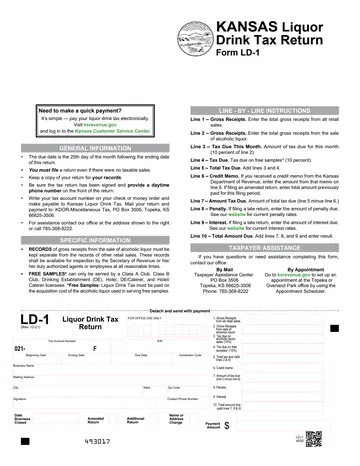
Form LD-1 is the Kansas Liquor Drink Tax Return, filed by the businesses that sell drinks containing alcoholic liquor for consumption on the premises: clubs, caterers and drinking establishments. The tax is 10 percent of the gross receipts from those drinks, plus 10 percent of the acquisition cost of liquor poured as free samples. The PDF is one page: instructions at the top and the return itself, a voucher, at the bottom (“Detach and send with payment”).
- Who files. Clubs, caterers and drinking establishments, including “farm wineries, microbreweries, and microdistilleries also licensed as a drinking establishment selling to customers for on-premises consumption”. They also need a liquor license from the Division of Alcoholic Beverage Control, a Kansas sales tax number and a bond.
- When. By the 25th day of the month following the ending date of the return. “You must file a return even if there were no taxable sales.”
- How. Online through the Kansas Customer Service Center; KDOR's liquor drink page also links WebTax for Liquor Taxes. On paper, mail the voucher and payment to KDOR-Miscellaneous Tax, PO Box 3506, Topeka, KS 66625-3506.
- Form. LD-1 (Rev. 12-21). A payment voucher on its own is the LD-1V.
- Bond. “Post a bond equal to $1,000, or the three-month average liquor drink tax liability, whichever is greater.” Forms: the LD-400 surety bond or the LD-401 escrow agreement.
Tap a box once for its note, again to jump to the line. Zoom in to read the small print.
The voucher: header and boxes
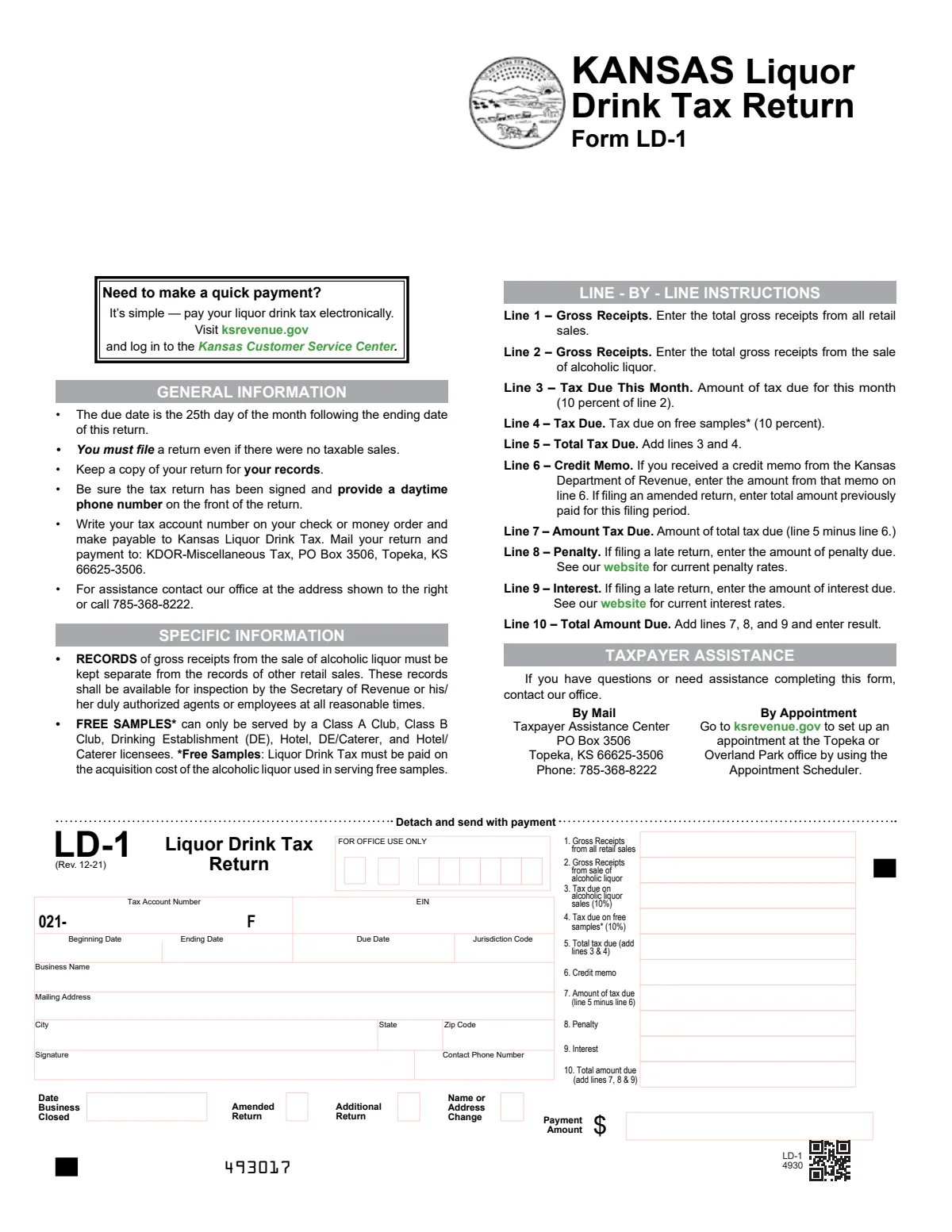
The left side of the voucher identifies the account, the period and the business, and carries the signature. The small boxes along the bottom flag a closed business, an amended or additional return, or a name or address change. The "For office use only" boxes stay blank.
| Line | Label | What goes there |
|---|---|---|
| Account | Tax Account Number (021- ... F) | Your Kansas liquor drink tax account number. The form prints the 021- prefix and the F suffix around it. Write it on your check too: “Write your tax account number on your check or money order and make payable to Kansas Liquor Drink Tax.” |
| EIN | EIN | The business's federal employer identification number. |
| Begin | Beginning Date | The first day of the filing period. |
| End | Ending Date | The last day of the filing period. The due date runs from it. |
| Due | Due Date | “The due date is the 25th day of the month following the ending date of this return.” |
| Jurisdiction | Jurisdiction Code | The jurisdiction code for the licensed location. The form does not explain it, and the saved instructions do not list the codes: Not listed. |
| Business | Business Name | The business name of the club, caterer or drinking establishment. |
| Mailing | Mailing Address | Mailing address. Check the name or address change box below if it changed. |
| City | City State Zip Code | City, state and ZIP code. |
| Signature | Signature | “Be sure the tax return has been signed and provide a daytime phone number on the front of the return.” |
| Phone | Contact Phone Number | A daytime contact number. |
| Closed | Date Business Closed | The date the business closed, on its final return. |
| Amended | Amended Return | Mark for an amended return. On an amended return, line 6 shows the total already paid for the period. |
| Additional | Additional Return | Mark for an additional return for the same period. The instructions do not say when to use it instead of an amended return. |
| Change | Name or Address Change | Mark when the business name or address on file has changed. |
Lines 1 to 10 and payment
The right side of the voucher is the computation. Line 1 is all retail sales; line 2 is the part from alcoholic liquor; the tax is 10 percent of line 2 plus 10 percent of free sample cost. A worked example: a drinking establishment with $60,000 of retail sales (line 1), of which $25,000 is liquor drinks (line 2), owes $2,500 on line 3. If it poured free samples that cost $300, line 4 is $30, and line 5 is $2,530.
| Line | Label | What goes there |
|---|---|---|
| 1 | 1. Gross Receipts from all retail sales | Line 1 instruction: “Enter the total gross receipts from all retail sales.” Food, soft drinks and everything else go in here, not only liquor. |
| 2 | 2. Gross Receipts from sale of alcoholic liquor | Line 2 instruction: “Enter the total gross receipts from the sale of alcoholic liquor.” Keep these records apart from your other sales records; “These records shall be available for inspection by the Secretary of Revenue”. |
| 3 | 3. Tax due on alcoholic liquor sales (10%) | Line 3 instruction: “Amount of tax due for this month (10 percent of line 2).” KDOR's page states the rate: “Kansas imposes a 10 percent liquor drink tax on the sale of drinks containing alcoholic liquor by clubs, caterers, or drinking establishments.” |
| 4 | 4. Tax due on free samples* (10%) | Line 4 instruction: “Tax due on free samples* (10 percent).” The base is cost, not price: “Liquor Drink Tax must be paid on the acquisition cost of the alcoholic liquor used in serving free samples.” Only some licensees may serve free samples (see below). |
| 5 | 5. Total tax due (add lines 3 & 4) | Add lines 3 and 4. |
| 6 | 6. Credit memo | Line 6 instruction: “If you received a credit memo from the Kansas Department of Revenue, enter the amount from that memo on line 6. If filing an amended return, enter total amount previously paid for this filing period.” |
| 7 | 7. Amount of tax due (line 5 minus line 6) | Line 5 minus line 6. |
| 8 | 8. Penalty | “If filing a late return, enter the amount of penalty due.” The rates are on KDOR's penalty and interest page. |
| 9 | 9. Interest | “If filing a late return, enter the amount of interest due.” The rates are on the same page. |
| 10 | 10. Total amount due (add lines 7, 8 & 9) | Add lines 7, 8 and 9. |
| Payment | Payment Amount $ | The amount you are paying with this voucher, which is detached and sent with the payment. It normally equals line 10. |
Free samples
Since July 1, 2013, some licensees may serve free samples, and the tax follows them. The instructions say “FREE SAMPLES* can only be served by a Class A Club, Class B Club, Drinking Establishment (DE), Hotel, DE/Caterer”, and hotel/caterer licensees. Notice 13-09 explains the line: “You will only be reporting the tax due on the samples on this line.” The gross receipts from drink sales stay on line 2 and their tax on line 3.
Liquor drink tax or liquor enforcement tax
Kansas taxes the same liquor a second time on the way in. The liquor enforcement tax of 8 percent applies to gross receipts from distributors' sales of alcoholic liquor to clubs, drinking establishments, public venues and caterers (K.S.A. 79-4101). The distributor charges and remits it. The LD-1 is only the 10 percent tax on the drink sold to the customer.
Kansas LD-1 (Rev. 12-21); KDOR Liquor Drink Tax page; K.S.A. 79-4101.
Rules that trip filers up
- Skipping a month with no sales. A return is due even with no taxable sales.
- Taxing all receipts. Line 1 is all retail sales, but the tax on line 3 is 10 percent of line 2 only.
- Samples at menu price. Free samples are taxed on acquisition cost, on line 4, not on line 2.
- Mixed records. “RECORDS of gross receipts from the sale of alcoholic liquor must be kept separate from the records of other retail sales.”
- The wrong due date. The liquor drink tax is due on the 25th, not the 20th that Kansas's tobacco and vapor returns use.
- An unsigned return or a missing phone number. The instructions ask for both on the front.
How it connects
- Kansas alcohol taxes, licenses and due dates: Kansas excise tax, alcohol section.
- Every state's alcohol rates: alcohol tax by state. Other state alcohol returns: Massachusetts AB-1 and Kentucky 73A525.
- The federal tax on the same liquor, paid by the producer or importer to the TTB: alcohol excise tax.
Questions filers ask
What is the Kansas liquor drink tax rate?
10 percent of gross receipts from the sale of drinks containing alcoholic liquor by clubs, caterers and drinking establishments, plus 10 percent of the acquisition cost of liquor served as free samples.
When is the LD-1 due?
By the 25th day of the month after the ending date of the return, even when there were no taxable sales.
Can I file the liquor drink tax online?
Yes. The form points to the Kansas Customer Service Center, and KDOR's page links WebTax for Liquor Taxes. Paper returns go to KDOR-Miscellaneous Tax, PO Box 3506, Topeka, KS 66625-3506.
What goes on line 6 of an amended return?
The total amount you already paid for the filing period. Otherwise line 6 is for a credit memo from KDOR.
Is the 8% liquor enforcement tax reported on the LD-1?
No. That tax is on the distributor's sale to the club or drinking establishment (K.S.A. 79-4101). The LD-1 covers the 10 percent liquor drink tax on the sale of drinks.