- At a glance
- The form, with hotspots
- Who needs a direct wine shipper license
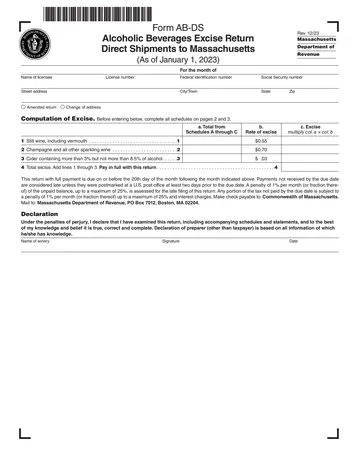
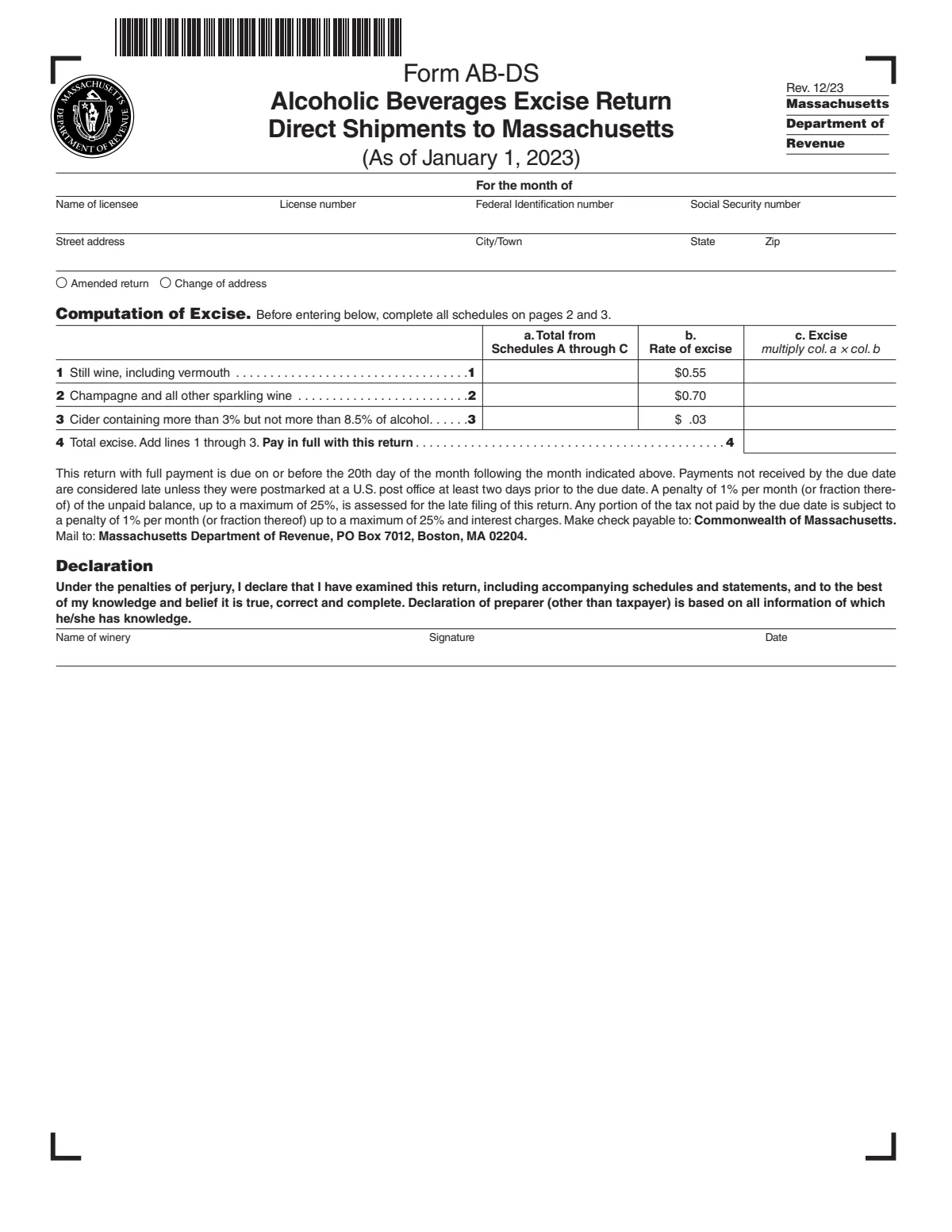
- Header and declaration
- Lines 1 to 4: computation of excise
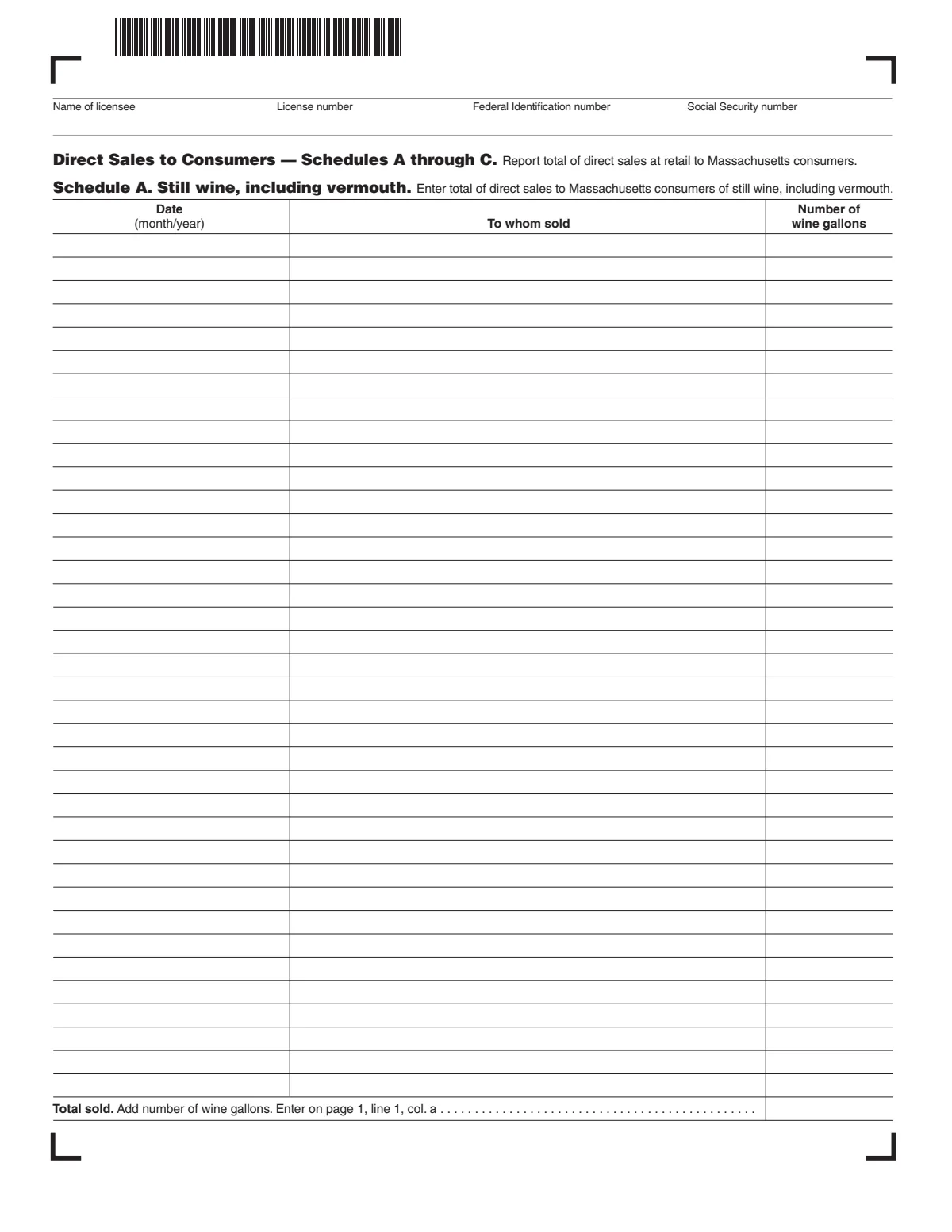
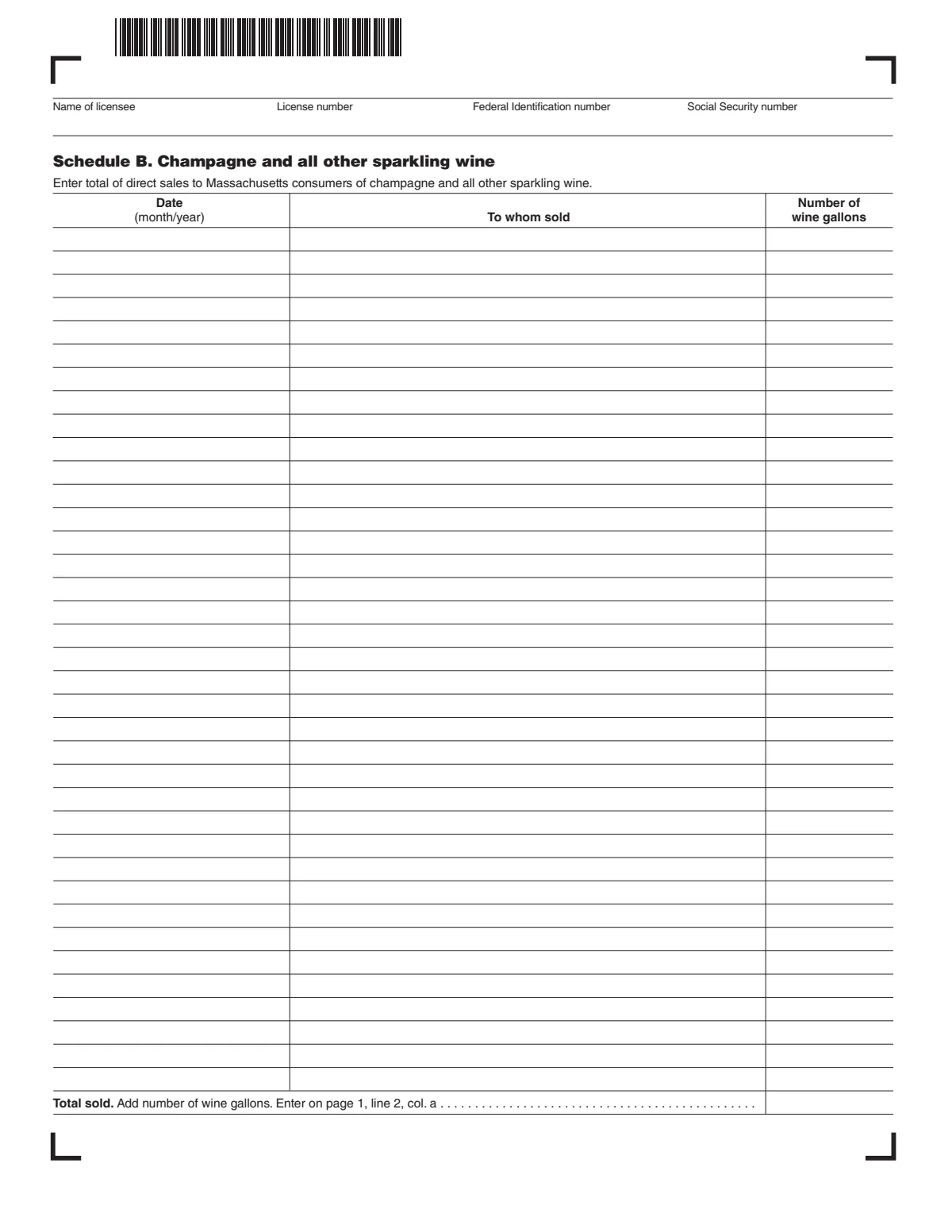
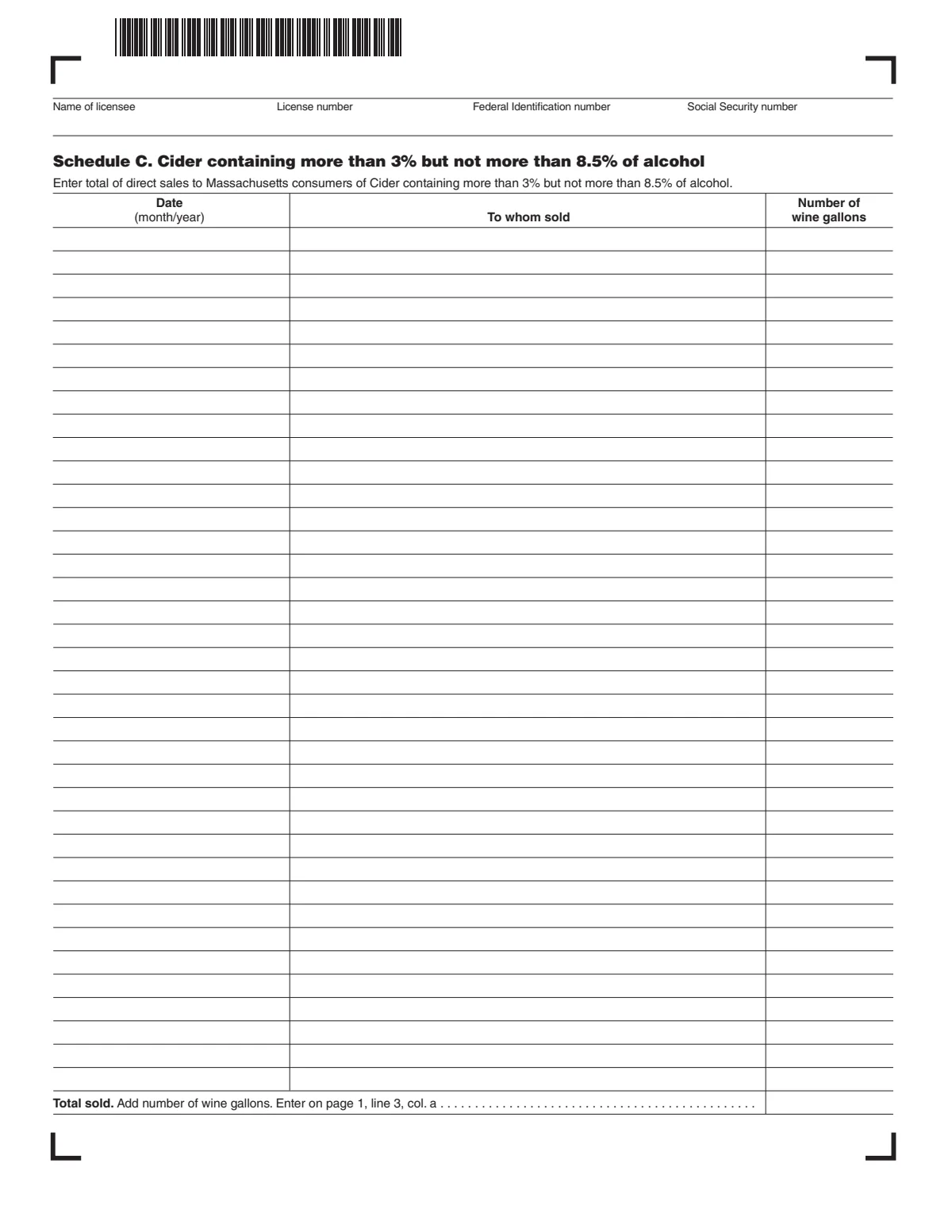
- Schedules A, B and C: direct sales to consumers
- Sales at wholesale: Form AB-10
- Due date, penalties and payment
- Rules that trip filers up
- How it connects
- Questions filers ask
- Sources
- Who files
- Licensed direct wine shippers
- Due
- 20th of the next month
- Filed with
- Massachusetts DOR, MassTaxConnect or mail
- Form revision
- Rev. 12/23
- Pages
- 4, plus 1 page of instructions
At a glance
Form AB-DS is the Massachusetts “Alcoholic Beverages Excise Return Direct Shipments to Massachusetts”: the monthly return a licensed direct wine shipper files for the wine and cider it ships straight to Massachusetts consumers. It is a short return. Three schedules list the month's sales in wine gallons, and page 1 multiplies them by the printed rates.
- Who files. “All persons making direct shipments of wine at retail to Massachusetts con-”sumers under G.L. c. 138, s. 19F must be licensed by the ABCC, register with DOR and file Form AB-DS. DOR's excise page: “Out-of-state wineries licensed in Massachusetts selling directly to Massachusetts consumers must file Form AB-DS on or before the 20th day of each month for sales in the previous month.”
- When. On or before the 20th day of the month after the month reported, with full payment.
- Where. By mail to the Massachusetts Department of Revenue, PO Box 7012, Boston, MA 02204, as the form prints. Or electronically in MassTaxConnect, which some filers must use (see below).
- Form. AB-DS (Rev. 12/23, rates as of Jan. 1, 2023): page 1, Schedules A, B and C, and a page of instructions, listed on DOR's alcoholic beverages excise forms page.
Form AB-DS (Rev. 12/23); G.L. c. 138, s. 19F.
Tap a box once for its note, again to jump to the line. Zoom in to read the small print.
Who needs a direct wine shipper license
The license comes from the Alcoholic Beverages Control Commission, not from DOR. Under the statute, the commission “may issue a direct wine shipper license pursuant to this section to any person, firm or corporation that holds a” federal basic permit and a license in Massachusetts or another state to manufacture and export wine. The licensed winery may sell and ship only wine produced by or for it under its own brand name, to Massachusetts residents at least 21 years old, for personal use and not for resale (G.L. c. 138, s. 19F(b)).
Shipping without the license is not allowed: “No person, firm or corporation shall ship wine directly to consumers without a direct wine shipper license.” The license costs $300 per winery and $150 a year to renew; each affiliate, franchise or subsidiary needs its own. Besides the monthly AB-DS, the statute requires a yearly report to the commission and DOR of the total gallons of wine shipped into Massachusetts in the year before.
Form AB-DS (Rev. 12/23) and its instructions; G.L. c. 138, s. 19F; DOR alcoholic beverage excise page.
Header and declaration
The header carries the month and the licensee's identifiers, which must match its DOR registration. The declaration at the bottom of page 1 is signed for the winery.
| Line | Label | What goes there |
|---|---|---|
| Month | For the month of | The month and year the return covers. “This return with full payment is due on or before the 20th day of the month following the month indicated above.” |
| Name | Name of licensee | The licensee's name. The instructions say to enter the name, address and FEIN exactly as you entered them on DOR's registration screen. |
| License | License number | The number of the direct wine shipper license the Alcoholic Beverages Control Commission (ABCC) issued you. |
| FEIN | Federal Identification number | The federal employer identification number, exactly as registered with DOR. Every schedule page repeats it. |
| SSN | Social Security number | A Social Security number, for a licensee that is an individual without an FEIN. The form asks for one or the other. |
| Address | Street address; City/Town, State, Zip | The street address, city or town, state and ZIP, exactly as registered with DOR. The instructions also say to enter a telephone number, but the form has no box for it. |
| Amended-Change | Amended return / Change of address | Fill in Amended return for a correction of a return already filed, or Change of address when the address has changed. |
| Winery | Name of winery | The winery's name, under the declaration signed under the penalties of perjury. The form names a winery because direct wine shipper licenses go to wineries. |
| Signature | Signature | The signature of the person signing for the winery. |
| Date | Date | The date signed. |
Lines 1 to 4: computation of excise
“Before entering below, complete all schedules on pages 2 and 3.” (The instructions say pages 2 through 4, which is where the three schedules are.) Each line takes its schedule's wine gallons in column a and multiplies them by the rate printed in column b. A worked example: 180 wine gallons of still wine (Schedule A) at $0.55 is $99.00; 24 wine gallons of sparkling wine (Schedule B) at $0.70 is $16.80; line 4 is $115.80.
| Line | Label | What goes there |
|---|---|---|
| 1 | 1 Still wine, including vermouth (rate printed: $0.55) | Column a: the wine gallons of still wine, including vermouth, sold directly to Massachusetts consumers, from Schedule A. Column b prints the rate, $0.55; column c is column a times column b. |
| 2 | 2 Champagne and all other sparkling wine (rate printed: $0.70) | Champagne and all other sparkling wine, from Schedule B, at the printed rate of $0.70 a wine gallon. |
| 3 | 3 Cider containing more than 3% but not more than 8.5% of alcohol. (rate printed: $ .03) | Cider over 3% and up to 8.5% alcohol, from Schedule C, at the printed rate of $.03 a wine gallon. DOR's alcoholic beverage excise page uses the same band: “Cider containing more than 3% but not more than 8.5% of Alcohol by volume at 60 degrees Fahrenheit:” $.03 a wine gallon. |
| 4 | 4 Total excise. Add lines 1 through 3. Pay in full with this return | Column c of lines 1 to 3 added: the excise due with this return, paid in full by check to the Commonwealth of Massachusetts or electronically. |
Schedules A, B and C: direct sales to consumers
The schedules report direct sales at retail to Massachusetts consumers: one schedule per beverage type, one row per sale. The statute caps what one resident can receive: “A direct wine shipper licensee may ship up to 12 cases of wine, containing not more than 9 liters of wine per case, per year to a resident of the commonwealth.” Wine is usually sold in liters; the companion Form AB-1 gives the conversion: “*To convert liters to gallons, multiply the quantity in liters by 0.264172.” A full year's limit of 12 cases of 9 liters is 108 liters, about 28.5 wine gallons (this site's arithmetic).
| Line | Label | What goes there |
|---|---|---|
| A-name | Name of licensee; License number; Federal Identification number; Social Security number | The licensee's name, license number and FEIN or SSN, repeated on each schedule page. |
| A-rows | Schedule A. Still wine, including vermouth. Enter total of direct sales to Massachusetts consumers of still wine, including vermouth. Date (month/year); To whom sold; Number of wine gallons | Each direct sale of still wine, including vermouth, to a Massachusetts consumer in the month: the date (month and year), the buyer and the wine gallons. Report wine gallons as whole gallons. |
| A-total | Total sold. Add number of wine gallons. Enter on page 1, line 1, col. a | The wine gallons on the schedule added, entered on page 1, line 1, column a. |
| B-name | Name of licensee; License number; Federal Identification number; Social Security number | The licensee's name, license number and FEIN or SSN, repeated on each schedule page. |
| B-rows | Schedule B. Champagne and all other sparkling wine Date (month/year); To whom sold; Number of wine gallons | Each direct sale of champagne or other sparkling wine to a Massachusetts consumer, laid out like Schedule A. Report wine gallons as whole gallons. |
| B-total | Total sold. Add number of wine gallons. Enter on page 1, line 2, col. a | The wine gallons on the schedule added, entered on page 1, line 2, column a. |
| C-name | Name of licensee; License number; Federal Identification number; Social Security number | The licensee's name, license number and FEIN or SSN, repeated on each schedule page. |
| C-rows | Schedule C. Cider containing more than 3% but not more than 8.5% of alcohol Date (month/year); To whom sold; Number of wine gallons | Each direct sale of cider of more than 3% but not more than 8.5% alcohol to a Massachusetts consumer, laid out like Schedule A. Report wine gallons as whole gallons. |
| C-total | Total sold. Add number of wine gallons. Enter on page 1, line 3, col. a | The wine gallons on the schedule added, entered on page 1, line 3, column a. |
Sales at wholesale: Form AB-10
The AB-DS is only for retail sales to consumers. “Sales to Massachusetts wholesalers should be reported on Form AB-10,” the Report of Alcoholic Beverages Shipped into Massachusetts, with the date, invoice number, consignee, kind of beverage and gallons for each sale. Massachusetts wholesalers file Form AB-1; DOR's excise page says “All winegrowers, all farmer-brewers, and all wholesalers of alcohol beverages licensed in Massachusetts must file Forms AB-1” and related returns.
Due date, penalties and payment
The return and full payment are due by the 20th of the following month. A payment that arrives after the due date counts as late unless it was postmarked at a U.S. post office at least two days before the due date. The late filing penalty is 1 percent a month or part month of the unpaid balance, up to 25 percent; tax not paid by the due date bears a separate 1 percent a month penalty, also up to 25 percent, plus interest.
Electronic filing: the instructions note that “Businesses with a combined tax liability threshold of $5,000 or” more must file and pay through MassTaxConnect (TIR 15-9). DOR's excise page puts the payment rule at total annual payments over $5,000.
Rules that trip filers up
- Shipping beyond the limit. No more than 12 cases of 9 liters or less to any one resident in a year.
- Other people's wine. A direct shipper may ship only wine produced by or for it and sold under its own brand name.
- Reporting wholesale sales here. Sales to Massachusetts wholesalers go on Form AB-10, not the AB-DS.
- Liters, cases or fractions. Report whole wine gallons; convert liters at 0.264172.
- Registration that does not match. Name, address and FEIN must be exactly as entered on DOR's registration screen.
- Mailing on the due date. A payment that arrives late counts as late unless postmarked at least two days before the due date.
- Forgetting the yearly gallons report. The statute also requires a yearly report of total gallons shipped to the commission and DOR.
How it connects
- Massachusetts alcohol taxes, licenses and due dates: Massachusetts excise tax, alcohol section.
- The wholesalers' and manufacturers' return: Massachusetts AB-1 line by line. Every state's rates: alcohol tax by state.
- The federal tax on the same wine, paid by the winery to the TTB: alcohol excise tax and TTB F 5000.24.
Questions filers ask
Who files Massachusetts Form AB-DS?
Wineries licensed by the ABCC as direct wine shippers that ship wine at retail straight to Massachusetts consumers. They must also register with DOR.
When is the AB-DS due?
On or before the 20th day of the month after the month reported, with full payment.
What are the rates on the AB-DS?
As printed (as of Jan. 1, 2023): $0.55 a wine gallon of still wine including vermouth, $0.70 of champagne and other sparkling wine, and $.03 of cider over 3% and up to 8.5% alcohol.
How much wine can I ship to one Massachusetts resident?
Up to 12 cases a year, each holding no more than 9 liters of wine (G.L. c. 138, s. 19F(e)).
Where do I report sales to Massachusetts wholesalers?
On Form AB-10, Report of Alcoholic Beverages Shipped into Massachusetts, not on the AB-DS.
Sources
- Massachusetts Form AB-DS, Alcoholic Beverages Excise Return, Direct Shipments to Massachusetts (Rev. 12/23), with instructions, PDF
- Massachusetts General Laws, c. 138, s. 19F: Direct wine shipper licenses
- Massachusetts DOR, Alcoholic Beverage Excise Tax
- Massachusetts DOR, Alcoholic Beverages Excise Forms and Reports
- Massachusetts Form AB-1, Alcoholic Beverages Excise Return (Rev. 12/23), PDF (liters conversion)