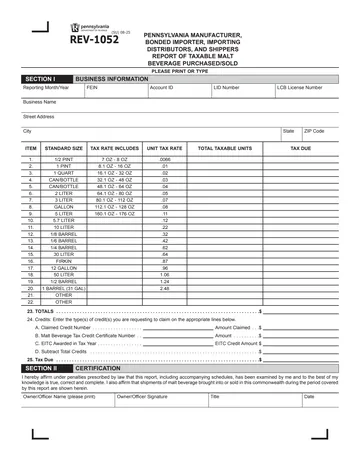
- Who files
- Brewers, importing distributors, direct beer shippers
- Due
- 15th of the next month
- Filed with
- PA Department of Revenue, myPATH
- Form revision
- (SU) 08-25
- Pages
- 1, plus instructions
At a glance
REV-1052 is the Pennsylvania Department of Revenue's monthly return for the malt beverage tax. “The tax is borne by the consumer, but manufacturers, importing distributors, direct beer shippers, and other applicable licensees remit the tax to the commonwealth.” The return counts taxable containers by size and applies a printed rate to each size, all built on the Department's rate of “a penny a pint”, or $2.48 a barrel.
- Who files. “Malt Beverage tax law states that all licensed manufacturers, which includes importing distributors, Direct Beer Shippers, and other licensees are required to file a REV-1052 tax return with the department by the 15th day of each month for all malt or brewed beverages sold in or imported into Pennsylvania during the previous month.”
- When. By the 15th of the next month, moved to the next business day for a weekend or holiday. “Please note that a report must be filed whether or not sales are made during a given month.”
- How. The form's instructions say returns and payments “can be made electronically using myPATH”. The Department's page for licensees is firmer: “These returns must be electronically filed via myPATH”. File in myPATH; the newer licensee page is the one to follow.
- Bond. “Each bond shall be in an amount equal to the highest two months’ average tax liability of the preceding 12-month period, but not less than $5,000.” A new bond or renewal is due by the bond's July 1 anniversary.
- Form. REV-1052, revision (SU) 08-25: one page, with instructions (REV-1052 IN, 08-25) at the back of the same PDF.
REV-1052 (SU) 08-25 and its instructions; Pennsylvania Department of Revenue, Malt Beverage Tax Rates. Rates as of November 2026.
Tap a box once for its note, again to jump to the line. Zoom in to read the small print.
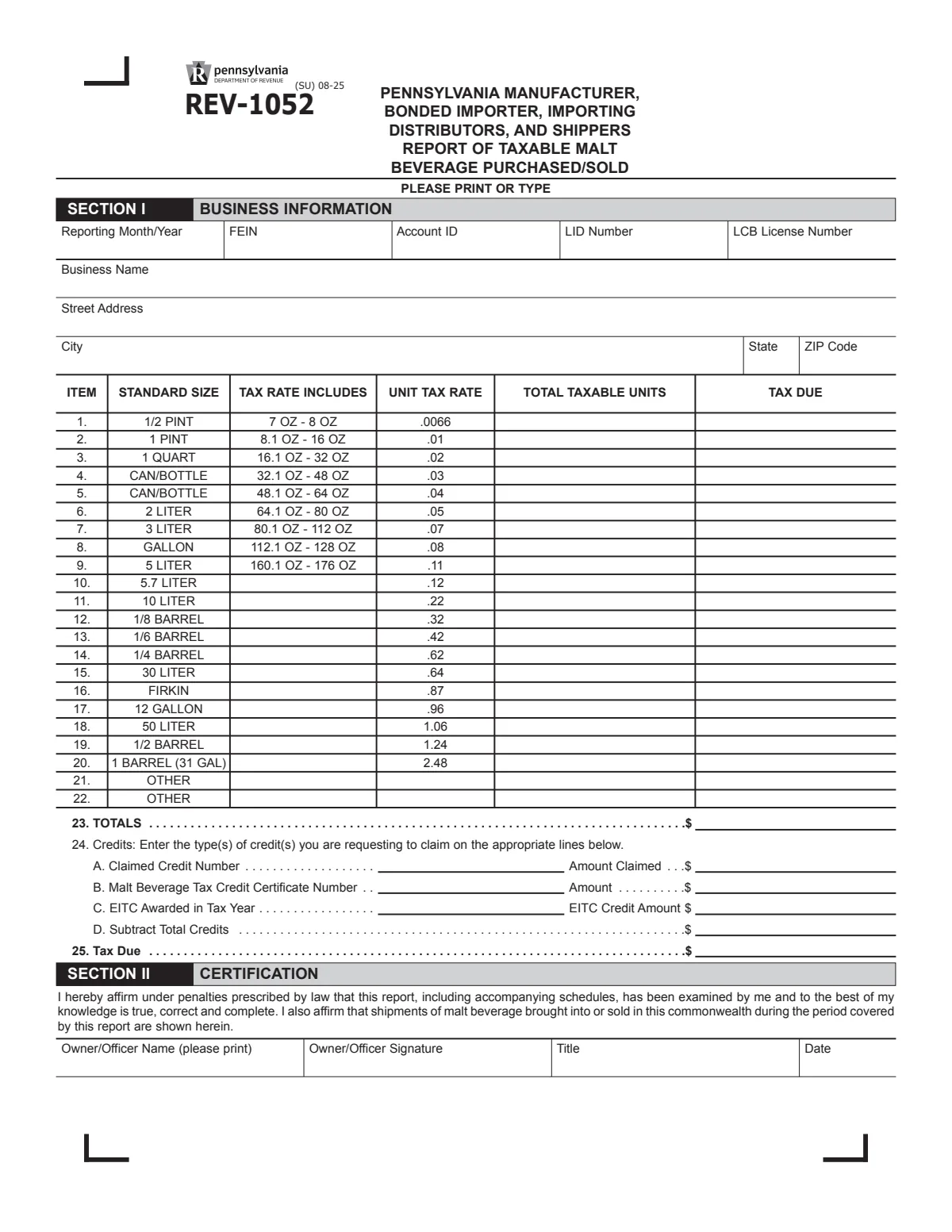
Section I: business information
The header ties the return to the Department account and to the Liquor Control Board's license and ID numbers for the location.
| Line | Label | What goes there |
|---|---|---|
| Month | Reporting Month/Year | The month reported, as MM/YYYY. “If the 15th of the month falls on a weekend or holiday, the report is due the next business day.” |
| FEIN | FEIN | Your federal employer identification number. |
| Account | Account ID | “Department of Revenue issued four digit account number.” Licensed manufacturers, including importing distributors, register for it on REV-1869. |
| LID | LID Number | “LCB issued liquor ID number.” |
| LCB | LCB License Number | “LCB issued license number (ie.G1334, GS1234, GP1234).” |
| Business | Business Name | The licensee's name. |
| Street | Street Address | The street address of the licensed location. The surety bond is per location: “Each licensee shall post an acceptable surety bond with the department for each license location to guarantee the payment of the taxes imposed by the law.” |
| City | City / State / ZIP Code | City, state and ZIP code. |
Items 1 to 22: taxable units
Each row is a container size. The Tax Rate Includes column gives the ounce range each small size covers, and the Unit Tax Rate column prints the tax per container. Enter the number of taxable units in each size, then the tax due. Only sales and transfers taxable in Pennsylvania belong here: the Schedule A-1 instructions define them as “Total of all taxable transactions to include sales in/into PA, transfers to a licensed brew pub under common control, or purchases made by importing distributors from out of state manufacturers.”
REV-1052 (SU) 08-25 and its instructions.
| Item | Standard size (tax rate includes) | What goes there |
|---|---|---|
| 1 | 1. 1/2 PINT (7 OZ - 8 OZ) | Unit tax rate printed on the form: .0066 per container. Enter the taxable units of this size and multiply by .0066 for the tax due. “Enter the total taxable unit for each applicable size and then multiply total taxable units by the tax rate to get the tax due.” |
| 2 | 2. 1 PINT (8.1 OZ - 16 OZ) | Unit tax rate printed on the form: .01 per container. Enter the taxable units of this size and multiply by .01 for the tax due. |
| 3 | 3. 1 QUART (16.1 OZ - 32 OZ) | Unit tax rate printed on the form: .02 per container. Enter the taxable units of this size and multiply by .02 for the tax due. |
| 4 | 4. CAN/BOTTLE (32.1 OZ - 48 OZ) | Unit tax rate printed on the form: .03 per container. Enter the taxable units of this size and multiply by .03 for the tax due. |
| 5 | 5. CAN/BOTTLE (48.1 OZ - 64 OZ) | Unit tax rate printed on the form: .04 per container. Enter the taxable units of this size and multiply by .04 for the tax due. |
| 6 | 6. 2 LITER (64.1 OZ - 80 OZ) | Unit tax rate printed on the form: .05 per container. Enter the taxable units of this size and multiply by .05 for the tax due. |
| 7 | 7. 3 LITER (80.1 OZ - 112 OZ) | Unit tax rate printed on the form: .07 per container. Enter the taxable units of this size and multiply by .07 for the tax due. |
| 8 | 8. GALLON (112.1 OZ - 128 OZ) | Unit tax rate printed on the form: .08 per container. Enter the taxable units of this size and multiply by .08 for the tax due. |
| 9 | 9. 5 LITER (160.1 OZ - 176 OZ) | Unit tax rate printed on the form: .11 per container. Enter the taxable units of this size and multiply by .11 for the tax due. The Department's rate page lists $0.10 for this size, against the form's .11; see the note below the table. |
| 10 | 10. 5.7 LITER | Unit tax rate printed on the form: .12 per container. Enter the taxable units of this size and multiply by .12 for the tax due. |
| 11 | 11. 10 LITER | Unit tax rate printed on the form: .22 per container. Enter the taxable units of this size and multiply by .22 for the tax due. |
| 12 | 12. 1/8 BARREL | Unit tax rate printed on the form: .32 per container. Enter the taxable units of this size and multiply by .32 for the tax due. |
| 13 | 13. 1/6 BARREL | Unit tax rate printed on the form: .42 per container. Enter the taxable units of this size and multiply by .42 for the tax due. |
| 14 | 14. 1/4 BARREL | Unit tax rate printed on the form: .62 per container. Enter the taxable units of this size and multiply by .62 for the tax due. |
| 15 | 15. 30 LITER | Unit tax rate printed on the form: .64 per container. Enter the taxable units of this size and multiply by .64 for the tax due. |
| 16 | 16. FIRKIN | Unit tax rate printed on the form: .87 per container. Enter the taxable units of this size and multiply by .87 for the tax due. |
| 17 | 17. 12 GALLON | Unit tax rate printed on the form: .96 per container. Enter the taxable units of this size and multiply by .96 for the tax due. |
| 18 | 18. 50 LITER | Unit tax rate printed on the form: 1.06 per container. Enter the taxable units of this size and multiply by 1.06 for the tax due. |
| 19 | 19. 1/2 BARREL | Unit tax rate printed on the form: 1.24 per container. Enter the taxable units of this size and multiply by 1.24 for the tax due. |
| 20 | 20. 1 BARREL (31 GAL) | Unit tax rate printed on the form: 2.48 per container. Enter the taxable units of this size and multiply by 2.48 for the tax due. The Department's rate page lists the same $2.48 for 1 barrel, the base the other sizes come from. |
| 21 | 21. OTHER | A container size the form does not list. The form gives no rate for it; describe the size and work the tax at the malt beverage rate. |
| 22 | 22. OTHER | A container size the form does not list. The form gives no rate for it; describe the size and work the tax at the malt beverage rate. |
The 5 liter rate
Item 9 prints .11 for a 5 liter container (160.1 to 176 ounces). The Department's rate page lists $0.10 for the same 5 liter size. All the other sizes on the two agree. The statute behind the rate was not read for this page, so we cannot say which figure the law requires; at a penny a pint a 5 liter container (about 169 ounces) works out to about 10.6 cents. Ask the Department before relying on either figure.
Lines 23 to 25 and certification
The totals line adds the units and tax, the credit lines take off any approved credits, and line 25 is the payment.
| Line | Label | What goes there |
|---|---|---|
| 23 | 23. TOTALS | “Enter Total Taxable Units and Tax Due.” The instructions for Schedule A-1 tie this line to inventory: column 5 is the taxable total, and “This total should match line 23 on the tax return or total taxable sales.” |
| 24 | 24. Credits: Enter the type(s) of credit(s) you are requesting to claim on the appropriate lines below. | Three kinds of credit can reduce the tax: an approved claimed credit (A), a Malt Beverage Tax Credit certificate (B) and an Educational Improvement Tax Credit (C). |
| 24A | A. Claimed Credit Number ... Amount Claimed | “Enter the credit claim number from the department’s Notice of Approved Credit and the amount of credit you are claiming.” “If filing electronically through myPATH, any approved claimed credits will automatically be applied to the tax due.” |
| 24B | B. Malt Beverage Tax Credit Certificate Number ... Amount | “Enter the Malt Beverage Tax Credit Certificate Number and the amount of credit you are claiming.” The program is described on the Department's Malt Beverage Tax Credit Program page. |
| 24C | C. EITC Awarded in Tax Year ... EITC Credit Amount | “Enter the tax year the Educational Improvement Tax Credit (EITC) was awarded by the Department of Community and Economic Development” and the amount of credit you are claiming. |
| 24D | D. Subtract Total Credits | “Subtract Total Credits from tax due on Line 23.” Enter the total of lines A to C here. |
| 25 | 25. Tax Due | “Enter total tax due. Total taxable units x the tax due minus any credits.” This is what you pay, through myPATH. |
| Cert | SECTION II CERTIFICATION: Owner/Officer Name (please print), Owner/Officer Signature, Title, Date (MM/DD/YYYY) | The signer affirms the report is complete and “that shipments of malt beverage brought into or sold in this commonwealth during the period covered by this report are shown herein”. “If filing electronically through myPATH, the acknowledgment and submission is the electronic signature.” |
The schedules behind the return
The instructions describe four schedules: Schedule A-1, the inventory report; Schedule A, sales or transfers to distributors, brew pubs or storage facilities in Pennsylvania; Schedule B, sales outside Pennsylvania; and Schedule C, purchases from manufacturers outside Pennsylvania. On attachment the two Department sources differ. The instructions say “IMPORTANT: All schedules must be kept for two years.” and that they “do not need to be attached to the tax return submitted”. The licensee page says “Each report must be signed and accompanied by all applicable schedules.” Keep the schedules for two years either way, and include them if myPATH asks for them.
Two rules on when the tax attaches inside a business: “For breweries that also have a brew pub, the tax is collected when the inventory is moved from the brewery to the brew pub.” The same applies when a brewery moves beer to its own licensed storage facility. Beer sold to individuals is not listed on Schedule A.
Rules that trip filers up
- Skipping a month with no sales. A report is due every month.
- Counting out-of-state sales as taxable. They go on Schedule B (manufacturers only) and column 6 of Schedule A-1, not in items 1 to 22.
- Double tax for importing distributors. Units on which the manufacturer already paid the tax are "other withdrawals or nontaxable sales" on Schedule A-1, column 7.
- Ending inventory that does not roll. Schedule A-1's opening inventory “should match your ending inventory from the period prior column”.
- Forgetting use tax. Beer a manufacturer sells straight to consumers also owes use tax: Act 13 of 2019 “sets the use tax base at 25% of the retail price of the malt or brewed beverage sold for consumption on or off premises”. That tax is reported on the sales and use tax return, not on REV-1052.
- Letting the bond lapse. The bond is per license location and renews by July 1.
How it connects
- Pennsylvania's beer, wine and spirits taxes, the PLCB and the direct wine shipment tax: Pennsylvania excise tax, alcohol section.
- Other states' beer rates: alcohol tax by state. The federal tax brewers pay to the TTB: alcohol excise tax and TTB F 5000.24.
- Another state alcohol return line by line: Oklahoma ATG-20012.
Questions filers ask
When is Pennsylvania's REV-1052 due?
By the 15th of the month after the month reported; if the 15th falls on a weekend or holiday, the next business day. File even when there were no sales.
What is Pennsylvania's malt beverage tax rate?
$2.48 a 31 gallon barrel, which the Department calls a penny a pint. REV-1052 prints a rate for each container size, from .0066 for a half pint to 2.48 for a barrel.
Who pays the malt beverage tax?
The consumer bears it, but licensed manufacturers, importing distributors, direct beer shippers and other applicable licensees remit it to the Commonwealth.
Can I file REV-1052 on paper?
The form's instructions allow electronic filing in myPATH; the Department's licensee page says returns must be filed electronically in myPATH. Follow the licensee page.
Do I attach the schedules?
The instructions say the schedules are kept for two years and need not be attached; the licensee page says each report must be accompanied by all applicable schedules. Keep them for two years and supply them if myPATH asks.
How big is the bond?
The highest two months' average tax of the past 12 months, at least $5,000, for each license location, renewed by July 1.
Sources
- Pennsylvania Department of Revenue, REV-1052, Report of Taxable Malt Beverage Purchased/Sold (08-25), with instructions, PDF
- Pennsylvania Department of Revenue, Malt Beverage Tax Rates
- Pennsylvania Department of Revenue, Tax Information for Licensees
- Pennsylvania Department of Revenue, Malt Beverage and Liquor Tax