- Who files
- Suppliers, carriers and terminal operators
- Due
- Report: last day of next month; payment: 15th
- Filed with
- Wisconsin DOR, My Tax Account or XML
- Form revision
- R. 3-20
- Pages
- 2 report pages (plus 2 of instructions)
At a glance
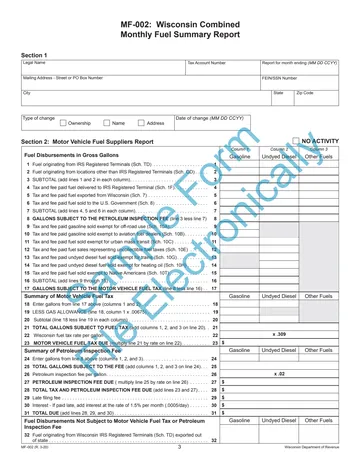
Form MF-002 is the “The Wisconsin Combined Monthly Fuel Summary Report is filed” monthly with the Department of Revenue. It is "combined" in two ways: it carries both the motor vehicle fuel tax and the petroleum inspection fee, and one form serves suppliers (Section 2), carriers (Section 3) and terminal operators (Sections 4 and 5). The report is a summary; the detail goes on the transaction schedules of Form MF-002T.
- Who files. “All motor vehicle fuel suppliers and petroleum products ship-”pers licensed to remit the tax or the fee (Section 2); registered fuel transporters, and pipeline, rail, ship and barge carriers even though they are not registered (Section 3); and registered terminal operators (Sections 4 and 5).
- When. The report: “This report, plus supporting schedules, is due on the last day of the month following the month covered by the report.” The payment comes first: “The combined motor vehicle fuel tax and petroleum inspection fee payment is due on or before the 15th day after the close of the month.”
- How. “This report must be filed electronically through My Tax Account” or a department approved XML schema (My Tax Account, motor fuel XML information). Payments are by electronic funds transfer. The PDF is a sample: its pages carry the watermark "Sample Form, File Electronically".
- Form. Form MF-002 (R. 3-20), with instructions on its first two pages; the schedules are on Form MF-002T.
Form MF-002 (R. 3-20) and its instructions; Wis. Stat. 78.01 and 168.12. Rates as of November 2026.
Tap a box once for its note, again to jump to the line. Zoom in to read the small print.
Section 1: who and when
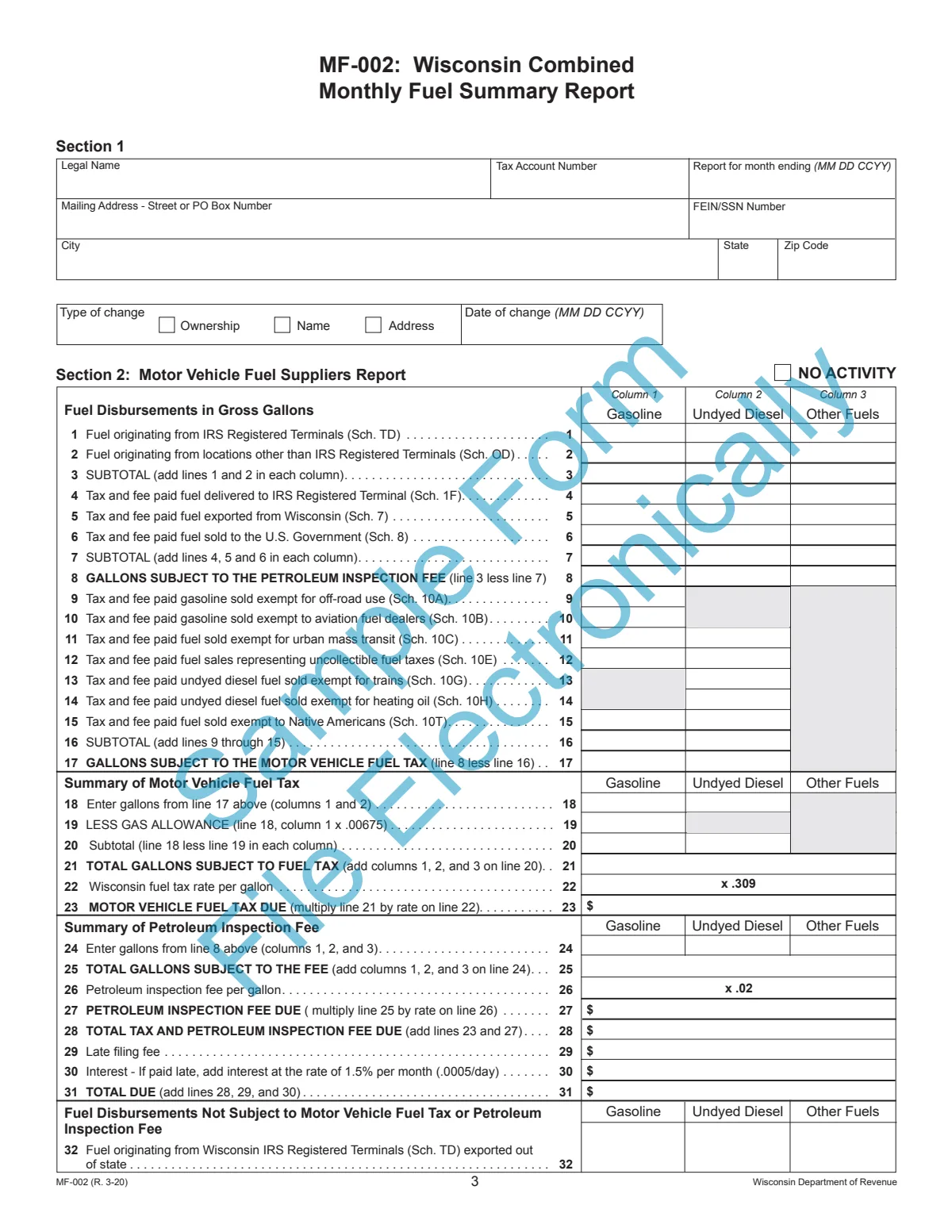
Section 1 identifies the filer and the month, and flags a change of ownership, name or address. Each of Sections 2, 3 and 4 has its own No Activity box, so a supplier that is also a terminal operator completes both parts.
MF-002 instructions: due date and payments.
| Line | Label | What goes there |
|---|---|---|
| Name | Legal Name | The business name as licensed. “Enter the business name, address, 15-digit Wisconsin Tax Account Number (WTN), and Federal Employee Identification Number (FEIN)” or Social Security number. |
| TAN | Tax Account Number | The 15-digit Wisconsin Tax Account Number (WTN). |
| Month | Report for month ending (MM DD CCYY) | “Enter the month, last day of the month, and year covered by the report (MM DD CCYY), for example: 05 31 2013.” |
| Address | Mailing Address - Street or PO Box Number | The mailing address. |
| FEIN | FEIN/SSN Number | The federal employer identification number, or a Social Security number for an individual. |
| City | City, State, Zip Code | The rest of the mailing address. |
| Change | Type of change (Ownership, Name, Address); Date of change (MM DD CCYY) | “If there has been a change in ownership, name or address, check the applicable box and enter the corrected information in the name and ad-”dress section. |
| NoAct-2 | NO ACTIVITY (Section 2) | “This report must be filed even if no tax or fee is due”; check No Activity for a month with nothing to report. |
| Cols | Column 1 Gasoline; Column 2 Undyed Diesel; Column 3 Other Fuels | “Gallons entered must be gross gallons (i.e., U.S. standard liquid gallons - 231 cubic inches).” “Column 3 - Enter fuel which is subject to the petroleum inspec-”tion fee but not the motor vehicle fuel tax: kerosene, aviation gasoline, jet fuel, racing fuel and dyed fuel oil, as the instructions' introduction lists. |
Section 2: Motor Vehicle Fuel Suppliers Report, lines 1 to 17
Section 2 starts from all the fuel you received and peels off, first, what is outside both the tax and the fee (line 8 is the fee base), then the exempt sales that still pay the fee (line 17 is the tax base). Each line is the total of a schedule on Form MF-002T.
Form MF-002 (R. 3-20), Section 2, and its instructions.
| Line | Label | What goes there |
|---|---|---|
| 1 | Fuel originating from IRS registered terminals | Gross gallons that left IRS registered terminals, from Schedule TD of the transaction schedules (Form MF-002T). “Lines 1 and 2. Enter the total gross gallons originating from ter-”minals (Schedules TD and OD). |
| 2 | Fuel originating from other locations | Gross gallons that came from locations other than registered terminals, from Schedule OD. |
| 3 | Subtotal | Lines 1 and 2 in each column: all the fuel you received for sale. |
| 4 | Tax and fee paid fuel delivered to a terminal | Tax and fee paid fuel delivered back into a registered terminal, from Schedule 1F. “Lines 4, 5 and 6. Enter the total gross gallons of these disburse-”ments from the related schedule. |
| 5 | Tax and fee paid fuel exported | Tax and fee paid fuel exported from Wisconsin, from Schedule 7. |
| 6 | Tax and fee paid fuel sold to the U.S. Government | Tax and fee paid fuel sold to the U.S. Government, from Schedule 8. |
| 7 | Subtotal | Lines 4, 5 and 6 in each column. |
| 8 | Gallons subject to the petroleum inspection fee | Line 3 minus line 7. “The gallons you enter on this line are subject to the 2¢ per gallon petroleum inspection fee” (lines 24 to 27). |
| 9 | Gasoline sold exempt for off-road use | Gasoline sold exempt for off-road use, Schedule 10A. “Lines 9 to 15. Enter the total gross gallons of these exempt sales from Form MF-002T, related schedule.” The shaded cells show which columns apply. |
| 10 | Gasoline sold exempt to aviation fuel dealers | Gasoline sold exempt to aviation fuel dealers, Schedule 10B. |
| 11 | Fuel sold exempt for urban mass transit | Fuel sold exempt for urban mass transit, Schedule 10C. |
| 12 | Uncollectible fuel taxes | Tax and fee paid fuel sales that represent uncollectible fuel taxes, Schedule 10E. |
| 13 | Undyed diesel sold exempt for trains | Undyed diesel sold exempt for trains, Schedule 10G (column 2 only). |
| 14 | Undyed diesel sold exempt for heating oil | Undyed diesel sold exempt for heating oil, Schedule 10H. |
| 15 | Fuel sold exempt to Native Americans | Fuel sold exempt to Native Americans, Schedule 10T. |
| 16 | Subtotal | Lines 9 through 15. |
| 17 | Gallons subject to the motor vehicle fuel tax | “Line 17. Subtract line 16 from line 8 in columns 1 and 2.” “These are the gallons subject to the motor vehicle fuel tax” (lines 18 to 23). |
Lines 18 to 32: the tax and the fee
The two summaries compute the motor vehicle fuel tax (lines 18 to 23) and the petroleum inspection fee (lines 24 to 27) separately, then add them with any late fee and interest. The fee base (line 8) is wider than the tax base (line 17): exempt sales on lines 9 to 15 still pay the 2 cent fee, and column 3 fuels pay only the fee.
| Line | Label | What goes there |
|---|---|---|
| 18 | Gallons from line 17 | Copy line 17, columns 1 and 2. |
| 19 | Less gas allowance | The administrative allowance, gasoline only: “by multiplying line 18 (column 1) by .00675.” “If you are registered as restricted supplier not required to file, you do not qualify for this allowance.” |
| 20 | Subtotal | Line 18 less line 19 in each column. |
| 21 | Total gallons subject to fuel tax | Add the columns of line 20: the total taxable gallons. |
| 22 | Wisconsin fuel tax rate per gallon | Printed: x .309, 30.9 cents a gallon. The tax “is imposed on all motor vehicle fuel received by a supplier for sale in this state”, and the indexing stopped long ago: “After the calculation of the rate that takes effect on April 1, 2006, the department shall make no further calculation”. |
| 23 | Motor vehicle fuel tax due | “Computer motor vehicle tax due by multiplying the gallons entered on line 21 by the cur-”rent rate on line 22 ("Computer" is the instructions' typo for compute). |
| 24 | Gallons from line 8 | “Line 24. Enter the gallons from line 8.” Copy each column of line 8. |
| 25 | Total gallons subject to the fee | Add the columns of line 24. |
| 26 | Petroleum inspection fee per gallon | Printed: x .02. The statute sets “a petroleum inspection fee at the rate of 2 cents per gallon on all petroleum products that are received by a supplier for sale in this state”. |
| 27 | Petroleum inspection fee due | Line 25 times line 26: “by multiplying the gallons entered on line 25 by the petroleum inspection fee of 2¢ per gallon.” |
| 28 | Total tax and petroleum inspection fee due | Lines 23 and 27 added. |
| 29 | Late filing fee | “If a report is not timely filed, it is subject to a $10.00 late filing fee.” The report counts as filed when the department receives it, not when it is sent. |
| 30 | Interest | “Line 30. Interest. Interest accrues at a rate of 1.5% per month” on tax or fee not paid by the due date. The form prints the daily figure, .0005. |
| 31 | Total due | “Line 31. Enter the total amount of motor vehicle fuel taxes and” petroleum inspection fees, interest and late filing fee due: lines 28, 29 and 30. |
| 32 | Exported fuel from Wisconsin terminals | A memo line, outside the tax: “Enter the number of gallons of fuel originating from Wisconsin IRS registered termi-”nals that were exported and reported on Schedule TD. |
Sections 3 to 5: carriers and terminal operators
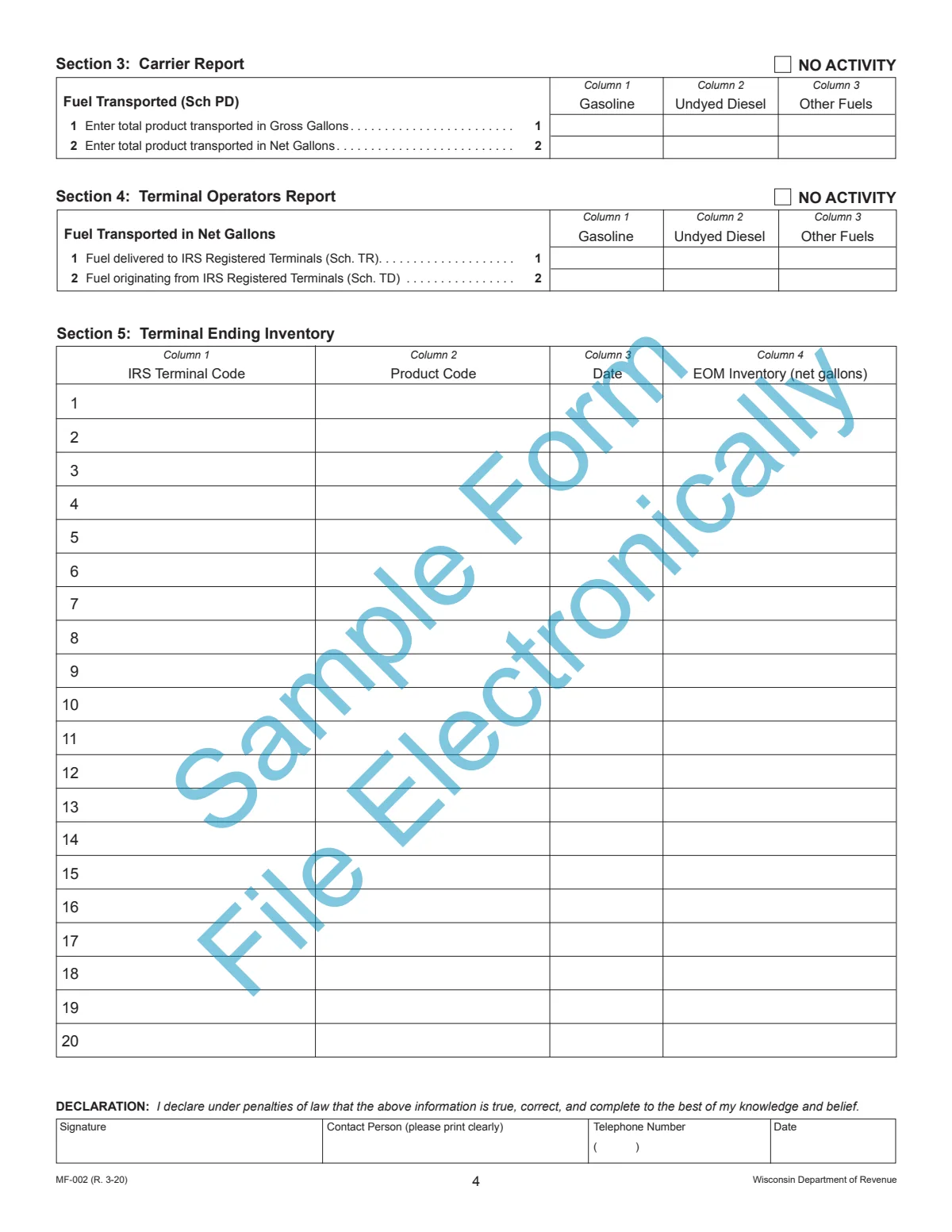
Page 4 carries no tax. Carriers report what they hauled, in gross and net gallons. Terminal operators report fuel in and out of their terminals, in net gallons, and an end-of-month inventory for each terminal and product.
| Line | Label | What goes there |
|---|---|---|
| NoAct-3 | Section 3: NO ACTIVITY | Check it for a month in which you transported no fuel in Wisconsin. Carriers still file: “This report must be filed even if no tax or fee is due, or a regis-”tered fuel carrier does not transport any petroleum products in Wisconsin during the month. |
| C1 | Section 3, line 1: Enter total product transported in Gross Gallons | “Line 1. Enter the total product transported, in Gross Gallons,” from Schedule PD, by column. |
| C2 | Section 3, line 2: Enter total product transported in Net Gallons | The same product in net gallons, from Schedule PD. |
| NoAct-4 | Section 4: NO ACTIVITY | Check it for a terminal operator with nothing to report. |
| T1 | Section 4, line 1: Fuel delivered to IRS Registered Terminals (Sch. TR) | “Line 1. Enter the total product delivered to IRS Registered Ter-”minals, in net gallons, from Schedule TR. |
| T2 | Section 4, line 2: Fuel originating from IRS Registered Terminals (Sch. TD) | Net gallons that left the terminal, from Schedule TD. |
| Inv-1 | Section 5, Column 1: IRS Terminal Code | “Column 1. Enter the IRS terminal code number for each terminal” that you use, one per row (20 rows). |
| Inv-2 | Section 5, Column 2: Product Code | “Column 2. For each terminal, enter the product code carried” within that terminal. |
| Inv-3 | Section 5, Column 3: Date | “Column 3. For each terminal, enter the date the End of Month” inventory was taken. |
| Inv-4 | Section 5, Column 4: EOM Inventory (net gallons) | “Column 4. For each terminal, enter the ending inventory of prod-”uct left in the terminal, in net gallons. |
| Sign | DECLARATION: Signature; Contact Person; Telephone Number; Date | Signed “under penalties of law that the above information is true, correct, and complete to the best of my knowledge and belief”. |
Rules that trip filers up
- Paying on the report date. Payment is due the 15th day after the month; the report is not due until the last day of the month. Interest runs from the payment due date.
- Net gallons in Section 2. Section 2 is gross gallons; only Sections 3 (line 2), 4 and 5 use net gallons.
- Taking the allowance as a restricted supplier. The line 19 allowance is gasoline only, and restricted suppliers not required to file do not get it.
- Amending through the next month. “Do not make the adjustments on a subsequent month’s report.” File an amended MF-002 showing only the changes, a schedule detailing them and a letter of explanation.
- Late filing. “There is a mandatory $10 fee for returns not timely filed.” A late report also draws a penalty of 5 percent of the tax and fee due for each month or part month, up to 25 percent.
- Records. Keep the filed reports, schedules and supporting records for at least four years.
- Fuel diversions. “All interstate fuel diversions involving Wisconsin must be report-”ed through the Fuel Trac web site named in the instructions.
How it connects
- Wisconsin's fuel tax, petroleum inspection fee and other excise taxes: Wisconsin excise tax, motor fuel section.
- The federal tax collected at the same terminal rack: federal fuel excise tax. Another state supplier return: West Virginia MFT-504.
- Carriers that buy fuel in Wisconsin and run in other states report on IFTA, covered at iftacompliance.com.
Questions filers ask
When is Wisconsin Form MF-002 due?
The report and schedules are due the last day of the month after the month covered, received electronically. The tax and fee payment is due earlier, on the 15th day after the month ends, by EFT.
What is Wisconsin's motor fuel tax rate on MF-002?
30.9 cents a gallon, printed on line 22 as .309. The rate has not been recalculated since April 1, 2006. The petroleum inspection fee of 2 cents a gallon is added on line 27.
Can MF-002 be filed on paper?
No. The instructions require filing through My Tax Account or a department approved XML schema. The PDF is a sample form marked to file electronically.
Who gets the gas allowance on line 19?
Suppliers, on gasoline only, at .00675 times the taxable gasoline gallons on line 18. Restricted suppliers not required to file do not qualify.
Do carriers and terminal operators file MF-002?
Yes. Carriers complete Section 3 and terminal operators Sections 4 and 5, even when they owe no tax, and pipeline, rail, ship and barge carriers file even though they do not register.