- Who files
- Petroleum refiners, distributors and importers in Connecticut
- Due
- Last day of the month after the quarter
- Filed with
- DRS, myconneCT only
- Form revision
- Rev. 07/26
- Pages
- 2, plus 2 pages of instructions
At a glance
Form OP-161 is the quarterly return for Connecticut's petroleum products gross earnings tax. Unlike the per-gallon fuel taxes, it is a tax on receipts: “must pay a quarterly tax at the rate of 8.1% of gross earnings in each taxable quarter derived from the first sale of petroleum products in Connecticut” (Conn. Gen. Stat. 12-587(b)). Importers that bring petroleum products in for their own sale or use pay 8.1% of the price under 12-587(c).
- Who files. Companies that refine or distribute petroleum products in Connecticut, and importers whose imports exceed $3,000 of consideration in a quarter. Petroleum products are broad: gasoline, jet fuel, kerosene, fuel and lubricating oils, asphalt, solvents, liquefied petroleum gases and more, but “except paraffin or microcrystalline waxes”.
- When. “Taxpayers must file a return for each calendar quarter by the last day of the month following the filing period shown on the return.” A weekend or legal holiday moves it to the next business day, and a return is due even when no tax is.
- How. Filed and paid electronically in myconneCT; do not mail the paper form.
- Form revision. Rev. 07/26, two pages with two pages of instructions (OP-161 PDF).
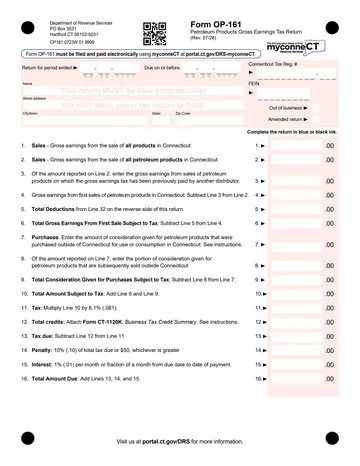
Form OP-161 instructions: due the last day of the month after each calendar quarter; a weekend or legal holiday moves it to the next business day.
Tap a box once for its note, again to jump to the line. Zoom in to read the small print.
Header
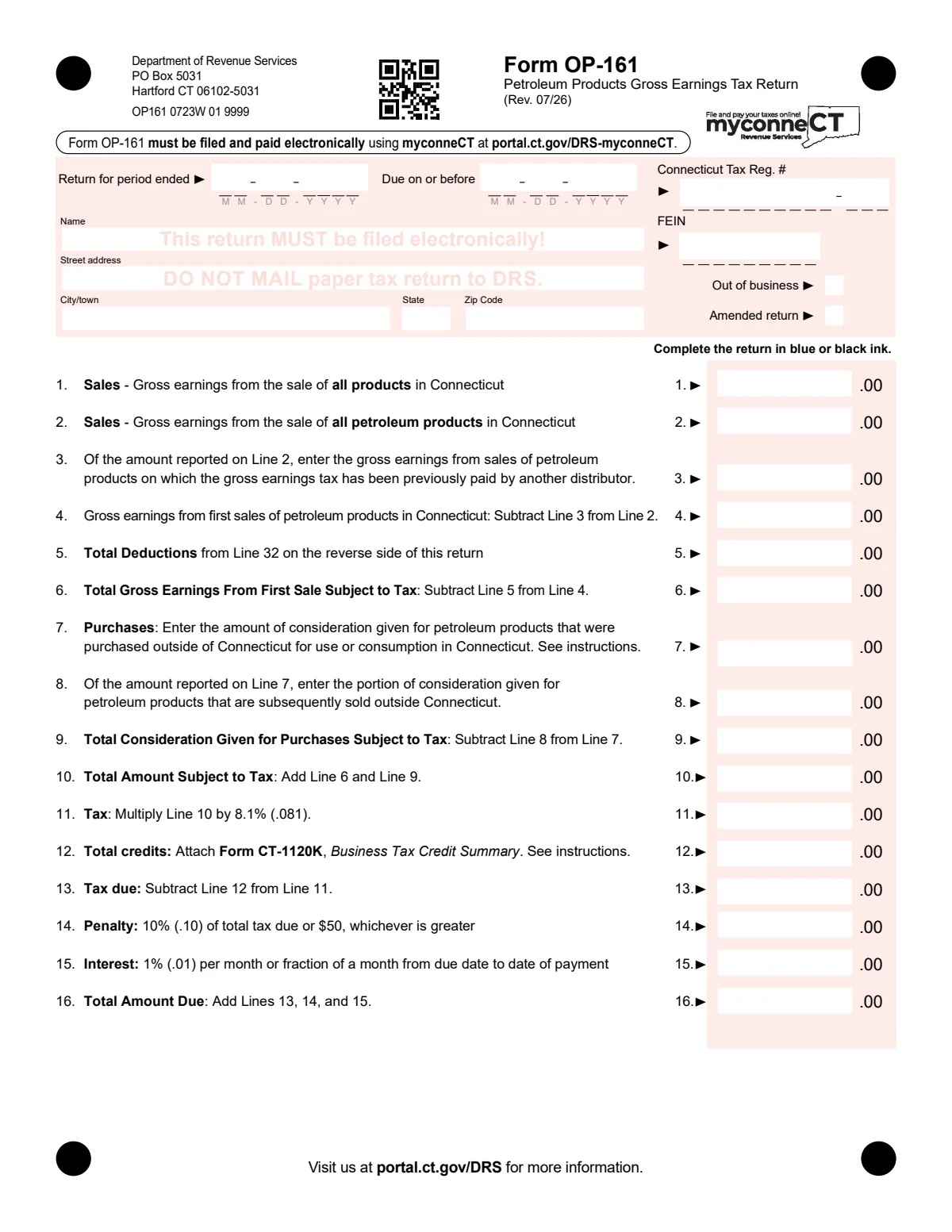
| Line | Label | What goes there |
|---|---|---|
| Period | Return for period ended; Due on or before | The period the return covers and its due date. OP-161 is quarterly, due the last day of the month after the quarter. |
| Name | Name; Street address; City/town; State; Zip Code | The taxpayer's registered name and address. The gray print across the boxes on the PDF says the return must be filed electronically and not mailed. |
| Reg | Connecticut Tax Registration Number | The DRS registration number for this tax account. |
| FEIN | Federal Employer Identification Number (FEIN) | The federal employer identification number. |
| Status | Out of business; Amended return | Check Out of business on the final return and Amended return when this return corrects one already filed. |
Lines 1 to 16: the tax
Page 1 has two bases added together: gross earnings from first sales in Connecticut (lines 1 to 6) and the price of imported products used here (lines 7 to 9). The sum is taxed at 8.1% (line 11).
| Line | Label | What goes there |
|---|---|---|
| 1 | 1. Sales - Gross earnings from the sale of all products in Connecticut | Gross earnings from sales of all products in Connecticut, petroleum or not. |
| 2 | 2. Sales - Gross earnings from the sale of all petroleum products in Connecticut | Gross earnings from sales of all petroleum products in Connecticut. “Gross earnings means all consideration received from the first sale of petroleum products within Connecticut, but does not include the amount of state or federal excise taxes on motor vehicle fuel or diesel fuel.” |
| 3 | 3. Of the amount reported on Line 2, enter the gross earnings from sales of petroleum products on which the gross earnings tax has been previously paid by another distributor. | Gross earnings from products on which another distributor already paid the gross earnings tax: only the first sale in Connecticut is taxed. |
| 4 | 4. Gross earnings from first sales of petroleum products in Connecticut: Subtract Line 3 from Line 2. | Line 2 minus line 3. The deductions on page 2 are each a part of this figure. |
| 5 | 5. Total Deductions from Line 32 on the reverse side of this return | The total of lines 17 to 31, from line 32. |
| 6 | 6. Total Gross Earnings From First Sale Subject to Tax: Subtract Line 5 from Line 4. | Line 4 minus line 5. |
| 7 | 7. Purchases: Enter the amount of consideration given for petroleum products that were purchased outside of Connecticut for use or consumption in Connecticut. See instructions. | The price paid for petroleum products imported into Connecticut for sale, use or consumption, when that price exceeds $3,000 during the quarter the products were used, sold or consumed. This is the importer's side of the tax. |
| 8 | 8. Of the amount reported on Line 7, enter the portion of consideration given for petroleum products that are subsequently sold outside Connecticut. | The part of line 7 for products later sold outside Connecticut. |
| 9 | 9. Total Consideration Given for Purchases Subject to Tax: Subtract Line 8 from Line 7. | Line 7 minus line 8. |
| 10 | 10. Total Amount Subject to Tax: Add Line 6 and Line 9. | Line 6 plus line 9. |
| 11 | 11. Tax: Multiply Line 10 by 8.1% (.081). | Line 10 times 8.1%. |
| 12 | 12. Total credits: Attach Form CT-1120K, Business Tax Credit Summary. See instructions. | General business tax credits claimed for the quarter. “If your company claims Connecticut business tax credits, you must complete and upload Form CT-1120K, Business Tax Credit Summary, when filing return electronically.” |
| 13 | 13. Tax due: Subtract Line 12 from Line 11. | Line 11 minus line 12. |
| 14 | 14. Penalty: 10% (.10) of total tax due or $50, whichever is greater | Late payment: 10% of the tax due or $50, whichever is greater. “Late Filing Penalty: $50 (The late filing penalty is not applicable if a late payment penalty is applicable.)” |
| 15 | 15. Interest: 1% (.01) per month or fraction of a month from due date to date of payment | 1% for each month or part of a month from the due date. |
| 16 | 16. Total Amount Due: Add Lines 13, 14, and 15. | Lines 13 to 15 added; pay it electronically in myconneCT. |
Lines 17 to 32: deductions, and the signature
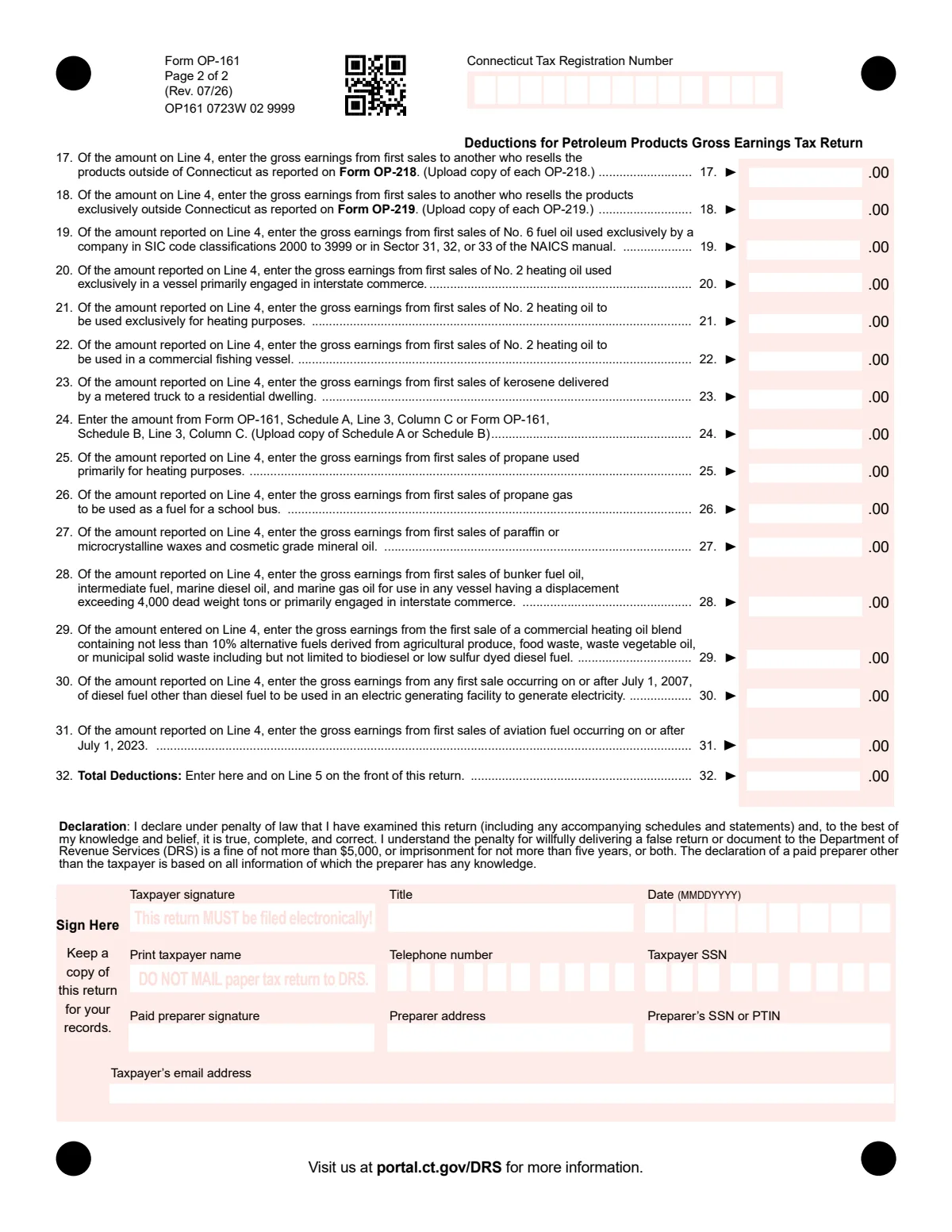
Every deduction is a part of line 4. “DRS requires that you obtain CERT-116, Exempt Petroleum Products Certificate, from your customers to document exempt sales as reported on Lines 19 through 31 (except Line 24).”
| Line | Label | What goes there |
|---|---|---|
| Reg-2 | Connecticut Tax Registration Number | The same number as page 1. |
| 17 | 17. Of the amount on Line 4, enter the gross earnings from first sales to another who resells the products outside of Connecticut as reported on Form OP-218. | Sales to other distributors who resell the products outside Connecticut, plus (since July 1, 2015) products used in a NAICS 3255 material that is exported. Document them with Form OP-218, Certification for Products Purchased in Connecticut But Sold Outside of the State. |
| 18 | 18. Of the amount on Line 4, enter the gross earnings from first sales to another who resells the products exclusively outside Connecticut as reported on Form OP-219. | Sales to distributors who resell exclusively outside Connecticut, documented with Form OP-219, the out-of-state affidavit. |
| 19 | 19. No. 6 fuel oil used exclusively by a company in SIC code classifications 2000 to 3999 or in Sector 31, 32, or 33 of the NAICS manual. | First sales of Number 6 fuel oil used exclusively by a manufacturer (SIC codes 2000 to 3999, 1987 edition, or NAICS sectors 31, 32 or 33, 1997 edition). |
| 20 | 20. No. 2 heating oil used exclusively in a vessel primarily engaged in interstate commerce. | First sales of Number 2 heating oil used exclusively in a vessel primarily engaged in interstate commerce that qualifies for the exemption in Conn. Gen. Stat. 12-412. |
| 21 | 21. No. 2 heating oil to be used exclusively for heating purposes. | First sales of Number 2 heating oil used exclusively for heating. |
| 22 | 22. No. 2 heating oil to be used in a commercial fishing vessel. | First sales of Number 2 heating oil for a commercial fishing vessel, to a buyer holding a DRS Fisherman Tax Exemption Permit valid on the date of purchase. |
| 23 | 23. Kerosene delivered by a metered truck to a residential dwelling. | First sales of kerosene (Number 1 oil) used exclusively for heating, when the delivery is of both Number 1 and Number 2 oil by a truck with a metered delivery ticket to a residential dwelling or a centrally metered group of dwellings. |
| 24 | 24. Enter the amount from Form OP-161, Schedule A, Line 3, Column C or Form OP-161, Schedule B, Line 3, Column C. | The amount from OP-161 Schedule A or Schedule B, line 3, column C, with a copy uploaded. The schedules themselves are Not listed in the PDF we saved (it has the return and instructions only). |
| 25 | 25. Propane used primarily for heating purposes. | First sales of propane used primarily for heating since Dec. 1, 2015 (exclusively for heating before that date). |
| 26 | 26. Propane gas to be used as a fuel for a school bus. | First sales of propane gas used as fuel for a school bus. |
| 27 | 27. Paraffin or microcrystalline waxes and cosmetic grade mineral oil. | First sales of paraffin or microcrystalline waxes and cosmetic grade mineral oil. |
| 28 | 28. Bunker fuel oil, intermediate fuel, marine diesel oil, and marine gas oil for use in any vessel having a displacement exceeding 4,000 dead weight tons or primarily engaged in interstate commerce. | First sales of bunker fuel oil, intermediate fuel, marine diesel oil and marine gas oil for vessels over 4,000 dead weight tons or primarily in interstate commerce. |
| 29 | 29. Commercial heating oil blend containing not less than 10% alternative fuels. | First sales of a commercial heating oil blend with at least 10% alternative fuels (biodiesel, low sulfur dyed diesel and the like). Commercial heating oil includes No. 2, No. 4 and No. 6 oil, low sulfur dyed diesel and kerosene, used for commercial heating. |
| 30 | 30. Diesel fuel other than diesel fuel to be used in an electric generating facility to generate electricity. | First sales on or after July 1, 2007 of diesel fuel, except diesel used in an electric generating facility. Diesel pays the motor vehicle fuels tax instead (see OP-216). |
| 31 | 31. Aviation fuel occurring on or after July 1, 2023. | First sales of aviation fuel on or after July 1, 2023. |
| 32 | 32. Total Deductions: Enter here and on Line 5 on the front of this return. | Lines 17 to 31 added. The same figure goes on page 1, line 5. |
| Sign | Taxpayer signature, title, date; print taxpayer name, telephone number, taxpayer SSN; paid preparer signature, address, SSN or PTIN; taxpayer's email address | Signed under the declaration “I declare under penalty of law that I have examined this return (including any accompanying schedules and statements) and, to the best of my knowledge and belief, it is true, complete, and correct.” The same declaration warns of a fine of up to $5,000, up to five years in prison, or both, for a willfully false return. In myconneCT the signature is part of the online filing. |
Rules that trip filers up
- Excise taxes are not gross earnings. The state and federal motor fuel and diesel excise taxes come out of gross earnings before the 8.1% applies.
- Only the first sale. A distributor that buys from another Connecticut distributor that already paid the tax takes those earnings out on line 3.
- The $3,000 import threshold. Line 7 applies only when the consideration for imported products exceeds $3,000 in the quarter of use, sale or consumption.
- Records. “All sales, purchases, and deductions must be documented by records that each taxpayer must retain for audit purposes for at least three years.”
- Rounding. Whole dollars: 1 to 49 cents round down, 50 to 99 cents round up.
How it connects
- Connecticut's other excise taxes, including this one: Connecticut excise tax, other taxes section. Motor fuel: motor fuel section.
- Connecticut's diesel return: OP-216. The federal fuel taxes: federal fuel excise tax.
Questions filers ask
What is Connecticut's petroleum products gross earnings tax rate?
8.1% of gross earnings from the first sale of petroleum products in Connecticut, and 8.1% of the price of products imported for use in Connecticut, as of November 2026.
When is OP-161 due?
Quarterly, by the last day of the month after the quarter: April 30, July 31, October 31 and January 31, moved to the next business day when that is a weekend or legal holiday.
Are fuel excise taxes part of gross earnings?
No. Gross earnings exclude the state and federal excise taxes on motor vehicle fuel and diesel fuel.
What certificate supports exempt sales on OP-161?
Form CERT-116, Exempt Petroleum Products Certificate, from the customer, for lines 19 to 31 except line 24. Lines 17 and 18 use Forms OP-218 and OP-219.
Is diesel taxed under the gross earnings tax?
First sales of diesel on or after July 1, 2007 are deducted on line 30, except diesel used to generate electricity. Diesel is taxed per gallon on OP-216.