- Who files
- Connecticut special fuel (diesel) distributors
- Due
- 25th of the next month
- Filed with
- DRS, myconneCT only
- Form revision
- Rev. 7/26
- Pages
- 2, plus 2 pages of instructions
At a glance
Form OP-216, the Special Fuel Tax Return, is how Connecticut special fuel (diesel) distributors report gallons and pay the motor vehicle fuels tax on diesel and on alternative fuels sold as motor fuel. The rate on diesel is reset each July 1 by formula (Conn. Gen. Stat. 12-458h); DRS revised OP-216 to Rev. 7/26 for the current rate: “The following forms have been revised to reflect the rate on diesel fuel discussed in this Announcement”.
- Who files. Licensed special fuel distributors in Connecticut. The instructions add a warning: “all taxpayers should be aware that they are liable for the motor vehicle fuels tax on all sales of motor vehicle fuels unless specifically exempted under Chapter 221 of the General Statutes of Connecticut”.
- When. “Form OP-216 must be filed for each calendar month by the twenty-fifth day of the following month.” A weekend or legal holiday moves it to the next business day, and “A return must be filed even if no tax is due.”
- How. Only online: “Form OP-216 must be filed and paid electronically using myconneCT.” File in myconneCT and upload the receipts (Form MF-R) and disbursements (Form MF-D) schedules; DRS's excise file uploads page explains the files. Do not mail the paper form.
- Rounding. Whole gallons and whole dollars: fractions under half a gallon round down and half a gallon or more round up; cents from 1 to 49 round down and 50 to 99 round up.
- Form revision. Rev. 7/26, two pages, with two pages of instructions (OP-216 PDF).
Form OP-216 (Rev. 7/26) and instructions; DRS Announcement AN 2026(2).
Tap a box once for its note, again to jump to the line. Zoom in to read the small print.
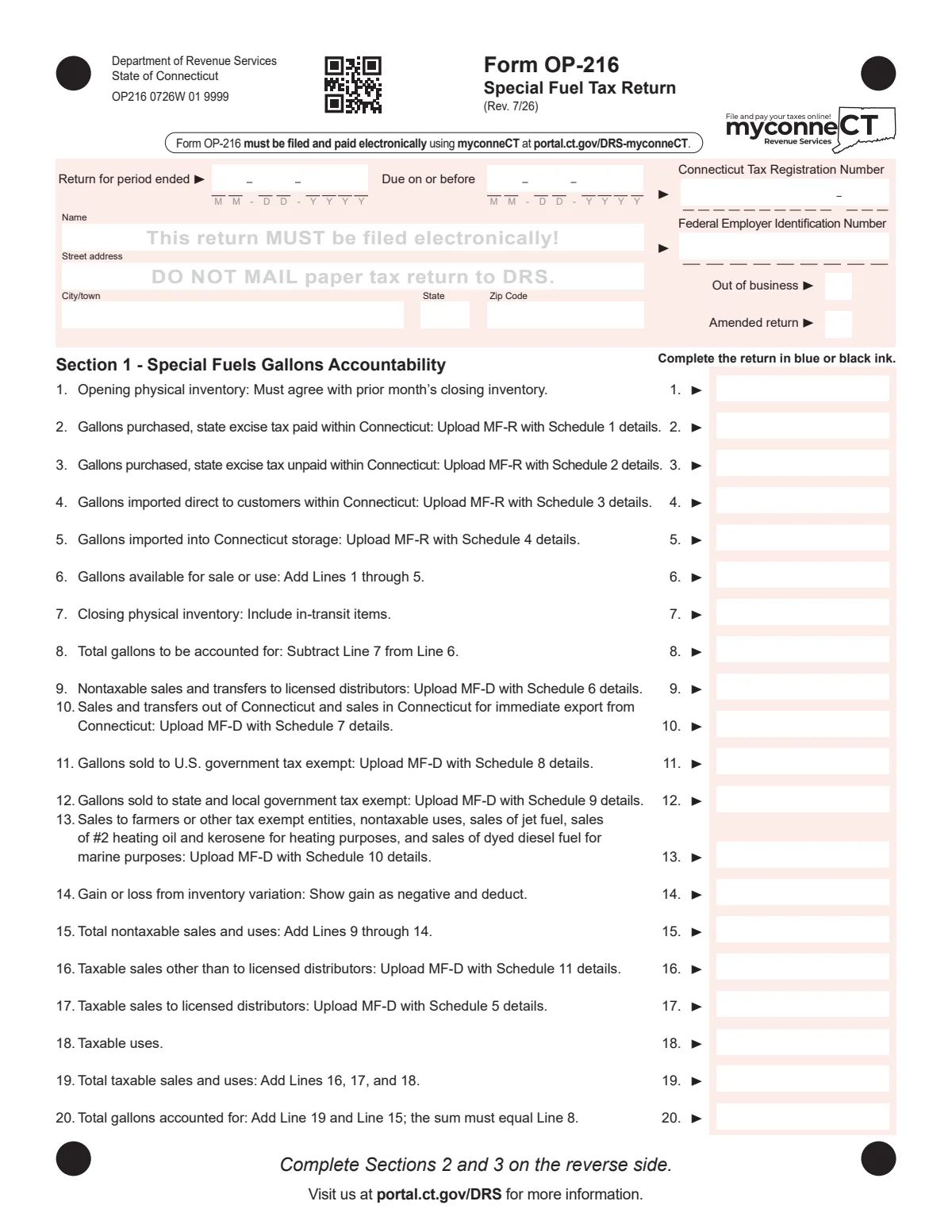
Header
| Line | Label | What goes there |
|---|---|---|
| Period | Return for period ended; Due on or before | The period the return covers and its due date. OP-216 is due the 25th of the following month, or the next business day. |
| Name | Name; Street address; City/town; State; Zip Code | The taxpayer's registered name and address. The gray print across the boxes on the PDF says the return must be filed electronically and not mailed. |
| Reg | Connecticut Tax Registration Number | The DRS registration number for this tax account. |
| FEIN | Federal Employer Identification Number (FEIN) | The federal employer identification number. |
| Status | Out of business; Amended return | Check Out of business on the final return and Amended return when this return corrects one already filed. |
Section 1: special fuels gallons accountability
Section 1 is a gallon balance for all special fuels you handle, not only diesel: heating oil, kerosene, jet fuel, biodiesel, propane and natural gas pass through it too. Every gallon that came in must leave as a nontaxable or a taxable disposition, so line 20 equals line 8.
Connecticut Form OP-216 (Rev. 7/26) and its instructions.
| Line | Label | What goes there |
|---|---|---|
| 1 | 1. Opening physical inventory: Must agree with prior month's closing inventory. | Gallons physically on hand at the start of the month: last month's line 7. |
| 2 | 2. Gallons purchased, state excise tax paid within Connecticut: Upload MF-R with Schedule 1 details. | “Report Connecticut state excise tax paid purchases of diesel fuel, #2 heating oil, kerosene, jet fuel, biodiesel, propane and natural gas.” Upload them on Form MF-R (schedule of receipts) as Schedule 1. |
| 3 | 3. Gallons purchased, state excise tax unpaid within Connecticut: Upload MF-R with Schedule 2 details. | “Report Connecticut state excise tax unpaid purchases of diesel fuel, #2 heating oil, kerosene, jet fuel, biodiesel, propane and natural gas.” MF-R, Schedule 2. |
| 4 | 4. Gallons imported direct to customers within Connecticut: Upload MF-R with Schedule 3 details. | “Report gallons imported from another state direct to customers within Connecticut.” MF-R, Schedule 3. |
| 5 | 5. Gallons imported into Connecticut storage: Upload MF-R with Schedule 4 details. | “Report gallons imported from another state into Connecticut storage.” MF-R, Schedule 4. |
| 6 | 6. Gallons available for sale or use: Add Lines 1 through 5. | Lines 1 to 5 added. |
| 7 | 7. Closing physical inventory: Include in-transit items. | The month-end physical count, in-transit product included. Next month's line 1 must match it. |
| 8 | 8. Total gallons to be accounted for: Subtract Line 7 from Line 6. | Line 6 minus line 7: what left your inventory, which lines 9 to 19 must explain. |
| 9 | 9. Nontaxable sales and transfers to licensed distributors: Upload MF-D with Schedule 6 details. | “Report Connecticut state excise tax-exempt sales and transfers of diesel fuel, #2 heating oil, kerosene, jet fuel, biodiesel, propane, and natural gas to licensed special fuel distributors.” Upload them on Form MF-D (schedule of disbursements) as Schedule 6. DRS posts the current list of licensed distributors on myconneCT. |
| 10 | 10. Sales and transfers out of Connecticut and sales in Connecticut for immediate export from Connecticut: Upload MF-D with Schedule 7 details. | “Report sales and transfers out of Connecticut and sales in Connecticut to licensed motor vehicle fuels exporters.” MF-D, Schedule 7. |
| 11 | 11. Gallons sold to U.S. government tax exempt: Upload MF-D with Schedule 8 details. | “Report tax-exempt sales to the U.S. government.” MF-D, Schedule 8. |
| 12 | 12. Gallons sold to state and local government tax exempt: Upload MF-D with Schedule 9 details. | Tax-exempt sales to the State of Connecticut and its municipalities, on MF-D, Schedule 9. |
| 13 | 13. Sales to farmers or other tax exempt entities, nontaxable uses, sales of jet fuel, sales of #2 heating oil and kerosene for heating purposes, and sales of dyed diesel fuel for marine purposes: Upload MF-D with Schedule 10 details. | Exempt sales to farmers and other exempt buyers; jet fuel sold to licensed aviation fuel dealers or to an aircraft owner or operator who gives Form AU-477; sales to vessels over 4,000 dead weight tons or in interstate commerce; dyed diesel to a licensed marine fuel dock on Form AU-478; and #2 heating oil and kerosene for heating. All on MF-D, Schedule 10, showing to whom each gallon was sold. |
| 14 | 14. Gain or loss from inventory variation: Show gain as negative and deduct. | Book-to-physical differences. A gain is entered as a negative number, so it reduces the nontaxable total. |
| 15 | 15. Total nontaxable sales and uses: Add Lines 9 through 14. | Lines 9 to 14 added. |
| 16 | 16. Taxable sales other than to licensed distributors: Upload MF-D with Schedule 11 details. | “Report all taxable sales other than to licensed distributors.” MF-D, Schedule 11. |
| 17 | 17. Taxable sales to licensed distributors: Upload MF-D with Schedule 5 details. | Taxable sales to licensed diesel fuel distributors, on MF-D, Schedule 5. |
| 18 | 18. Taxable uses. | “Report all taxable use.” |
| 19 | 19. Total taxable sales and uses: Add Lines 16, 17, and 18. | Lines 16 to 18 added. Section 2 splits this into diesel and alternative fuel. |
| 20 | 20. Total gallons accounted for: Add Line 19 and Line 15; the sum must equal Line 8. | Line 15 plus line 19. If it does not equal line 8, a sale, use or inventory figure is missing. |
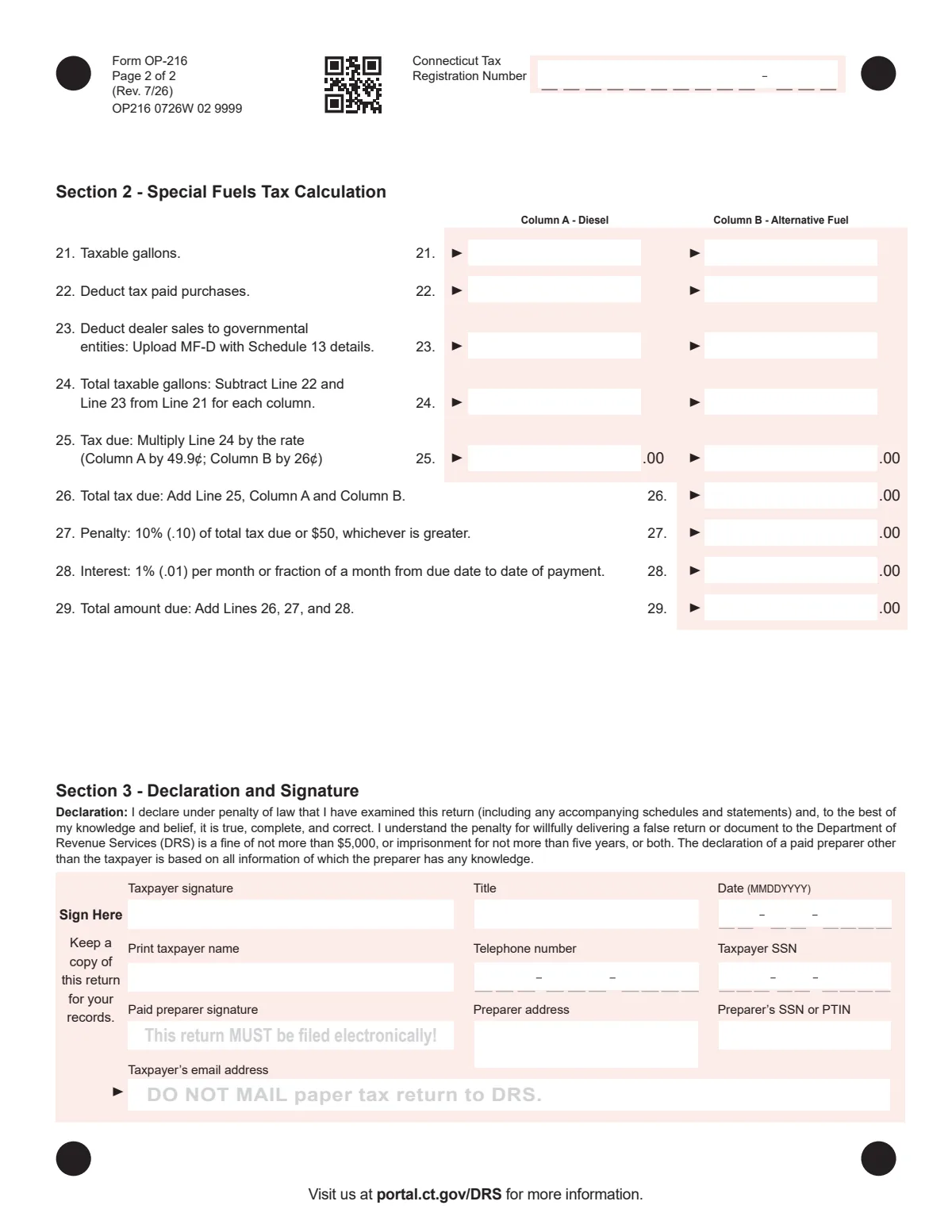
Section 2: tax calculation, and Section 3: signature
Section 2 takes the taxable total from line 19 and splits it into diesel (column A) and alternative fuel (column B), then removes gallons already taxed.
| Line | Label | What goes there |
|---|---|---|
| Reg-2 | Connecticut Tax Registration Number | The same number as page 1. |
| 21 | 21. Taxable gallons. | Column A: “Report the diesel gallons included in Line 19.” Column B: “Report the alternative fuel gallons included in Line 19.” |
| 22 | 22. Deduct tax paid purchases. | Of the line 21 gallons, those you bought state excise tax-paid, as reported on MF-R, Schedule Type 1, in each column. The tax on them was paid up the chain. |
| 23 | 23. Deduct dealer sales to governmental entities: Upload MF-D with Schedule 13 details. | Credit card sales of diesel (column A) or alternative fuel (column B) to governmental entities made at retail outlets, on MF-D, Schedule 13. |
| 24 | 24. Total taxable gallons: Subtract Line 22 and Line 23 from Line 21 for each column. | Line 21 minus lines 22 and 23, in each column. |
| 25 | 25. Tax due: Multiply Line 24 by the rate (Column A by 49.9¢; Column B by 26¢) | Column A (diesel) times 49.9 cents a gallon, the rate DRS computed for “July 1, 2026, through June 30, 2027, to be 49.9” cents (Announcement AN 2026(2)); column B (alternative fuel) times 26 cents: “sales of compressed natural gas, liquefied petroleum gas, and liquefied natural gas (alternative fuels) are subject to motor vehicle fuels tax at 26¢ per gallon.” |
| 26 | 26. Total tax due: Add Line 25, Column A and Column B. | Line 25, column A plus column B. |
| 27 | 27. Penalty: 10% (.10) of total tax due or $50, whichever is greater. | “Late Payment Penalty: The penalty for late payment is 10% of tax due or $50, whichever is greater.” A late return with no tax due can still draw a $50 late filing penalty. |
| 28 | 28. Interest: 1% (.01) per month or fraction of a month from due date to date of payment. | “Interest: The interest charge for late payment is 1% per month or fraction of a month from the due date.” |
| 29 | 29. Total amount due: Add Lines 26, 27, and 28. | Lines 26 to 28 added. Pay it electronically with the return in myconneCT. |
| Sign | Taxpayer signature, title, date; print taxpayer name, telephone number, taxpayer SSN; paid preparer signature, address, SSN or PTIN; taxpayer's email address | Signed under the declaration “I declare under penalty of law that I have examined this return (including any accompanying schedules and statements) and, to the best of my knowledge and belief, it is true, complete, and correct.” The same declaration warns of a fine of up to $5,000, up to five years in prison, or both, for a willfully false return. In myconneCT the signature is part of the online filing. |
Rules that trip filers up
- The diesel rate changes every July 1. The 49.9 cent rate runs from July 1, 2026 through June 30, 2027. A return for June 2026 or earlier uses the rate for that period and the form revision for it.
- Gaseous fuels. For CNG and other fuels sold in gaseous form, the instructions point to DRS Announcement 2024(1), Conversion Factors for Motor Vehicle Fuels Occurring in Gaseous Form Beginning July 1, 2024.
- Off-highway is still taxable. Fuel delivered to a retail or consumer location in Connecticut is treated as sold and taxed, whether it is used on or off the highway; users claim exempt uses with DRS refund forms (AU-724 and the rest) rather than on OP-216.
- Records. “All sales and purchases must be documented by records that each taxpayer must retain for audit purposes for at least three years.”
How it connects
- Connecticut's fuel taxes, gasoline at 25 cents and the gross earnings tax: Connecticut excise tax, motor fuel section. The petroleum gross earnings tax return: OP-161.
- The federal diesel tax and dyed fuel: federal fuel excise tax and dyed diesel. Carriers who buy diesel in one state and burn it in another report through IFTA: IFTACompliance.com's Connecticut page.
Questions filers ask
What is Connecticut's diesel tax rate on OP-216?
49.9 cents a gallon for July 1, 2026 through June 30, 2027, set by DRS Announcement AN 2026(2) under Conn. Gen. Stat. 12-458h. Alternative fuels sold as motor fuel are 26 cents a gallon.
When is OP-216 due?
By the 25th day of the month after the month reported, or the next business day when the 25th is a weekend or legal holiday. A return is due even when no tax is owed.
Can I mail OP-216?
No. The form must be filed and paid electronically in myconneCT, with the MF-R and MF-D schedules uploaded.
Why do heating oil and jet fuel appear on a diesel return?
Section 1 accounts for every special fuel the distributor handles. Exempt sales of heating oil, kerosene and jet fuel come out on line 13 so only taxable gallons reach Section 2.
What does the late payment penalty cost?
10% of the tax due or $50, whichever is greater, plus interest of 1% a month or fraction of a month from the due date.