- Who files
- Connecticut tobacco products distributors and unclassified importers
- Due
- 25th of the next month
- Filed with
- DRS, myconneCT only
- Form revision
- Rev. 07/26
- Pages
- 2, with instructions on page 2
At a glance
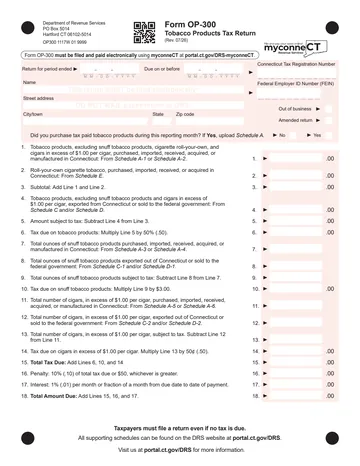
Form OP-300, the Tobacco Products Tax Return, is Connecticut's monthly return for tobacco products other than cigarettes: cigars, pipe and roll-your-own tobacco, chewing tobacco and snuff. It is filed by licensed distributors and unclassified importers. The return defines its scope: “Tobacco products do not include cigarettes, electronic nicotine delivery systems, or vapor products.”
- Who files. “Any person engaged in the business of manufacturing tobacco products or in the business of selling tobacco products, whether at wholesale or retail in the State of Connecticut must register and file for Tobacco Products Taxes.”
- When. “Businesses must file Form OP-300, Tobacco Products Tax Return for each calendar month by the twenty-fifth day of the following month.” The form's example: the January return is due February 25. “Taxpayers must file a return even if no tax is due.”
- How. “Businesses required to file for the Tobacco Products tax must file online through myconneCT.” File at myconneCT; the schedules are on the DRS website. Payments are electronic too, and “To file an amended Form OP-300, Tobacco Products Tax Return, amend online through myconneCT.”
- Form revision. Rev. 07/26, two pages: the return, and a page of instructions with the signature block (OP-300 PDF).
Form OP-300 (Rev. 07/26), lines 6, 10 and 14; DRS tobacco products tax page.
Form OP-300 (Rev. 07/26) and its instructions; DRS tobacco products tax page.
Tap a box once for its note, again to jump to the line. Zoom in to read the small print.
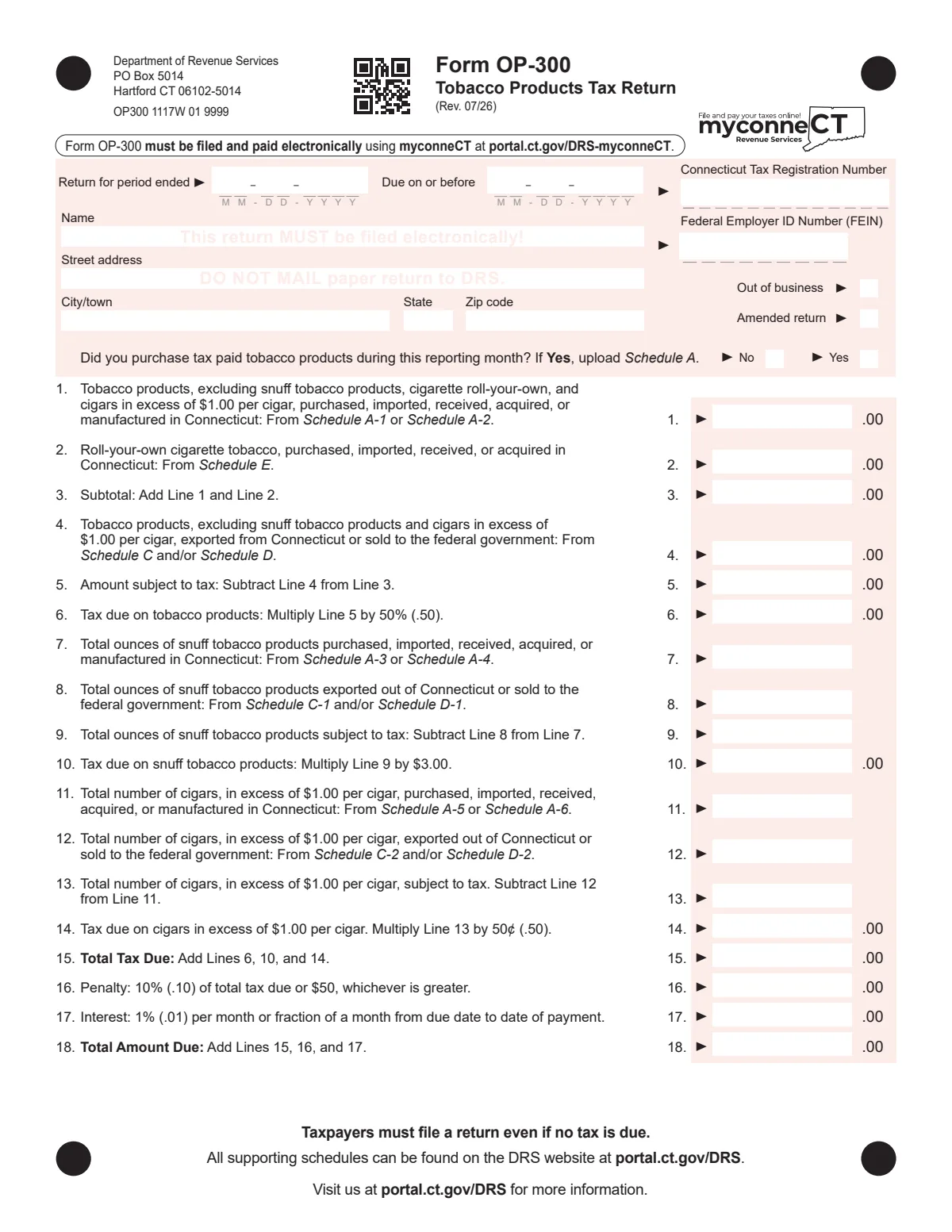
Header
| Line | Label | What goes there |
|---|---|---|
| Period | Return for period ended; Due on or before | The period the return covers and its due date. OP-300 is due the 25th of the following month. |
| Name | Name; Street address; City/town; State; Zip Code | The taxpayer's registered name and address. The gray print across the boxes on the PDF says the return must be filed electronically and not mailed. |
| Reg | Connecticut Tax Registration Number | The DRS registration number for this tax account. |
| FEIN | Federal Employer Identification Number (FEIN) | The federal employer identification number. |
| Status | Out of business; Amended return | Check Out of business on the final return and Amended return when this return corrects one already filed. |
| Q-A | Did you purchase tax paid tobacco products during this reporting month? If Yes, upload Schedule A. | Check No or Yes. A Yes means you bought tobacco products on which Connecticut tax was already paid, and you upload Schedule A to show them. |
Lines 1 to 18
The return has three taxes in one: 50% of the wholesale sales price on tobacco products (lines 1 to 6), $3.00 an ounce on snuff (lines 7 to 10), and 50 cents a cigar on cigars costing more than $1.00 (lines 11 to 14). Each starts from what came into Connecticut and takes out exports and federal sales. The schedule letters tell you which supporting schedule each line comes from.
| Line | Label | What goes there |
|---|---|---|
| 1 | 1. Tobacco products, excluding snuff tobacco products, cigarette roll-your-own, and cigars in excess of $1.00 per cigar, purchased, imported, received, acquired, or manufactured in Connecticut: From Schedule A-1 or Schedule A-2. | A resident distributor enters the wholesale sales price from Schedule A-1 of tobacco products bought, imported, received, acquired or made in Connecticut; a nonresident distributor enters from Schedule A-2 the wholesale sales price of products it imported into Connecticut. Snuff, roll-your-own and cigars over $1.00 each are left out here and reported on their own lines. Wholesale sales price is “the price at which the distributor purchased the products” when the distributor is not the manufacturer. |
| 2 | 2. Roll-your-own cigarette tobacco, purchased, imported, received, or acquired in Connecticut: From Schedule E. | The wholesale sales price of roll-your-own cigarette tobacco, from Schedule E. It is taxed at the same 50% as line 1. |
| 3 | 3. Subtotal: Add Line 1 and Line 2. | Line 1 plus line 2. |
| 4 | 4. Tobacco products, excluding snuff tobacco products and cigars in excess of $1.00 per cigar, exported from Connecticut or sold to the federal government: From Schedule C and/or Schedule D. | The wholesale sales price, from Schedules C and D, of tobacco products you exported or sold to the federal government. “Prepare a separate Schedule C for each state of destination.” |
| 5 | 5. Amount subject to tax: Subtract Line 4 from Line 3. | Line 3 minus line 4. |
| 6 | 6. Tax due on tobacco products: Multiply Line 5 by 50% (.50). | Line 5 times 50%. DRS's page: “Tobacco products, other than snuff tobacco, are taxed at 50% of their wholesale price.” |
| 7 | 7. Total ounces of snuff tobacco products purchased, imported, received, acquired, or manufactured in Connecticut: From Schedule A-3 or Schedule A-4. | Total ounces of snuff tobacco products, from Schedule A-3 or A-4. Snuff means products marked “the designation ‘snuff’ or ‘snuff flour’ or the federal tax designation ‘Tax Class M,’ or both.” |
| 8 | 8. Total ounces of snuff tobacco products exported out of Connecticut or sold to the federal government: From Schedule C-1 and/or Schedule D-1. | Ounces of snuff exported or sold to the federal government, from Schedules C-1 and D-1. |
| 9 | 9. Total ounces of snuff tobacco products subject to tax: Subtract Line 8 from Line 7. | Line 7 minus line 8. |
| 10 | 10. Tax due on snuff tobacco products: Multiply Line 9 by $3.00. | Line 9 times $3.00. “Snuff tobacco is taxed at a rate of $3 per ounce.” |
| 11 | 11. Total number of cigars, in excess of $1.00 per cigar, purchased, imported, received, acquired, or manufactured in Connecticut: From Schedule A-5 or Schedule A-6. | The number of cigars costing more than $1.00 each, from Schedule A-5 or A-6. These cigars pay a flat 50 cents each instead of 50% of price: “Cigars in excess of $1.00 per cigar means the tax will not exceed $0.50 per cigar.” |
| 12 | 12. Total number of cigars, in excess of $1.00 per cigar, exported out of Connecticut or sold to the federal government: From Schedule C-2 and/or Schedule D-2. | The number of such cigars exported or sold to the federal government, from Schedules C-2 and D-2. |
| 13 | 13. Total number of cigars, in excess of $1.00 per cigar, subject to tax. Subtract Line 12 from Line 11. | Line 11 minus line 12. |
| 14 | 14. Tax due on cigars in excess of $1.00 per cigar. Multiply Line 13 by 50¢ (.50). | Line 13 times $0.50. “The tax on cigars is capped at 50 cents (CGS § 12-330c).” |
| 15 | 15. Total Tax Due: Add Lines 6, 10, and 14. | Lines 6, 10 and 14 added. |
| 16 | 16. Penalty: 10% (.10) of total tax due or $50, whichever is greater. | Only on a late return or payment: 10% of the tax due or $50, whichever is greater. |
| 17 | 17. Interest: 1% (.01) per month or fraction of a month from due date to date of payment. | 1% of the tax for each month or part of a month from the due date to the payment date. |
| 18 | 18. Total Amount Due: Add Lines 15, 16, and 17. | Lines 15 to 17 added; pay it electronically with the return. |
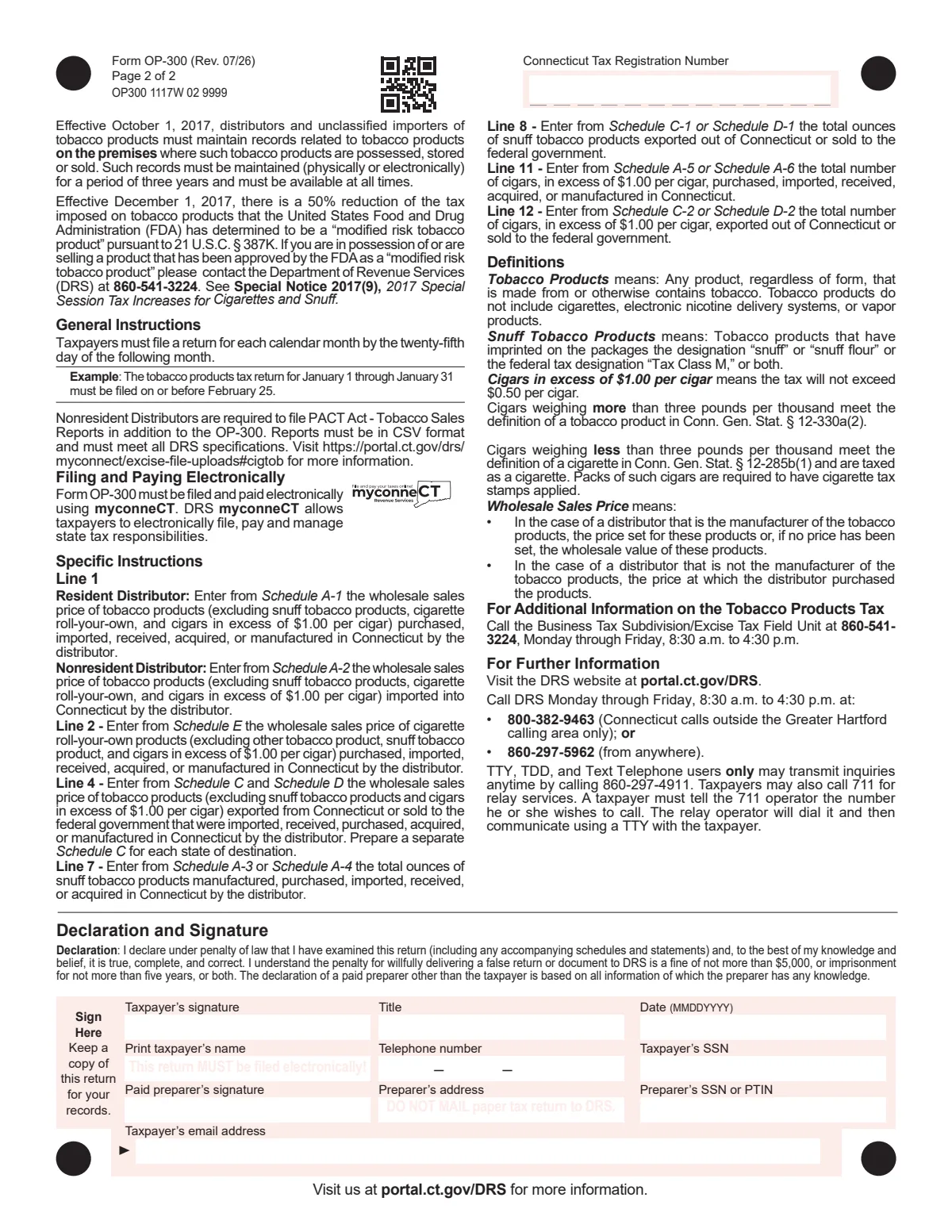
Page 2: instructions and signature
Page 2 holds the instructions, the definitions and the declaration. Nonresident distributors also file PACT Act tobacco sales reports in CSV format with OP-300 (DRS excise file uploads).
| Line | Label | What goes there |
|---|---|---|
| Reg-2 | Connecticut Tax Registration Number | The same number as page 1. |
| Sign | Taxpayer signature, title, date; print taxpayer name, telephone number, taxpayer SSN; paid preparer signature, address, SSN or PTIN; taxpayer's email address | Signed under the declaration “I declare under penalty of law that I have examined this return (including any accompanying schedules and statements) and, to the best of my knowledge and belief, it is true, complete, and correct.” The same declaration warns of a fine of up to $5,000, up to five years in prison, or both, for a willfully false return. In myconneCT the signature is part of the online filing. |
Rules that trip filers up
- Light cigars are cigarettes. Cigars weighing less than three pounds per thousand are taxed as cigarettes and need cigarette tax stamps; only heavier cigars belong on OP-300.
- Modified risk products. Since Dec. 1, 2017 the tax is cut by half for products the FDA has authorized as modified risk tobacco products; DRS asks sellers of such products to call it at 860-541-3224.
- Records on the premises. “Such records must be maintained (physically or electronically) for a period of three years and must be available at all times.” They must be kept where the products are possessed, stored or sold.
- Wholesale sales price. A manufacturer-distributor uses “the price set for these products or, if no price has been set, the wholesale value of these products.”
How it connects
- Connecticut's cigarette, tobacco and e-cigarette taxes: Connecticut excise tax, tobacco section.
- Connecticut's cigarette stamp reports: CT-15 and CT-15A. Other states' tobacco products returns: Delaware TP-1 and New Jersey TPT-10.
- The federal tobacco tax: tobacco excise tax.
Questions filers ask
What is Connecticut's tax on cigars and other tobacco products?
50% of the wholesale sales price, capped at 50 cents for each cigar that costs more than $1.00. Snuff is $3.00 an ounce. Rates as of November 2026.
When is OP-300 due?
By the 25th day of the month after the month reported, filed online in myconneCT, even when no tax is due.
Are e-cigarettes reported on OP-300?
No. Tobacco products exclude cigarettes, electronic nicotine delivery systems and vapor products. Connecticut taxes e-cigarette products separately.
Do I report tobacco I bought tax-paid?
Answer Yes to the question at the top of the return and upload Schedule A.
What is the wholesale sales price for a distributor that does not manufacture?
The price the distributor paid for the products.