- Who files
- GET filers claiming exemptions or deductions
- Due
- With the G-45 or G-49
- Filed with
- Hawaii Tax Online or Dept. of Taxation
- Form revision
- Rev. 2025
- Pages
- 1 (plus codes page)
At a glance
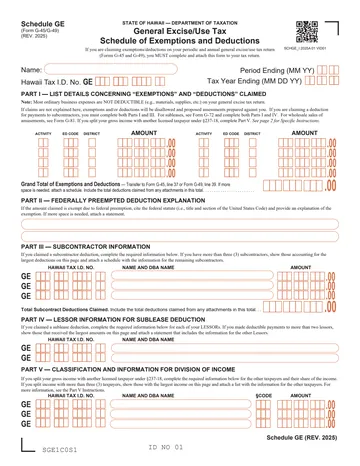
Schedule GE (Form G-45/G-49) is the General Excise/Use Tax Schedule of Exemptions and Deductions. It is the attachment that explains every amount in column b of Hawaii's general excise tax returns. “If you are claiming exemptions/deductions on your periodic and annual general excise/use tax return (Forms G-45 and G-49), you MUST complete and attach this form to your tax return.”
- Who files. Any GET licensee claiming an exemption, deduction or other benefit on Form G-45 or Form G-49. “Schedule GE is not required if you are not claiming any GET exemptions, deductions, or other benefits.”
- When. With each return that claims one: “Form G-45 is due on or before the 20th day of the calendar month following the end of the filing period.” “Form G-49 is due on or before the 20th day of the fourth month following the close of the tax year.”
- How. Attached to the return, in Hawaii Tax Online or on paper. The Department publishes a fillable Schedule GE (Rev. 2025) and a printable copy on its General Excise and Use Tax forms page, with an Excel workbook of exemptions and deductions by activity code.
- Form revision. Rev. 2025: one page of Parts I to V and a page of instructions and ED codes.
Why the schedule matters
Hawaii taxes gross income, and the general instructions are blunt about the cost of skipping the schedule: “If a taxpayer fails to file a completed Schedule GE with the G-45 or G-49 return, any exemptions, deductions, or other” benefits “claimed by the taxpayer will be denied by the Department.” The schedule itself adds: “If claims are not explained here, exemptions and/or deductions will be disallowed and proposed assessments prepared against you.”
The Form G-45 says the same at the line the total lands on: line 37, “If Schedule GE is not attached, exemptions/deductions claimed will be disallowed”. And not every cost of doing business is an exemption: “Note: Most ordinary business expenses are NOT DEDUCTIBLE (e.g., materials, supplies, etc.) on your general excise tax return.”
Schedule GE (Form G-45/G-49) (Rev. 2025) and its page 2 instructions.
Tap a box once for its note, again to jump to the line. Zoom in to read the small print.
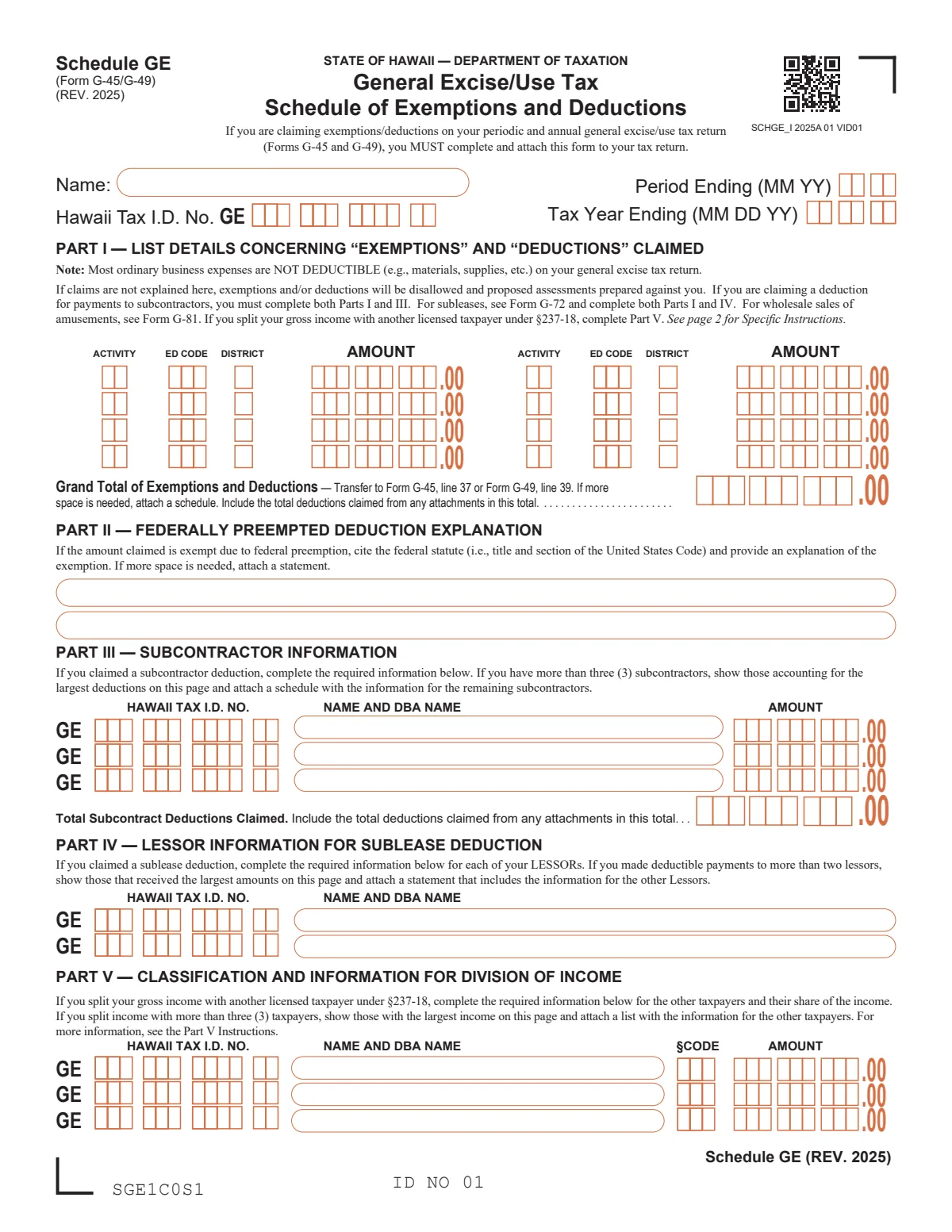
Header
The header ties the schedule to its return: a period ending with a periodic G-45, or a tax year ending with an annual G-49.
| Line | Label | What goes there |
|---|---|---|
| Name | Name: | The taxpayer's name, the same as on the return the schedule is attached to. |
| Period | Period Ending (MM YY) | With a periodic Form G-45, the month and year the filing period ends, as on the return. Leave it blank with a G-49. |
| TaxID | Hawaii Tax I.D. No. GE | Your GET account number (the GE number on your license), not the FEIN. |
| TaxYear | Tax Year Ending (MM DD YY) | With an annual Form G-49, the date your tax year ends (12 31 26 for a calendar year 2026 filer). |
Part I: exemptions and deductions
Part I lists every claim by activity, ED code and district. “For each ED code you claim, enter:” the activity's line number, the ED code, the district and the amount. The schedule's own example: “Taxpayer A has made a $2,000 sale of tangible personal property to the Federal Government on Oahu.” Taxpayer A enters activity 8 (retailing), ED code 141, district 1 and $2,000, matching the deduction in column b of the return.
| Line | Label | What goes there |
|---|---|---|
| Activity | ACTIVITY | “For the ‘Activity’ column, enter the line number from your general excise tax return for the activity.” Wholesaling is 1, contracting 10, insurance commissions 18, and a county surcharge exemption for Kauai 22. |
| EDcode | ED CODE | The exemption or deduction (ED) code from the list on page 2 of the schedule. “List each ED code only ONCE per Activity and District.” |
| District | DISTRICT | The taxation district where the exemption is claimed: Oahu 1, Maui 2, Hawaii 3, Kauai 4. “You must explain your exemptions and deductions by tax District, otherwise they will be disallowed and you will owe more taxes.” |
| Amount | AMOUNT | “Enter your total amount of the exemption/deduction claimed for that Activity, ED Code and District.” The cents are preprinted as .00: enter whole dollars. |
| I-right | ACTIVITY ED CODE DISTRICT AMOUNT | The right half repeats Activity, ED code, District and Amount for four more claims. More than eight: attach a schedule in the same format. |
| Total | Grand Total of Exemptions and Deductions | “Transfer to Form G-45, line 37 or Form G-49, line 39.” “Include the total deductions claimed from any attachments in this total.” |
Common ED codes
Page 2 of the schedule lists about sixty codes, each with its Hawaii Revised Statutes section. These are some of the ones businesses meet most; the full list and the sections are on the form. “*Additional information is required to claim these exemptions. Complete Parts II, III and/or IV.” The starred codes are 118, 126 and 148.
| ED code | Exemption or deduction | What it covers |
|---|---|---|
| 104 | Bad debts | Accrual basis taxpayers deduct accounts charged off as worthless for income tax purposes. |
| 118 | Federal preempted amount | Income the U.S. Constitution or federal law bars Hawaii from taxing; also complete Part II. |
| 126 | Lease or sublease of real property | Computed on Form G-72; also complete Part IV with each lessor. |
| 130 | Nonprofit organizations | Exempt income of qualifying nonprofits. |
| 132 | Exported tangible personal property | Goods shipped out of the state. |
| 141 | Sales of goods to the federal government | The page 2 example: a $2,000 sale on Oahu reported as activity 8, code 141, district 1. |
| 148 | Subcontract deduction | Payments to subcontractors; also complete Part III. |
| 150 | Taxes passed on | Certain taxes collected and passed on, under the listed sections. |
The county surcharge has its own exemptions and its own codes (for example 126 for the sublease deduction and 152 for wholesale amusements under section 237-8.6(d)(1)), reported on the Part IV lines of the return: for Kauai, activity 22.
Parts II to V: the extra detail
Four claims need more than a code. A federal preemption claim names the federal statute. The subcontract deduction lists each subcontractor; the general instructions say “The subcontractor's name, the subcontractor's Hawaii Tax I.D. No., and the amount of deduction must be provided in Part III on Schedule GE.” The sublease deduction lists each lessor; the deduction multiplies the gross proceeds “paid by the taxpayer to the lessor by 0.875”, and “The taxpayer calculates the sublease deduction using Form G-72.” And a division of gross income under section 237-18, HRS lists each taxpayer you split with, who report their shares “of the gross income received on the Schedule GE (Form G-45/G-49).”
| Line | Label | What goes there |
|---|---|---|
| II | PART II | “If the amount claimed is exempt due to federal preemption, cite the federal statute (i.e., title and section of the United States Code) and provide an explanation of the exemption.” Claims under ED code 118 need this part. |
| III-ID | HAWAII TAX I.D. NO. | Each subcontractor's Hawaii Tax I.D. number. Under the subcontract deduction (ED code 148), a prime contractor or developer “may be eligible for a deduction in the amount of payments made to a” subcontractor or specialty contractor. |
| III-name | NAME AND DBA NAME | The subcontractor's name and DBA. “If you have more than three (3) subcontractors, show those accounting for the largest deductions on this page and attach a schedule with the information for the remaining subcontractors.” |
| III-amt | AMOUNT | The payments to that subcontractor you deduct, in whole dollars. |
| III-total | Total Subcontract Deductions Claimed. | The total of every subcontractor deduction, attachments included. It should match the ED code 148 amounts in Part I. |
| IV-ID | HAWAII TAX I.D. NO. | “If you claimed a sublease deduction, complete the required information below for each of your LESSORs.” The deduction itself is figured on Form G-72. |
| IV-name | NAME AND DBA NAME | The lessor's name and DBA. With more than two lessors, show the two that received the largest amounts and attach a statement for the others. |
| V-ID | HAWAII TAX I.D. NO. | The GE number of each licensed taxpayer you divide gross income with under section 237-18, HRS. With more than three, show those with the largest income and attach a list. |
| V-name | NAME AND DBA NAME | The other taxpayer's name and DBA name. |
| V-code | §CODE | The section code for the kind of division: 18A coin operated devices, 18B producers and promoters, 18E insurance agents and realtors, 18F tour packagers and travel agents, 18G noncommissioned transient accommodations, 18H motor carriers. |
| V-amt | AMOUNT | The other taxpayer's share of the gross income, in whole dollars. |
Rules that trip filers up
- No schedule, no exemption. Column b amounts without Schedule GE are disallowed and assessed.
- Codes repeated. “List each ED code only ONCE per Activity and District.” Add the amounts instead.
- Missing the district. Every claim needs its district number, even for a one-island business.
- Ordinary expenses. Materials, supplies and similar costs are not deductions.
- Starred codes without the detail. Codes 118, 126 and 148 need Parts II, IV and III; a division of income needs Part V.
- Several returns, one schedule. Attach a schedule to each return that claims an exemption, including an amended G-45: “if any exemptions are claimed, complete and attach Schedule GE to the amended Form G-45.”
How it connects
- The returns it attaches to: Form G-45 line by line (line 37) and Form G-49 line by line (line 39).
- Income in more than one district: Form G-75, the schedule of assignment by district.
- Hawaii's taxes and filing table: the Hawaii excise tax page and its returns and due dates.
Questions filers ask
When do I need Schedule GE?
Whenever a Form G-45 or G-49 claims an exemption, deduction or other GET benefit in column b. Without it, the Department denies the claims.
Where does the Schedule GE total go?
The grand total of exemptions and deductions goes to Form G-45, line 37, or Form G-49, line 39.
What is an ED code?
The three-digit code for each exemption or deduction, listed with its HRS section on page 2 of Schedule GE: for example 141 for sales of goods to the federal government, 148 for the subcontract deduction.
How do I claim the subcontract deduction?
Enter ED code 148 in Part I and list each subcontractor's Hawaii Tax I.D. No., name and amount in Part III, attaching a list if there are more than three.
Are business expenses deductible on the GET return?
Most ordinary business expenses, such as materials and supplies, are not. Only the exemptions and deductions the law lists, each with its ED code.
Do I attach Schedule GE to the annual return too?
Yes, if the G-49 claims exemptions or deductions: the schedule serves both returns, with the total going to G-49 line 39.
Sources
- Schedule GE (Form G-45/G-49), General Excise/Use Tax Schedule of Exemptions and Deductions (Rev. 2025)
- General Instructions for Filing the General Excise/Use Tax Returns (Rev. 2025)
- Form G-45 (Rev. 2025)
- Hawaii Department of Taxation, General Excise and Use Tax forms
- Hawaii Department of Taxation, General Excise Tax (GET)