- At a glance
- The form, with hotspots
- The rates: diesel and liquefied gas
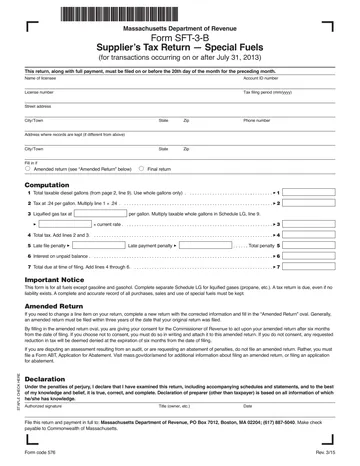
- Header and declaration
- Page 1, lines 1 to 7: computation
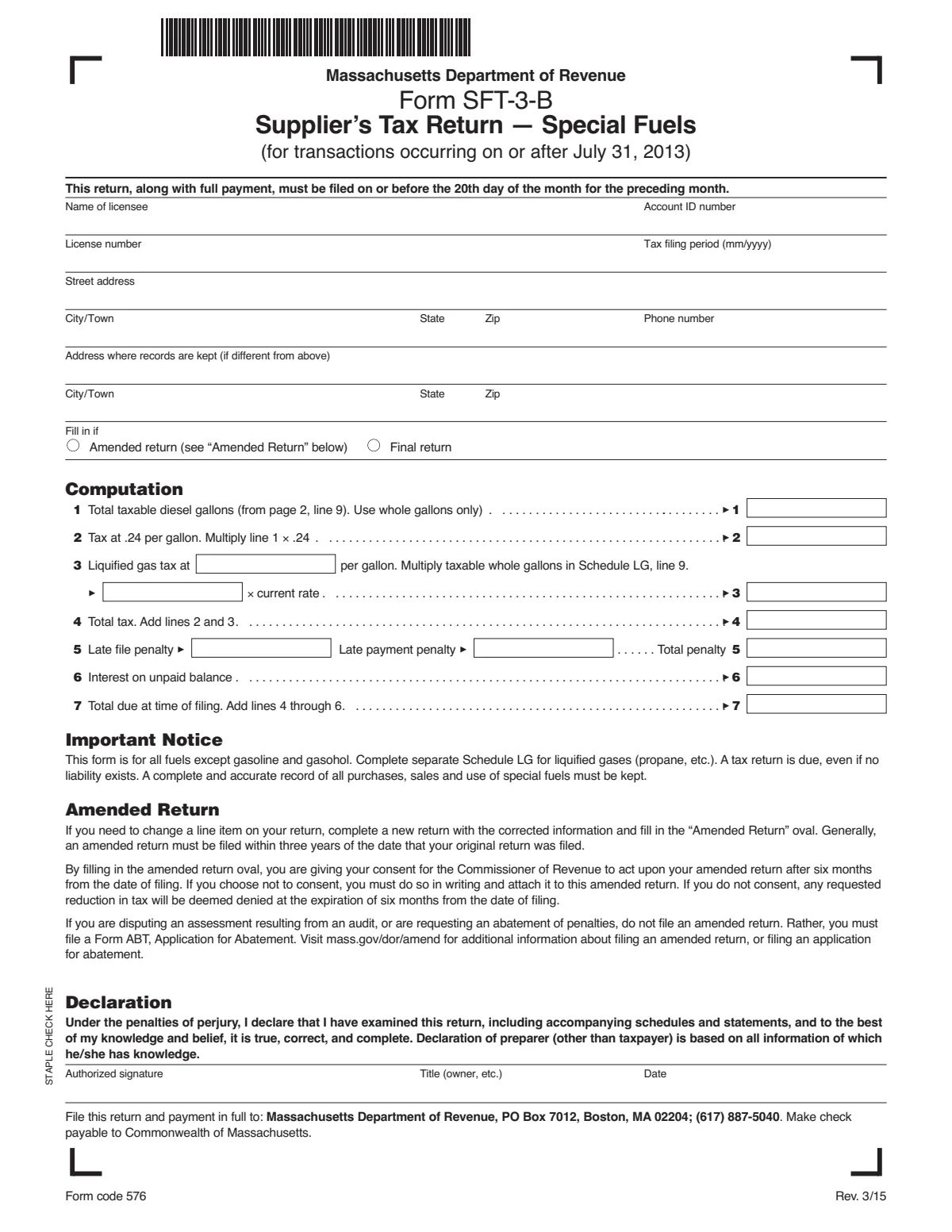
- Page 2, lines 1 to 5: inventories and receipts
- Page 2, lines 6 to 12: disposition
- Page 2, lines 13 to 16: type of special fuel
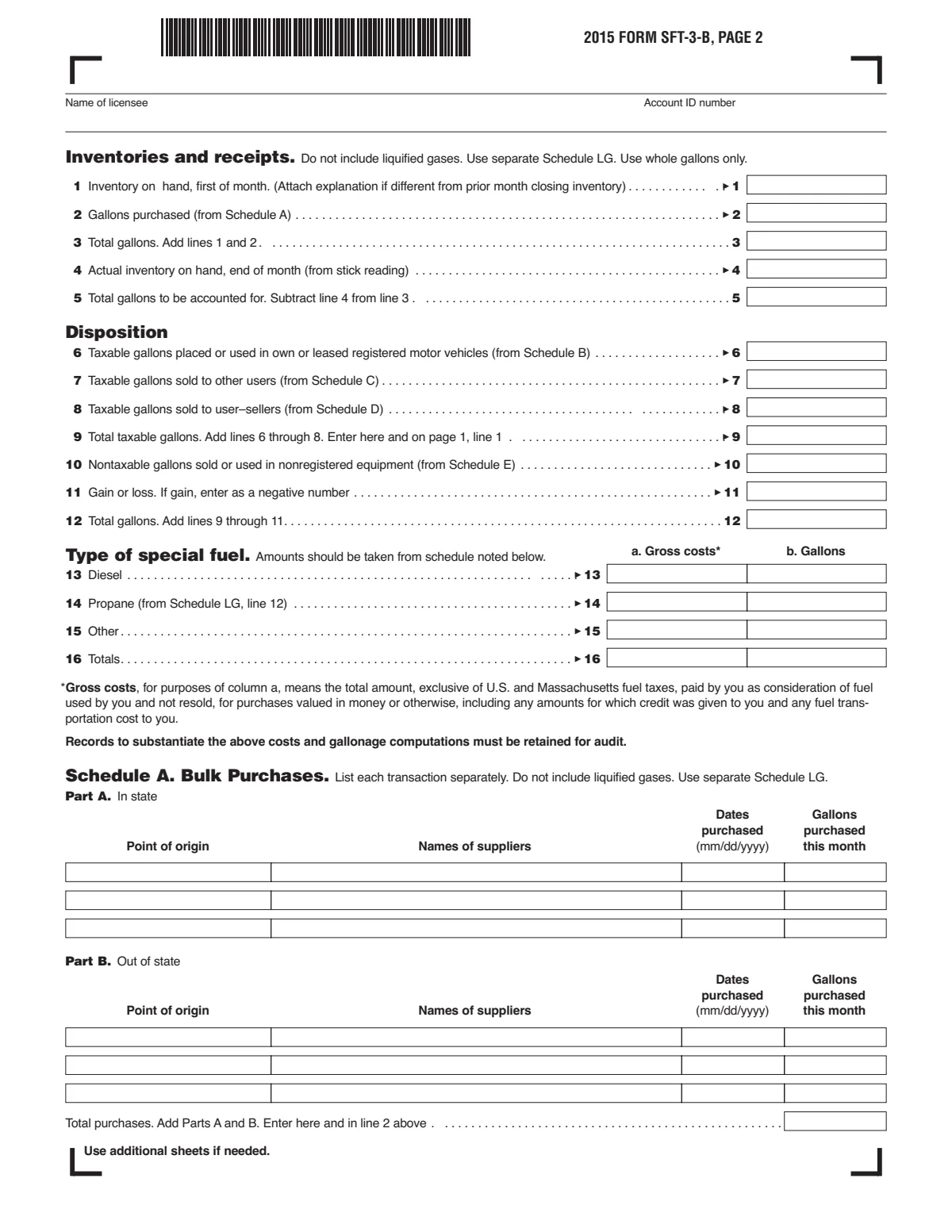
- Schedules A to E
- Paper or MassTaxConnect
- Rules that trip filers up
- How it connects
- Questions filers ask
- Sources
- Who files
- Massachusetts licensed special fuels suppliers
- Due
- 20th of the next month
- Filed with
- Massachusetts DOR, MassTaxConnect or mail
- Form revision
- Rev. 3/15
- Pages
- 4
At a glance
Form SFT-3-B is the Massachusetts “Supplier’s Tax Return” for special fuels, the monthly return licensed suppliers file for diesel and every other motor fuel except gasoline. “Special fuels are all fuels, except gasoline, used to propel motor vehicles on or over the highway.” The supplier accounts for every gallon it held, bought, used and sold, and pays the excise on the taxable gallons. Gasoline goes on Form GT-456.
- Who files. “Suppliers remit all tax due with their monthly returns (Form SFT-3-B).” A business that imports special fuels or sells them in bulk to user-sellers must be licensed as a supplier; one that only dispenses fuel from its own bulk storage into motor vehicles is a user-seller and files Form SFT-4 instead, unless it elects to license as a supplier.
- When. “This return, along with full payment, must be filed on or before the 20th day of the month for the preceding month.” A return is due even if no tax is due.
- Where. On paper with payment to the Massachusetts Department of Revenue, PO Box 7012, Boston, MA 02204, as the form prints. Or electronically in MassTaxConnect (see below).
- Form. SFT-3-B (Rev. 3/15, form code 576), for transactions on or after July 31, 2013: four pages, the return and Schedules A to E, listed on DOR's fuel excise forms page. No line instructions are posted; the notes below come from the form, DOR's AP 111 and its motor fuel page, and the statute. Liquefied gases are reported on a separate Schedule LG.
Massachusetts SFT-3-B (Rev. 3/15); AP 111; DOR fuels excise rate table.
Tap a box once for its note, again to jump to the line. Zoom in to read the small print.
The rates: diesel and liquefied gas
Diesel has a fixed rate. Line 2 prints it, and AP 111 confirms it at $.24 per gallon, the same as gasoline since July 31, 2013. Liquefied gases change every quarter. The statute sets the formula: “at a rate of 19.1 per cent of the average price computed to the nearest tenth of one per cent per gallon” (G.L. c. 64E, s. 4). AP 111 says the same and adds that “Liquefied gas suppliers will be notified of the rate approximately four (4) weeks before the start of the calendar quarter.” DOR posts each quarter's figure in its fuels excise rate table.
One DOR page disagrees. Its tax rates table lists “Propane, liquefied gas, etc. (no minimum) | 29.2%”, while the statute and AP 111 say 19.1 percent of the average price. The statute governs; use the per gallon rate DOR publishes for the quarter.
DOR Massachusetts Fuels Excise Rate Table, 1st quarter 2027. Diesel stays at $0.24 every quarter.
Header and declaration
Page 1 names the supplier, the month and where its records are kept. Each later page repeats the name and account ID. The declaration is signed with the signer's title.
| Line | Label | What goes there |
|---|---|---|
| Name | Name of licensee | The licensed supplier of special fuels. AP 111: suppliers apply on Form SFT-1 with a $25.00 fee and renew by each January 1. |
| Account | Account ID number | Your Department of Revenue account ID, used in MassTaxConnect. |
| License | License number | Your special fuels supplier license number. DOR posts the active fuel licensee lists. |
| Period | Tax filing period (mm/yyyy) | The month and year of the return, as mm/yyyy. |
| Address | Street address; City/Town, State, Zip; Phone number | The licensee's street address, city or town, state, ZIP and phone number. |
| Records | Address where records are kept (if different from above); City/Town, State, Zip | Where the books and records are kept, if that is a different address. “A complete and accurate record of all purchases, sales and use of special fuels must be kept.” |
| Amended-Final | Amended return (see “Amended Return” below) / Final return | Amended: complete a new return with the corrected information and fill in the amended oval, generally within three years of the original. AP 111 adds that most taxpayers must amend electronically in MassTaxConnect. Final: your last return. |
| Signature | Authorized signature | An authorized person signs under the penalties of perjury, declaring the return and its schedules true, correct and complete. |
| Title | Title (owner, etc.) | The signer's title, for example owner. |
| Date | Date | The date signed. |
| Name-2 | Name of licensee; Account ID number (page 2) | The licensee's name and account ID again, so the pages can be matched. |
Page 1, lines 1 to 7: computation
Fill in page 2 and the schedules first; page 1 only carries the taxable gallons and computes the tax. A worked example: 120,000 taxable diesel gallons (line 1) at $.24 is $28,800 (line 2). With 10,000 taxable propane gallons on Schedule LG at the first quarter 2027 rate of $0.265, line 3 is $2,650, and line 4 is $31,450.
| Line | Label | What goes there |
|---|---|---|
| 1 | 1 Total taxable diesel gallons (from page 2, line 9). Use whole gallons only) | Total taxable diesel gallons from page 2, line 9, in whole gallons. |
| 2 | 2 Tax at .24 per gallon. Multiply line 1 × .24 | Line 1 times $.24, the rate the form prints and AP 111 confirms. |
| 3 | 3 Liquified gas tax at ___ per gallon. Multiply taxable whole gallons in Schedule LG, line 9. ___ × current rate | Liquefied gases (propane, CNG, LNG and the like) are reported on the separate Schedule LG. Enter the quarter's rate in the first box and the taxable whole gallons from Schedule LG, line 9, in the second; line 3 is the product. DOR's rate table for the first quarter of 2027 lists “Special Fuels (Liquified Gases/Propane) | 0.265” a gallon. Schedule LG is not posted on DOR's fuel forms list; where to get it is Not listed. |
| 4 | 4 Total tax. Add lines 2 and 3. | Line 2 plus line 3. |
| 5 | 5 Late file penalty ___ Late payment penalty ___ Total penalty | Two boxes, late file and late payment, and their total. AP 111: “The penalty for late filing is 1%/month or fraction thereof, not to exceed 25% of the amount due; and the penalty for late payment is 1%/month for each month or fraction thereof, not to exceed 25% of the amount due.” |
| 6 | 6 Interest on unpaid balance | Interest on any balance paid late. AP 111 puts the Massachusetts rate at the federal short-term rate plus four percentage points, compounded daily. |
| 7 | 7 Total due at time of filing. Add lines 4 through 6. | Lines 4, 5 and 6 added: the amount to pay with the return, by check to the Commonwealth of Massachusetts or electronically if you must. |
Page 2, lines 1 to 5: inventories and receipts
Leave liquefied gases out of page 2 (they go on Schedule LG) and use whole gallons only. The closing inventory is a stick reading, a physical measurement, so the month's figures are checked against the tanks.
| Line | Label | What goes there |
|---|---|---|
| P2-1 | 1 Inventory on hand, first of month. (Attach explanation if different from prior month closing inventory) | Diesel and other special fuels (not liquefied gases) in your storage at the start of the month, in whole gallons. It should equal last month's line 4; attach an explanation if it does not. |
| P2-2 | 2 Gallons purchased (from Schedule A) | Gallons bought in bulk during the month, from Schedule A. |
| P2-3 | 3 Total gallons. Add lines 1 and 2. | Line 1 plus line 2. |
| P2-4 | 4 Actual inventory on hand, end of month (from stick reading) | The actual inventory at month end, from a stick reading: a physical measurement of your tanks, not a book figure. |
| P2-5 | 5 Total gallons to be accounted for. Subtract line 4 from line 3 | Line 3 minus line 4: the gallons that left your storage during the month and have to be accounted for below. |
Page 2, lines 6 to 12: disposition
Lines 6 to 8 are the taxable gallons: fuel put in your own registered vehicles, fuel sold to users who put it in a registered vehicle, and bulk sales to user-sellers. Line 10 is everything that was not taxable, and line 11 the normal gain or loss. Line 12 should come back to line 5.
| Line | Label | What goes there |
|---|---|---|
| P2-6 | 6 Taxable gallons placed or used in own or leased registered motor vehicles (from Schedule B) | Taxable gallons placed or used in your own or leased registered motor vehicles, from Schedule B. |
| P2-7 | 7 Taxable gallons sold to other users (from Schedule C) | Taxable gallons sold to other users and put in a registered motor vehicle, from Schedule C. |
| P2-8 | 8 Taxable gallons sold to user-sellers (from Schedule D) | Taxable bulk sales to user-sellers, from Schedule D. A user-seller pays you the tax when it buys and files its own informational return, Form SFT-4. |
| P2-9 | 9 Total taxable gallons. Add lines 6 through 8. Enter here and on page 1, line 1 | Lines 6, 7 and 8 added. Enter it here and on page 1, line 1. |
| P2-10 | 10 Nontaxable gallons sold or used in nonregistered equipment (from Schedule E) | Gallons sold or used for purposes not subject to the special fuels excise, from Schedule E: own off-highway use, in-state sales for nontaxable use and transfers out of state. |
| P2-11 | 11 Gain or loss. If gain, enter as a negative number | The month's gain or loss in your stock. A gain is entered as a negative number. |
| P2-12 | 12 Total gallons. Add lines 9 through 11. | Lines 9, 10 and 11 added. It should equal line 5, the gallons to be accounted for. |
Page 2, lines 13 to 16: type of special fuel
The last block splits the month by fuel type, with the gross costs of fuel you used and did not resell in column a and the gallons in column b.
| Line | Label | What goes there |
|---|---|---|
| P2-13 | 13 Diesel (a. Gross costs*; b. Gallons) | Diesel: column a, the gross costs of fuel you used and did not resell; column b, the gallons. The footnote defines gross costs as “the total amount, exclusive of U.S. and Massachusetts fuel taxes, paid by you as consideration of fuel” |
| P2-14 | 14 Propane (from Schedule LG, line 12) | Propane, from Schedule LG, line 12: gross costs and gallons. |
| P2-15 | 15 Other | Any other special fuel: gross costs and gallons. |
| P2-16 | 16 Totals | Columns a and b of lines 13 to 15 added. Keep the records behind the costs and gallon figures for audit, as the form says. |
Schedules A to E
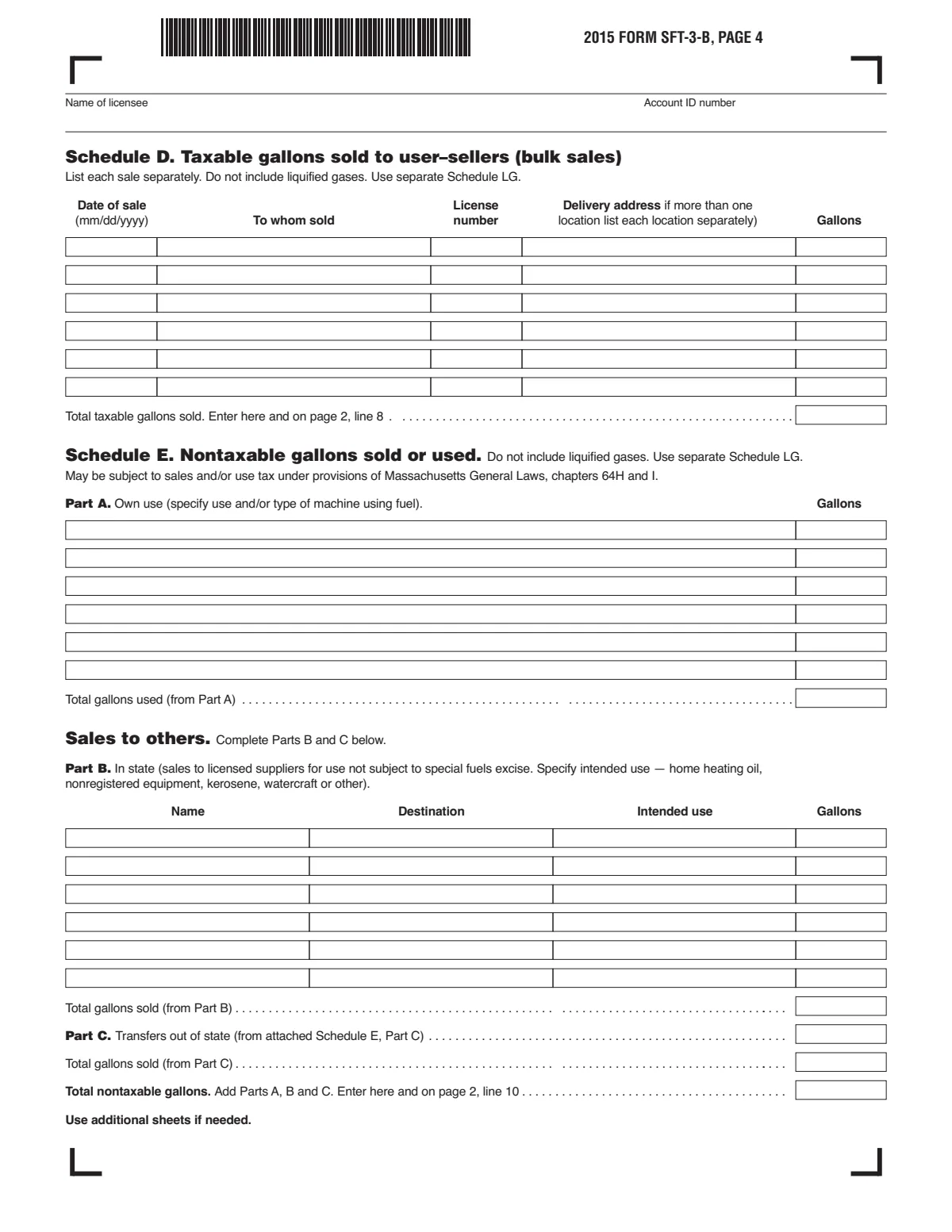
Schedule A lists bulk purchases; Schedules B, C and D back the taxable lines 6, 7 and 8; Schedule E backs the nontaxable line 10. Each says to leave liquefied gases out and use Schedule LG. AP 111 lists the sales and uses that are exempt or refundable, among them sales to the federal government, to the MWRA, MBTA and Massport and regional transit authorities, special fuels used in watercraft, off-highway and farm use, turnpike use and fuel used as heating oil.
| Line | Label | What goes there |
|---|---|---|
| A-in | Schedule A. Bulk Purchases. List each transaction separately. Part A. In state: Point of origin; Names of suppliers; Dates purchased; Gallons purchased this month | Bulk purchases from points of origin in Massachusetts, one row per transaction: point of origin, supplier, date and gallons. Liquefied gases go on Schedule LG instead. |
| A-out | Part B. Out of state: Point of origin; Names of suppliers; Dates purchased; Gallons purchased this month | Bulk purchases from out of state, laid out the same way. AP 111 says anyone who imports special fuels into Massachusetts must be licensed as a supplier. |
| A-total | Total purchases. Add Parts A and B. Enter here and in line 2 above | Parts A and B added: the total to enter on page 2, line 2. |
| Name-3 | Name of licensee; Account ID number (page 3) | The licensee's name and account ID again. |
| B-rows | Schedule B. Taxable gallons consumed: Make; Type; Odometer reading; Engine hour reading; From own storage; Road purchase from others | Each owned or leased registered vehicle you fueled: make, type (tractor, backhoe and so on), end of month odometer and engine hour readings, and the gallons from your own storage and road purchases from others. |
| B-total | Total gallons. Enter on page 2, line 6 | Total gallons, entered on page 2, line 6. |
| C-rows | Schedule C. Taxable gallons sold: Name(s) of purchaser(s); Address(es); Total gallons for month | Each purchaser that put the fuel in a registered motor vehicle, with address and gallons for the month. |
| C-total | Total taxable gallons. Enter here and on page 2, line 7. | Total taxable gallons sold to users, entered on page 2, line 7. |
| Name-4 | Name of licensee; Account ID number (page 4) | The licensee's name and account ID again. |
| D-rows | Schedule D. Taxable gallons sold to user-sellers (bulk sales): Date of sale; To whom sold; License number; Delivery address; Gallons | Each bulk sale to a licensed user-seller, listed separately: date, buyer, license number, delivery address (each location separately) and gallons. |
| D-total | Total taxable gallons sold. Enter here and on page 2, line 8 | Total taxable gallons sold to user-sellers, entered on page 2, line 8. |
| E-A | Part A. Own use (specify use and/or type of machine using fuel). Gallons | Fuel you used yourself for nontaxable purposes, naming the use or the machine, such as nonregistered equipment. The schedule warns that sales or use tax may apply under chapters 64H and 64I. |
| E-A-total | Total gallons used (from Part A) | The Part A total. |
| E-B | Part B. In state (sales to licensed suppliers for use not subject to special fuels excise): Name; Destination; Intended use; Gallons | Sales in Massachusetts for use not subject to the special fuels excise, with the intended use: home heating oil, nonregistered equipment, kerosene, watercraft or other. AP 111: a buyer claiming an exemption generally gives the seller Form ST-12, the exempt use certificate. |
| E-B-total | Total gallons sold (from Part B) | The Part B total. |
| E-C | Part C. Transfers out of state (from attached Schedule E, Part C) | Transfers out of state, from the separate Schedule E, Part C, Nontaxable Sales and Transfers Outside Massachusetts, attached. |
| E-C-total | Total gallons sold (from Part C) | The Part C total. |
| E-total | Total nontaxable gallons. Add Parts A, B and C. Enter here and on page 2, line 10 | Parts A, B and C added: total nontaxable gallons, entered on page 2, line 10. |
Paper or MassTaxConnect
AP 111 sets two thresholds. “Suppliers with total annual payments in excess of $5,000 must make payments electronically through MTC.” And businesses with certain combined liabilities at or over $5,000 must file electronically through MassTaxConnect (TIR 16-9). Missing a required electronic payment can bring a penalty under G.L. c. 62C, s. 33(g). Suppliers below the thresholds may mail the return with a check.
Rules that trip filers up
- Putting propane on the main pages. Liquefied gases go on Schedule LG and page 1, line 3; page 2 and Schedules A to E are for diesel and other special fuels.
- Last quarter's liquefied gas rate. The rate changes every calendar quarter. Use the one DOR publishes for the month you report.
- Book inventory instead of a stick reading. Line 4 on page 2 is the actual inventory from a stick reading.
- Opening inventory that does not match. Line 1 on page 2 should equal last month's closing inventory; attach an explanation if it does not.
- Gains entered as positive numbers. A gain on page 2, line 11 is a negative number.
- Skipping a month. The return is due even when no tax is due.
- Amending to dispute an audit. File Form ABT, not an amended return, to dispute an assessment or ask for penalty abatement.
How it connects
- Massachusetts motor fuel, licenses and the other fuel returns: Massachusetts excise tax, motor fuel section. The gasoline return: Massachusetts GT-456.
- Other states' special fuel returns: Connecticut OP-216 and West Virginia MFT-504. The federal diesel tax at the terminal rack: fuel excise tax; tax-free off-road diesel: dyed fuel.
- Motor carriers that buy diesel are not SFT-3-B filers; they report through IFTA (iftacompliance.com). Off-road and turnpike users claim refunds on Form SFT-9-B and Form SFT-9T-B.
Questions filers ask
Who files the Massachusetts SFT-3-B?
Licensed suppliers of special fuels: businesses that import special fuels into Massachusetts or sell them in bulk to user-sellers, and user-sellers that elect to license as suppliers. They file every month, even with no tax due.
What is the Massachusetts diesel tax rate?
$.24 per gallon, printed on line 2 and confirmed by AP 111 and DOR's motor fuel page.
How is the propane rate set?
Each quarter, at 19.1 percent of the average price (G.L. c. 64E, s. 4). DOR's rate table gives $0.265 a gallon for January to March 2027.
What is the difference between the SFT-3-B and the SFT-4?
Suppliers file the SFT-3-B and pay the tax. User-sellers, which dispense fuel from bulk storage into vehicles, pay the tax to their supplier when they buy and file the SFT-4 as an informational return.
Do I have to file electronically?
AP 111: suppliers with total annual payments over $5,000 must pay electronically through MassTaxConnect, and businesses with certain combined liabilities of $5,000 or more must file there.
Sources
- Massachusetts Form SFT-3-B, Supplier's Tax Return, Special Fuels (Rev. 3/15), PDF
- Massachusetts DOR, AP 111: Special Fuels G.L. c. 64E
- Massachusetts General Laws, c. 64E, s. 4: Payments; tax rate
- Massachusetts DOR, Motor fuel excise
- Massachusetts DOR, Fuels Excise Rate Table, 1st quarter 2027 (XLSX)
- Massachusetts DOR, Fuel Excise Forms, Licensee Lists, and Rate Table
- Massachusetts DOR, Massachusetts tax rates