- Who files
- Licensed tobacco products distributors
- Due
- 18th of the next month
- Filed with
- Minnesota Department of Revenue, e-Services or mail
- Form revision
- Rev. 10/21
- Pages
- 1, plus 3 pages of instructions
At a glance
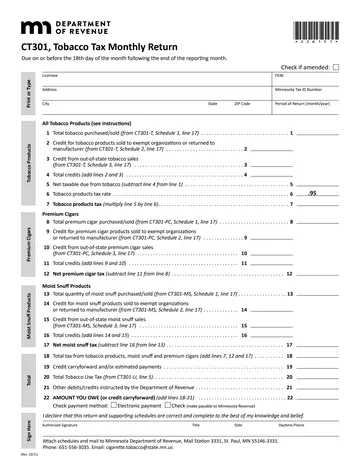
CT301 is the monthly return a Minnesota tobacco products distributor files for the Tobacco Tax. The tax “applies to all tobacco products in Minnesota (except cigarettes)”, and cigarettes have their own stamp and return. “All Minnesota tobacco products distributors must file a return and applicable schedules each month.” The return has three blocks, one per product class (tobacco products, premium cigars and moist snuff), and each block takes its figures from its own schedule.
- Who files. Licensed tobacco products distributors, resident and nonresident. The Department taxes the distributor when it brings tobacco products into Minnesota, makes them in Minnesota for sale in the state, or ships them to Minnesota retailers.
- What counts as a tobacco product. Cigars, smoking and chewing tobacco, and vapor products: “Vapor products, also known as nicotine solution products, that contain nicotine derived from tobacco or any other source, are also tobacco products under Minnesota law.”
- When. “All cigarette and tobacco tax returns and payments are due on the 18th day of the month following the end of the reporting month.” A Saturday, Sunday or legal holiday moves it to the next business day.
- How. Electronically in e-Services, or on paper with the schedules attached, mailed to Minnesota Department of Revenue, Mail Station 3331, St. Paul, MN 55146-3331.
- Form and schedules. CT301 (Rev. 10/21), one page plus three pages of instructions, from the Department's tobacco tax forms page. The schedules CT301-T, CT301-PC and CT301-MS are separate PDFs.
CT301 (Rev. 10/21) and its instructions; Minnesota Department of Revenue, Tobacco Tax Requirements, read Nov. 22, 2026.
Tap a box once for its note, again to jump to the line. Zoom in to read the small print.
Header
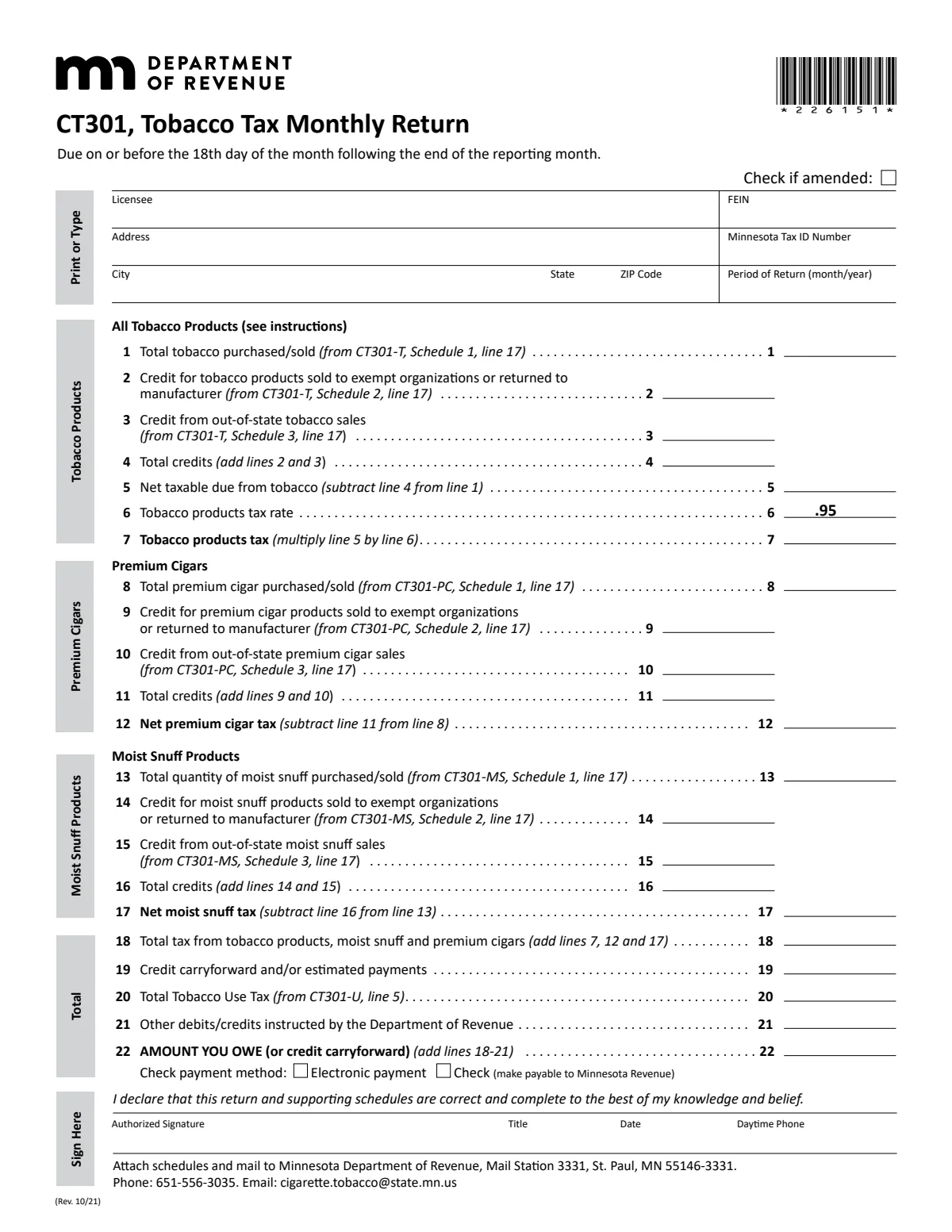
The header identifies the licensee and the month. The same identifying details go on every schedule.
| Line | Label | What goes there |
|---|---|---|
| Amended | Check if amended | Mark the box at the top when you file a corrected return for a month. “If you are filing an amended return, be sure to check the box at the top of the form.” |
| Licensee | Licensee | The distributor's name as licensed by the Department of Revenue. “Enter your name, address, FEIN, Minnesota tax ID number and tax period on each form.” That applies to every schedule you attach too. |
| FEIN | FEIN | Your federal employer identification number. |
| Address | Address | The business address. A change of name, address or ownership is reported to the Department in writing, with your Minnesota tax ID number and FEIN. |
| MNID | Minnesota Tax ID Number | “Your Minnesota tax ID number is the seven-digit number you’re assigned when you register with the Minnesota Department of Revenue.” A distributor without one registers first; the license itself comes from the Department's cigarette and tobacco licensing page. |
| City | City, State, ZIP Code | City, state and ZIP code of the address above. |
| Period | Period of Return (month/year) | The reporting month and year. One return covers one calendar month, and “You must file a return even if there is no tax liability or transactions for that month.” |
Lines 1 to 7: tobacco products
This block covers everything taxed at 95% of the wholesale sales price: cigars other than premium cigars, pipe and roll-your-own tobacco, chewing tobacco, and vapor products. “Complete all applicable supporting schedules first.” Lines 2 and 3 are credits only resident distributors claim.
CT301 instructions: complete all applicable supporting schedules first.
| Line | Label | What goes there |
|---|---|---|
| 1 | Total tobacco purchased/sold (from CT301-T, Schedule 1, line 17) | Resident and nonresident distributors enter the total from Form CT301-T, Schedule 1, Taxable Purchases/Sales, line 17. The amount is the wholesale sales price, and “Wholesale sales price includes applicable federal excise tax, freight charges, or packaging costs, regardless of whether they were included in the purchase price.” |
| 2 | Credit for tobacco products sold to exempt organizations or returned to manufacturer (from CT301-T, Schedule 2, line 17) | Resident distributors only: the total from CT301-T, Schedule 2, Credits, line 17. It covers tobacco products sold to exempt organizations or returned to the manufacturer. Nonresident distributors leave it blank. |
| 3 | Credit from out-of-state tobacco sales (from CT301-T, Schedule 3, line 17) | Resident distributors only: the total from CT301-T, Schedule 3, Out-of-State Sales, line 17. |
| 4 | Total credits (add lines 2 and 3) | Line 2 plus line 3. |
| 5 | Net taxable due from tobacco (subtract line 4 from line 1) | Line 1 minus line 4: the wholesale sales price that is taxed this month. |
| 6 | Tobacco products tax rate | Printed on the form as .95. “The tobacco products tax rate is 95% of the wholesale sales price.” Imports from another country are taxed on the wholesale sales price plus the federal tax, duties and transportation costs to the U.S. |
| 7 | Tobacco products tax (multiply line 5 by line 6) | Line 5 times .95. |
Lines 8 to 12: premium cigars
A premium cigar, in the Department's words, is a hand-constructed cigar with a whole-leaf wrapper and an all-tobacco filler and binder, with a wholesale price of $2.00 or more. Its tax is capped per cigar, so it has its own schedule, CT301-PC.
| Line | Label | What goes there |
|---|---|---|
| 8 | Total premium cigar purchased/sold (from CT301-PC, Schedule 1, line 17) | Resident and nonresident distributors: the total from CT301-PC, Schedule 1, line 17. Premium cigars are taxed at the lower of two amounts: “95% of the wholesale sales price or $0.50 per cigar, whichever is less.” The form has no rate line for cigars, and line 12 is labeled a tax, so the amounts on lines 8 to 12 come over from CT301-PC as figured there. |
| 9 | Credit for premium cigar products sold to exempt organizations or returned to manufacturer (from CT301-PC, Schedule 2, line 17) | Resident distributors only: the total from CT301-PC, Schedule 2, Credits, line 17. |
| 10 | Credit from out-of-state premium cigar sales (from CT301-PC, Schedule 3, line 17) | Resident distributors only: the total from CT301-PC, Schedule 3, Out-of-State Sales, line 17. |
| 11 | Total credits (add lines 9 and 10) | Line 9 plus line 10. |
| 12 | Net premium cigar tax (subtract line 11 from line 8) | Line 8 minus line 11. |
Lines 13 to 17: moist snuff
Moist snuff carries a floor instead of a cap. The form's instructions describe the floor as the “Tax rate on a pack of 20 cigarettes weighing not more than three pounds per thousand, per container”; the Department's page states it in dollars ($3.04 a container of 1.2 ounces or less). Its schedule is CT301-MS.
| Line | Label | What goes there |
|---|---|---|
| 13 | Total quantity of moist snuff purchased/sold (from CT301-MS, Schedule 1, line 17) | Resident and nonresident distributors: the total from CT301-MS, Schedule 1, line 17. Moist snuff is taxed at the higher of two amounts. The Department's page gives them as of November 2026: “Container that weighs 1.2 ounces or less is 95% of the wholesale sales price or $3.04, whichever is greater.” Nicotine pouches count here: the page defines moist snuff to include “similar tobacco-free product containing nicotine, that is intended to be placed or dipped in the mouth”. |
| 14 | Credit for moist snuff products sold to exempt organizations or returned to manufacturer (from CT301-MS, Schedule 2, line 17) | Resident distributors only: the total from CT301-MS, Schedule 2, Credits, line 17. |
| 15 | Credit from out-of-state moist snuff sales (from CT301-MS, Schedule 3, line 17) | Resident distributors only: the total from CT301-MS, Schedule 3, Out-of-State sales, line 17. |
| 16 | Total credits (add lines 14 and 15) | Line 14 plus line 15. |
| 17 | Net moist snuff tax (subtract line 16 from line 13) | Line 13 minus line 16. Like the premium cigar block, the snuff block has no rate line: the schedule figures the tax. |
Lines 18 to 22 and signature
| Line | Label | What goes there |
|---|---|---|
| 18 | Total tax from tobacco products, moist snuff and premium cigars (add lines 7, 12 and 17) | Add the tax due from tobacco products, premium cigars and moist snuff. |
| 19 | Credit carryforward and/or estimated payments | “If line 22 of the previous month’s CT301 is a credit or if you made an estimated or accelerated payment, enter the total of those amounts on this line.” The form prints no sign for this line; the instructions do not say whether to enter it as a negative. |
| 20 | Total Tobacco Use Tax (from CT301-U, line 5) | The use tax total from the tobacco use tax schedule for businesses. The form names it CT301-U and the line instruction writes CT301T-U; the schedule list in the instructions calls it CT301-U, Tobacco Use Tax for Businesses. |
| 21 | Other debits/credits instructed by the Department of Revenue | Only for a debit or credit the Department of Revenue tells you to enter. |
| 22 | AMOUNT YOU OWE (or credit carryforward) (add lines 18-21) | Lines 18 to 21 combined, then mark Electronic payment or Check. A credit here carries to line 19 of next month's return. A check needs a payment voucher made in e-Services, and a business that owes $10,000 or more a year must pay electronically (see Payment rules below). |
| Sign | Authorized Signature, Title, Date, Daytime Phone | Signed under the printed declaration: “I declare that this return and supporting schedules are correct and complete to the best of my knowledge and belief.” Attach the schedules and mail to the address printed at the bottom when filing on paper. |
Due date, payment and penalties
- Filing date. “The U.S. postmark date is considered the filing date (postage meter marks are not valid).”
- Electronic payment. “If you owe $10,000 or more in tax during the last 12-month period ending June 30, you’re required to pay your tax electronically the following calendar year.” A business that must pay any Minnesota business tax electronically must pay this one electronically too, and “If you’re required to pay electronically and do not, you’ll be assessed a 5% penalty on each payment.”
- Paying by check. A check goes with a payment voucher created in e-Services (payment voucher system). The check is converted to a one-time electronic transfer.
- Late payment. “The penalty is 5% of the unpaid tax for each 30 days the payment is late (or any part of 30 days) up to 15%.” Late filing adds 5% of the unpaid tax, and “The maximum penalty for paying and filing late is 20%.” Interest runs on the unpaid tax and penalty from the due date.
- Records. Keep itemized invoices at each licensed location and “Save all books, records and other documents for at least 3½ years.”
- Closing the business. Notify the Department in writing with the effective date, file a return for the last month, and attach the permit to the final return: “Permits are not transferable and must be returned to the department.”
Common mistakes
- Skipping a month with no sales. The return is still due.
- Leaving freight or federal excise tax out of the wholesale price. Both belong in the wholesale sales price, whether or not the invoice includes them.
- Reporting cigarettes here. “The tobacco products tax is not imposed on non-tobacco items (for example, paper, pipes or lighters) or cigarettes.”
- A nonresident distributor claiming lines 2, 3, 9, 10, 14 or 15. The instructions limit those credits to resident distributors.
- Mailing the return without the schedules. “You must mail the schedules with the return.”
How it connects
- Minnesota's tobacco, vapor and nicotine taxes in one place: Minnesota excise tax, tobacco section, and the vapor rules at Minnesota vapor.
- Other states' rates: cigarette and tobacco tax by state and vapor tax by state. Licensing: tobacco distributor licenses.
- Other state tobacco returns on this site: New York MT-203, New Jersey TPT-10 and West Virginia TPT-709. The federal tax on the same products: tobacco excise tax.
Questions filers ask
When is Minnesota Form CT301 due?
On the 18th day of the month after the reporting month, with the payment. When the 18th falls on a Saturday, Sunday or legal holiday, a return filed, paid electronically or postmarked by the next business day is on time.
What is Minnesota's tax rate on tobacco products?
95 percent of the wholesale sales price, as printed on line 6. Premium cigars pay the lower of 95 percent or $0.50 a cigar, and moist snuff pays the higher of 95 percent or $3.04 a container of 1.2 ounces or less, per the Department's page as of November 2026.
Are e-cigarettes reported on CT301?
Yes. Minnesota treats vapor products, also called nicotine solution products, as tobacco products, so they go through CT301-T and lines 1 to 7 at 95 percent of the wholesale sales price.
Do I file CT301 if I sold nothing this month?
Yes. The instructions say you must file a return even if there is no tax liability or transactions for the month.
Where do nicotine pouches go?
In the moist snuff block. The Department's definition of moist snuff includes similar tobacco-free products containing nicotine that are placed or dipped in the mouth, such as pouches.
Can I pay by check?
Yes, with a payment voucher made in e-Services, unless you must pay electronically because you owed $10,000 or more in the 12 months ending June 30 or pay another Minnesota business tax electronically.