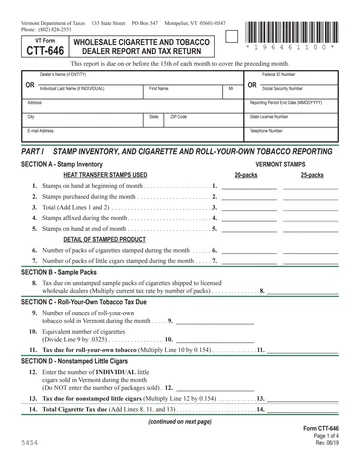
- Who files
- Licensed wholesale cigarette and tobacco dealers
- Due
- 15 days after the month, even with no tax
- Filed with
- Vermont Department of Taxes, myVTax or paper
- Form revision
- Rev. 06/19
- Pages
- 4 (Parts I to IV)
At a glance
Form CTT-646 is Vermont's “Wholesale Cigarette and Tobacco Dealer Report and Tax Return”: one monthly return for the cigarette stamp tax (reconciled in Section A), the roll-your-own and unstamped little cigar tax, and the tobacco products tax on new smokeless tobacco, snuff, cigars, e-cigarettes and other tobacco products. The Department of Taxes lists its instructions as “Included on Form CTT-646”, so the printed lines are the instructions.
- Who files. Every licensed wholesale dealer. The Department's page says “A return must be filed each month by every licensed wholesale dealer, even when no tax is due.” A retailer that finds untaxed products pays the tax itself.
- When. “The return and payment are due 15 days following the end of the month.” “A return with a due date that falls on a weekend or holiday becomes due the next business day.”
- How. Online in myVTax, the Department's filing system. “If you cannot file and pay through myVTax, you may still use the paper forms.” Paper payments go with the CTT-961 payment voucher; the paper return goes to the Vermont Department of Taxes, PO Box 547, Montpelier, VT 05601-0547, the address printed on the form.
- Form. Form CTT-646 (Rev. 06/19), four pages: Part I (stamps, roll-your-own, little cigars and sales by manufacturer), Part II (smokeless, snuff, cigars, e-cigarettes and other products), Part III (totals) and Part IV (signature).
Form CTT-646 (Rev. 06/19); 32 V.S.A. 7771 and 7811. Rates as of November 2026.
Tap a box once for its note, again to jump to the line. Zoom in to read the small print.
Header
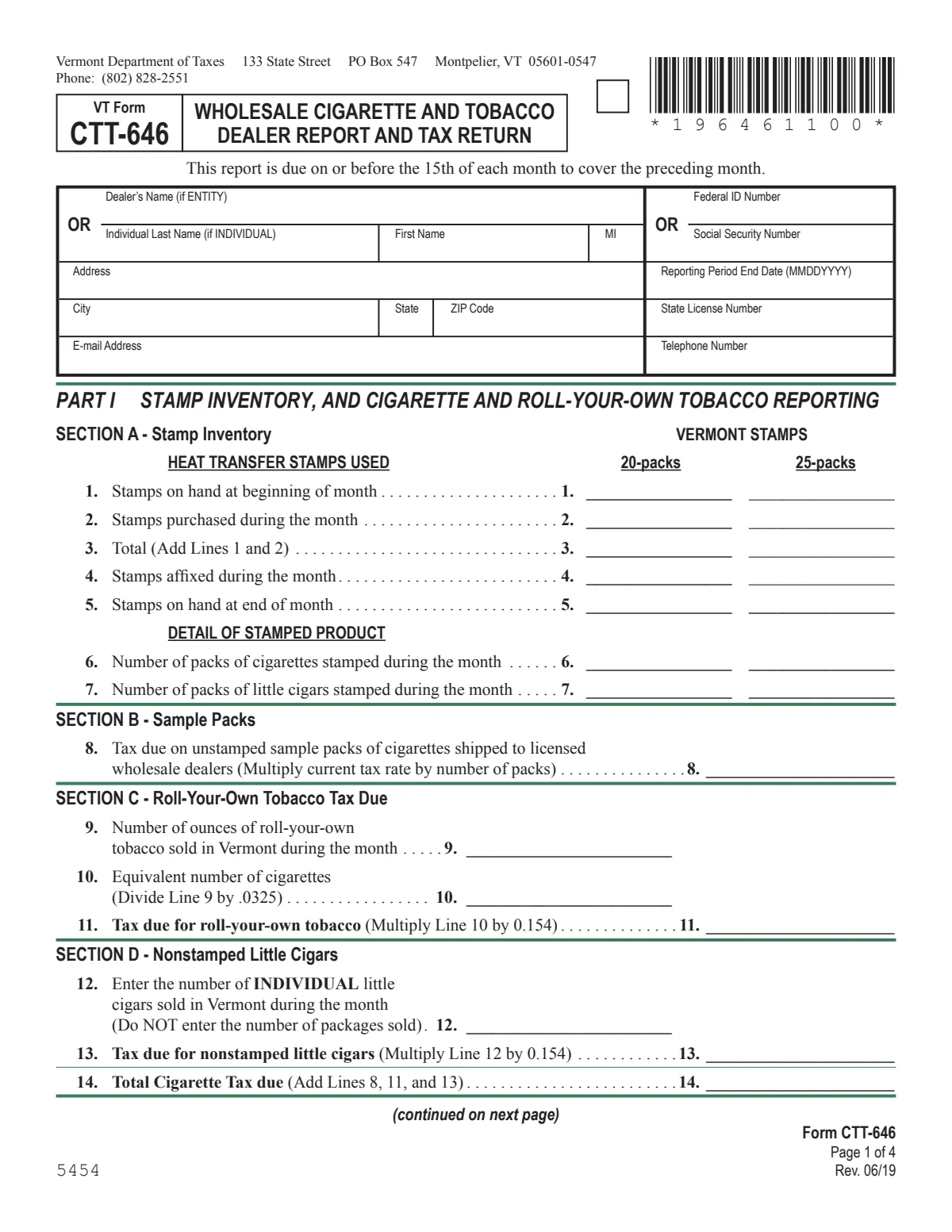
The header names the dealer and the month. Pages 2 to 4 repeat the name, ID number and period end date.
| Line | Label | What goes there |
|---|---|---|
| Name | Dealer’s Name (if ENTITY) OR Individual Last Name (if INDIVIDUAL), First Name, MI | The licensed wholesale dealer. Fill in the entity line or the individual line, not both. |
| FEIN | Federal ID Number OR Social Security Number | The entity's federal ID number, or the individual's Social Security number. |
| Address | Address | The mailing address. |
| Period | Reporting Period End Date (MMDDYYYY) | The last day of the month the return covers, for example 10312026. “This report is due on or before the 15th of each month to cover the preceding month.” |
| City | City, State, ZIP Code | The rest of the mailing address. |
| License | State License Number | Your Vermont wholesale cigarette and tobacco dealer license, issued on Form CTT-647. “Effective July 1, 2027, the Vermont Department of Liquor and Lottery will assume licensing for wholesale dealers of cigarette and tobacco products.” |
| E-mail Address | An e-mail address for questions about the return. | |
| Phone | Telephone Number | A telephone number. |
Part I: stamps, roll-your-own and little cigars
Vermont collects most of its cigarette tax through stamps: “Payment of the tax on cigarettes under this section shall be evidenced by the affixing of stamps to the packages containing the cigarettes.” Section A reconciles the stamps you bought and affixed, so it carries no tax. The cigarette tax that is paid with this return comes from sample packs (Section B), roll-your-own tobacco (Section C) and little cigars sold without stamps (Section D), all at the same 154 mills per cigarette.
| Line | Label | What goes there |
|---|---|---|
| 1 | Stamps on hand at beginning of month | Section A counts Vermont stamps (the form heads it "Heat transfer stamps used"), with a column for 20-packs and one for 25-packs. Line 1 is unaffixed stamps on hand on the first day of the month. |
| 2 | Stamps purchased during the month | Stamps bought from the Department during the month. Dealers order them on Form CTT-642. “Tax on cigarette packs and little cigar packs is paid by licensed wholesale dealers who purchase cigarette tax stamps directly from the Department.” |
| 3 | Total | Line 1 plus line 2, for each pack size. |
| 4 | Stamps affixed during the month | Stamps affixed to packs during the month. |
| 5 | Stamps on hand at end of month | Stamps still on hand, unaffixed, at the end of the month. Line 3 minus line 4 should equal it. |
| 6 | Packs of cigarettes stamped | The number of cigarette packs stamped in the month, by pack size. Lines 6 and 7, the form's "Detail of stamped product", break down the stamps affixed on line 4. |
| 7 | Packs of little cigars stamped | The number of little cigar packs stamped in the month. Little cigars pay the same stamp tax as cigarettes: “154 mills per cigarette or little cigar”. |
| 8 | Tax due on unstamped sample packs | Unstamped sample packs of cigarettes shipped to licensed wholesale dealers: “Multiply current tax rate by number of packs”. At 154 mills a cigarette, a 20-pack carries $3.08. |
| 9 | Ounces of roll-your-own sold | The ounces of roll-your-own tobacco you sold in Vermont during the month. |
| 10 | Equivalent number of cigarettes | Line 9 divided by .0325, which turns ounces into cigarettes. The statute taxes “each 0.0325 ounces of roll-your-own tobacco” as one cigarette. |
| 11 | Tax due for roll-your-own tobacco | Line 10 times 0.154, the 154 mills per cigarette. |
| 12 | Individual little cigars sold | Little cigars sold without stamps, counted one by one. The form is emphatic: “Do NOT enter the number of packages sold”. |
| 13 | Tax due for nonstamped little cigars | Line 12 times 0.154. |
| 14 | Total Cigarette Tax due | Lines 8, 11 and 13 added. This is the cigarette tax paid with the return; the tax on stamped packs was paid when the stamps were bought. It goes to line 43. |
Section E: sales by manufacturer
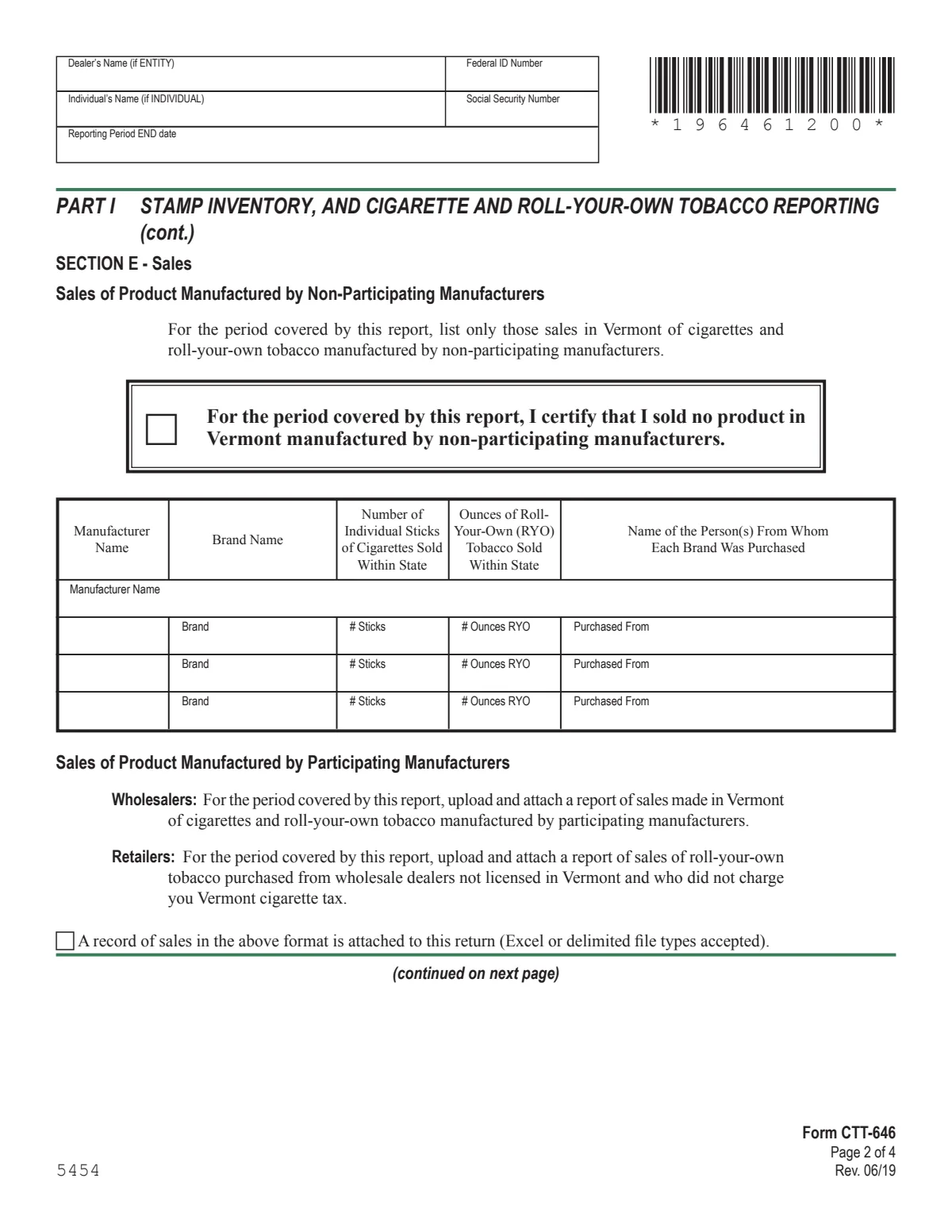
Page 2 carries no tax. It reports where your cigarettes and roll-your-own came from: a list of sales of non-participating manufacturers' products (or a certification that there were none) and an attached sales report for participating manufacturers' products.
| Line | Label | What goes there |
|---|---|---|
| Head-2 | Dealer’s Name (if ENTITY), Individual’s Name (if INDIVIDUAL), Federal ID Number, Social Security Number, Reporting Period END date | Repeat the identity and period on each page. |
| E-cert | For the period covered by this report, I certify that I sold no product in Vermont manufactured by non-participating manufacturers. | Check this box when you had no non-participating manufacturer (NPM) sales. The Department also runs separate NPM monthly reporting. |
| E-npm | Manufacturer Name; Brand Name; Number of Individual Sticks of Cigarettes Sold Within State; Ounces of Roll-Your-Own (RYO) Tobacco Sold Within State; Name of the Person(s) From Whom Each Brand Was Purchased | “For the period covered by this report, list only those sales in Vermont of cigarettes and roll-your-own tobacco manufactured by non-participating manufacturers.” Sticks are individual cigarettes, not packs. |
| E-pm | Sales of Product Manufactured by Participating Manufacturers: Wholesalers; Retailers; A record of sales in the above format is attached to this return | Wholesalers upload a report of their Vermont sales of participating manufacturers' cigarettes and roll-your-own. Retailers report roll-your-own bought from wholesalers not licensed in Vermont that did not charge Vermont tax. Check the box: “Excel or delimited file types accepted”. |
Part II: smokeless tobacco, snuff and cigars
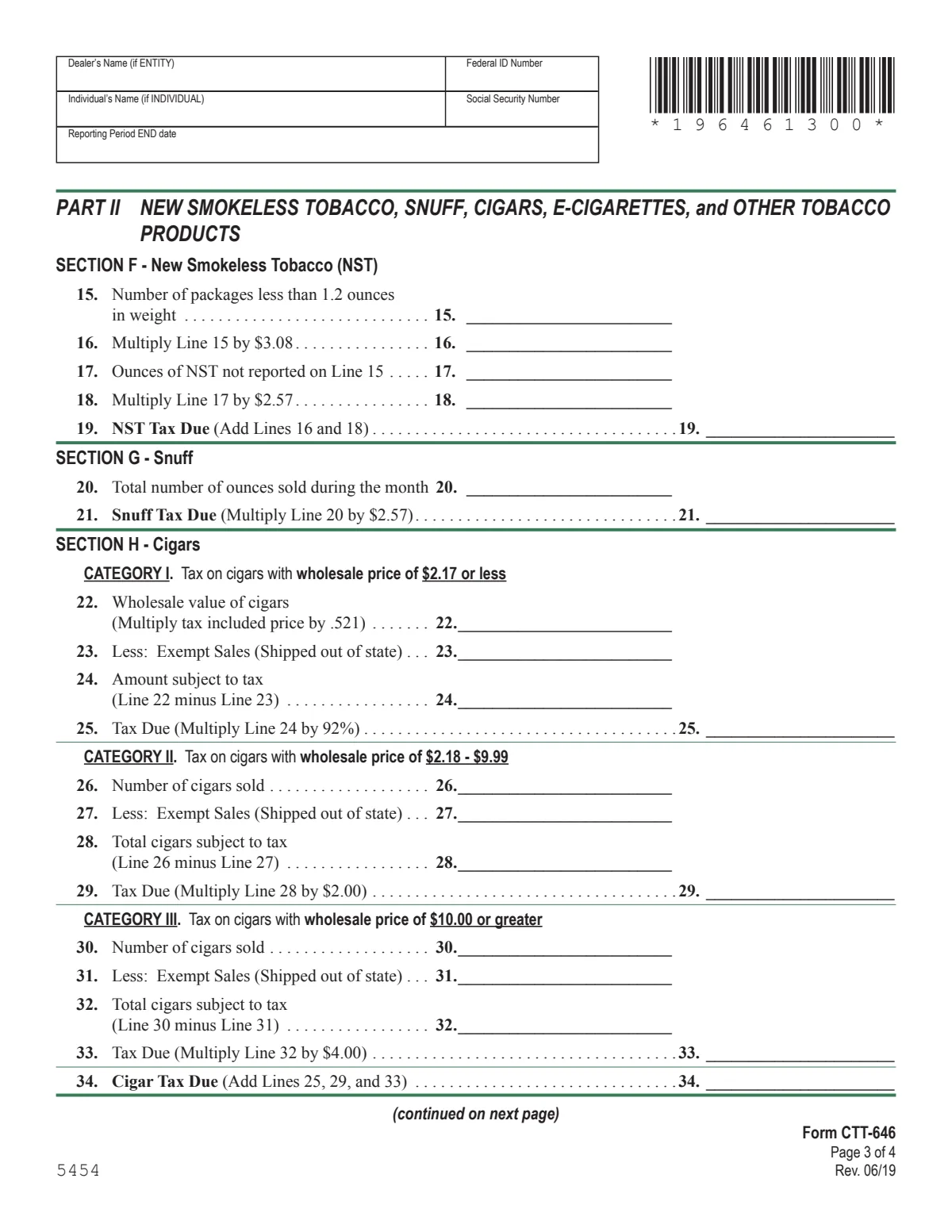
The tobacco products tax is “intended to be imposed only once upon the wholesale sale of any other tobacco product”. Most products pay 92 percent of the wholesale price, but snuff and new smokeless tobacco are taxed by weight or package, and cigars above $2.17 wholesale pay a flat amount per cigar. Page 3 handles those three.
| Line | Label | What goes there |
|---|---|---|
| Head-3 | Dealer’s Name, Federal ID Number, Reporting Period END date (page 3) | Repeat the identity and period. |
| 15 | NST packages under 1.2 ounces | Section F is new smokeless tobacco (NST). Count the packages that hold less than 1.2 ounces. |
| 16 | Line 15 times $3.08 | Line 15 times $3.08. The statute taxes NST “at the greater of $2.57 per ounce or, if packaged for sale to a consumer in a package that contains less than 1.2 ounces of the new smokeless tobacco, at the rate of $3.08 per package”. |
| 17 | Ounces of NST not on line 15 | Ounces of NST in larger packages, not counted on line 15. |
| 18 | Line 17 times $2.57 | Line 17 times $2.57. |
| 19 | NST Tax Due | Lines 16 and 18 added. |
| 20 | Ounces of snuff sold | Section G is snuff: the total ounces sold during the month. |
| 21 | Snuff Tax Due | Line 20 times $2.57. Snuff is taxed “at $2.57 per ounce or fractional part thereof”, so a part ounce counts as a whole one. |
| 22 | Category I: wholesale value of cigars | Category I covers cigars with a wholesale price of $2.17 or less, taxed at 92 percent. The form starts from the tax-included price: “Multiply tax included price by .521”. Since the tax is 92 percent of the wholesale price, 1 divided by 1.92 is about .521, which backs the tax out. |
| 23 | Category I: exempt sales | Category I cigars shipped out of state, at the same value as line 22. |
| 24 | Category I: amount subject to tax | Line 22 minus line 23. |
| 25 | Category I: tax due | Line 24 times 92%. |
| 26 | Category II: number of cigars sold | Category II: the number of cigars with a wholesale price of $2.18 to $9.99. These pay a flat amount per cigar, not a percentage. |
| 27 | Category II: exempt sales | Category II cigars shipped out of state. |
| 28 | Category II: cigars subject to tax | Line 26 minus line 27. |
| 29 | Category II: tax due | Line 28 times $2.00. The statute sets “$2.00 per cigar if the wholesale price of the cigar is greater than $2.17 and less than $10.00”. |
| 30 | Category III: number of cigars sold | Category III: the number of cigars with a wholesale price of $10.00 or more. |
| 31 | Category III: exempt sales | Category III cigars shipped out of state. |
| 32 | Category III: cigars subject to tax | Line 30 minus line 31. |
| 33 | Category III: tax due | Line 32 times $4.00, the rate “per cigar if the wholesale price of the cigar is $10.00 or more”. |
| 34 | Cigar Tax Due | Lines 25, 29 and 33 added. |
Part II (cont.) and Part III: e-cigarettes, other products and the totals
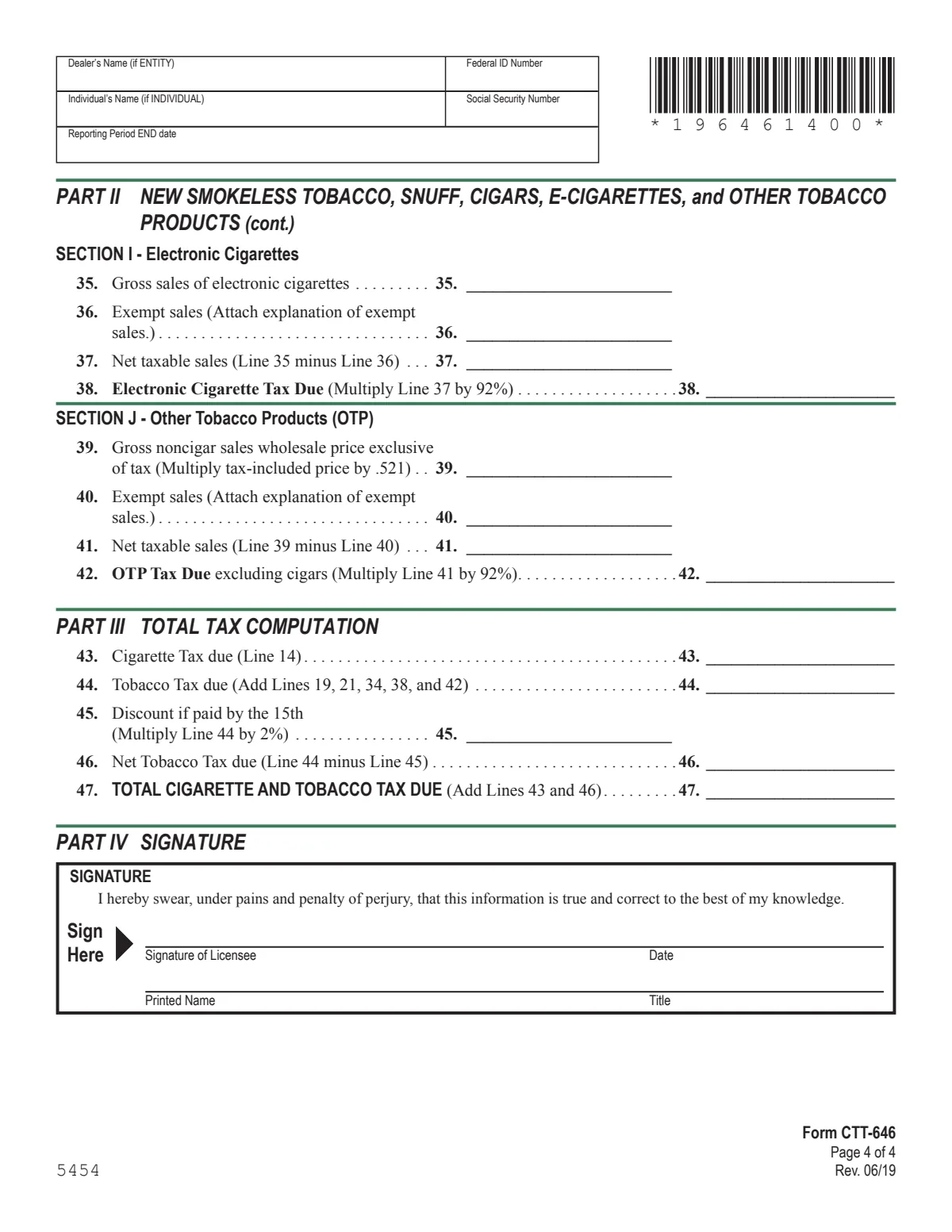
Page 4 finishes the 92 percent products (e-cigarettes in Section I and other noncigar products in Section J), then adds everything up in Part III. The 2 percent discount applies only to the tobacco products tax.
| Line | Label | What goes there |
|---|---|---|
| Head-4 | Dealer’s Name, Federal ID Number, Reporting Period END date (page 4) | Repeat the identity and period. |
| 35 | Gross sales of electronic cigarettes | Section I: gross sales of electronic cigarettes in the month. Vermont taxes them as other tobacco products, a class that “includes tobacco substitutes (which include e-cigarettes), liquids, whether nicotine-based or not, and delivery devices when sold separately for use with a tobacco substitute, but not including nicotine pouches”. |
| 36 | Exempt sales | Exempt e-cigarette sales. “Attach explanation of exempt” sales. |
| 37 | Net taxable sales | Line 35 minus line 36. |
| 38 | Electronic Cigarette Tax Due | Line 37 times 92%. The statute's rate for all tobacco products other than snuff, new smokeless tobacco and the higher priced cigars is “92 percent of the wholesale price”. |
| 39 | Gross noncigar OTP sales | Section J: all other tobacco products except cigars (pipe tobacco, chewing tobacco and the rest), at the wholesale price without the tax: “Multiply tax-included price by .521”. |
| 40 | Exempt sales | Exempt OTP sales, with an explanation attached. |
| 41 | Net taxable sales | Line 39 minus line 40. |
| 42 | OTP Tax Due excluding cigars | Line 41 times 92%. |
| 43 | Cigarette Tax due | Copy line 14, the cigarette tax. |
| 44 | Tobacco Tax due | Lines 19, 21, 34, 38 and 42 added: the tobacco products tax before the discount. |
| 45 | Discount if paid by the 15th | Line 44 times 2%, if you pay by the 15th. The discount applies to the tobacco tax only, not the cigarette tax on line 43. The statute words the condition differently: “upon payment of the tax within 10 days, the distributor or dealer may deduct from the tax two percent of the tax due”. See the note under Rules below. |
| 46 | Net Tobacco Tax due | Line 44 minus line 45. |
| 47 | Total cigarette and tobacco tax due | Lines 43 and 46 added: what you pay with the return. |
| Sign | PART IV SIGNATURE: Signature of Licensee, Date, Printed Name, Title | The licensee signs under the printed oath: “I hereby swear, under pains and penalty of perjury, that this information is true and correct to the best of my knowledge.” |
Rules that trip filers up
- No return in a quiet month. The return is due every month, even when no tax is due.
- Tax-included prices. Lines 22 and 39 ask for the wholesale price without the tax. Multiply a tax-included price by .521 first; do not apply 92 percent to a price that already contains it.
- Packages instead of little cigars. Line 12 is the number of individual little cigars.
- Discount on the cigarette tax. Line 45 is 2 percent of line 44, the tobacco tax only.
- The discount date. The form allows the discount “Discount if paid by the 15th”, the return's due date. The statute allows it “upon payment of the tax within 10 days”, without saying in the text read here when the 10 days start. The statute governs; the form is how the Department applies it, so a return paid by the 15th takes the discount as printed. Ask the Department if you pay late in the month.
- Nicotine pouches. They are excluded from Vermont's other tobacco products definition, so they do not go on line 35 or 39.
- Direct sales to consumers. “The sale of cigarettes and tobacco products by direct delivery is prohibited in Vermont.”
Refunds are claimed on separate forms: Form CTT-645 for cigarette stamp tax and Form CTT-648 for tobacco tax. Licenses are applied for on Form CTT-647 with its instructions.
Vermont Department of Taxes, Cigarette and Tobacco Products Filing Due Dates table.
How it connects
- Vermont's fuel, tobacco, vapor, alcohol and cannabis taxes, licenses and due dates: Vermont excise tax, tobacco section.
- Other states: cigarette tax by state and vapor tax by state. Other state tobacco returns: Virginia TT-8, West Virginia TPT-709 and New Jersey TPT-10.
- The federal tax on cigarettes and tobacco, paid by manufacturers and importers to the TTB: tobacco excise tax.
Questions filers ask
When is Vermont Form CTT-646 due?
15 days after the end of the month, every month, even with no tax due. A due date on a weekend or holiday moves to the next business day, so the October 2026 return was due Nov. 16, 2026.
Are e-cigarettes reported on CTT-646?
Yes, in Section I (lines 35 to 38), at 92 percent of the wholesale price. Vermont treats e-cigarettes, liquids with or without nicotine and separately sold devices as other tobacco products. Nicotine pouches are excluded.
Why multiply by .521 on lines 22 and 39?
Those lines start from a tax-included price. Because the tax is 92 percent of the wholesale price, the wholesale price is the tax-included price divided by 1.92, which the form rounds to .521.
How are cigars taxed in Vermont?
Cigars with a wholesale price of $2.17 or less pay 92 percent of the wholesale price. Cigars from $2.18 to $9.99 pay $2.00 each, and cigars at $10.00 or more pay $4.00 each.
Is the 2 percent discount taken on the whole return?
No. Line 45 is 2 percent of line 44, the tobacco products tax. The cigarette tax on line 43 gets no discount on this form.
Who licenses Vermont tobacco wholesalers?
The Department of Taxes, on Form CTT-647, until July 1, 2027, when the Department of Liquor and Lottery takes over wholesale dealer licensing under Act 148 of 2026.
Sources
- Vermont Form CTT-646, Wholesale Cigarette and Tobacco Dealer Report and Tax Return (Rev. 06/19), PDF
- Vermont Department of Taxes, Cigarette Tax and Tobacco Products Tax (Including Electronic Cigarettes)
- 32 V.S.A. 7771, rate of tax (cigarettes, little cigars, roll-your-own)
- 32 V.S.A. 7811, tobacco products tax